Driving a Desk


Before last June, there hadn't been an officer-involved shooting in Miami Beach, FL since 2003. In a single week in June, there were two. But that's not what makes this situation noteworthy. What's noteworthy is that the same police officer, Officer Adam Tavss, was involved in both shootings, which occurred just 4 days apart. Tavss was taken off the street for 72 hours following the first shooting. The families of both of the dead men are asking the Justice Department to investigate the situation, and why Tavss was allowed back on the street so quickly.
It might be a good idea, then, to review the thinking behind taking an officer off the street when there has been an officer-involved shooting. After all, if we don't understand why someone is taken off the street, it's hard to assess when they should go back. There are a number of reasons.
- Avoiding Lawsuits: There is a general understanding that if a police officer who has just shot someone shoots someone else, the department is opening itself up to legal scrutiny. That is exactly what happened in this case. Pragmatically, departments like to play it safe.
- The Officer Isn't Safe: Officers involved in a shooting, or any other traumatic incident, may experience memory loss, slow cognitive processing, depression and impaired decision making, just to name a few reactions. The person most at risk from this is the officer him or herself, since thinking slowly can be deadly on the street.
- Make Sure the Officer Isn't Trigger Happy: It is possible, although unlikely, that the officer really has impaired judgement to begin with, and that the first shooting was completely unjustified. The last thing you want is to put him back on the street and let him do it again.
- The Officer Might Scare Too Easily: If the officer is traumatized by the first shooting, which probably occurred because his life was in danger, he may be at a heightened state of alert and more likely to perceive that his life is in danger than someone who hasn't been through that. This may cause him to make the decision to use lethal force at a time when someone else would not.
Officer Tavss is under investigation, as is the department. A thorough investigation is always warranted when someone is killed, and it's worth asking whether Officer Tavss was ready to go back on the street when he did. But it bears remembering that keeping officers off the street after a shooting isn't just to prevent additional shootings, it's to protect the officer himself. It's always possible that the second incident was just a horrible coincidence, and still a justified shooting.

Violence on Campus

It's another Quarterback Truth-Telling Moment. What do you assume this post is going to be about? What current event comes to mind when you hear "violence on campus?" I'm guessing that, for those of you who have an answer, you're thinking about the murder of Annie Le, the Yale pharmacology graduate student. It's all over the news, with new suspicions and breaking stories several times a day. I blogged about it myself twice in one day this weekend.
Actually, the story that caught my attention this morning was the murder of Juan Carlos Rivera at about 9 AM at Coral Gables High School in Florida. I thought this would be big news, but it disappeared off the major news sites basically as fast as it appeared, and it made me wonder why. Why is the murder of Annie Le, and adult in a relatively large city, more newsworthy than that of Juan Carlos Rivera, a teenager in an suburban high school? In fact, the Internet community itself is debating a very similar question as we speak -- is the murder of Annie Le a big enough event to merit its own Wikipedia page, or is it just a flash in the pan.
My first hypothesis on this was that murder on college campuses is significantly less frequent than murder on K-12 campuses. A little rummaging turns up the fact that in 2004 (the most recent statistics I could find for both years) there were 15 homicides on college campuses in the United States, while in the 2003-2004 school year there were 22 homicides at K-12 schools. So yes, murder in a K-12 school is more rare, but not by much, and not when you consider that the total student population of colleges is significantly smaller than the student population of K-12 schools. This doesn't seem like the answer.
Part of the answer, I think, is that American society is quite captivated with weddings, what happens before weddings and what happens after them. The fact that Annie Le disappeared a few days before her wedding caught our attention, and once we were paying attention to the mystery, we weren't going to let it go. Part of the answer is probably also the mystique of an Ivy League College and an obviously bright victim.
Still, we as a society are usually really interested in school violence. The murder of Juan Carlos Rivera hit the national news this morning, I think, because it played to our deepest fears about our children's safety in school. The problem is that as soon as the press got more information about this murder, the victim suddenly didn't seem the innocent schoolchild we envision when we think about school violence. It turns out that Rivera was in a fight, reportedly over a girl, and the other student pulled out a box cutter and stabbed him. That defies our idea of what "school violence" is -- when we get scared about it, we get scared about random mass shootings and people from the outside coming in, not about fights.
More than that, though, we tend to have this idea that if someone is killed in a fight at a school, it must be at a school that is "used to" this kind of violence. While certainly there is more violence at some schools than at others, I don't think any school is "used to" students killing each other. Keep in mind, only about 20 kids in the whole country die this way each year. Violent death at a school where you work or study violates the generally true premise that school is a safe place and that the adults in a school can keep children safe. Keep in mind that children are twice as likely to be victims of a violent crime when they are not at school as they are at school.
Finally, and perhaps most disturbingly, Juan Carlos Rivera is not the quintessential "sympathetic victim" our society rallies around. He is male. He appears to have been somewhat violent himself, at least today. And, yes, he is Latino. And our gut intuitions about some schools being "used to" violence pales in comparison to what we assume to be true of violence in Latino communities. Few would have such a thought consciously, but that underlying racist assumption is reinforced daily in popular culture. Consciously or not, the press began with "this is big, a student was killed at school" and quickly reverted to "it was a Latino boy in a fight, that's not news."
At the end of the day, the Le family and the Rivera family have empty seats at their tables. Whether one victim is "sympathetic" or "deserved it" is really an offensive question. Their families don't deserve to be without their children, period.
How Do Little Kids Understand Tragedy?

A friend called last night to talk about her son. A daycare classmate's mother died unexpectedly this week, just days after a cancer diagnosis, and she knew her son would hear about it. What, she wondered, should she tell her own three and a half year old when he asked what that meant?
This is an understandably difficult situation. First of all, talking to children about traumatic events is always hard. Our first inclination is to protect them. We are afraid of scaring them, and we think if we just don't talk about it they won't be afraid. But we're wrong. Children know that something has happened -- in this case the classmate has told him. When we don't talk about it we send a very powerful signal that the topic is really horrible -- so horrible that we can't even talk about it. Children have vivid imaginations, and what they envision in the absence of good information is often much, much worse than what has really occurred.
In this instance, we have the added twist that the children involved are very young. They are old enough to hear the words and ask the question, but they don't really understand the concept of death. The classmate is demonstrating this when he so casually tells his friends that his mother died. He knows she is dead, and probably someone has explained what that means, but he doesn't have the experience or cognitive framework to understand it. Kids at this age do not understand the concept of time very well, and they don't understand what "never" and "forever" mean.
The words we often use to explain death to young children can actually make their understanding harder. When we say, "she went to sleep and will never wake up" the child understands that sleeping is a dangerous thing. When we say, "God wanted her to come be in heaven," they don't think God is very nice. It is quite a trick to come up with a way to explain this that is both comprehensible to young children and not even more frightening than it needs to be.
It happens that my friend's dog died a while back, and they had told her son that he went up to heaven with God. Based on this, I suggested she explain the current situation to him this way:
Billy's mommy got very very very very very very very very very very sick. The doctors tried to make her better but they couldn't, and her body stopped working, so she went up to heaven to be with God.Note the enormous numbers of "very's." Children, particularly young children, are concrete thinkers. If you tell them that Billy's mommy got sick, then when they or their parents are sick with a cold, they may be afraid they will die. They have no conception that certain types of sick can kill you and others usually don't. By putting lots of "very's" in the explanation, you create a way to talk about this. If they express concern about their cold, you can say,
Yes, I'm sick, but I'm not very very very very very very very very very very sick.Now your child will know what that means.
I also warned my friend that her son may be totally unaffected by this. He may not make the connection at all that if his classmate's mommy died, his mommy might die too. Children at this age are still very egocentric. Everything in the world has to do with them. Their mommy has absolutely nothing to do with someone else's mommy, because they don't really understand the relationship between their classmate and their classmate's mommy. I told her not to be surprised if her son seemed fine. This afternoon she emailed to say, "He totally didn't get it."
It was also possible, of course, that he wouldn't be fine. He could have processed, on some level, that this is bad and scary. If so, he might have nightmares or trouble sleeping, regress in his potty training, be more cranky or lose his appetite. All of that would be nothing to worry about unless it lasted a long time. In the meantime, he needs his parents to cuddle him and reassure him and validate his feelings. We can all use that sometimes.
As my friend's son gets older, he may revisit this incident in different ways. With each developmental stage, he may, reprocess it based on his new understanding of what death means and what his mommy means to him. More than likely, however, he won't remember this at all -- he's awfully young. His friend may not remember it either, although he, of course, will grow up with the impact of not having his mother. That's another journey altogether.
You can find more tips on talking to children about traumatic events here.
Update: Annie Le

Earlier today I blogged about Annie Le, the Yale grad student who went missing five days before her wedding. I wrote about how hard it is to respond to an incident that does not have a clear end to it.
As you may have already heard, a body presumed to be Le was found in the walls of the building where she was last seen. Now the incident has an end, and the hard work of dealing with it falls to her fiance, family and friends. I wish them well, and send my deepest sympathies.
Annie Le's Wedding Day: Who Could We Help, and How?

Yale pharmacology graduate student Annie Le was supposed to get married today. Instead, her fiance is in New Haven, trying to help law enforcement officials figure out where she is and what happened to her. She was last seen outside the Yale medical school on Tuesday. Her keys, purse and cell phone were all left in her office. She doesn't have a car. Friday brought word that a Professor whose class she was to take Tuesday afternoon, and who canceled class abruptly on that day, was being interviewed. Evidence was removed from the med school building yesterday, and unofficial, unconfirmed reports say that evidence was bloody clothing found in the drop ceiling of the lab in which she worked. Police say they don't think she ran away.
This has got to be gut-wrenching for her fiance, family and friends. The twists and turns are coming quickly, but no resolution is in sight. While everything I've detailed here is true, it's entirely possible some or all of it is irrelevant. The reports regarding the clothes could be false, or they aren't hers. The Professor could have gotten the stomach flu. Clues give hope for figuring this out, but they don't make the waiting much easier.
From a crisis response point of view, this is also incredibly tricky. It's not that no one needs help, it's that it's not at all clear who we should be supporting or how we would go about doing it. We're supposed to respond after the event is over. This one isn't, but it's in a new stage. We've moved from "she'll turn up" to "something happened to her," but we don't know that for sure and we don't know what it was. We also don't know if she's alive. And worse, it could be we will never know. At what point do we decide that it's time to help out anyway? Or is this one of those incidents when help will never come, because there will never be a time we can say it's over?
What particularly gives me the creeps, however, is the notion that if, at some point, we decided it was time to try to offer some early crisis intervention to those affected -- and there have to be a lot of them, including everyone who goes to school or works there -- there is a significant possibility we'd be working with the person or persons responsible for her disappearance. Now, there are times when working with the person responsible for an event is more than appropriate. I'm thinking, for example, of the person who ran a red light and caused a fatal car accident. But there, their level of culpability is out in the open. Here, we'd be working with someone who is simply lying to us. And the thought that there would be the remotest possibility of learning something during the course of the intervention that the police did not already know is horrifying. We promise confidentiality, but privilege has not been established. I don't want to be in that position.
All this, I suppose, is why you wait until the event is over to respond. It's just much easier to do that when the event has a clear beginning, middle and end. The current endless middle is hard for us. It has to be a zillion times harder for Annie Le's friends and family and the Yale community. I hope they get their resolution soon, and I hope against hope that she comes home safe.
Terror(?) on the Potomac

Yesterday, September 11, at about 9:30 AM, CNN breathlessly reported that Coast Guard boats and a helicopter were apparently confronting a suspicious vessel in the security area of the Potomac River, near where the President was commemorating 9/11 at the Pentagon. The reports escalated -- the vessel had been fired upon. Cable news and the Internet picked up the story.
It was a training exercise.
Let the finger-pointing begin. CNN reported an interpretation of what they heard over a scanner picking up the Coast Guard radio traffic, but apparently didn't think it odd that the report of gun fire began with the radio transmission, "bang bang bang bang." They say they called the Coast Guard and were told they were not aware of anything going on on the Potomac. Meanwhile, the Coast Guard says that they never coordinate their training exercises with other agencies, and they train like this all the time.
So what went wrong? If training exercises like this one are commonplace in that area, why did this one make national news? I bet you already know part of the answer. It was September 11. And yes, that matters, and no, it's not because we're all crazy.
The date itself -- September 11 -- is a trigger for most people in this country. The various commemorations on the news heighten that. And that's not a bad thing, necessarily. But it means we are all in a space where we are much more willing to believe that terrorists will attack the US. Most days we know it's a possibility, but on September 11 it feels like a likelihood. This exercise, and what CNN heard over the scanners, was therefore much more believable, and the lack of confirmation was less troubling. It might have been a good idea if the Coast Guard had considered this and announced the exercise, or held it on another day, or at least made sure it's own people could tell the press what was going on. There are two sides to every coin, though, and CNN should probably have known that both they and their viewers were more willing to believe the worst and more prone to panic yesterday than, say, the day before.
It's interesting to consider how long it will be before we are not so triggered by September 11. I see signs that it is fading already: A few years ago I was lambasted for holding a fire drill on that date. We had one yesterday, and no one said a thing. The edge has, at least a little, been taken off. But not so much that everyone can not worry about the impact of anti-terror exercises and erroneous news reports.
The Trauma of the "Other Side"
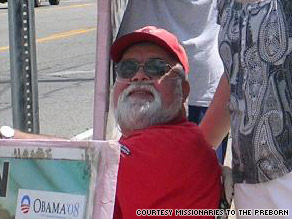
James Pouillon, age 63, was murdered today across the street from the high school in Owosso, MI. The same shooter allegedly also killed the owner of a local gravel pit, Mike Fuoss, 61. You've probably never heard of Owosso -- it's about an hour and a half from my house and I had never heard of it. You also probably have never heard of James Pouillon, although my understanding is that if you were from Owosso you probably would have.
James Pouillon was a prominent and vocal anti-abortion activist. He frequently stood near the High School holding graphic pictures of fetuses. Police say that the shooter was offended by material he had been displaying this week.
When you do a response to a traumatic event, you have to commit to leaving your politics at the door. A traumatized person is a traumatized person, and whether you agree with their politics or their life choices or whatever else has to be irrelevant. I have done interventions with people who talked about how only members of their religion were going to heaven, and the rest of us were going to hell. I have worked with people who drank to excess and did drugs and were irresponsible about their lives. I have helped teenagers who were clearly trying to provoke the adults by talking on their cell phones and chewing tobacco during a debriefing. And really, I didn't have much trouble with those.
But everyone has events that they should not be responding to. Sometimes, it's the nature of the incident that is the issue. I know tremendously well-respected responders who simply will not respond to the death of children, because they find it too upsetting. An event that is too close to a trauma in the responder's own life can be too much. Sometimes, you're just plain burnt out.
Then there are events that you cannot respond to because you know you will not show the level of compassion that the traumatized people deserve. I absolutely believe that the family and friends of James Pouillon, as well as those who witnessed his murder, deserve the best crisis intervention out there. But I have to be honest and say that I could not do this response. As someone who has volunteered to assist at abortion clinics, tangled with anti-abortion protesters, and has a family member who worked at a clinic where people were murdered by an anti-abortion activist, I do not believe I could put that to the side to work with this family. Knowing what he was doing when he was killed and having to in any way validate that would be too difficult for me.
Part of being a good responder is knowing when to say no. I would much rather have a team member bow out then sit down with a victim and judge them, say something inappropriate or break down crying. I would also much prefer it if I could muster the needed skills to be helpful in a situation such as this one. But I know my limitations, and I have to honor mine as much as I honor others. This one, I would have to refer to someone else. I hope there's a team in Owosso more prepared to deal than I.
Eight Years Out
It was a Tuesday. I don't know why I know it was a Tuesday, but I do. The fact that I do tells you the impact that that day had on me, since the only other days of a year or more ago for which I remember the day of the week are the days each of my children were born and the day I was married. And that last one probably shouldn't count, since Jewish weddings are almost always on a Sunday, at least where I'm from.
It was a Tuesday and the kids were lined up for the bathroom when I heard. And when I talked to my husband on the phone I was sitting in the corner of the office looking at a garbage can. I can still see it in my mind. I can hear my daughter's daycare teacher telling me they were closing, and forgetting to tell me who was calling, first. I can still feel -- not just remember feeling, but actually experience feeling -- the brief terror when I heard an airplane go over my house in the afternoon and realized there were not supposed to be planes in the air, and I ran from the third floor of my house to the first before I realized it was an Air Force jet. I can also see the sign on Rita's Italian Ice saying they were closed for the rest of the day. What I remember perhaps even more vividly is putting my daughter, aged 3 1/2 years, to bed a few weeks later and reassuring her that our house was a safe place, that we were safe, and leaving her room and saying, "OK, now she feels safe. Who's going to make me feel safe?"
Absolutely everyone has at least some memories like this. This was a national, group trauma. And while we all experienced it differently, and certainly some of us experienced it much more directly than others, virtually no one over the age of about 13 doesn't remember it, or doesn't thing it affected them.
Trauma violates our worldview. That day violated the notion that many of us still had that this was a safe country, that we were personally not in danger, and that getting up in the morning and going to work was a reasonably safe activity. It happened in specific cities, but it happened in all of our living rooms, to all of us. That was the intent of it in the first place -- to terrorize. It is small wonder that most of us still can have those sensory memories triggered by something or other.
If you think this analysis is overblown, or overly dramatic -- if you think the effect on us collectively was not that great -- consider this. Nowhere in this post have I mentioned what day I remember so vividly. But you all knew anyway.
Stephen Farrell: Survivor's Guilt, Survivor's Anger

New York Times reporter Stephen Farrell was rescued from the Taliban early this morning. He and his translator, Sultan Munadi, had been taken captive in Afghanistan four days before. The raid by British soldiers that rescued Mr. Farrell resulted in the death of both Mr. Munadi, one of the British soldiers and at least two others (news reports conflict about how many and who they were).
Most of us have heard the term "survivor's guilt." It's the guilty feeling that people have when someone else has died in an incident that could have killed them. It's the feeling of the person who called in sick to the World Trade Center on 9-11, or who skipped the exercise class at LA Fitness the night of the shootings, or who survived the accident that killed their friend. I think it's safe to say that Stephen Farrell is, at best, at high risk for feelings of survivor's guilt, both because of Mr. Munadi's death and because a soldier died trying to save Farrell's life.
There's a difficult twist to this episode as well, however. The British went in to rescue Farrell in part because he is a British citizen. His colleague, Munadi, died at least in part because the British initiated the raid, although it isn't clear who fired the shots that killed him. Certainly the British soldier died trying to resuce Farrell. This has the potential to leave some tricky mixed feelings.
On the one hand, Farrell has expressed great thankfulness for his rescue. He is glad to be alive and glad to be free. On the other hand, it has to have crossed his mind that, were it not for him, Munadi would probably not have been abducted and that, were it not for the British coming to rescue him, Munadi might still be alive.
Obviously none of that is Farrell's fault. It also doesn't mean the British military made the wrong call in going in. But it leaves Farrell feeling grateful to the same group that he is, on some level, angry at, and angry at someone who died trying to save him. We can all take a step back and say that all of this was the fault of the Taliban. Farrell probably can too. But the gut feelings following trauma are often not nearly that logical, and Farrell may not just experience survivor's guilt, he may experience survivor's anger, too.
Asa Hill's Legacy

Last Thursday, a seven year-old boy from Buffalo named Asa Hill was critically injured in a car accident. He died on Friday night, and was buried yesterday. Asa's parents have been a couple since high school but were not married. Asa often asked them to get married, and they always told him they would, but it just hadn't happened. Yesterday, at the end of Asa's funeral, his parents finally tied the knot.
This is one of those stories that leaves me speechless. It is fascinating and horrible and touching and sad all at the same time. I don't know what useful box to put my reactions into. And of course, it's not about me, or you, or anyone else, it's about Asa's family. They have to make the choices that are right for them, and it is none of my business to tell them what they should or shouldn't do, let alone second guess their choices after the fact. But it is interesting to think about the pros and cons of Asa's parents' choice to get married when and how they did.
On the plus side, we have the fact that Asa clearly wanted this. Families in mourning often talk about what the deceased would have wanted. In this instance, there wasn't much question that Asa wanted his parents to get married. They may well come to view their marriage as a gift he left behind when he died, and to the extent that they frame it that way that is all for the good. Their decision to marry now also reinforces their commitment to support each other in what has to be the darkest time of their relationship.
On the minus side, it is a frequent mantra of early crisis intervention that you should not make important decisions immediately following a trauma. Action feels better than inaction following a critical incident, and people are prone to do fairly rash things -- buy a house, quit their job, drop out of school, move out of town, etc. -- because at the time it feels like that will help. When the dust settles, often they regret those decisions. I don't know whether Asa's parents really had intended to get married and figured they'd do it now, or made the decision now. If it's the latter, that could be problematic. In a similar vein, it's possible that his parents will not see their marriage as a blessing bestowed by their son, but as a tangible reminder of his death. If so, that can certainly cause difficulty for them down the road.
At least anecdotally, the number of couples who split up following the death of a child is pretty high. Asa's parents' decision to get married under these circumstances could be a move against that trend, or it could make them more likely to be part of that statistic. Time will tell.
In keeping with my personal religious tradition, I hope that Asa's memory is a blessing to his parents and that they know no further sorrow. I also wish them 120 years of happiness in their lives together.
Ready, Set, Swine Flu!

Tomorrow is the first day of school in the great state of Michigan and in many other places. In honor of this, the New York Times is running an article in its "Well" section tomorrow about what parents need to know about H1N1. It's a pretty good article and is full of practical information (e.g. when to call the doctor) placed in reasonable context.
I actually laughed out loud, however, when I read the first few sentences:
A few weekends ago, a mother I know called to ask about swine flu after her daughter complained of breathing trouble and other worrisome symptoms. Fortunately, my friend quickly reached her pediatrician, who reassured her about the child’s condition. But the conversation made me realize just how stressful this flu season is going to be for parents.My first reaction to this was, "Gee, ya think?!? What was your first clue?" How soon we forget the mass hysteria of just 4 months ago, when schools were closing at the first sniffle and emergency rooms were flooded by the not-that-sick and the worried well.
As I've discussed in this space, the quality of information coming from the Centers for Disease Control, the World Health Organization and local health departments has greatly improved since April. The dire warnings are still there, but they are placed in the context of both statistics from seasonal flu and the relative likelihood of the various scenarios. The media, on the other hand, seems, for the most part, not to have gotten the message, and is reporting outbreaks of H1N1 as though they are outbreaks of bubonic plague.
In the midst of all this, we educators are preparing for school and for H1N1. By far the biggest thing we are preparing for, at least in my district, is not death and destruction, it's absenteeism and parental over- and under-reaction. We are quickly getting up to speed on how to post educational activities on the web in ways that parents can access them, making sure that substitute plans are in place, and contemplating what will happen if enough staff are affected that we don't have enough subs to cover them all. We are learning the new mantra -- stay home if you've had a fever of 100 degrees or more in the past 24 hours -- and strategizing what to do about parents who send their children to school anyway. We are making sure all of our staff have the same information so that if an outbreak does occur we can give parents consistent, calm messages.
As laid back as this may all sound, I do have something to admit. When I pause to think about my own friends and family, I am a little stressed. I listen to the cough my son, who has mild asthma, has had for a few weeks and I worry that we missed something, even though I know we didn't. A friend who is undergoing cancer treatment has a suspected case of H1N1, and I not only worry about him but feel personally responsible for nagging him to get to the doctor (I'm sure he appreciates that). Which just goes to show you that preventing panic in others does not prevent stress in oneself. It's going to be an interesting flu season.
Who Owns Your Death?

Lance Corporal Joshua M. Bernard, 21, died in Afghanistan on August 14. An Associated Press photographer embedded with his unit captured a picture of him after he was wounded and before he was transferred to a medical facility, where he died. This week Defense Secretary Robert Gates blasted the AP for publishing the picture, against the express wishes of Bernard's family.
On Friday, my niece's high school notified parents of the death of one of her classmates. Support was offered to students and guidance offered to parents, but no information was shared about the cause of death. The local newspaper reported it was a suicide.
These two events may not seem to have much in common, but in fact they capture a very common problem in traumatic situations. What happens when the powers that be, or just some random witness, have information about a death that the family does not want to share?
There are always two sides to this argument. In the case of Lance Cpl. Bernard, the AP argues that publishing the picture helps the public understand what war is really about. It says it is,
choosing after a period of reflection to make public an image that conveys the grimness of war and the sacrifice of young men and women fighting it.Bernard's family, on the other hand, feels that the publication of the photo inflicts more pain on a family already traumatized and grieving. They prefer not to remember their son that way, and do not want others to see him that way. His father says the photo is disrespectful of his memory.
In cases of suicide, families often want to withhold the fact that their loved one killed themselves. There is a tremendous stigma in our society about suicide. Families often refuse to accept that the victim's death was, indeed, a suicide. Even if they do accept it, they fear that others will look down on them as the family, or will think ill of the dead family member who completed the suicide. It is not at all uncommon for families of those who complete suicide to hear from people trying to be "helpful" that their loved one was selfish or is going to Hell. Not surprisingly, families opt to limit the number of people who have cause to be "helpful" in this way.
On the other hand, from a high school administration point of view (and just generally from a public health point of view), it is important to talk about suicide. While no one wants to destigmatize it to the point where it is considered completely normal and acceptable, community leaders do want to get people talking about the depression and desperation that leads to suicide. The stigma surrounding suicide can prevent those who are contemplating killing themselves from getting the help they need, because they fear people's reactions if they talk about it. In a school setting, often the students know a classmate has completed a suicide, even when the administration does not acknowledge it. Not talking about it when everyone knows about it further sends the message that help is not available, and can lead to the clustering of suicides at high schools that sometimes occurs.
So, what to do? How do you weigh the educational and/or news value of a picture or a piece of information against the legitimate needs of a family in crisis? Whose needs for mitigating critical incident stress win? And whose values should we base that decision on?
We have a strong custom in this society of respecting the wishes of families of the dead. Because of this, violating those wishes provides an easy target for the natural anger that families feel after a traumatic death. I can't say that the AP made the right choice in the death of Lance Cpl. Bernard, even if I wish the family had given permission. They didn't. And I am not convinced that the picture had so much value that it should eclipse those wishes. Luckily, I don't have to make judgements like that most of the time.
As a school administrator and crisis team member, I will not disclose that a death was a suicide without family permission. But I will do two things to try to get around this. The first is that I will explain why I think it is important to share the information. Very often families are willing to hear that their disclosure may help another suicidal person, but they do not make that connection alone. School staff are also often reluctant to share this information, even if they can. We have to educate them about suicide prevention as well.
The second is, if I cannot get permission, to acknowledge when others say they heard it was a suicide. You can talk about it in the abstract even if you can't confirm. So when a child says, "I heard he killed himself" or "the paper says she took pills" I wills say, "I heard that too. If that were true, what do you think about that?" This finesses the whole question of telling when someone's death is a suicide by letting the students tell themselves. The AP could have written a story about the picture without publishing the picture, and explained that the family, who could be kept anonymous, did not give permission. This would have been a chance to talk about the impact of war on families at home, something they chose to gloss over by publishing the picture.
I think the AP, school administrators, and anyone else who has tough decisions to make about sharing or not sharing information, would do well to ask themselves what their ultimate goal is. If it's just to share information for its own sake, that takes you in a different direction than if, as in both of these cases, the aim is to educate. As the saying goes, there is more than one way to skin a cat, and there is more than one way to educate following a traumatic death.
I have chosen not to add the picture that the AP published of Lance Cpl. Bernard after his injury. I hope that the picture above is more in keeping with how the family would like this soldier remembered.
The Georgia Murders

Last Saturday morning, a man called 911 in Brunswick, GA, and said that he had returned home to find 7 members of his family dead and two critically injured. One of the two died on the way to the hospital. The other is still on life support. Today, the caller was arrested for the murders.
It's hard to imagine something more horrific than this. It's difficult to imagine what brings a person to this level of violence, particularly against their own family. It's also hard to imagine how Diane Isenhower, whose ex-husband, four children, ex-brother-in-law and ex-sister-in-law, as well as her daughter's boyfriend, were all murdered and whose grandchild is in critical condition, moves on from something like this. Now her ex-husband's nephew is under arrest. That hardly makes things less complicated.
What particularly caught my attention in the coverage were a couple of comments that various people made about how those affected were coping. Isenhower's brother-in-law, Clint Rowe, expressed concern about the police officers:
They're the ones who walked in on that, so you know it wears on the police as well.I think it's remarkable that a member of this family would think of the police at this moment. It's not that, when you think about it, it's particularly surprising that police officers would be affected by working on a case like this, particularly if they were on scene when the bodies were first found. It's just remarkable that anyone from the family would think of it, given what they themselves are going through.
The Police Chief also commented on the burden of what the police are going through right now. Chief Matt Doering responded to some criticism that police have not released much information about the case, and said that releasing more information will not stop people from being afraid:
We, too, have that same fear. We're the ones that have to get out there and try to make people feel better as best that we can
I felt a personal connection with the Chief when I read this. As a school administrator, I have several times been in the position of having to keep things confidential in a crisis and under pressure, and to reassure people about safety when I wasn't feeling so safe myself. People get very upset when they feel they don't have all the information, but often that is more about directing their anxiety and anger towards the nearest available target than it is about anything those in charge have done wrong.
Information does help, but it doesn't change reality and sometimes it just can't be released. At the end of the day, even with all the information in the world, this community must come to grips with the fact that 8 people were brutally murdered, allegedly by one of their own. Knowing the intimate facts of the case will not make that much easier.
Sometimes a Campus Shooting is Just a Shooting

Imagine there is an argument half a mile from your house. Someone is shot. The perpetrators run, and it's not clear in what direction. You are minding your own business in your house. What would you do? Depending on where you live, your answer is most likely nothing. Unless there is reason to think the perpetrators are headed for your house, you probably wouldn't even know about it.
But imagine you're not in your house. Your in a class at a community college, and there is a shooting half a mile away, on the other side of campus. This is what happened yesterday at Skyline College, a community college in San Bruno, CA. And let me tell you, the response wasn't "nothing." The campus locked down, then evacuated. SWAT teams were all over the place. Classes were canceled for the evening, and then for today while the investigation continued. Why such a huge reaction for an incident in which a single person was shot and no one was killed?
Because it happened on a college campus, and we as a nation are absolutely terrified about shootings at schools and on college campuses. When we open up the "shooting on college campus" file drawer in our minds, what comes out is really awful. We perceive college students as sitting ducks, vulnerable to violent rampages. And we are afraid of missing something, or branding something as small when it turns out to be really big. We are afraid of Virginia Tech.
Obviously there are some contexts that warrant bigger responses than others. A shooting 10 blocks away in a high crime area of New York City is less alarming than a shooting half a mile from the White House where the gunman is yelling political slogans. A shooting where the motive and perpetrator are known is less alarming than something random. But at the heart of it, I have to ask whether all violence on a college campus has to be treated like the entire place is under siege, and to wonder what it is that they thought they knew at Skyline yesterday that I don't know.
Why Do We Care, Or Not?

- So far, 34 people have died in today's earthquake.
- In the last 6 years, at least 300,000 people have died and 3 million have been forced to leave their homes because of their ethnicity.
- More than 1,300 children have abnormally high levels of lead in their system due to the malfeasance of 8 local factories.
- Five years ago this week, 334 people, 180 of them children, were killed following a three day hostage-taking standoff at a school.
- A kidnapped girl reappeared after being missing 18 years.
Now, let's be honest. Which one of these incidents did you instantly recognize? Which ones did you say, "Wait, where did that happen?"
"Where did that happen," is often our instant reaction to bad news. And, on the whole, that's not an unreasonable question. If there is a major earthquake at my parents' house, for example, I really would like to know that (and it would really be big news, since major earthquakes are not frequent in Massachusetts). It seems straightforward and understandable that we want to know whether people we know and love may be in trouble.
If you don't have any relatives or friends in, say, California or Indonesia, for example, why do you care where today's earthquake was? But you probably do. There are two explanations for this phenomenon, one more palatable than the other.
The first explanation is that you simply are trying to reassure yourself that not only are your loved ones safe, but that something like this will not happen to you or your loved ones in the future. An earthquake in California makes us feel, somewhat irrationally, like an earthquake in Massachusetts is more likely. Certainly a hostage siege in a school in California makes us worry about security in American schools.
The second explanation, which is a little harder to swallow, is that this is not actually about location, but about "alikeness." When things happen to people "like us" it makes us feel less safe -- and less compassionate -- than when they happen to people who we think are not "like us." On some level, we even come to imagine that events that would absolutely devastate anyone in this country are not so upsetting to people elsewhere, particularly in non-European, non-prosperous countries. Somehow, "they" must be used to it. We may not say these things out loud, or even think them consciously, but they resonate with us. Call it racism, call it xenophobia, call it American self-centeredness, but we just do not care nearly as much about trauma that happens in other parts of the world.
- Today's earthquake was in Indonesia. It's not even the top story on CNN as of 12:30 this afternoon. Imagine what the coverage would be if it were in California.
- The genocide in Darfur, Sudan, is something we know about but which gets next to no daily coverage, nor most people's attention, in this country.
- The factories in China have been shut down until they comply with safety standards. It's not a "top story" in this country.
- The siege in Beslan, Russia, caught our attention as it was happening and quickly faded from memory.
- Imagine what the coverage would be of Jaycee Lee Dugard's story if she were in Senegal, or China, or Belize. Imagine what it would be if she were African-American.
The Station Fire
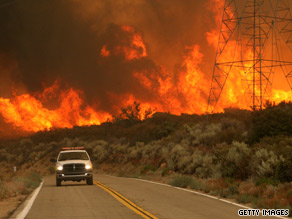
More than 105,000 acres are on fire in Southern California. For those of us from relatively wet regions of the country, this seems unbelievable. For those of us with children with a particular fear of fire, it's horrifying. For a firefighter and their family, it's a source of some ambivalence.
Firefighters become firefighters because they want to fight fire. It sounds silly when you put it that way, but often we forget. No one trains for this who doesn't get something out of it. Jeff Mitchell (whose brother, Doug, is a fire fighter) says you have to be crazy to do it. The natural reflex of any sane person is to run out of a burning building -- these guys run in. So many firefighters across the country are looking at the Station Fire and wishing they were there. Some of them are getting their chance, as firefighters from neighboring states are being called in.
On the other hand, firefighting is only enjoyable when everything comes out right. Nothing beats the rush these guys can have when they beat back the flames and save a house or a life and no one gets hurt. But when one of our nation's bravest dies fighting a fire, every firefighter in America feels the loss, and every family member of a firefighter takes a blow to the gut. Two firefighters out of Los Angeles have died in the Station Fire already. When this is over -- which isn't predicted to be for one or two more weeks -- that's going to be a hard truth to cope with for the others in their own company, the other fighting this fire, and those who just know it could have been them.
Reading the coverage of the fire, the inklings of what the themes of an intervention on this event might be are starting to emerge. Right now there are five people trapped by the fire because they did not comply with mandatory evacuation orders. Not only did they put their own lives at risk when they made that choice, but they also put the lives of the firefighters who now must try to get to them on the line. I can't imagine there isn't going to be anger about that, particularly if someone gets hurt or, God forbid, dies trying to get them out.
CISM teams most often help with incidents that happen very close to home. Right now, CISM teams all over the west are getting ready to intervene with firefighters caught in a critical incident in another state -- some of them may be deploying there right now. And CISM teams may be hearing about the Station Fire all over this country, as fire departments everywhere watch, wait, and mourn two of their own.
Ask the Question: Suicide in the Workplace

This week's edition of Business Insurance notes that last year there was a 28% increase in the number of suicides completed in the workplace in the United States. While the numbers are still relatively small -- 251 last year -- the rapid increase is really alarming. Can you imagine if I told you that cancer rates had gone up by 28% last year? We'd all be terrified.
However, as you know, I'm a stickler for putting these things in context and so I did some digging to see what other workplace causes of deaths look like in general and looked like last year. On the one hand, the number of workplace suicides is miniscule compared to the number of deaths from all causes in the workplace in 2008. Last year, 5,071 people died at work. You were far more likely to die in a fall at work or by something falling on you than you were to complete a suicide at work. You were even more likely to be killed during an assault (keeping in mind that this also includes police officers on the job). Suicides accounted for just about 5% of workplace deaths. It's also important to note that in 2006 (the most recent year for which statistics are available) there were more than 33,000 suicides in the United States, so workplace suicide is still a tiny fraction of suicides overall.
On the other hand, the year before, suicides accounted for just 3.5% of workplace deaths. In fact, while suicides went up by more than a quarter, workplace deaths on the whole declined by more than 10%. So I do think this is worth paying attention to. Look at it this way. At your job, which do you think your employer has paid more attention to preventing, employee death in a fire, or employee suicide? I'll bet you anything it's fire. But there were more than 30% fewer workplace deaths by fire last year than there were completed workplace suicides. In fact, there were probably fewer deaths by fire because employers and governments spend so much energy trying to prevent them.
When people complete suicides at work, they usually are sending a message about work. People who don't have particular issues with their jobs or workplaces do not generally kill themselves there. So if the suicide rate is going up at work, that tells you that people's stress level around work is also going up. In other words, as I've said before, it's the economy. You are more likely to complete a suicide at work if you are about to be laid off, are afraid you are going to be laid off, are mad because others have been laid off, or are stressed by having to do more with a smaller staff.
Unless your occupation has a particularly high rate of suicide (e.g. law enforcement or military), and sometimes even if it does, chances are that your employer does not have any systematic suicide prevention programming for employees. You may have an Employee Assistance Program (EAP), and if your supervisor is worth her salt she refers people to it from time to time. The problem is, referring people to EAP is a far cry from actually getting them to get help. If the workplace is where the issue is noticed, then there needs to be some way for the workplace to do something.
In the absence of some more formal system to prevent suicide among the workforce, here's something you can do at work tomorrow if the need arises. Ask the question. If you have a coworker who seems down or depressed, ask them if they are considering killing themselves. People are afraid to do this because they are afraid it will give the person ideas, but no one has ever gotten the idea to kill themselves solely from someone asking them. You aren't going to cause any harm. And if they say yes, they need to be seen at a psychiatric ER right away.
Anecdotally, it appears that the suicide rate overall rose last year. Statistics are spotty, but they exist for certain locations and segments of society. Suicides are up in the military, among veterans and in national parks, and there is speculation that the suicide rate was up among the middle aged. We are at war, we are in financial straits, and things aren't looking very far up. Now would be a good time to start taking care of each other a little better.
Big thanks to Nick Arnett over at Bay Area CISM (cricialincident.net) for the lead on this story. Big ups to Business Insurance for pointing out that worker suicides must be followed up by CISM services.
H1N1: When the News Isn't Scary, They Just Make it Up

The World Health Organization came out with its latest overview of H1N1 on Friday. Unlike many previous reports, this one didn't take the American media by storm. I suspect that has a lot more to do with the news cycle and funeral coverage for Senator Kennedy than anything else. The report is interesting to read, because, as one would expect, it takes a global perspective. It starts with an overview of recommendations for heightened surveillance and preparedness by regions of the world, and our region is about what we've heard before.
WHO is advising countries in the northern hemisphere to prepare for a second wave of pandemic spread.
OK, so we're preparing. But what else is in this report?
Mostly, this report is an overview of where we are and what countries in the southern hemisphere have experienced during their flu season. So you might think that American blogs and news organizations, if they covered it at all, would have headlines like WHO Shares Lessons Learned on H1N1. OK, you probably don't think that, but only because you know that American writers do not cover at all what they cannot sensationalize.
From a document of 1,087 words, writers have almost unanimously seized upon the following 134:
OK, so reasonably one could expect from this a headline that says something like WHO Urges ICU Preparedness for H1N1. After all, that is what this section of the report is about, and it is very much not about people dying from severe H1N1.Severe respiratory failure
Perhaps most significantly, clinicians from around the world are reporting a very severe form of disease, also in young and otherwise healthy people, which is rarely seen during seasonal influenza infections. In these patients, the virus directly infects the lung, causing severe respiratory failure. Saving these lives depends on highly specialized and demanding care in intensive care units, usually with long and costly stays.
During the winter season in the southern hemisphere, several countries have viewed the need for intensive care as the greatest burden on health services. Some cities in these countries report that nearly 15 percent of hospitalized cases have required intensive care.
Preparedness measures need to anticipate this increased demand on intensive care units, which could be overwhelmed by a sudden surge in the number of severe cases.
But of course not. A sampling of headlines from around the net includes:
- WHO Warns of Severe Form of Swine Flu Affecting Young and Healthy
- Doctors are Seeing “Very Severe” Types of H1N1 Flu Where Immediate and Sophisticated Treatment is Needed for Survival
- Doctors Report Severe Form Of H1N1
- WHO Cites Severe H1N1 Cases as Southern Outbreaks Wane
In related news, a new poll shows that the public's fear about H1N1 is growing. I hardly think this is a surprise. Perhaps if the media was not so hell bent on scaring us and actually shared the facts and the correct interpretation of those facts, we might have a fighting chance of reacting rationally. Yes, we're scared. And we're still going to be scared, even without sensationalism. But if it's all the same to you bloggers and journalists out there, we really don't need their help getting more scared than we already are.
Hurricane Katrina and the Help That Never Came

Where were you four years ago? This is an easy one for me, since I was home with a three month-old baby watching "overblown" news coverage about this hurricane that was heading straight for New Orleans. The predictions seemed outlandish. Flooding of an entire city? Don't be silly. In the days that came, my son and I continued to watch as the Convention Center in New Orleans where I had given a talk just a year before filled with people and the spokespeople in Washington incredibly said they were unaware that anyone was there, because they had been told not to go there.
The delay in rescuing the people of New Orleans was a national shame. The delay in restoring essential services got less attention, but was no less appalling and no less a failure of our society to care for those in need. There was another delay, though, that is more understandable. That is the delay -- or absence -- of mental health assistance for those whose lives were demolished by the storm and by the lack of help that followed.
In the days directly after the storm, people's basic physiological needs were not being met. It would have been totally inappropriate to go talk to people who are crammed into the Superdome or the Convention Center without basic food and sanitation about how they are feeling. Anyone who had the time and ability to do that should have been, and mostly was, getting people to safety, feeding them, and finding them someplace to stay.
The rule of thumb is to provide early crisis intervention services when the situation is stable and the incident itself is over, as close as possible in time and location to where it happened. But because of the way this disaster played out and the delays in assistance for physical needs, there was never an obvious opportunity to do that. It took many months, if not years, for many who had weathered the storm to be in a physically stable situation. By the time they were, they were literally scattered all over the country. CISM is designed for people who have been through hell and are now returning to a world that is basically still normal, but they don't feel normal. The world was never "still normal" for many Katrina survivors.
That is not to say that no one ever got help. Those with the most extreme manifestations of Post-Traumatic Stress Disorder are still being served by the mental health system. CISM is not designed to prevent PTSD, so I won't argue that earlier intervention would have made a difference. However, studies of PTSD in Katrina victims show that increased watching of news coverage following the storm was associated with risk of PTSD symptoms, and between 38% and 50% of people who lived in New Orleans when Katrina hit have or had symptoms of PTSD. The only thing I can imagine might have been done early is to advise people not to watch TV. That probably wouldn't have worked.
By the way, it's not that no one got CISM services after Katrina. Teams from around the country were mobilized to work with rescue workers following the storm. They had the possibility of coping with this as a discrete incident. Most of the residents never did.
Waking Up From a Nightmare You've Gotten Used To

It is hard for most people to even imagine, but let's try. Your daughter is 11 (this part is easy for me, since my daughter actually is 11). She leaves the house to walk to school, and you stand on your driveway, watching her as she goes. When she's about a quarter of a mile away, you see a car pull up next to her and someone pulls her inside. The car drives away before you can get there. No trace of her is ever found.
This is a nightmare for any parent. It would take a tremendous amount of assistance and intervention to return you to any kind of functioning. You do not "get over" something like this. The fact that your daughter was never found means that accepting that she isn't coming back is going to be that much harder and take that much longer. Eventually, you find a space for this reality in your mind, and you reach a "new normal."
Then one day, 18 years later (it happens to be the day before what would have been her 29th birthday), the phone rings and you hear something you can't believe. A woman has walked into a police department and told them she is your daughter. Two people are under arrest for kidnapping. You have woken up from the nightmare.
Obviously there is much to celebrate in the reappearance of Jaycee Dugard in California on Wednesday, 18 years after her abduction. It certainly is preferable to the more common alternative, where what is finally found is only remains. At the same time, I strongly suspect her parents and she are going to experience some mixed emotions in the days, weeks and months ahead.
Jaycee's parents somehow came to grips with her being gone and built their lives on the notion that she wasn't coming home. It was imperative for them to do this, because it was the only way they could reclaim their lives. Now, they're going to have to readjust back. One presumes that will be easier, but that doesn't make it trivial. They have missed 18 years of their little girls' life. They can't pick up where they left off with her. Whatever guilt they had about not being able to save her in 1991 is going to come back, compounded by whatever residual anger Jaycee brings with her as an adult.
I am thrilled for the Dugard family, and I know they are truly thankful for this miracle. I just hope that everyone gives them -- and they give themselves -- the space to have some mixed feelings moving forward, and the time to resolve them as best they can.
Meet the Quarterback

- Naomi Zikmund-Fisher
- is a clinical social worker, former school Principal and a Crisis Consultant for schools and community organizations. You can learn more about her at www.SchoolCrisisConsultant.com

Subscribe


 Posts
All Comments
Posts
All Comments