Showing posts with label wildfire. Show all posts
Showing posts with label wildfire. Show all posts
Monday, August 31, 2009
The Station Fire

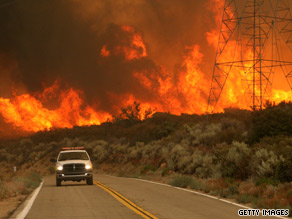
More than 105,000 acres are on fire in Southern California. For those of us from relatively wet regions of the country, this seems unbelievable. For those of us with children with a particular fear of fire, it's horrifying. For a firefighter and their family, it's a source of some ambivalence.
Firefighters become firefighters because they want to fight fire. It sounds silly when you put it that way, but often we forget. No one trains for this who doesn't get something out of it. Jeff Mitchell (whose brother, Doug, is a fire fighter) says you have to be crazy to do it. The natural reflex of any sane person is to run out of a burning building -- these guys run in. So many firefighters across the country are looking at the Station Fire and wishing they were there. Some of them are getting their chance, as firefighters from neighboring states are being called in.
On the other hand, firefighting is only enjoyable when everything comes out right. Nothing beats the rush these guys can have when they beat back the flames and save a house or a life and no one gets hurt. But when one of our nation's bravest dies fighting a fire, every firefighter in America feels the loss, and every family member of a firefighter takes a blow to the gut. Two firefighters out of Los Angeles have died in the Station Fire already. When this is over -- which isn't predicted to be for one or two more weeks -- that's going to be a hard truth to cope with for the others in their own company, the other fighting this fire, and those who just know it could have been them.
Reading the coverage of the fire, the inklings of what the themes of an intervention on this event might be are starting to emerge. Right now there are five people trapped by the fire because they did not comply with mandatory evacuation orders. Not only did they put their own lives at risk when they made that choice, but they also put the lives of the firefighters who now must try to get to them on the line. I can't imagine there isn't going to be anger about that, particularly if someone gets hurt or, God forbid, dies trying to get them out.
CISM teams most often help with incidents that happen very close to home. Right now, CISM teams all over the west are getting ready to intervene with firefighters caught in a critical incident in another state -- some of them may be deploying there right now. And CISM teams may be hearing about the Station Fire all over this country, as fire departments everywhere watch, wait, and mourn two of their own.

Saturday, August 15, 2009
CISM (Or Lack Thereof) at the Lockheed Wildfire

Over 2,400 people in Santa Cruz County, California, have now been evacuated due to the Lockheed Wildfire which began burning earlier this week. With all these people in crisis, you might wonder what the CISM response looks like right now. And if you think of CISM as mostly being one-to-one and small group work, then the answer is: not much.
But that's not completely accurate. CISM includes a large number of components, but I would predict that right now there are only two that are generally and widely appropriate: the Crisis Management Briefing (CMB) and the Demobilization. Both of these, however, are large group interventions.
Demobilization is a strategy used mostly for first responders in large scale operations, which this certainly is. In a demobilization in this instance, as firefighters come off the line following their first shift, they come to some predetermined location where there is food and drink, possibly shower facilities and/or cots. A member of the CISM team spends maybe 10 minutes with them while they eat. They share any new information about the fire and give them some self-care tips and information about what they can expect emotionally in the days ahead, gives them a handout about common stress reactions and about self-care, and then sends them off either to rest or to go home, depending on how the rotation is working.
CMBs may be being used for evacuated residents and/or first responders prior to subsequent shifts. In this intervention, some person in authority (a representative from the fire department or the governor's office, for example) gives the latest information about the fire, what is currently being done, and what the plans are moving forward, and a member of the CISM team does some education about critical incident stress and how to take care of yourself.
What you'll notice in both instances that all the CISM team is doing is "information push." Disaster victims and responders are not really being given an opportunity to process their thoughts and feelings with the team. The reason for this is simple -- the incident isn't over. To draw an analogy, it would be like trying to stitch up a dog bite in someone who is still being chased by a dog. They can't possibly hold still and cooperate in their care because their mind is on outrunning the dog, and they're going to be pretty mad at you if you try to stitch them up instead of at least cheering them on in the outrunning of the dog.
I can't say categorically that nowhere in any shelter is anybody getting any individual or small group help. Folks who had to be rescued from a burning building, for example, may need some support for that portion of the incident and they may be ready to talk about it. But maybe not. Most folks are still worried about whether their home will be there when they get back, whether their pets made it, trying to find loved ones and a more permanent place to stay, etc. And crisis responders ought to be helping them with those things.
Sometimes after mass disasters and major incidents people don't ever get the help they need because it takes so long for an incident to end or the ending is not very clear. For example, many rescue and recovery workers at Ground Zero got some support at the scene but never did a Critical Incident Stress Debriefing (CISD) because there was no agreed upon time when they were done. The CISM teams that supported them on site also didn't always get Post Action Staff Support (PASS) because it never felt like they were done. After Katrina, by the time New Orleans residents were settled enough to get CISM help, they were scattered all over the country. Planning to support victims of long-lasting disasters is a great challenge for crisis responders. I know my colleagues in Santa Cruz are up to the job.
Subscribe to:
Posts (Atom)
Meet the Quarterback

- Naomi Zikmund-Fisher
- is a clinical social worker, former school Principal and a Crisis Consultant for schools and community organizations. You can learn more about her at www.SchoolCrisisConsultant.com

Subscribe


 Posts
All Comments
Posts
All Comments