Showing posts with label evacuation. Show all posts
Showing posts with label evacuation. Show all posts
Wednesday, August 31, 2011
All Hazard Preparedness (for Some, Anyway)

 |
| Rikers Island circled in blue on evacuation map from NY Times |
As Hurricane Irene churned its way up the East Coast last week, New York City Mayor Michael Bloomberg ordered the evacuation of coastal areas of the city. 300,000 people were ordered out of their homes (although a fair number didn't leave).
In the middle of this unusual situation, someone asked a very interesting question. What about Rikers Island? For those of you who don't watch Law & Order
 reruns, Rikers is the principal correctional facility for New York City. It currently houses about 12,000 prisoners. As the name suggests, it's on an island, and it's smack dab in the middle of the zone that was evacuated ahead of the hurricane.
But Rikers Island was not evacuated for Irene. We can argue about whether it -- or anywhere else in New York City -- really needed to be. But it turns out that Rikers has no evacuation plan. Let me reiterate that, because it really is striking. There is no plan in place to evacuate Rikers Island under any circumstance. Not a hurricane, tornado, flood, fire, earthquake, riot or anything else. If someone brings a bomb into the visitor's room and they can't diffuse it, too bad. If the whole island catches fire, oh, well.
I know that concern about the welfare of criminals is not a politically popular stance, and maybe that's why they haven't figured this out. But there are some other things to consider. First of all, Rikers houses people temporarily awaiting transfer to other facilities, those serving less than a year in jail and those awaiting trial who cannot make bail or are being held without bail. This is not, overall, the place you find the most hardened criminals of New York. What's more, a sizable number of them have never been convicted of a crime. They are accused and poor, but presumed innocent.
What's more, in order to maintain the prisoners at Rikers, there is a sizable staff of guards, cleaning crew, cooks, medical personnel and others who make the place run. Those people aren't even accused of crimes. They're just doing their jobs. And as long as there are prisoners on Rikers Island, they have to be there.
The public school where I was Principal has not one but two different evacuation locations plus a variety of plans based on the hazard. We have to practice evacuating the building, as does every school in the country. If your business doesn't know how to evacuate its personnel and its customers in the event of a disaster, I'd call that negligent. But a facility with about 20,000 people in it, all told, has no plan.
I'm sure evacuating Rikers would be a nightmare. It is possible that even if they had a plan, implementing it for Irene would not have been worth it. Fine. But not having a plan at all isn't just stupid, it's criminal. I don't know which is more horrifying -- that there is no plan, or that nobody thought it was a problem until now.


Friday, May 6, 2011
White Powder in Letters: DC Schools Say, "Nya, nya, you can't scare us!"

Someone is sending letters to Washington, D.C. schools with white powder in them. The letters, which also contain the typewritten message, "AL AQEDA-FBI [sic]," have arrived at at least 28 schools thus far, and four more letters have been intercepted. Authorities say that the substance inside them is not hazardous, although they haven't said what it is.
If you do a Google News search for "white powder schools" you will find numerous incidents over the last decade, plus a bunch involving various organizations, institutions, and even Dancing With the Stars. Apparently, something similar even happened in Washington schools last October.
Am I the only one who remembers a time when it would have been the furthest thing from someone's mind to try to scare people with cornstarch? Before the anthrax attacks of 2001
 , this just wasn't on anyone's radar screen -- not even the lunatic fringe. Since then, it seems like almost an epidemic.
In 2001, schools in Western Pennsylvania (and perhaps elsewhere -- I just happened to work in Western PA at the time) had to scramble over "white powders." A local supplier of science curriculum had a 5th grade science explorations unit which many districts used which asked students to identify various "mystery powders," all of them white. All of a sudden, this didn't seem like a good idea, and replacement units had to be created or purchased.
As far as I can tell from the news coverage of the latest incident, the level of panic occurring at the schools involved is extremely low. It looks like people opened the letters and notified the authorities, who took it seriously and came out to the schools. I'm not seeing reports of school personnel becoming hysterical or evacuating buildings. I'm not seeing any reaction from kids, which seems to indicate that most of them didn't know about it. One school did notice the letter before it came inside and left it outside -- that seems cautious without being a complete overreaction.
The thing is, if we panic every time someone does this, then the bozos who are doing it get what they want. This encourages future bozos to do the same thing. Would it be safer to evacuate every building where this happens? Maybe, maybe not. We may be at the point where the chances of someone getting hurt in the evacuation -- tripping, stepping on something, getting hit by lightning, being a crime victim, getting hit by a car -- are actually greater than the chances of someone getting hurt by a mystery powder in a letter.
You might be surprised to know that the same logic often applies to bomb threats in schools. Many schools do not routinely evacuate if they receive a bomb threat. They wait for the advice of the police and fire departments regarding the specific threat. That's because if you know you can disrupt school -- any school, but particularly your own school -- by phoning in a bomb threat, then this becomes a very attractive thing for kids to do to get out of exams and such. Add to this the risk that someone will phone in a bomb threat and then wait for everyone to start coming outside and do something to them there, and evacuating is not always the thing to do. It depends on the situation.
Often times parents, in particular, don't want to hear that not evacuating is the best thing. Our knee-jerk reaction is that we should evacuate kids if there is any risk or threat. The thing is, that may not be in the best of interests of the kids. If we actually did that, we could well spend every day going in and out of school buildings. Schools have to evaluate relative risk, just as parents do at home. We don't get everyone outside when our dirty ovens start to smoke at home, or every time we hear a funny noise in the night. In loco parentis means that schools must act with the same care that parents would at home, not that they must jump every time someone says "boo." It would be a lot easier, however, if people didn't think it was a good idea to say "boo" in the first place.

Wednesday, March 16, 2011
The Japanese Crisis: Assessing the Need Stateside

The attention of most of the country continues to be across the Pacific in Japan. The loss of life is horrific. The material damage is enormous. The fear regarding the radiation in Fukushima is mounting.
Now is not the time for a psychological crisis intervention in Japan. The situation is still unfolding, and there are still significant basic physical and safety needs to be met. The best that can be done from a mental health standpoint in Japan right now is managing people's fear. Both the Prime Minister and the Emperor appear, from this vantage point, to be doing a pretty good job at exercising resilient leadership. The consistent emphasis on coming together and getting through this is good practice.
What about folks in the U.S.? Is there anything we can or should be doing for people here? I think there is.
First of all, everyone in the world needs some decent information about the radiation risk
 . With the exception of nuclear scientists, most of us have very little understanding of how much radiation is too much, how the current accident will affect people in Japan and whether it will affect anyone anywhere else at all. The news media is doing a somewhat better job of bringing in experts to explain this to us, but I think it would help if they acknowledged that none of us like hearing that there's any radiation at all, and that the biggest impact here is from fear, not nuclear byproducts.
People here who have family and close friends in Japan, particularly in the area where the quake and tsunami were, need something a little more. I think you could further separate that group into two -- those who come from Japan and have roots there, and those who don't trace their roots to Japan but have family studying or visiting there. Last Friday was ghastly for both of these groups, and it would not be surprising if they're feeling the affects even now, presuming that they now know how their loved ones fared in the quake.
For those who come from Japan, this incident is not, in some ways, over. The pictures the rest of us see and think are horrible are more personal. They may have lost homes or other special places. They may not be ready, yet, to process through their feelings and try to put them away.
For those who had family visiting or living in Japan but are not themselves Japanese, the incident is largely over and they are probably ready for some intervention. It would be totally understandable if they are having some issues with feeling irritable, having trouble concentrating, not sleeping well or having intrusive thoughts about the quake and the agonizing wait to hear from loved ones. They need to know they're normal -- it's the situation that isn't.
Then there is that group that is somewhere in a no man's land in between. They are from Japan, every picture is personal, the situation is ongoing, and they also experienced the traumatic death of someone they love. For them, some understanding and moral support is in order until the dust can settle a little more and they can start to come to terms with all of this.
I wrote yesterday about my son's friend, Taro. When I wrote, I wasn't sure which category Taro fell into. Late yesterday we confirmed that he is in this last category. He lost his grandmother and his home. The only bright side, perhaps, is that young children don't really understand death and loss as permanent things. But his family does, like so many other families in Japan, here and elsewhere. The latest estimate I've heard is 10,000 dead. That's a lot of people in limbo, waiting for this to be over so they can grieve.

Sunday, March 13, 2011
Now that Japan Has Your Attention, Let's Talk Preparedness

Depending on where you live, the earthquake and tsunami in Japan may or may not seem like something that can happen to you. Here in Michigan, our chances of an 8.9 earthquake are pretty low. Even a tsunami on Lake Michigan wouldn't reach my house. But a nuclear reactor accident? Before today I didn't even know where the nearest nuclear power plant to my house was (it's about 40 miles). Floods, tornadoes, hurricanes, blizzards, chemical spills . . . there are a lot of reasons why you might, someday, need to either evacuate your house or shelter in place.
FEMA has been on us for years to get ready. Most of us aren't. At a recent meeting of CISM providers, the FEMA director asked for a show of hands of how many people had an emergency bag for evacuations. Less than half of us raised our hands. Then he asked how many had a plan for evacuating their family. In a room of 800 people, I was one of two.
Make no mistake about it. When the time comes to leave your house, you will not necessarily have any time to get ready. Depending on what the disaster is, you might have a day and you might have less than 5 minutes. That's not the time to be thinking about this for the first time.
So, let's get practical. Here is a list of things you can do, roughly in order of the ease of doing them. This list is not exhaustive, nor does it take into consideration every possible catastrophe that could befall you. But it's a start. Find something on this list you haven't done yet, and do it.
- Talk. Seriously. Have a conversation with the other people in your house and make the following decisions:
- Where would you meet in the event of an evacuation at a time you weren't together. Pick someplace out of the immediate area.
- Where would you meet if that place was also evacuating.
- Who are two people outside your area who you will call in an emergency if you can't reach each other, so they can relay messages to the others when they call.
- If you have children and you have to evacuate during the school day, who is responsible for picking them up (if possible -- they may have to go with school personnel, keep in mind).
- If your children are home alone, where should they go? Who is a safe person who is nearby who can help them?
- Find out what the official evacuation route or procedure is, if there is one, for the catastrophe most likely to happen in your area.
- Educate yourself about that catastrophe. Find out what the dos and don'ts of surviving it are. Do this even if you think you already know. Conventional wisdom may well be wrong.
- Make sure you have a battery operated radio
and a flashlight
, and that everyone in the house knows how to use them. Also make sure everyone in the house knows where in the house is safest in the event of an earthquake or tornado, if applicable.
- Make a list of the medications everyone in the house takes, both so you can grab them on your way out and so you can tell people at the shelter if you don't have your meds.
- Make sure you keep 3 days worth of food in your house at all times. It doesn't have to be 3 days of great food, but don't let your cupboards get bare.
- Stock up on clean water. You should have one gallon per person per day for 3 days. If you have a chest freezer, you can stick a gallon or two in the freezer, which will also save electricity.
- Create a bag with the things you would need if absolutely everything else in the world were destroyed. This probably includes medications, vital documents, a first aide kit, and at least a little non-perishable food. Put a list in the bag of anything that isn't in there that you need to remember (e.g. your child's asthma nebulizer).

Thursday, September 3, 2009
Sometimes a Campus Shooting is Just a Shooting

Imagine there is an argument half a mile from your house. Someone is shot. The perpetrators run, and it's not clear in what direction. You are minding your own business in your house. What would you do? Depending on where you live, your answer is most likely nothing. Unless there is reason to think the perpetrators are headed for your house, you probably wouldn't even know about it.
But imagine you're not in your house. Your in a class at a community college, and there is a shooting half a mile away, on the other side of campus. This is what happened yesterday at Skyline College, a community college in San Bruno, CA. And let me tell you, the response wasn't "nothing." The campus locked down, then evacuated. SWAT teams were all over the place. Classes were canceled for the evening, and then for today while the investigation continued. Why such a huge reaction for an incident in which a single person was shot and no one was killed?
Because it happened on a college campus, and we as a nation are absolutely terrified about shootings at schools and on college campuses. When we open up the "shooting on college campus" file drawer in our minds, what comes out is really awful. We perceive college students as sitting ducks, vulnerable to violent rampages. And we are afraid of missing something, or branding something as small when it turns out to be really big. We are afraid of Virginia Tech.
Obviously there are some contexts that warrant bigger responses than others. A shooting 10 blocks away in a high crime area of New York City is less alarming than a shooting half a mile from the White House where the gunman is yelling political slogans. A shooting where the motive and perpetrator are known is less alarming than something random. But at the heart of it, I have to ask whether all violence on a college campus has to be treated like the entire place is under siege, and to wonder what it is that they thought they knew at Skyline yesterday that I don't know.
Monday, August 31, 2009
The Station Fire
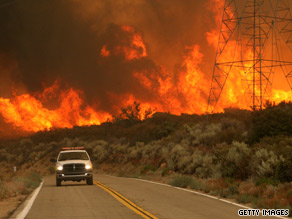
More than 105,000 acres are on fire in Southern California. For those of us from relatively wet regions of the country, this seems unbelievable. For those of us with children with a particular fear of fire, it's horrifying. For a firefighter and their family, it's a source of some ambivalence.
Firefighters become firefighters because they want to fight fire. It sounds silly when you put it that way, but often we forget. No one trains for this who doesn't get something out of it. Jeff Mitchell (whose brother, Doug, is a fire fighter) says you have to be crazy to do it. The natural reflex of any sane person is to run out of a burning building -- these guys run in. So many firefighters across the country are looking at the Station Fire and wishing they were there. Some of them are getting their chance, as firefighters from neighboring states are being called in.
On the other hand, firefighting is only enjoyable when everything comes out right. Nothing beats the rush these guys can have when they beat back the flames and save a house or a life and no one gets hurt. But when one of our nation's bravest dies fighting a fire, every firefighter in America feels the loss, and every family member of a firefighter takes a blow to the gut. Two firefighters out of Los Angeles have died in the Station Fire already. When this is over -- which isn't predicted to be for one or two more weeks -- that's going to be a hard truth to cope with for the others in their own company, the other fighting this fire, and those who just know it could have been them.
Reading the coverage of the fire, the inklings of what the themes of an intervention on this event might be are starting to emerge. Right now there are five people trapped by the fire because they did not comply with mandatory evacuation orders. Not only did they put their own lives at risk when they made that choice, but they also put the lives of the firefighters who now must try to get to them on the line. I can't imagine there isn't going to be anger about that, particularly if someone gets hurt or, God forbid, dies trying to get them out.
CISM teams most often help with incidents that happen very close to home. Right now, CISM teams all over the west are getting ready to intervene with firefighters caught in a critical incident in another state -- some of them may be deploying there right now. And CISM teams may be hearing about the Station Fire all over this country, as fire departments everywhere watch, wait, and mourn two of their own.
Friday, August 28, 2009
Hurricane Katrina and the Help That Never Came

Where were you four years ago? This is an easy one for me, since I was home with a three month-old baby watching "overblown" news coverage about this hurricane that was heading straight for New Orleans. The predictions seemed outlandish. Flooding of an entire city? Don't be silly. In the days that came, my son and I continued to watch as the Convention Center in New Orleans where I had given a talk just a year before filled with people and the spokespeople in Washington incredibly said they were unaware that anyone was there, because they had been told not to go there.
The delay in rescuing the people of New Orleans was a national shame. The delay in restoring essential services got less attention, but was no less appalling and no less a failure of our society to care for those in need. There was another delay, though, that is more understandable. That is the delay -- or absence -- of mental health assistance for those whose lives were demolished by the storm and by the lack of help that followed.
In the days directly after the storm, people's basic physiological needs were not being met. It would have been totally inappropriate to go talk to people who are crammed into the Superdome or the Convention Center without basic food and sanitation about how they are feeling. Anyone who had the time and ability to do that should have been, and mostly was, getting people to safety, feeding them, and finding them someplace to stay.
The rule of thumb is to provide early crisis intervention services when the situation is stable and the incident itself is over, as close as possible in time and location to where it happened. But because of the way this disaster played out and the delays in assistance for physical needs, there was never an obvious opportunity to do that. It took many months, if not years, for many who had weathered the storm to be in a physically stable situation. By the time they were, they were literally scattered all over the country. CISM is designed for people who have been through hell and are now returning to a world that is basically still normal, but they don't feel normal. The world was never "still normal" for many Katrina survivors.
That is not to say that no one ever got help. Those with the most extreme manifestations of Post-Traumatic Stress Disorder are still being served by the mental health system. CISM is not designed to prevent PTSD, so I won't argue that earlier intervention would have made a difference. However, studies of PTSD in Katrina victims show that increased watching of news coverage following the storm was associated with risk of PTSD symptoms, and between 38% and 50% of people who lived in New Orleans when Katrina hit have or had symptoms of PTSD. The only thing I can imagine might have been done early is to advise people not to watch TV. That probably wouldn't have worked.
By the way, it's not that no one got CISM services after Katrina. Teams from around the country were mobilized to work with rescue workers following the storm. They had the possibility of coping with this as a discrete incident. Most of the residents never did.
Friday, August 21, 2009
Why the Press Doesn't Get It

My Sister-in-law, who lives in my old hometown of Concord, Massachusetts, wrote today about the evacuation of the Prudential Center in Boston:
As I sit in the waiting room hearing the reports on the Pru Tower water main break, I'm thinking of the "proper" way to keep people updated. Are there newscaster conferences? Can groups like yours do classes specifically for newscasters to be part of the solution instead of a big problem? Or do they already, and the news people don't listen or show up?SIL is making an assumption here, which is that newscasters, all things considered, want to do this the "proper" way. I don't want to say that isn't true, but I will submit to you that that is not their primary goal.
To bring you up to speed, a pipe for the air conditioning system, which runs from water tanks on the 52nd floor all the way down, cracked on the second floor of the Prudential Center, which is the second tallest building in Boston. Water flooded the mall below, knocked out much of the power and disabled the elevators. About 2,000 people were evacuated from the building using the stairs, and firefighters had to go fetch some folks who couldn't come down the stairs. There is water damage on multiple floors (including above the crack) but no one knows how much yet.
There, are you all worried? Traumatized? Concerned for the safety of your loved ones who work there? Probably not. The fact is that this is a "big" story in that it affects a lot of people in a very well-known building. But it's actually not a big story in terms of danger or trauma. It's a big nuisance more than anything else for most people.
So why are the newscasts so breathless? (I encourage you to watch one if you haven't seen them to get a sense of the tone.) Because the press' number one priority is not to keep people calm. It is to keep people informed while still keeping them watching. So they break into the regularly scheduled programming to tell us that this big story has happened, but it's hard to report that something is both important and not a scary situation. They really only have one model of reporting breaking news, and that is based on situations that are more dangerous, or at least more dramatic, than this one. And on some level, they are also anticipating that this could become dramatic, or might already be dramatic and they don't know it yet, and if that is true they want to be ready.
As a big story unfolds, the press is trying to report what happened, who it affects, and what will happen next. The result is that they report the absence of news as news. They say, "there are no reports of injuries thus far," for example, because people watching want to know if there are any injuries. But the result of a statement like that is to imply that there could be injuries at any moment. The elevators are out, so it's going to be a little harder to get those in wheelchairs out, and they report that there are "concerns about the evacuation." What they mean is that it's not completely straightforward, but what they imply is that it's dangerous.
To answer SIL's question, yes, there are classes that reporters take about disseminating public information. Some of them are much better at it than others. But fundamentally, they know you are not going to keep watching the broadcast if they say, "There's some excitement at the Pru, but really it's more of a mess than anything else."
N.B. If you want to ask me a question or suggest a topic for the Quarterback, feel free to leave a comment in the box in the righthand column, or email me at naomi@SchoolCrisisConsultant.com
Saturday, August 15, 2009
CISM (Or Lack Thereof) at the Lockheed Wildfire

Over 2,400 people in Santa Cruz County, California, have now been evacuated due to the Lockheed Wildfire which began burning earlier this week. With all these people in crisis, you might wonder what the CISM response looks like right now. And if you think of CISM as mostly being one-to-one and small group work, then the answer is: not much.
But that's not completely accurate. CISM includes a large number of components, but I would predict that right now there are only two that are generally and widely appropriate: the Crisis Management Briefing (CMB) and the Demobilization. Both of these, however, are large group interventions.
Demobilization is a strategy used mostly for first responders in large scale operations, which this certainly is. In a demobilization in this instance, as firefighters come off the line following their first shift, they come to some predetermined location where there is food and drink, possibly shower facilities and/or cots. A member of the CISM team spends maybe 10 minutes with them while they eat. They share any new information about the fire and give them some self-care tips and information about what they can expect emotionally in the days ahead, gives them a handout about common stress reactions and about self-care, and then sends them off either to rest or to go home, depending on how the rotation is working.
CMBs may be being used for evacuated residents and/or first responders prior to subsequent shifts. In this intervention, some person in authority (a representative from the fire department or the governor's office, for example) gives the latest information about the fire, what is currently being done, and what the plans are moving forward, and a member of the CISM team does some education about critical incident stress and how to take care of yourself.
What you'll notice in both instances that all the CISM team is doing is "information push." Disaster victims and responders are not really being given an opportunity to process their thoughts and feelings with the team. The reason for this is simple -- the incident isn't over. To draw an analogy, it would be like trying to stitch up a dog bite in someone who is still being chased by a dog. They can't possibly hold still and cooperate in their care because their mind is on outrunning the dog, and they're going to be pretty mad at you if you try to stitch them up instead of at least cheering them on in the outrunning of the dog.
I can't say categorically that nowhere in any shelter is anybody getting any individual or small group help. Folks who had to be rescued from a burning building, for example, may need some support for that portion of the incident and they may be ready to talk about it. But maybe not. Most folks are still worried about whether their home will be there when they get back, whether their pets made it, trying to find loved ones and a more permanent place to stay, etc. And crisis responders ought to be helping them with those things.
Sometimes after mass disasters and major incidents people don't ever get the help they need because it takes so long for an incident to end or the ending is not very clear. For example, many rescue and recovery workers at Ground Zero got some support at the scene but never did a Critical Incident Stress Debriefing (CISD) because there was no agreed upon time when they were done. The CISM teams that supported them on site also didn't always get Post Action Staff Support (PASS) because it never felt like they were done. After Katrina, by the time New Orleans residents were settled enough to get CISM help, they were scattered all over the country. Planning to support victims of long-lasting disasters is a great challenge for crisis responders. I know my colleagues in Santa Cruz are up to the job.
Friday, July 31, 2009
The Texas Fertilizer Fire
 About 10 minutes west of my house, there is a billboard on the highway, courtesy of the Department of Homeland Security. It has a stylized map on it with an arrow pointing to part of it, and it says, "You are here. Where is your family?" It then directs you to the government preparedness website. My family has a little silly ritual we follow every time we pass that billboard. We drive by, I point to the billboard without speaking, and my 11 year-old daughter sighs and says, "Aunt Shirley's house."
When I tell friends and family this, some of them are somewhat disapproving. They are concerned that by having this conversation with our kids, we are scaring them unnecessarily. They also think that the emphasis on constant vigilance is a little overblown. I do see their points, but at least on that first item -- not scaring the children -- they have it exactly backwards.
It is in fact because of my daughter that we've had many of these conversations. Her temperament has always been such that she confronts things she is afraid of head on and wants to know exactly what "the plan" is if these things should happen. She is the one who insists on having fire drills at home. She has talked through every permutation of stranger danger that there is. She knows that we have a will and have provided for her and her brother if we should die. She likes to know the plan. And while she may be more inclined in that direction than average, kids in general do like to know the plan. Every school in this country is required to practice for a fire, and few argue that we are causing kids to be unnecessarily afraid of fire. In fact, I would argue that we are giving kids a feeling of power over something frightening. We can't make the possibility go away, but we can make them feel like they could handle it if it came along.
I am the first to say that we have been emergencied to death in this country since 9-11. I think we have been encouraged to experience fear for its own sake, and it hasn't helped anyone. However, there is some point to being prepared for bad things happening. There is a level of readiness short of stockpiling a year's worth of food and water and some firearms and ammunition for the coming apocalypse, where we simply ask ourselves what we would do in various circumstances.
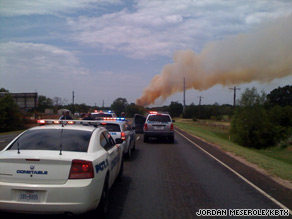 I bring this up because the town of Bryan, Texas is very much in need of a plan tonight. There is a major fertilizer fire at the El Dorado Chemical Company and 70,000 people have been told to evacuate. This is absolutely not the sort of thing that most of us are prepared for. If we live in a hurricane-prone area, we usually have a plan for that. If we live near a fault line, we have a plan for earthquakes. If we live in tornado alley, we know what to do when the sirens sound. But very few of us have looked at a map of, say, a five mile radius around our homes and figured out what hazards there are in the factories and businesses near us. Even fewer have considered what is being transported by rail and truck right past our doors.
 However, the lesson of this is not, as you might imagine, that we should all start making a list of things that could go wrong and what we would do about them. The lesson is that we can't possibly anticipate everything that might happen. Therefore, we need to have a generic, all-threat plan. In my family, we don't know what on earth could cause us to have to rendez vous outside of our town, but we know we'll meet at Aunt Shirley's.
Here's the kicker, though. The purpose of having such a plan actually has very little to do with our physical safety. I have no doubt that in an emergency I could grab my kids and find somewhere to go, even if we didn't have a plan. The point of having a plan is to reduce the traumatic stress we experience in the event of an emergency. We will be scared, no doubt. We will be worried about each other until we meet. We will worry about our posessions and our friends. But we will not worry about whether we are doing the right thing, or about generating ideas for what to do, because we have a plan. Just like children, we need to feel power over that which we cannot control, so we've built a little bit of that into our lives ahead of time. We can't prevent traumatic events from occurring, but we can feel a sense of agency when they do, and hopefully that will give us a little bit of leg up when it comes time to recover.
(Check out these additional tips for talking to children about traumatic events)
Subscribe to:
Posts (Atom)
Meet the Quarterback

- Naomi Zikmund-Fisher
- is a clinical social worker, former school Principal and a Crisis Consultant for schools and community organizations. You can learn more about her at www.SchoolCrisisConsultant.com

Subscribe


 Posts
All Comments
Posts
All Comments