Showing posts with label inoculation. Show all posts
Showing posts with label inoculation. Show all posts
Wednesday, March 23, 2011
Soldiers are People Too


Yesterday morning, an F-15 Eagle Fighter
 crashed in rebel-held territory in Libya. The crew safely ejected and was rescued. Yesterday morning, NPR had some snippets from an Egyptian doctor who happened to be staying in the hotel where one of the crew members was brought. She was asked to treat him, but he pretty much only had bumps and bruises. The doctor commented that although the pilot was basically unhurt, he needed someone to sit with him because he was anxious and unsettled.
Our servicemen and women go through a lot of training, and they're very good at what they do. Pilots are trained on how to eject during a crash, and this crew clearly utilized that training. Anyone who flies in the military has considered the possibility that they're going to either be shot down or crash for some other reason. This isn't completely unforseen.
It pays to remember, however, that training for what to do and considering it ahead of time is very different than actually doing it. Servicepeople train so they can do the job, and so panic will not be added to the emotional stress of the situation. But you can't prevent people from feeling stress at all. The training these pilots had was like an emotional bullet proof vest
 -- it prevented this crash from completely overwhelming them. But people who get shot while wearing Kevlar will tell you that it still hurts, and can knock you down. It's not unreasonable for them to need a little help getting back up.
We tend to look at situations like this and think, "Well, that's their job," and, of course, it is. But even if it's your job to be in danger, there are times that are just plain scary, regardless. You might be prepared for them. You might handle them just right. But you're going to feel it when you're done. This might be a good time to remember that the men and women who serve in the military are still, first and foremost, people.


Friday, September 24, 2010
The World Isn't Coming to an End -- It's Only an #X24

If you were killing time on Twitter around noon Eastern Time today, you might well have gotten the impression that there was something big going on in California. Shortly after noon, news filtered out of an earthquake measuring 9.2 on the Richter Scale near the Aleutian Trench, south of Alaska. A tsunami warning was issued, and a few minutes later a magnitude 7.2 earthquake hit California. Then came the tsunami. If you weren't paying close attention, you might have been alarmed, but none of it was real. It's part of an exercise running today and tomorrow called Exercise24, or X24.
The purpose of X24 is to test the use of various tools on the Internet in the event of a major disaster. X24 has been using Twitter (with the hashtag #X24 and clear warnings of "This is a test. This is not real." They have a page on Facebook. They are using Google Docs to exchange requests for aid and match providers with requesters. The idea is to see what works and what doesn't, and whether there are uses for social media and the Internet in such a situation that folks might not already have thought of.
Exercises like this one are used in emergency response organizations all over the world. Sometimes they are simulated using actors to portray victims or criminals, and sometimes they are done entirely virtually, merely sitting around a table and talking through what should happen next.
The idea is that having a great plan is wonderful, but you won't really know if you have a great plan until you try to use it. The problem is, if you need to use it, it's really too late to discover it's not all that wonderful. In addition, being taught or trained how to do something in an emergency is different than actually doing it. For example, if you had a choice between two surgeons with exactly the same education, one who had done your procedure five times this week and one who had only watched other people do it, who would you want? Simulations also serve as inoculation training for first responders. They introduce various traumatic possibilities to people in a relatively controlled way. When a real emergency hits, there are fewer elements that the responders' brains have never encountered before. This makes them more resistant to the effects of the trauma exposure, and more able to stay calm and do their jobs.
There are two truths about exercises like this. Truth #1 is that something will happen or not happen during the exercise that no one, in all of their planning, ever thought about. This is, in some sense, the entire point. By running a drill, you can discover what is missing from your plan. Truth #2 is that, no matter how extensive your drills are or how many you have, during an actual emergency something will happen that never happened during the drill. There are, in turn, two reasons for this. First, every emergency is different and you can't possibly simulate every possible scenario. Second, people behave differently in an actual emergency than they do if they know it's just for practice.
X24 is an interesting exercise because it uses the Internet -- and hence the whole world -- to practice in. The organizers should be cautious, however, in leaning too much on this exercise to answer specific questions about how the Internet would handle an emergency. I strongly suspect that the number of people retweeting the #X24 tweets and posting information to Facebook, as well as looking for information on emergency and news sites, during the exercise is a tiny fraction of the number who would do so if an actual tsunami hit California. You can tell from this exercise whether you can use Internet tools to share information, but until it actually happens we won't really know if those tools have enough capacity to make it a good idea.
Tuesday, April 13, 2010
How to Give Bad News

Tomorrow, I will sit down, one by one, with several members of my teaching staff and inform them that they will be getting a layoff notice next week. I am not treasuring this experience -- it certainly is not why I became a school administrator. These are the newest, most energetic, and in many cases most talented teachers in the school, who can least afford to lose their jobs because they make the least in the first place. Because I've known for a while that I am likely to have to do this, I've given a lot of thought to how to do it right. I know I'm not the only manager these days faced with this task, so I thought I'd share some basic rules to follow when you have to deliver bad news, no matter what that news is.
- Prepare and be prepared. If the news is at all forseeable, share that it's a possibility before it becomes a reality. We think we are doing people a favor by reassuring them that nothing bad will happen, but that's only true until something bad actually happens. People need time to process bad news, and a little expectation goes a long way. (For more on this, read my thoughts about preparing my staff for layoffs here.
- It's not about you. Very often, when you need to deliver bad news to someone else, you are also distressed by what has happened. It's easy to fall into the trap of talking about how incredibly hard this is for you. No matter how impacted you are yourself, however, when you deliver bad news that will seriously impact someone else, that interaction is about the other person, not you.
Here's a good example of what not to do: I worked as an office temp just after high school, and my first assignment was cut short. I was supposed to work for 6 weeks but they didn't need me after 4. This was not a big deal to me, since it just meant the agency would send me somewhere else. When the manager at the office where I was temping called me in to tell me, he began with, "This is probably the hardest job a manager has to do." And then he waited and didn't say anything else. I remember thinking that someone must have died, because I couldn't imagine what would be so awful that the manager couldn't bring himself to say it. Had he delivered the news and waited for my reaction, we both could have saved a lot of stress. Which brings us to our next rule . . .
- Let the reaction be your guide. You may be able to guess at how someone will react, but people do all kinds of strange things in the face of bad news. Be prepared for a colossal reaction or overreaction, but also for the possibility that they won't seem upset at all. This is particularly true with kids, whose reactions often are not the same at all as the adults around them. Thus, a kid who is heartbroken by the loss of a favorite piece of Lego can be completely unfazed by the death of a grandparent -- one is very real to him and one is not.
- Skip the platitudes and offer real help. "Everything's going to be OK" sounds better in your head than it probably does to the person receiving the news. On the other hand, if you can sincerely say, "I'm going to help you" or "I'm going to stay with you until you're OK" or the like, that's a measurable, observable piece of support.
- Be careful about leaving people alone. People who are seriously upset can easily faint, crash their car or hurt themselves intentionally. When in doubt, simply say, "I'm a little worried about leaving you alone. Who can I call? It will make me feel better." In this instance, making it about you may be a good strategy.
Tuesday, March 23, 2010
Mom's on the Roof and We Can't Get Her Down

Tomorrow night, the Superintendent of the Ann Arbor Public Schools, where I am a school Principal, will make budget recommendations for next year to the Board of Education. Next year's budget is about $20 million in the red, and so the recommendations will involve substantial cuts. In a school district, where 85-90% of the budget is spent on people, $20 million is a lot of jobs.
There's an old joke my family likes to tell that goes something like this:
A man is on vacation and his brother is taking care of his cat. The man calls his brother to check in and asks, "How is the cat?" The brother says, "The cat's dead." The man is distraught. He says, "You can't just tell me like that. You have to ease me into it. The first day, you tell me the cat's on the roof and you can't get her down. The second day, you tell me the cat fell and she's in a coma. Then on the third day you can tell me the cat died." The brother apologizes profusely. Then the man says, "It's ok. Don't worry about it. How's mom?" The brother responds, "Mom's on the roof and we can't get her down."
It's only a joke, and perhaps (depending upon your sense of humor) not that funny of one. At the same time, however, it illustrates an important point, and one I've been trying to keep in mind as our district goes through this painful process: Whenever possible, people should have warning of bad news. That doesn't mean we need to artificially prolong the sharing of news, as the man in the joke would have us do. But it does mean that, when we can see that something bad is possibly looming, it's a kind gesture to let those affected know.
This is the same principle that lies behind doing inoculation training for critical incidents. Inoculation training is simply giving people some exposure to what a crisis might be like, what they might experience, and what they can expect. The principle is that people will be more resistant to stress and more resilient from it if, when the crisis happens, this is not the first time they've considered its possibility. That's why train engineers are prepared for crashes, and that's why our district is using grant money to have me walk every school's staff through how a crisis in their school would unfold.
Which brings us back to the budget. We have known since November that big cuts were on the horizon. I have tried hard to talk candidly with my staff about what those cuts might entail, particularly with our less senior staff whose jobs might be on the line. We have taken a "we're all in this together" approach to talking about it, even though we know that we won't all bear the burden equally. I've tried to answer as many "what if" questions as I know the answers to, and I've tried to acknowledge the stress that the uncertainty is causing for everyone.
Tomorrow night, when the Superintendent makes his recommendations, there may well be bad news for a lot of people. I hope I am correct in saying that there will not be anything that is a brand new surprise to my staff, however. That doesn't make everything OK, but with any luck it will make it just a little bit easier.
Sunday, January 10, 2010
How Big a 6.5 Earthquake Is Depends On You

Yesterday evening, an earthquake measuring 6.5 on the Richter scale struck off the coast of Northern California, near Eureka. To refresh your memory, the Richter scale is logarithmic, which means that every increase of 1 on the scale means the earthquake is 10 times more powerful. So by way of comparison, this earthquake packed about 1/5 the power of the one that struck San Francisco during the World Series in 1989, and about 1/2000 of the one that caused the tsunami in the Indian Ocean the day after Christmas, 2004. On the other hand, it had more than 30 times the power of the atomic bomb that was dropped on Nagasaki, Japan.
It's hard for your average person to get a good feel for earthquake magnitudes. The difficult math of a logarithmic scale is only part of the problem, however. The other big part is what your previous experience with earthquakes has been.
Residents of Eureka have been quoted in the press discussing the earthquake. Reactions range from the alarmed, as demonstrated by Phil Burns, a cafe owner in Eureka, who said, "It was a monstrous one," to the more relaxed Cole Machado, who told CNN, "I thought my TV was going to fall over." There are also those who try to explain how the earthquake felt, like Chris Durant, a reporter who explained, "We are used to feeling small ones, but after the first few seconds, we looked at each other and said this is not a small one." Jessica Tucker of Ferndale said, " "It rolled and rolled and then it slammed."
Notably, none of these people were experiencing their first earthquake. This is important for two reasons. First of all, they all have a frame of reference. They talk about this one in relation to other ones, and they have vocabulary with which to describe it. Second, not one person I've come across said they were afraid they were going to die. Believing you are going to die is a strong predictor of post traumatic stress and PTSD, so this is a good thing.
Compare this to what would have happened if a 6.5 earthquake hit in, say, Boston, where a "big one" might be 3.0. First of all, the damage would have been much more severe, because Boston is not built for earthquakes the way California is. But the fear would also be much more severe, solely based on the earthquake without the damage, because most people in Boston have never been in an earthquake of any remarkable size. The reactions we are hearing out of California probably compare to what we would hear from Boston in a 5.5 or 6.0 -- 1/10 to 1/5 the size of this one. If a 6.5 earthquake hit Boston, people would believe they were going to die, in part because they would be more likely to, and the amount of stress symptoms you would see afterwards would be much higher.
I've been in two sizable earthquakes in my life -- both 5.6 on the Richter sale. I'm from Boston. I was scared. My husband spent his teen years in the San Francisco Bay Area. It's not that he didn't have a healthy respect for these two earthquakes, but he knew they weren't "big ones" much faster than I did. Life in California is, in part, about pre-earthquake inoculation. By experiencing small ones so often, the bigger ones just aren't as terrifying.
Monday, October 12, 2009
We Have Met the Enemy, and He is Us

After a while, writing a blog like this, there are certain things you find yourself talking about over and over again. In the blogosphere, those simply become "tags" for your writing. But some themes are more than tags -- I'm talking about the posts your write where you have to go back and look to make sure you hadn't actually written that post before, because it all sounds too familiar. That's how I'm feeling, today, about the issues of distancing and blame.
It seem like coverage of trauma in the news separates itself, rather neatly, into two categories: stories that are tragic but point out the various reasons this tragedy could have been avoided, and stories that express shock that such a thing could happen. These are two sides of the same coin. Saying an incident was avoidable implies that we will be able to avoid it happening to us. Expressing shock implies that it is anomalous -- that things like this are not "supposed" to happen to people like us, and therefore won't in the future. From these stories, we get a very interesting picture of what a victim of trauma or a perpetrator of crime is and is not "supposed" to be like. If you pay attention to the news, particularly the coverage of traumatic incidents, you will find the following:
- Victims of trauma -- those who die in traumatic incidents -- are supposed to be poor, not white, and live in cities. They are supposed to be stupid and preferably morally questionable. They tolerate domestic violence and marry entirely the wrong people. They don't have the sense to ask for help when they need it. If they are children, then the adults in their lives fit this description.
- Perpetrators of trauma -- those who cause death by crime or even by negligence -- are supposed to be poor, not white and live in cities as well. They are supposed to not have jobs and to drop out of school. They are supposed to be male. They are supposed to have a history of drug use and have been abused as children. They are supposed to care about nothing but the almighty dollar, and view women as inherently subservient.
There are many problems with this way of thinking, of course. The virtual codification of racism, classism and sexism they demonstrate is at best disheartening. Because they sort tragedies into categories, they help us deny the humanity of those affected by trauma. They make it easy to blame.
Fundamentally, they also do a tremendous disservice to our preparedness for trauma. Part of how we become resistant to traumatic stress and resilient following an incident is by having a realistic expectation of what might happen to us and how we will feel afterwards. While it is not healthy to live in fear of rare events, it is also not healthy to believe they are significantly rarer than they are. Perhaps if we were not so busy convincing ourselves that trauma happens somewhere else to someone else, we might be able to face what our actual risks are and prepare to cope with them.
Sunday, October 4, 2009
Do You Have to be an Amateur to Be a Hero?
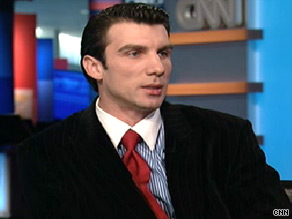
You may have seen the video. A Bronx, New York apartment building is on fire. A man, a civilian is on the top of the fire escape outside a fourth floor window. A firefighter hands him an unconscious 4 year-old boy, and he begins to walk down the fire escape. At the next landing he stops, lies the boy down and does something for a few seconds. Then he gives the thumbs up sign and yells "he's OK."
The man is Horia "Billy" Cretan, 33. He is a Romanian immigrant who owns an electronics store in the building. When the fire broke out late Wednesday afternoon, he heard the boy screaming and went up the fire escape to try to get to him. After firefighters arrived, one went into the apartment and handed the boy out to Cretan, who has become something of an instant hero as the video of the
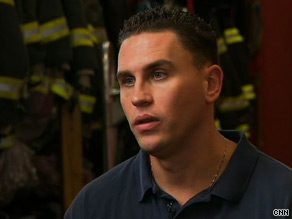 rescue circulates.
But, of course, there are two heroes in this story. Cretan is getting a lot of attention because he is a civilian who risked his own life for a little boy, and because the rescue was captured on video. Getting less attention is Jimmy Senk, the Bronx firefighter who entered the burning apartment and found the boy after he, as young children often do, moved away from the window just as Senk arrived on a ladder to rescue him. Senk went in the window next to where the boy wound up, and so handed him to Cretan rather than take him down the ladder.
Interestingly, this is not the first person Cretan has rescued from a fire. When he was 12, he rescued his own sister from a fire that killed his father. This makes me wonder whether he was motivated more by his own experience of fear and loss from his childhood or by his own experience of success in rescuing someone before. Either way, you have to imagine that this incident triggered some feelings and reactions related to that past trauma.
Senk, on the other hand, doesn't seem too phased. The fact of the matter is, firefighters are trained to do this. A successful rescue is a triumph, not a trauma. Firefighters are prepared for the fact that they will be working in burning buildings. The rest of us expect our buildings to, well, not be on fire. So an experience of successfully saving someone from a burning building, while joyous for everyone, is also traumatic for civilians. It isn't, necessarily, for firefighters.
That difference is part of the reason why Cretan has gotten all the attention. Senk did what he was trained to do. Cretan made a very risky choice that no one would expect of a civilian. Let's not forget, though, that working in a burning environment is dangerous for everyone, and rescuing someone from it is heroic regardless of whether it's your job or not.
Saturday, September 26, 2009
The Devil You Know

There's a wonderful young lady I know, a senior in high school whom we'll call "Hannah," mostly because being a senior in high school is hard enough without having your personal stuff splashed all over an adult friend's blog. At Hannah's school, on Monday, a threat was found written on the walls of the boys' bathroom. There's been no official word on what it said, but rumor has it it was something about how the school was going to "pay for this with lives." Parents were notified, and the school said they were sure there was nothing to worry about.
On Thursday, all afternoon activities were canceled, and before long word got out that another threat had been written on the bathroom walls. This time, people who saw it were asked not to tell what it said. Students were forbidden from bringing bags of any kind to school and had to walk through a metal detector on their way in on Friday morning. About half the students just didn't come.
Last night, my phone rang at 10:45 PM. That can only be a bad sign or a wrong number, and in this case it was the former. It was Hannah, calling to say that police had arrested a friend's boyfriend, a boy she knew but wasn't close friends with, on multiple felony counts for writing the threats. She was a little freaked out.
This turns my usual experience with crisis intervention on its head. Usually, I'm working with the people whose lives or whose loved ones' lives have been disrupted by the "bad guys." In this instance, that was true, but with the added layer that Hannah liked the bad guy, and didn't think he was bad, and didn't know what to think.
There's plenty here to overwhelm Hannah's usual ability to process information and "put it away," as we do with most things that upset us on a daily basis. If he did this, does that make her a bad judge of character, or a bad person? What about her friend, the suspect's girlfriend? And how must she be feeling? How can Hannah support her? What would it be like if Hannah's boyfriend had done this? Is the suspect really violent, or did he make a bad choice? How could he have ruined his life like this? If he could do this, and he seems like a regular person, does that mean that any regular person could do this? Could Hannah? Was she ever in danger from being around this guy? Is it OK to feel relieved that the scary situation at school has been resolved, if the way it was resolved hurts people she cares about? What happened to the sense of security she had about her school? About being with friends? If this guy was dangerous, how would she know who else was?
And this was before the shock wore off.
As we rush to help the victims of trauma and their families, it's sometimes easy to forget that the perpetrators have families and friends, too. Their trauma exposure is different, but it is there, and it is complicated. I told Hannah that she was asking all the right questions, and to give herself some space to not have the answers right now. We also talked about the disturbing realization that if this boy could make such a bad choice, she could too. I encouraged her to remember that while she could have, she didn't. In the words of Albus Dumbledore,
It is our choices that show what we really are, much more than our abilities.
Post-script: Amusingly, in the middle of our conversation, Hannah said, "I'm supposed to be drinking water, aren't I?" I had once told her about a colleague doing an intervention on the phone and telling the person to drink a lot of water, both to help flush out the stress hormones and to give the person something to do. Hannah remembered -- it was a case of unintentional pre-incident inoculation.
Friday, July 31, 2009
The Texas Fertilizer Fire
 About 10 minutes west of my house, there is a billboard on the highway, courtesy of the Department of Homeland Security. It has a stylized map on it with an arrow pointing to part of it, and it says, "You are here. Where is your family?" It then directs you to the government preparedness website. My family has a little silly ritual we follow every time we pass that billboard. We drive by, I point to the billboard without speaking, and my 11 year-old daughter sighs and says, "Aunt Shirley's house."
When I tell friends and family this, some of them are somewhat disapproving. They are concerned that by having this conversation with our kids, we are scaring them unnecessarily. They also think that the emphasis on constant vigilance is a little overblown. I do see their points, but at least on that first item -- not scaring the children -- they have it exactly backwards.
It is in fact because of my daughter that we've had many of these conversations. Her temperament has always been such that she confronts things she is afraid of head on and wants to know exactly what "the plan" is if these things should happen. She is the one who insists on having fire drills at home. She has talked through every permutation of stranger danger that there is. She knows that we have a will and have provided for her and her brother if we should die. She likes to know the plan. And while she may be more inclined in that direction than average, kids in general do like to know the plan. Every school in this country is required to practice for a fire, and few argue that we are causing kids to be unnecessarily afraid of fire. In fact, I would argue that we are giving kids a feeling of power over something frightening. We can't make the possibility go away, but we can make them feel like they could handle it if it came along.
I am the first to say that we have been emergencied to death in this country since 9-11. I think we have been encouraged to experience fear for its own sake, and it hasn't helped anyone. However, there is some point to being prepared for bad things happening. There is a level of readiness short of stockpiling a year's worth of food and water and some firearms and ammunition for the coming apocalypse, where we simply ask ourselves what we would do in various circumstances.
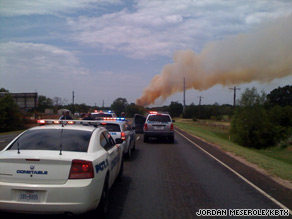 I bring this up because the town of Bryan, Texas is very much in need of a plan tonight. There is a major fertilizer fire at the El Dorado Chemical Company and 70,000 people have been told to evacuate. This is absolutely not the sort of thing that most of us are prepared for. If we live in a hurricane-prone area, we usually have a plan for that. If we live near a fault line, we have a plan for earthquakes. If we live in tornado alley, we know what to do when the sirens sound. But very few of us have looked at a map of, say, a five mile radius around our homes and figured out what hazards there are in the factories and businesses near us. Even fewer have considered what is being transported by rail and truck right past our doors.
 However, the lesson of this is not, as you might imagine, that we should all start making a list of things that could go wrong and what we would do about them. The lesson is that we can't possibly anticipate everything that might happen. Therefore, we need to have a generic, all-threat plan. In my family, we don't know what on earth could cause us to have to rendez vous outside of our town, but we know we'll meet at Aunt Shirley's.
Here's the kicker, though. The purpose of having such a plan actually has very little to do with our physical safety. I have no doubt that in an emergency I could grab my kids and find somewhere to go, even if we didn't have a plan. The point of having a plan is to reduce the traumatic stress we experience in the event of an emergency. We will be scared, no doubt. We will be worried about each other until we meet. We will worry about our posessions and our friends. But we will not worry about whether we are doing the right thing, or about generating ideas for what to do, because we have a plan. Just like children, we need to feel power over that which we cannot control, so we've built a little bit of that into our lives ahead of time. We can't prevent traumatic events from occurring, but we can feel a sense of agency when they do, and hopefully that will give us a little bit of leg up when it comes time to recover.
(Check out these additional tips for talking to children about traumatic events)
Saturday, July 11, 2009
The Other Survivors of Train Accidents
Four families (two of the dead were siblings) are in a state of shock and anger and disbelief this weekend. Friends, classmates and people who live near the track are also traumatized. The situation is further muddied by the fact that the driver had had his license suspended just the day before. Plenty of blame and anger is being thrown around, I'm sure.
But there is one person you might not be feeling for today, and maybe you should. What about the train's engineer?
The statistics about railway fatalities are pretty stark. In 2007, there were 856 people killed in railroad incidents in the United States. Of those, 339 were at railroad crossings. The vast majority of fatalities -- 630 -- were what are called "trespasser fatalities." Those are people on the tracks, either at the crossing or elsewhere, who should not have been there (this accident was not a trespasser fatality, since the car was trying to cross the tracks, not sitting on them). There are no official statistics on how many of those trespasser fatalities were suicides, but the number is high.
The Quarterback had the pleasure, at a recent conference, of getting to know a gentleman who works in the Employee Assistance Program at Amtrak. I asked him what the chances were that any given engineer would be involved in an incident in which the train struck and killed someone during his career. My colleague said, "If you stick with the job, it will happen to you, possibly more than once." In fact, Amtrak includes pre-incident inoculation -- preparing people for such an accident -- as part of its education of new train crews.
The fact of the matter is, if someone is on the tracks who shouldn't be, or crossing the tracks when it's not safe, there is nothing the engineer can possibly do to stop the train in time. With the power of operating an enormous, fast machine like a train, comes the knowledge that in fact the train is more powerful than you. What an awful part of the job to have to "get used to."
We've all heard people joke about, or maybe even discuss seriously, throwing themselves under a train or a bus. We rarely stop to think that when someone does that, intentionally or not, they also force the operator to kill them. So this evening, I'm taking a moment to think about my new acquaintance and the men and women he works with, and the engineer who will have to live with this experience for the rest of his or her life.
Tuesday, June 30, 2009
Journalists Under Fire

Yesterday on NPR, Fresh Air had on Chris Cramer. He was a reporter for the BBC in 1980 when he was applying for a visa at the Iranian embassy in London. You may recall that there was a hostage siege at the Iranian embassy in London that year, and lucky Mr. Cramer happened to be there when the terrorists showed up. He was held captive for a day and a half.
Following that experience, he decided that perhaps he did not want to be covering war and conflict and went into management. He was an executive at the BBC, president of CNN International, and is now Global Editor for Multimedia at Reuters. More interestingly, at least for the Quarterback's purposes, Cramer is President of the International News Safety Institute.
I, for one, had never heard of INSI, but they look pretty cool. They are committed to having safety standards for journalists. Very controversially, Cramer was among the first to say that, "no story is worth a life." INSI also trains journalists who are going into conflict areas on things like battle first aid, how to survive a kidnapping, and other light topics.
From a CISM point of view, all that training not only gives journalists the skills that they need if they're going to be in the middle of a war zone, but it also serves to inoculate them against the stress of the experience, at least to some degree. You may recall the Quarterback's recent speculations about New York Times columnist David Rohde and how he might be doing following his recent escape from the Taliban. It might be interesting to know if he had gone through INSI training.
Cramer talked a lot about how journalists know when to take a break, and about the need for managers to tell them when it's time to come home because they don't always see the situation clearly up close. He also talked about how some journalists immediately go see a counselor when they come back from an assignment, and others have trusted friends they talk to.
This is a poster child advertisement for Critical Incident Stress Management. The original idea behind CISM is that first responders would be more comfortable talking to another first responder -- a peer -- than to a counselor, so it was important to train the peers in early crisis intervention and train the mental health professionals both in early crisis intervention and in working with peers. Seems like the same principle might apply to journalists: If folks are going to talk to their peers about traumatic experiences, let's train the peers.
The Quarterback has no idea whether there are journalists out there -- a few or a lot -- who are trained in CISM. It sure sounds like there should be. And if they need a Quarterback to train them, I know just the person!
Monday, June 22, 2009
"Do What You Know You Can Do Well and Get Out of There":The Escape of David Rohde

New York Times reporter David Rohde escaped from 7 months of captivity in Afghanistan on Friday night. He had been kidnapped by Taliban and, if you are like most people, you had no idea. The New York Times decided not to publish the story out of fear for Rohde's safety.
Certainly being kidnapped by the Taliban qualifies as a "critical incident," and I think we could all forgive Mr. Rohde if he has some critical stress reactions in the next several months. But his is an interesting case. You see, he'd been abducted before -- several years ago in Bosnia.
The Quarterback certainly has no way of knowing what either experience was like for Mr. Rohde, but the fact that he continued to work as he did in dangerous, kinapping-prone areas after the first time suggests that he was doing OK. How is he doing now?
There are a number of possibilities:
- For whatever reason, Mr. Rohde is fairly well inoculated against the traumatic stress of being kidnapped. That doesn't mean he likes it, mind you, but that it doesn't give him nightmares and flashbacks and depression. This is the phenomenon that allows most first responders to stay on the job and only be impacted by the most grisly and shocking events -- day-to-day violence and blood become part of the job.
- The first kidnapping was indeed traumatic for Rohde, but he got good intervention and the experience largely inoculated him against the distress of the second one.
- Both kidnappings were traumatic, independent of each other.
- Rohde's reaction to the second kidnapping is big, and as much about the first incident as the second one. He is reliving the previous traumatic stress while trying to process the current.
In fact, the Quarterback knows a lot of responders who wouldn't touch Mr. Rohde with a ten foot pole. I participated in a training once where we planned a response to a workplace hostage situation which ended in a fire and the police shooting the perpetrator. The question of what should be done for the person who was taken hostage, who was the estranged wife of the perpetrator, got about 30 seconds of attention, with everyone (except the Quarterback) agreeing "she gets a referral" to psychiatric intervention. We don't like to work with people who are smack dab in the middle of the trauma. The next concentric circle out is more comfortable.
Certainly there are times when working with the most impacted people is not advisable. You should never be doing intervention with people who are still injured in the hospital, because they are still getting their physical needs met and can't yet attend to their safety and security or belonging and love needs. And it is absolutely the mantra of CISM providers to do what you know you can do well and get out of there -- doing nothing is preferable to doing it wrong, and if you really don't think you can handle this, then you shouldn't be doing it at all.
The problem is, the standard of care for the treatment of traumatic stress, as contrasted by the intervention in traumatic stress, is to wait 30-60 days after the event. And if no one intervenes with the primary victim during that time, it can be a truly hellish couple of months. It's the equivalent of breaking your arm and having the ER say, "We can't operate for a week until the swelling goes down, so go home and wait" without putting it in a splint. The splint isn't going to heal it, but it will make the waiting more bearable and hopefully prevent the injury from getting worse.
But before we go rushing in to hypothetically assist Mr. Rohde, one last caution is in order. Critical Incident Stress Management does not respond to the critical incident. It responds to the critical incident stress. So before anyone does anything, they need to assess what exactly is going on for Mr. Rohde, and don't forget his family and colleagues. If everyone's doing OK, we can go find another trauma to intervene with -- there are plenty. And if not, let's do what we know we can do well, and get out of there.
Subscribe to:
Posts (Atom)
Meet the Quarterback

- Naomi Zikmund-Fisher
- is a clinical social worker, former school Principal and a Crisis Consultant for schools and community organizations. You can learn more about her at www.SchoolCrisisConsultant.com

Subscribe


 Posts
All Comments
Posts
All Comments