Showing posts with label triggering. Show all posts
Showing posts with label triggering. Show all posts
Friday, September 9, 2011
Turn Into the Wind: Dealing With the 9-11 Anniversary and its Hype


All week I've been writing about how American society matches the symptom profile for Post Traumatic Stress Disorder. This morning, I took the first of those pieces to my writer's group, a small circle of women writers who share and respond to each other's work every Friday mornings. I knew it was not my best work, and I wanted feedback.
As usual, the group was very helpful, but one of their reactions caught me by surprise. Members felt that my writing was distressing (not in terms of quality, but in terms of topic), and that I needed to give information on how to deal with that distress. So I'm taking a detour from the exploration of PTSD in a post 9-11 society to help all you Quarterbackers out there as we head into the 10th anniversary of the attacks.
Perhaps the most important thing you should know is that, if you're feeling blah this week, or sad, or anxious, or irritable, or having trouble sleeping, or anything else that makes you feel "off," even if you do not consciously connect those feelings to this anniversary, you're normal. Anniversaries are very powerful, and quite often people who don't even realize that it is an anniversary have negative reactions nonetheless. This isn't helped by the terrorism alert for New York and Washington. What might be somewhat distressing anyway only feels magnified given the time of year.
You also aren't crazy if you are sick and tired of the anniversary coverage (although chances are you aren't reading this, so I may be wasting my breath). The extra coverage is draining because it prevents us from getting away from the intense memories and the feelings they evoke.
Whichever of these two groups you most identify with, you're normal. Don't waste one minute worrying that your reaction is too much or not enough or inappropriate, any more than you would criticize yourself for feeling pain when you stub your toe. You couldn't control those feelings if you wanted to, so don't bother trying.
But what can you do? If the coverage or the date or the blogging about our messed-up society is bothering you, what is the solution? You may not like the answer, because here's what it isn't. Turning off the TV, avoiding reading my blog, doing something completely non-9-11 related on Sunday and generally trying to get your mind off it may feel good for the moment, but it is a quick fix for a longer term problem. That's because problem isn't the reminders of the attack, it's how upsetting they are to you. Avoiding the reminders won't solve the underlying issue, it will just push it back underground.
What I suggest is completely counter-intuitive. When you find yourself having negative feelings -- sadness, fear, hurt, anger, guilt, shame or whatever -- don't try to turn away from them. Turn towards them. Identify what you are feeling and what caused it. Label them consciously. Don't try to explain it rationally, because emotions are not rational -- they're, well, emotional. Whatever you're feeling just is, so you might as well feel it.
The reason this is a good idea is that, when you turn and face your negative emotions, they stop feeling so overwhelming. Feelings, by themselves, do not hurt us. What we tell ourselves about those feelings and the events that trigger them can. No one likes to feel sad or afraid, but you can tolerate it. Your negative emotion loses its power when you acknowledge it and face it head on.
Does this mean you should glue yourself to the TV and watch as much coverage as you can this weekend? No. Just as avoiding reminders isn't healthy, seeking them out to excess isn't, either. Watch, read and hear what interests and moves you or is meaningful to you. Consider for yourself what type of commemoration, if any, you believe is appropriate for you to participate in. Just monitor yourself and be careful when you find yourself saying things like, "I can't watch that," "I want to get my mind off it," or "I won't be able to handle that." Those are signs you're avoiding, and you're not turning into the wind.
For me, this Sunday is about reclaiming September 11th as a day of grief and fear -- yes, I'm reclaiming fear -- and as a day of unity, service and collective support. I am allowing myself to feel the sadness and, as hard as it is, some of the horror of that day. And I'm patting myself on the back for doing it, because it isn't easy. I hope you'll join me.


Wednesday, May 4, 2011
Should the Bin Laden Pictures Have Been Released?

Today, the White House announced that President Obama has decided not to release photographs of Osama bin Laden's dead body. As reported in the press, there was some disagreement over whether releasing them would be a good idea. One view was that it would convince people that he is actually dead. The other was that it would "inflame" his followers, in part because it might be seen as an act of disrespect.
I actually don't have any opinion about whether either of these arguments is true. I was interested, however, that, at least publicly, a third issue was not being discussed. These pictures are described as "gruesome." What effect would seeing them have on your average person on the street?
I myself don't really need to see "gruesome" images. Just as I felt triggered by listening to audio of people screaming on 9-11, I find certain kinds of images very disturbing. Over the years, for example, I have studiously avoided the video of people jumping out of the twin towers. I don't need to see it to understand what happened, but seeing it is too vivid for me. It takes me from the reasonable point of needing to understand others' trauma to being traumatized myself.
Now, it's perfectly reasonable to say that we don't censor the press to protect Naomi Zikmund-Fisher from objectionable images. If I don't want to look, I won't -- just as is the case with the 9-11 videos. This relies, however, on media outlets handling the images in a manner that acknowledges that not everyone wants to see them, or wants their children to see them.
I vividly remember the day more than 4 years ago when I hooked up my laptop to a projector to show a website to some kids, opened my browser (which had CNN as its startup page) and was confronted by -- and confronted my students with -- a picture of the Virginia Tech shooter
 aiming a firearm at the camera. I had some explaining to do to some parents, and I wished CNN
 had made it just a tiny bit harder to see those pictures.
This is a free society, and we don't censor our press. If my sensibilities, or even the sensibilities of a lot of people, were the sole issue, the pictures of bin Laden should have been released. The President has decided not to, and I know that a lot more went into that decision than whether they would be traumatizing to the average American. This is a good occasion to remember, however, that sensory input -- sights, sounds, smells, tastes and feelings -- can trigger very strong emotional reactions, much more intense than just hearing about a traumatic event. While we shouldn't prohibit them, we should be careful about exposing people to them by accident.

Tuesday, May 3, 2011
Bin Laden Coverage: Protecting Our Kids and the Kid Inside All of Us

Yesterday, I shared with you my thoughts about explaining Osama bin Laden to children. I was apparently not the only person worrying about this. Time
 ran a piece which began,
 President Obama certainly wasn't taking the sensibilities of West Coast children into consideration when he made his stunner of a speech Sunday night.Parents in the Pacific time zone found themselves scrambling to explain the news in real time, and some of them were pretty unhappy about it.
While I certainly understand the problems of trying to explain this stuff to kids -- that's why I wrote yesterday's piece in the first place -- I will admit to feeling a little frustrated with those who would make this complaint. If there was one thing we all should have learned from 9-11, it is that live television is unpredictable. Anything can happen at any time. Part of being a parent is recognizing this and using it to make decisions about whether your children can watch TV, and whether you will choose to watch things live. Part of being a parent is also realizing that kids will inevitably ask about things we'd just as soon they not know about, and we have to answer the questions when they come.
In addition, speaking as someone from the east coast, Obama's speech didn't start until way past my bedtime. If he had waited until every kid in the country was asleep, he wouldn't catch a whole lot of adults, either. News happens when it happens. If you don't want your kids to see it, don't turn on the news.
That having been said, I have been somewhat appalled by what some media outlets have chosen to run in their coverage of bin Laden's death. Yesterday afternoon I was listening to "Here and Now," a public radio show from WBUR in Boston. They had the usual talking heads discussing the implications of bin Laden's death, which was all well and good. At the very end, the host said that his death also brought us "back in time" to 9-11. They then proceeded, with explanation of what each clip was, to play the audio of the second plane hitting the World Trade Center (complete with screaming), audio of someone who died in the towers on the phone, and audio of a very frightened voicemail message left by someone who died.
I cried. Then I got mad. Don't get me wrong, I certainly understand that this weekend's events bring back memories of 9-11, and to some extent they will trigger any unresolved trauma we all have. But wasn't the memory enough? Did we really need the extra boost of some vivid sensory input? Did we need to invade the privacy of dead people just one more time? Were they afraid we wouldn't remember unless they retraumatized us? And if you're worried about the sensibilities of children, would you want your kids hearing that with no warning at all?
9-11 is unique in our collective experience because it was a trauma for almost everyone in the country. That means that, in planning what to broadcast, you have to treat everyone in the audience as a trauma victim. You wouldn't force the victim of a shooting, for example, to listen to the audio of the incident without a good reason. We all deserve a little less sensationalism and a little more respect for how raw this still feels.
* The artwork on this post, like yesterday's, comes from the FEMA website and was created by a 5th grader at Chagrin Falls Intermediate School for the 1st anniversary of 9-11.

Saturday, July 31, 2010
The Courage of Lisa Marie Iyotte
On Thursday, President Obama signed the Tribal Law and Order Act of 2010. Now, this is not a political blog and I generally try to keep direct discussion of politics and politicians out of it, but something happened at the signing ceremony that I think is really important.
President Obama was to be introduced by Lisa Marie Iyotte, a member of the White Clay People and, like one third of Native American women, a survivor of rape. I encourage you to watch the beginning of the video of the ceremony for yourself:
It's hard to watch this video and not be moved. Scratch that -- it's hard to watch this video.
What I want to point out is that the rape that Ms. Iyotte talks about happened more than 16 years ago. She clearly has found a way to deal with it, and now works as an advocate for other women. At the same time, she is unable even to stand up and introduce herself, knowing that she is going to tell the story. Of course, Ms. Iyotte was nervous. You would be too if you were introducing the President, regardless of your politics. This was also an emotional day, for something she had worked long and hard for was finally coming to fruition. Even acknowledging all of that, however, I doubt it accounts for her tears.
This was a triggering event. Even if you've done a pretty decent job of processing a traumatic experience, there will still be times when thinking about it, or about something similar to it, upsets you. To his credit, President Obama both tried to be comforting and continued to listen. He could just as easily have told her not to continue, or otherwise taken the attention off of the power of the moment. Survivors of trauma need to be heard, even through the tears, and he is to be commended for modeling that.
The courage of Lisa Marie Iyotte is not only exemplified by the fact that she is a survivor, that she has used this experience to help others, or that she volunteered to tell her story. Her courage is also exemplified by the fact that she started to cry, and stood there, and told her story anyway. That is how we know that this trauma has not defeated her -- she wouldn't let it.
President Obama was to be introduced by Lisa Marie Iyotte, a member of the White Clay People
and, like one third of Native American women, a survivor of rape. I encourage you to watch the beginning of the video of the ceremony for yourself:It's hard to watch this video and not be moved. Scratch that -- it's hard to watch this video.
What I want to point out is that the rape that Ms. Iyotte talks about happened more than 16 years ago. She clearly has found a way to deal with it, and now works as an advocate for other women. At the same time, she is unable even to stand up and introduce herself, knowing that she is going to tell the story. Of course, Ms. Iyotte was nervous. You would be too if you were introducing the President, regardless of your politics. This was also an emotional day, for something she had worked long and hard for was finally coming to fruition. Even acknowledging all of that, however, I doubt it accounts for her tears.
This was a triggering event. Even if you've done a pretty decent job of processing a traumatic experience, there will still be times when thinking about it, or about something similar to it, upsets you. To his credit, President Obama both tried to be comforting and continued to listen. He could just as easily have told her not to continue, or otherwise taken the attention off of the power of the moment. Survivors of trauma need to be heard, even through the tears, and he is to be commended for modeling that.
The courage of Lisa Marie Iyotte is not only exemplified by the fact that she is a survivor, that she has used this experience to help others, or that she volunteered to tell her story. Her courage is also exemplified by the fact that she started to cry, and stood there, and told her story anyway. That is how we know that this trauma has not defeated her -- she wouldn't let it.
Monday, May 24, 2010
Verdict in Newark Schoolyard Murders

The first of six defendants was convicted today in the murder of three young adults in Newark, New Jersey
 three years ago and the attempted murder of a fourth. The dead, Iofemi Hightower, 20; Terrance Aeriel, 18; and Dashon Harvey, 20; and the survivor, Natasha Aeriel, 19, were all students or soon-to-be-students at Delaware State University, were hanging out on a Newark school playground when they were attacked with guns and machetes. At least one of the female victims was sexually assaulted.
These murders are widely referred to as the "Newark Schoolyard Murders." They got a fair amount of attention when they happened, and the Associated Press says they
jolted New Jersey's largest city into trying to fix its crime problem.I find this an interesting phenomenon. Clearly this is not the only homicide Newark has ever seen. There were 106 homicides in Newark the year that these killings took place. What made these stand out?
While there is plenty that is fairly typical about these murders, they also have particular aspects that propel them to the top of the front page. First of all, while people in Newark might have come to expect homicides by the time these occurred in August of 2007, there were some caveats. Generally speaking, there was one victim at a time, killed by one or two perpetrators. There was gang violence, but it usually killed other gang members. The number of murders involving unknown assailants and random violence was still a tiny percentage. In this instance, the murders happened in a low crime part of town, relatively speaking, and the victims were college students, not gang bangers. The motive appears to have been initiating a new gang member, with robbery as an afterthought. In short, these murders violated all of the basic worldviews that allow people to think of violence as something that happens to other people. If these kids could be killed, anyone could.
I think that the factor that most tipped the scales in favor of massive publicity, however, was that the killings took place in a schoolyard. When you read the term "schoolyard murders," your first thought is probably about school children being killed, perhaps by other students. We as a society are obsessed with school violence
 despite lots of evidence that school is one of the safest places for children in this country. Sending our kids to school takes a leap of faith, because we as parents can't watch over them, so murders in schools are a big deal. In this instance, even though it was nighttime, summer, and neither the victims nor the killers were students at the school, the simple use of the term "schoolyard murders" triggers a visceral response, and we want to learn more.
Certainly these young people did not deserve to die like this. No one does. And to the extent that this event was a catalyst for change, that's all to the good. It's important to remember, though, that 103 other people were murdered in Newark that year. Not all of them were minding their own business, not all were college students, not all happened to have been killed on a school playground. All 106 murder victims were human beings who had people who cared about them. As the coverage of this and the remaining trials hits the news, let's take a moment to remember them, too.
Saturday, April 24, 2010
Mama Bears Comment on a School Fight

On Tuesday, a sixth grader at Heritage Elementary School in Saline, Michigan
 , south of Ann Arbor, was rushed to the hospital after a fight on the playground. He was unconscious and having convulsions. It appears that he was pushed from behind and possibly kicked by two or three other students while other children watched.
This story hit the news this morning, and I've already had it emailed to me by more than one parent. People are upset by the story, and they are also upset by the comments they see posted by readers of the story. These comments can be divided into a few major categories:
Category 1: What is the world coming to?
This behavior is beocming [sic] an everyday event. What has happened to our children? They are violent and seem to have little respect for life. The bigger question is, why are grade schoolers beating another child to a point that a child is put into a hospital? What are they thinking? What are their parents doing? Who is teaching humanity?Category 2: It's no different than it always was.
NEWSFLASH- Children fight on playgrounds! Please where did you people grow up. Saline grad here k-12, and a playground fight is not really news. I've seen a student knocked out before and plenty of fights. As children age it tapers off- more fights in younger grades but they don't knock each other out. There is no one to blame -its called growing up, and its the same in every public school.Category 3: It's the school's fault.
What has the school done to protect him? How come there was no teacher in sight? Maybe the first punishment was not strong enough to show the previous and current attackers that the school is serious about protecting students in school and that their acts would not be tolerated at all. All these questions need to be answered by the School principle [sic], obviously he/she failed to have any adequate planning in protecting the kids at school. The previous punishment failed to send a clear message to all students about bullying other fellow students at school that it will not be tolerated under any circumstances. This should not be brushed easily aside, we need answers and responsible people to provide education and safety for our kids in Michigan schools. Unless this is properly addressed, it will most likely be repeated.
None of these commenters, as far as I can tell, have any more information about the incident than the sketchy details from the news article, but they all are making assumptions about what happened before, during and/or after this incident. Some of the parents who are emailing me, furthermore, want to know what we are "doing about this" at our school, in a different town and a different district. Why is this eliciting these reactions?
This story has all the makings of a triggering event -- one with which people have strong emotional associations. It took place in a setting that almost everyone has experience with -- a school playground. For we Ann Arborites, it took place not too far away. It involves school violence which, on some level, we all also had experience with.
Perhaps most importantly, this incident not only involves children, but it involves children in a setting where their parents are particularly powerless. We can watch our kids at the mall or the grocery store or our own yard, but when we drop them off at school we have to trust that they are going to be OK. When something happens that indicates that kids are not safe at school, we parents become like mama bears protecting their cubs. Don't mess with us.
The categories of comments on the news article indicate where people's anxieties and biases -- about the world, their children and schools -- already were before they read the article. If you firmly believed that school personnel were somewhat incompetent yesterday, then when you read about this today you saw evidence of that. If you believed that the world is going to Hell in a handbasket, here's your proof. And if you yourself were a fighter and turned out OK, or if you deal with the fact that you can't protect your kids at school by telling yourself you don't have to, you'll say that kids will be kids.
Who knows what the backstory on this incident is. Did the child have an undiagnosed medical condition? How long did the fight last? Who was the aggressor, and what previous problems have they had? I know from having my own school incidents covered in the press that there is always, no matter what, some side of the story that does not make the paper and which I think is very important to understanding the whole picture. In the end, however, these comments aren't about the whole picture and they're barely about this incident. They're about the people who write them, and we can tell a lot about the authors just by reading them.
Thursday, April 22, 2010
The Everyday Crises We Can't Prevent

Yesterday afternoon we had a perfect storm
 at my school. The secretary was out sick. The clerk is in China. The lead teacher was out of the building. The nurse and all of the special education staff were in a meeting. One of the teacher's assistants, the one who works with our most medically fragile students, was picking up her ill child from another school. I was in my office with my boss having my evaluation conference. It's hard to imagine a worse time for a student to have a seizure in the lunch room.
In all likelihood, there were probably a total of 90 seconds between the start of the seizure and when I got there. The nurse was 30 seconds behind me. In this day and age, we were lucky she was even in the building -- she is only there one and a half days a week. Had everyone been in their usual places, it might have shaved 30 seconds off the entire thing. Those extra 30 seconds, of course, felt like an eternity to the lunchroom staff, and probably sounded like an eternity to the family when we spoke to them.
This child has a known seizure disorder and a written plan for what to do. I won't say my adrenalin didn't kick in at all when I started heading for the lunch room, but I will say I wasn't scared. We had a plan, the nurse was on her way, and I knew this child was susceptible to seizures. Stuff happens.
Once the nurse had taken over, I looked around at the lunchroom staff and realized that my reaction was not the same as theirs. The one who had first noticed the student seizing was beside herself wondering if she had done the right thing. Another one told me her brother, who died a couple of years ago, had died during a seizure. Most of them just were not at all convinced that this child was going to be ok. They work at the school 2 hours a day. They've never encountered this child having a seizure before, and it triggered all sorts of emotions for them, as you might expect. Those of us who have seen this before felt much better than they did.
I went back to my office and called the family. Then I returned to my evaluation conference, and joked with my boss that there must be somewhere on that evaluation form to notate that in fact that had gone pretty well.
We spend a lot of time and energy preventing things from happening in schools, from shootings to fires to kids tripping over their shoelaces. At the end of the day, however, you can't prevent everything. And while we couldn't prevent this seizure, we could make sure we were ready, and we can go back and review how everything unfolded and tweak our procedures. But even with these relatively "little" incidents, it's important to remember that, to someone on staff, this may not be little at all. Someone's brother died. Someone felt incompetent. When it's over, it's important to support them, too, and review to see how you might have protected them from the trauma -- with a small "t."
Sunday, March 7, 2010
All Trauma is Personal

On February 17 at about 8 AM, a small plane carrying three employees of Tesla Motors crashed on takeoff from Palo Alto Airport into a residential neighborhood in East Palo Alto, California. All three people on board were killed, but miraculously no one on the ground was injured. The ensuing fire damaged buildings and scorched the pavement of the street.
Frequent Quarterbacker Mike Miller, a longtime friend of mine, suggested shortly thereafter that I blog about the crash. I will admit that I wasn't particularly intrigued. I didn't have an "angle." Planes crash. Some privileged techies crashing into a much less privileged neighborhood did not make me want to blog about their survivors, harsh as that might seem.
For Mike, on the other hand, this was a very interesting story. Mike's father was a pilot for United Airlines for many years, and at one time he, too, aspired to be an airline pilot. He flew small planes and loved aviation, even after his career plans shifted and he became an attorney. I flew with him only once, the medication I took to avoid motion sickness putting me to sleep in the back seat of his plane as my stomach churned nonetheless.
Mike also lived in the San Francisco Bay Area, where this was a big story. To him, there was a lot to consider about this story, from the trauma it posed for the families to what it meant for other pilots like himself. He had a personal connection to this incident in a way I never would.
Today's San Jose Mercury News has a story about the East Palo Alto neighborhood where the plane crashed last month. The residents don't feel very safe right now, and one can hardly blame them. The sky pretty literally fell on them, and they have no reassurance that it won't happen again. The sound of every plane engine is a reminder of what happened and a trigger for their trauma reactions. They look up with trepidation and wonder when the next plane will come down. In a city rocked by gang violence, it is a plane crash that has residents thinking of moving out.
Usually I get my news stories from Google, the New York Times or suggestions from friends. The article about this neighborhood did not cross my radar from any of these sources. I was on the Mercury News website today looking to see if Mike Miller's obituary had been posted yet. He died on Monday at the age of 39 after a truly spirited battle with melanoma. He never got to read about the story he suggested, the story that was so personal to him, in this space. Oddly enough, reading the article was a trigger for me, not because of the crash itself but because of Mike. His memory is a blessing.
Monday, February 15, 2010
A New View of 9-11
 Last week, ABC News released 12 photographs that were among the thousands they received in response to a Freedom of Information Act Request for pictures of the collapse of the World Trade Center. These images, which had never been released before, were taken on September 11, 2001 from a New York Police Department helicopter.
These new images have a huge amount of power. They are sharp and clear, and offer a new angle -- from above. They are good photography by any standard. As you flip through them, it is like using an old-fashioned animation flip book. In time lapse animation, we see the towers come down. From a dispassionate standpoint, it looks pretty cool. Then you remember that this isn't a movie, or a planned building implosion, but an occupied building, and it isn't cool anymore.
There isn't an adult in American who hasn't seen pictures or video of the collapse before. On some level, we think we're "over it," some more than others. Yet there is something compelling and awful about these new pictures. Maybe it's the new angle, maybe it's the clear sequencing, but these pictures put me back to that day more than 9 years ago in a way that little else has. Perhaps because they are so dispassionate, they refocus the viewer on the facts -- not the politics or even the fear or anger.
I have not chosen to post any of the pictures in this space because I want you to have control over whether and when you look at them. If you haven't yet, however, I would encourage you to. They aren't gory, but they do pack a wallop. If you want to understand what happened that day, I think you need to see these. You can view them here.
Thursday, January 21, 2010
Beware of Exploding Tefillin

A USAirways flight from New York to Kentucky was diverted for an emergency landing due to a "disruptive passenger" causing "security concerns" today. A teenage boy had tied an unidentified object to his head and another to his forearm, alarming a flight attendant. The items turned out to be tefillin.
Roughly 95% of you, at least before today, had no idea what tefillin are. If this is the first time you're hearing about this story, you may still not. Tefillin is a word of Aramaic origin which is usually translated as "phylacteries." There, don't you feel informed? It is little wonder that, shortly after this story hit the news today, "tefillin" and "phylacteries" were two of the five most googled terms on the Internet. If you're still wondering, tefillin are leather boxes with biblical passages inside which are affixed by observant Jewish men to their heads and arms during weekday (but not Sabbath or holiday) morning prayer. The picture above gives you an idea. News reports indicate that the boy tried to explain what he was doing, but not only did that not satisfy the flight attendant, the pilots were not convinced. They decided to "take no chances" and land the plane in Philadelphia.
I cannot begrudge the flight attendant not knowing what these were. Unless she was Jewish, she would have had no reason to ever have seen them or even heard of them before. It was certainly worth a question to the passenger involved, who appears to have been saying his morning prayers because he was on a plane at the appropriate time. To those of us who know what tefillin are, and for whom they are an unusual but not unheard of sight, the notion that the plane was diverted, however, is at best silly and at worst offensive. However, I try to look for understandable motivations when people do strange things, and so, although I think this could have been easily avoided, I can understand, from a trauma reaction perspective, what happened.
As you all know, on Christmas day someone with explosives in his underwear tried to blow up an airplane. If you work as a member of a commercial airline flight crew, that has to have affected you particularly strongly. It's one thing for those of us who fly on planes, even frequent flyers, to contemplate that someone is trying to bring one down. If you're on a plane daily or several times a day, it has to be that much worse. Mathematically, your chances of being on the one plane that blows up greatly increase if you're flying that much, and that's just the rational view.
People who are recovering from a trauma often find themselves alarmed by things that don't bother other people. For example, someone who was exposed to gunfire may flinch every time a door slams. Soldiers returning from Iraq report having difficulty walking past lines of cars in parking lots because they reflexively fear that one is a bomb. This all makes sense, and as a short term reaction it's pretty typical. So, given the recent attempted bombing on an airliner, the fact that the flight attendant was somewhat more easily alarmed and suspicious makes a lot of sense.
That having been said, there is a difference between saying that someone's reaction makes sense and completely indulging it. There is a difference between understanding that car doors make someone jump, and so perhaps closing the doors more gently or giving warning, and driving with the doors open to accomodate the person. Similarly, the fact that this flight attendant was alarmed does not really excuse the rest of the flight crew from the obligation to decide whether there actually was something dangerous going on. It may be understandable that people are a little afraid. That doesn't actually mean we have to give over all rationality to hysteria.
Monday, January 18, 2010
The New Normal for 9-11 Rescuers in Haiti

The New York Times website has an article today about a team of first responders from New York who are working to find survivors in the rubble of Port-au-Prince. There are eighty people from an urban search and rescue team there right now, pulling the living and the dead from the ruins. Yesterday they found four survivors. The article points out the direct parallels between their work looking for survivors of the collapsed World Trade Center and their work now.
Some of the things the searchers have to say are very familiar to those who have experience with traumatized people. One firefighter commented,
I can’t forget the smell of death from New York, and I can smell it right now. Sniff in the air. That’s it. Once it’s in your head it doesn’t come out.What this man is describing is a strong sensory memory. You've probably heard the adage that smell is the sense most closely linked to memory. I don't know if that's true, but it certainly is true that, at moments of great stress, our senses are heightened and much more likely to make it into our long term memory. This man isn't just saying he smells death, he's saying he smells death and associates it with New York. This is quite understandable.
Later in the article, another firefighter remarked,
When you have your head in the hole, you forget where you are. You could be anywhere really. And that person you’re looking for could be anywhere. It’s real simple though. You want to get them out alive.Certainly this sentiment is admirable. But I suspect that his description of forgetting where he is isn't for dramatic effect or poetic impact. People who go through traumatic events who are then placed in very similar situations, or in situations their minds have encoded as being similar, can experience disorientation. When things are similar enough, you actually aren't sure whether you're in the previous event or the current one. And if you're not ready for it, it can be extremely scary.
I don't know how much the current search, rescue and recovery operation is actually triggering these responders and how much it is just reminding them of their past experience. There is a difference, and one is much more distressing than the other. I hope that when they return to the U.S. there is a good CISM team ready to help them, both with what they're seeing now and with what it brings back about what they saw 8 years ago. Both are real.
Saturday, January 16, 2010
Tainted Tylenol Causing Flashbacks

If you, like most of us, have either been riveted to news of the disaster in Haiti or avoiding the news altogether, you may have missed the fact that Johnson & Johnson has issued a recall of an enormous number of its products, including Tylenol, Motrin, Rolaids and Benadryl. It appears that a chemical called TBA, which is used to treat wooden pallets that the medicines are shipped in. TBA is not all that dangerous, but it has been causing a moldy smell to the packaging and sometimes the medication itself, and in some cases has caused nausea, vomiting, and diarrhea. According to the FDA, Johnson & Johnson knew it had a problem with this as early as September 2008 and didn't notify them until September 2009. An initial, much smaller recall was issued in November, and was expanded yesterday at the urging and, frankly, scolding of the FDA.
This is a big story but not a particularly scary incident in and of itself. No one's life is in danger and it never was, at least from this particular problem. It is more interesting to consider whether or not Johnson & Johnson acted quickly enough and whether, had this been a life-threatening situation, they would have acted faster. That is probably the real news value in this story.
At the same time, I suspect that these procedural issues are not what is catching people's eye and capturing their attention as they scan the headlines. For those of us who were around in 1982, tainted Tylenol has a whole different, more sinister meaning. We remember the days before medications had tamper resistant seals, when capsules (not "caplets") were still sold over the counter and seven people died after someone laced Tylenol capsules with cyanide. The killer has never been caught.
If the headlines yesterday and today read, "Aspirin Recall" or "Tainted Tums" we might be interested, but we wouldn't be sucked right into the story. Headlines like "Major Tylenol Recall Sparks Fear Among Consumers," aside from being unnecessarily sensationalistic, bring us back to those days 27 years ago when we were eying everything we ate, drank or ingested with suspicion. We know this case is totally unrelated and totally different, but the notion of Tylenol not being safe is a trigger, however small, for us. Most of us will look through our cabinets to see if we have anything that's being recalled (a full list is here). A lot of us will also eye the tamper-resistant seals on the medicine we're opening just a little more carefully today than we would have last week.
Wednesday, January 13, 2010
More Than We Can Imagine

There really isn't anything a blog about trauma in the news could cover today besides the earthquake in Haiti. As most of you know, a quake registering 7.0 on the Richter scale struck just off the coast. Communications are sketchy, and it will certainly be a while before we know the full extent of the damage and deaths. Estimates put the loss of life at 30,000 to 100,000 people. Pictures coming out of the country show entire neighborhoods of buildings collapsed.
Every tragedy has a potential to really "get to" us. Anything bad that happens could strike us in a particularly poignant way. Similarly, some things that upset most people may not bother any given individual. Everyone is different, based on their own past experiences, and different elements of traumatic events trigger different people. This earthquake has certainly gotten many Americans' attention, as it should. Whether or not it "gets to" you, this one is bad enough that even understanding it intellectually is enough to know it's really, really bad.
This earthquake was not getting to me last night or most of today. This afternoon, however, CNN sent out a breaking news update (which I have gotten via e-mail since 9-11), that read,
President Rene Preval tells CNN that Haiti lacks capacity to hospitalize quake victims, asks for medical aid.Now, I certainly knew that Haiti was a very poor country. I also knew it was very small. But something about the idea that the entire country lacks capacity to care for the number of injured they have struck me.
If there is a major earthquake in San Francisco and the hospitals are overwhelmed, help comes from Los Angeles and Sacramento or from neighboring states. The idea that something would happen that is so bad that we as a country would not be able to handle it is not even on our radar screen. That is the privilege of living in an affluent, large country. That is also what made the response to Hurricane Katrina so shameful -- we have the means if we have the will.
Haiti does not have the means. They are on a tiny little island that they share with the Dominican Republic. 78% of Haitians live on less than $2 a day. They had nothing before the quake. Now they have nothing and they are injured. Something about that, coupled with the closeness of Haiti to the United States, really gets to me. They are less than 700 miles from Miami. They are closer to the United States mainland than Puerto Rico is. They are our neighbors.
It will be a long time before it's appropriate to start trying to help with the psychological impact of this calamity on the survivors of the earthquake. Right now, all that's relevant is keeping people safe and getting them healed. It's interesting to consider what the psychological impact on us here in the United States will be, if any. It's also interesting to consider that it may be, morally or ethically, better to suffer that impact than it would be to not feel it at all.
Many fine charitable organizations are already on the ground helping in Haiti. Two of my favorites are Doctors Without Borders and the American Jewish World Service. If you are able to, I hope you will make a donation to one of these or one of your choice. The help is truly needed, and the time is short.
Tuesday, October 13, 2009
Justice and the Healing of Trauma

Jennifer Schuett was 8 years old in 1990 when she was kidnapped from her bedroom, sexually assaulted, had her throat slashed and was left for dead in a field. Her voice was damaged in the attack and she could not scream for help. She told investigators she knew she was going to die. She didn't. Not only did she live, but she was able to help with a sketch of her attacker and his first name.
Today, 19 years later, modern science did the rest. A suspect was arrested based on a DNA match with evidence at the scene. The suspect's DNA was in the system from a very similar attack on an adult woman for which he has served time. At a press conference, Schuett, now 27, said,
This event in my life was a tragic one, but today, 19 years later, I stand here and want you all to know that I am OK. I am not a victim, but instead, victorious.Schuett went public with her story in hopes of finally finding the perpetrator. She wants to encourage other victims of violent crime to speak out.
A common and simple summary of this story would say that Schuett will finally get "closure." If authorities have arrested the right man, the perpetrator of her attack is no longer a threat to her and will go to jail. But saying that she now has closure is far too simplistic. Trauma isn't quite that linear and straightforward.
Those who have experienced trauma -- whether from crime or from less nefarious sources -- experience it as a series of events. There is the initial critical incident -- the one that shakes their world view and makes them feel completely off center. Then there are other events, often less severe in their impact, which represent new chapters in their understanding and processing of the experience.
One need only look at the video of Schuett's press conference and listen to her tears to know that this is not "closed." That in no way makes her less of a survivor, or less victorious, or less strong. What it does mean is that once a traumatic incident occurs, it is always a part of the people it impacts. They may process it, incorporate it, and understand it, but it will never be gone.
Most likely, Schuett had acclimated to the "new normal" as a tween, teen, and young adult who had survived a vicious attack. Now, she will acclimate to a new, new normal, where the alleged perpetrator is brought to justice. She will come to understand what that means for her, and she will move on to the next thing. While getting there will, hopefully, not be anywhere near as difficult as processing the original incident must have been, it will still take some doing. If her past history is any indication, she is certainly strong enough to accomplish the task.
Sunday, October 4, 2009
Do You Have to be an Amateur to Be a Hero?
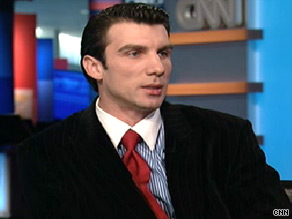
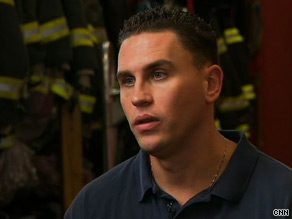
You may have seen the video. A Bronx, New York apartment building is on fire. A man, a civilian is on the top of the fire escape outside a fourth floor window. A firefighter hands him an unconscious 4 year-old boy, and he begins to walk down the fire escape. At the next landing he stops, lies the boy down and does something for a few seconds. Then he gives the thumbs up sign and yells "he's OK."
The man is Horia "Billy" Cretan, 33. He is a Romanian immigrant who owns an electronics store in the building. When the fire broke out late Wednesday afternoon, he heard the boy screaming and went up the fire escape to try to get to him. After firefighters arrived, one went into the apartment and handed the boy out to Cretan, who has become something of an instant hero as the video of the
 rescue circulates.
But, of course, there are two heroes in this story. Cretan is getting a lot of attention because he is a civilian who risked his own life for a little boy, and because the rescue was captured on video. Getting less attention is Jimmy Senk, the Bronx firefighter who entered the burning apartment and found the boy after he, as young children often do, moved away from the window just as Senk arrived on a ladder to rescue him. Senk went in the window next to where the boy wound up, and so handed him to Cretan rather than take him down the ladder.
Interestingly, this is not the first person Cretan has rescued from a fire. When he was 12, he rescued his own sister from a fire that killed his father. This makes me wonder whether he was motivated more by his own experience of fear and loss from his childhood or by his own experience of success in rescuing someone before. Either way, you have to imagine that this incident triggered some feelings and reactions related to that past trauma.
Senk, on the other hand, doesn't seem too phased. The fact of the matter is, firefighters are trained to do this. A successful rescue is a triumph, not a trauma. Firefighters are prepared for the fact that they will be working in burning buildings. The rest of us expect our buildings to, well, not be on fire. So an experience of successfully saving someone from a burning building, while joyous for everyone, is also traumatic for civilians. It isn't, necessarily, for firefighters.
That difference is part of the reason why Cretan has gotten all the attention. Senk did what he was trained to do. Cretan made a very risky choice that no one would expect of a civilian. Let's not forget, though, that working in a burning environment is dangerous for everyone, and rescuing someone from it is heroic regardless of whether it's your job or not.
Friday, October 2, 2009
Welcome Back Sully

U.S. Airways Captain Chesley "Sully" Sullenberger and First Officer Jeffrey Skiles flew from New York to Charlotte yesterday. This wouldn't be such a big deal except that the last time these two men tried to fly a plane from New York to Charlotte, they hit a flock of geese and had to land in the Hudson River. In fact, four of the passengers who were on the plane for the so-called "miracle on the Hudson" also flew the route yesterday, with at least one reserving the exact same seat she sat in on that fateful flight in January.
This is the type of story we, as a society, just eat up. It's heartwarming. It has a hero everyone can love. It has symbolic significance. What's not to love? What it means to the six people who reunited for the flight yesterday, however, is somewhat more complicated.
It took Skiles 3 months to complete mandatory requalification training and return to flying. It took Sullenberger 9 months. And this is for a flight where everyone survived. (To be fair, Sullenberger also apparently wrote a book and got a promotion in there, so it was not all trauma recovery time, but still.) Sully may have been a hero, but he was a stressed out hero. Despite the fabulous outcome, this incident was unbelievably scary and he has to have thought he was going to die and take his passengers with him.
Returning to the thing you were doing when something awful happened is hard. If you've ever had a serious car accident, you know that getting in a car again is not trivial, and driving one again is even worse. At least one of the flight attendants on flight 1549 has said she will never return to work. The closer an activity approximates what you were doing when something bad happened, the harder it's going to be. Yesterday's flight was both a reunion and a triumph. It represented not only these six people getting back to the business of living life, but also overcoming the final hurdle of putting themselves in the position that was so traumatizing in the first place.
Captain Sullenberger got a huge round of cheers and applause when he introduced himself over the loud speaker before his flight yesterday. He certainly deserved it. People on the flight were quoted as saying they felt incredibly lucky to have him in the cockpit. At the same time, I have to admit to just a moment's hesitation at the thought of being on that flight. On the one hand, it is a triumph. Sullenberger said he wanted to complete the flight that went down with his co-pilot, and he finally got a chance to do that. On the other hand, I'm not sure how calm I would feel about being on a plane knowing that the pilot and co-pilot were putting themselves, for the first time, back in a situation which so clearly was associated with trauma for them. What would happen if this environment triggered some bad reactions from them? But it didn't -- they were as ready as they needed to be -- and I welcome them back to the sky.
Wednesday, September 30, 2009
Earthquakes, Tsunamis and Typhoons, Oh My!

My husband and I have a theory. It posits that any given person, when contemplating earthquakes, hurricanes and tornadoes, is ok with one, has a healthy fear of another and is absolutely terrified of the third. Growing up, as he did, in the midwest, earthquakes are not such a big deal to him, but hurricanes scare him to death. I, on the other hand, grew up in New England, where hurricanes hit but not hard. What scares the daylights out of me is tornadoes.
To be fair, however, our theory is incomplete. While it is true that I have recurring nightmares about tornadoes, I also have recurring nightmares about being covered by waves of water. My husband points out that, when I have these, it probably means I need to go to the bathroom. My worst nightmares involve water spouts -- tornadoes over water. I don't have them very often, but they are very consistent and consistently scary.
You might think, then, that the tsunamis that hit Samoa yesterday and the typhoons in the Philippines and Vietnam, with all of their flooding, would be very scary for me to contemplate. In fact, they probably would be, if I could bring myself to contemplate them, but I can't. And this is how I know that my fear of giant waves and of unrestrained water is actually not pathological.
If this were truly a dangerous phobia, I would hear about a tsunami and find myself thinking about it all the time. I would "live" it in my mind. It would trigger more nightmares. But in fact, I know my fears and have control of them sufficiently that I know not to do that. I can bring myself to imagine what the earthquakes in Indonesia and Samoa must have felt like, or the rain and winds from the typhoon in the Philippines and Vietnam. I can contemplate the death and destruction in all three places. But when it comes to the flooding and the tsunamis, I simply cannot see them happening in my mind's eye. I cannot put myself there. My mind is very good at protecting itself.
I was recently involved in a Critical Incident Stress Debriefing (CISD) where some of the participants kept talking about how awful the incident must be for others. They were saying things like, "I just keep thinking what he must be going through" and "I imagine how awful it is for her and I just cry all the time." My partner for the CISD had what I thought was a terrific way of responding to this. During the teaching phase, he said, "Let me suggest to you that you do not have to try on other people's trauma."
I am horrified and yes, a little terrified by what I see on the news today. But I know enough to know that I don't have to try it on to care.
Saturday, September 12, 2009
Terror(?) on the Potomac

Yesterday, September 11, at about 9:30 AM, CNN breathlessly reported that Coast Guard boats and a helicopter were apparently confronting a suspicious vessel in the security area of the Potomac River, near where the President was commemorating 9/11 at the Pentagon. The reports escalated -- the vessel had been fired upon. Cable news and the Internet picked up the story.
It was a training exercise.
Let the finger-pointing begin. CNN reported an interpretation of what they heard over a scanner picking up the Coast Guard radio traffic, but apparently didn't think it odd that the report of gun fire began with the radio transmission, "bang bang bang bang." They say they called the Coast Guard and were told they were not aware of anything going on on the Potomac. Meanwhile, the Coast Guard says that they never coordinate their training exercises with other agencies, and they train like this all the time.
So what went wrong? If training exercises like this one are commonplace in that area, why did this one make national news? I bet you already know part of the answer. It was September 11. And yes, that matters, and no, it's not because we're all crazy.
The date itself -- September 11 -- is a trigger for most people in this country. The various commemorations on the news heighten that. And that's not a bad thing, necessarily. But it means we are all in a space where we are much more willing to believe that terrorists will attack the US. Most days we know it's a possibility, but on September 11 it feels like a likelihood. This exercise, and what CNN heard over the scanners, was therefore much more believable, and the lack of confirmation was less troubling. It might have been a good idea if the Coast Guard had considered this and announced the exercise, or held it on another day, or at least made sure it's own people could tell the press what was going on. There are two sides to every coin, though, and CNN should probably have known that both they and their viewers were more willing to believe the worst and more prone to panic yesterday than, say, the day before.
It's interesting to consider how long it will be before we are not so triggered by September 11. I see signs that it is fading already: A few years ago I was lambasted for holding a fire drill on that date. We had one yesterday, and no one said a thing. The edge has, at least a little, been taken off. But not so much that everyone can not worry about the impact of anti-terror exercises and erroneous news reports.
Thursday, September 10, 2009
Eight Years Out

It was a Tuesday. I don't know why I know it was a Tuesday, but I do. The fact that I do tells you the impact that that day had on me, since the only other days of a year or more ago for which I remember the day of the week are the days each of my children were born and the day I was married. And that last one probably shouldn't count, since Jewish weddings are almost always on a Sunday, at least where I'm from.
It was a Tuesday and the kids were lined up for the bathroom when I heard. And when I talked to my husband on the phone I was sitting in the corner of the office looking at a garbage can. I can still see it in my mind. I can hear my daughter's daycare teacher telling me they were closing, and forgetting to tell me who was calling, first. I can still feel -- not just remember feeling, but actually experience feeling -- the brief terror when I heard an airplane go over my house in the afternoon and realized there were not supposed to be planes in the air, and I ran from the third floor of my house to the first before I realized it was an Air Force jet. I can also see the sign on Rita's Italian Ice saying they were closed for the rest of the day. What I remember perhaps even more vividly is putting my daughter, aged 3 1/2 years, to bed a few weeks later and reassuring her that our house was a safe place, that we were safe, and leaving her room and saying, "OK, now she feels safe. Who's going to make me feel safe?"
Absolutely everyone has at least some memories like this. This was a national, group trauma. And while we all experienced it differently, and certainly some of us experienced it much more directly than others, virtually no one over the age of about 13 doesn't remember it, or doesn't thing it affected them.
Trauma violates our worldview. That day violated the notion that many of us still had that this was a safe country, that we were personally not in danger, and that getting up in the morning and going to work was a reasonably safe activity. It happened in specific cities, but it happened in all of our living rooms, to all of us. That was the intent of it in the first place -- to terrorize. It is small wonder that most of us still can have those sensory memories triggered by something or other.
If you think this analysis is overblown, or overly dramatic -- if you think the effect on us collectively was not that great -- consider this. Nowhere in this post have I mentioned what day I remember so vividly. But you all knew anyway.
Sunday, August 23, 2009
Getting Back on the Horse

The L.A. Fitness in Bridgeville, Pennsylvania reopened yesterday, 18 days after a gunman opened fire on a fitness class, killing 3 and injuring 9 more, and then killed himself. Reports say that the room where the shooting occurred is already being used for classes. The floors and mirrors have been completely redone. Apparently it looks pretty nice.
Upon reading about this, I tried to put myself in the shoes of a member of that club. I tried to imagine going back into that club, into that room, knowing what had happened there. And honestly, I'm not sure I could, not after just 18 days. But at the same time, I know that I go into rooms where tragedy has occurred all the time. As tourists, we often go to see the place where someone famous was assassinated or something terrible happened. My own daughter, who was visiting relatives in Washington, D.C. this week, took a tour of the Ford Theater, where Lincoln was shot.
How can we reconcile the idea that it would be hard to return to a space where someone was killed with the fact that we seek them out without a second thought? Two factors come into play: time and emotional distance. There is no doubt in my mind that it would be easier for me to go to that L.A. Fitness than it would for someone who was injured in the shooting. It's probably easier for me than for someone who is a member but wasn't there that night. I have a cognitive association, but I don't have any sensory connection to that space. When I open up the file drawer on that space in my memory, I have newspaper stories and web photos, but I don't have any visceral associations. What's more, I have no doubt that as time passes that space will become less "loaded" for those who were there.
That having been said, there are probably victims who will never set foot in that building again. When the shooting started, their brains flooded with chemicals that heightened their senses and their memory, a throwback to our days in the wild when it was very important to be able to remember everything that was associated with a danger so you could avoid another one. The sight of that space may well be a trigger for them or, alternately, they may find it distressing that the room doesn't look the same. Over time they may feel better about going there, but maybe not.
The earliest studies on post traumatic stress (which is not necessarily post traumatic stress disorder, remember) were done on soldiers in World War I. They found that if soldiers were removed from the front lines and sent to a hospital for treatment, they were much less likely to return to the line than those who had intervention off the front line but still in the field. Once you leave the place where a trauma occurred, it is that much harder to go back.
That's why, to the maximum extent possible, we always tell people not to send their staff home after a trauma until there has been some opportunity to give them information about critical incident stress and self-care. When they leave when things are still in a state of chaos, that is what they viscerally believe will be there to greet them when they return. When they leave after help has arrived -- help for them-- it's easier to believe that things may be manageable if they come back.
The space where a tragedy occurred holds power, sometimes forever. There was a car accident that killed both parents and a son half a mile from my house four years ago, and I think about it every single time I drive through that intersection. But holding power doesn't mean that power has to be absolute. Healing holds power, too.
Subscribe to:
Posts (Atom)
Meet the Quarterback

- Naomi Zikmund-Fisher
- is a clinical social worker, former school Principal and a Crisis Consultant for schools and community organizations. You can learn more about her at www.SchoolCrisisConsultant.com

Subscribe


 Posts
All Comments
Posts
All Comments