Showing posts with label tsunami. Show all posts
Showing posts with label tsunami. Show all posts
Tuesday, March 15, 2011
Japan -- The Kid Version


As many of you know, I have a 5-year-old son. As you may also know, I believe strongly in talking to children about traumatic events if they affect your family, if they are going to hear about them from somewhere else, or if you are very affected by them. Since my husband, my 12-year-old and I are talking a lot about Japan and it is all over the news, I have been talking to my 5-year-old as well. This seemed especially important since he has a little friend in his kindergarten class whose family is from Japan. I'll call him Taro.
My son knows about earthquakes. He heard about the one in Haiti, and that learning was reinforced when I went to Haiti to do some intervention work with kids last summer. His class also recently learned a little about plate tectonics, and his science fair project involved modeling how mountains form using sheets of lard floating in a pan of water. So we had a starting place.
On Friday, I explained that there had been a very huge earthquake in Japan. He immediately exclaimed, "Taro comes from Japan!" He was happy about this -- he had a personal connection to a grownup thing. That's a big deal when you're five. We then talked about tsunamis, which he has also heard of from a children's book called The Magic Fan
 in which the hero saves the town from a tsunami because he has built a giant bridge over the village. We talked about how the earthquake starts a big wave, and how, just like water sloshing in the tub, it sloshes one way and then sloshes the other. In this case, it sloshed all the way to Hawaii and California.
Interestingly, my son seemed to completely miss the idea that this was a scary thing. He's in the stage of his life where science is very cool and big things moving in the earth are even cooler. He does not connect that real people just like him live where all this is happening. It's like a cartoon to him, and that's probably just as well. His comment after I explained all of this was, "On Monday, I will tell Taro that there was a big earthquake and tsunami in Japan." I suggested that Taro might already know.
Over the weekend, my son asked what a nuclear accident is. This feeds into another parenting principle -- if they're asking, you need to answer. But explaining nuclear power to an adult is hard enough, let alone a kid. I explained it this way:
There are lots of different ways to make electricity. A lot of times, to make electricity you need something very hot. Often they use fire by burning coal or gas. Another way to make something very hot is called nuclear reaction. They take two chemicals and they bang them together, and it makes a whole new chemical and it gets very hot. The chemicals are dangerous, so they keep them in a strong container so they won't make anyone sick. After they use the chemicals to make the electricity, they're still hot, so they put water around them to cool them down.
In Japan, they had a very smart system. As soon as there was an earthquake, the chemicals stopped banging together. That was really good thinking. But the earthquake broke the part that puts water around the chemicals to cool them down. So they are really, really hot and people are worried because they might melt the strong container and let some of the chemicals out, and people could get very sick from that.
This explanation is not very precise, but I thought it wasn't bad for a five-year-old's purposes, and my son seemed satisfied.
This morning, I asked him if he had talked to Taro about the earthquake. He replied, somewhat dejectedly, "Yeah, he already knew about it." I said I wasn't surprised, and that I guessed Taro's family was very worried. I said (and kicked myself for not saying earlier), "A nice thing to say would be, 'I heard about the earthquake. I hope your family is OK.'" Then, out of nowhere, my son said, "Taro says his grandmother was swept away in the tsunami. He also says that his house is gone and he doesn't know where he will live when he goes back to Japan."
Now, let me say up front that I have no idea if this is true. I don't know if Taro said it, and if he did, I don't know if he meant it. It is not at all unusual for kids -- either Taro or my son -- to "try on" a tragedy to experiment with what it would feel like or mean if it were true. Of course, it might be true. My son said that this was a discussion he had with Taro after school at daycare, so it wasn't at all clear to me that the adults knew about it. I put in a call this morning to my son's teacher and left her a message to let her know, in case she didn't, that either this family has suffered a terrible loss or that the kids are trying this trauma on for size. This triggers yet another principle -- if the kids are talking about it, you need to be talking about it too.
My son is still not too phased by the situation. He knows about it, and he knows it touches his friend. It certainly matters to him. But it's about at the level of the extinction of the dinosaurs in his mind. It happened, but it so remote from his experience that there's no real need to worry about it. I don't know about you, but I find myself wishing I could feel that way sometimes, too.


Sunday, March 13, 2011
Now that Japan Has Your Attention, Let's Talk Preparedness

Depending on where you live, the earthquake and tsunami in Japan may or may not seem like something that can happen to you. Here in Michigan, our chances of an 8.9 earthquake are pretty low. Even a tsunami on Lake Michigan wouldn't reach my house. But a nuclear reactor accident? Before today I didn't even know where the nearest nuclear power plant to my house was (it's about 40 miles). Floods, tornadoes, hurricanes, blizzards, chemical spills . . . there are a lot of reasons why you might, someday, need to either evacuate your house or shelter in place.
FEMA has been on us for years to get ready. Most of us aren't. At a recent meeting of CISM providers, the FEMA director asked for a show of hands of how many people had an emergency bag for evacuations. Less than half of us raised our hands. Then he asked how many had a plan for evacuating their family. In a room of 800 people, I was one of two.
Make no mistake about it. When the time comes to leave your house, you will not necessarily have any time to get ready. Depending on what the disaster is, you might have a day and you might have less than 5 minutes. That's not the time to be thinking about this for the first time.
So, let's get practical. Here is a list of things you can do, roughly in order of the ease of doing them. This list is not exhaustive, nor does it take into consideration every possible catastrophe that could befall you. But it's a start. Find something on this list you haven't done yet, and do it.
- Talk. Seriously. Have a conversation with the other people in your house and make the following decisions:
- Where would you meet in the event of an evacuation at a time you weren't together. Pick someplace out of the immediate area.
- Where would you meet if that place was also evacuating.
- Who are two people outside your area who you will call in an emergency if you can't reach each other, so they can relay messages to the others when they call.
- If you have children and you have to evacuate during the school day, who is responsible for picking them up (if possible -- they may have to go with school personnel, keep in mind).
- If your children are home alone, where should they go? Who is a safe person who is nearby who can help them?
- Find out what the official evacuation route or procedure is, if there is one, for the catastrophe most likely to happen in your area.
- Educate yourself about that catastrophe. Find out what the dos and don'ts of surviving it are. Do this even if you think you already know. Conventional wisdom may well be wrong.
- Make sure you have a battery operated radio
and a flashlight
, and that everyone in the house knows how to use them. Also make sure everyone in the house knows where in the house is safest in the event of an earthquake or tornado, if applicable.
- Make a list of the medications everyone in the house takes, both so you can grab them on your way out and so you can tell people at the shelter if you don't have your meds.
- Make sure you keep 3 days worth of food in your house at all times. It doesn't have to be 3 days of great food, but don't let your cupboards get bare.
- Stock up on clean water. You should have one gallon per person per day for 3 days. If you have a chest freezer, you can stick a gallon or two in the freezer, which will also save electricity.
- Create a bag with the things you would need if absolutely everything else in the world were destroyed. This probably includes medications, vital documents, a first aide kit, and at least a little non-perishable food. Put a list in the bag of anything that isn't in there that you need to remember (e.g. your child's asthma nebulizer).

Saturday, March 12, 2011
Quakes, Tsunamis, Nuclear Accidents and the Bushido Spirit

In 2004, I accompanied 12 middle school children on an exchange program for 11 days in Hikone
 , Japan. In case you're wondering, Hikone is southwest of Tokyo, north of Osaka, and nowhere near the major damage of the earthquake. However, all things are relative -- Japan is not that big a place. As part of our trip, I spent several nights at the home of a local school administrator, Masaru, and his wife, Kayo. We hit it off tremendously, and have kept in occasional contact ever since.
Yesterday morning, right after I heard about the earthquake, I sent an email to Kayo and Masaru, telling them we were praying for them and all of Japan and expressing our hope that they and their family were safe. This morning, I got a response. I should mention, by way of explanation, that although both of my friends speak fairly good English, they often use an automatic translator in email. I still give them credit, since I can barely order dinner in Japanese. Here is what they wrote:
Dear Naomi,
The earthquake made tsunami. And then it attacked the area of north in Japan. We felt a bit of the earthquake. All of family are safe. But over 2000 persons dead now in Japan. I worried about electric power of atomicenergy. That was broken. A lot of radioactivity was spread. A few days later or month later Japan will be more miserable. Now we are alive. Of course in future we live. But... We hope a lot of people alive. If people are alive, we can make new Japan like Kobe city. Japanese have Bushido sprits. I believe so. Thank you so much for us to pray.Bushido
 , if you're not familiar, is roughly translated as "the way of the warrior." It is the Samurai way, the basis for much of the value system that underpins Japanese society. To say that the Japanese have Bushido spirits is to say that they're tough and they'll stick this out.
This email has stuck with me all day. "We will make new Japan . . . The Japanese have Bushido spirits." Part of the mythology of this tiny, earthquake-prone country is that earthquakes happen to reorder the world. They set things to rights. They allow things to start over. In some traditional prints, money is seen in pictures of earthquakes to show the redistribution of wealth.
This view of earthquakes is very foreign to most "westerners." But it makes a lot of sense. If I never experience earthquakes, or only small ones once in a blue moon, I see them as scary and negative. If I experience them all the time, sometimes really big ones, I need to come to some peace with what they mean and why they happen. That doesn't make them fun, but that makes them bearable. This is what Japanese tradition has done for Japanese society. The whole country, in some sense, has had training in resiliency from earthquakes.
The Japanese have Bushido spirits. They will make a new Japan, as long as people are alive. Tonight, watching the news from the failing nuclear power plants, that last piece is the kicker. The Bushido spirit is needed from those scrambling to cool those cores. I hope it's enough.

Friday, March 11, 2011
Namazu Wakes: The Japanese Earthquake
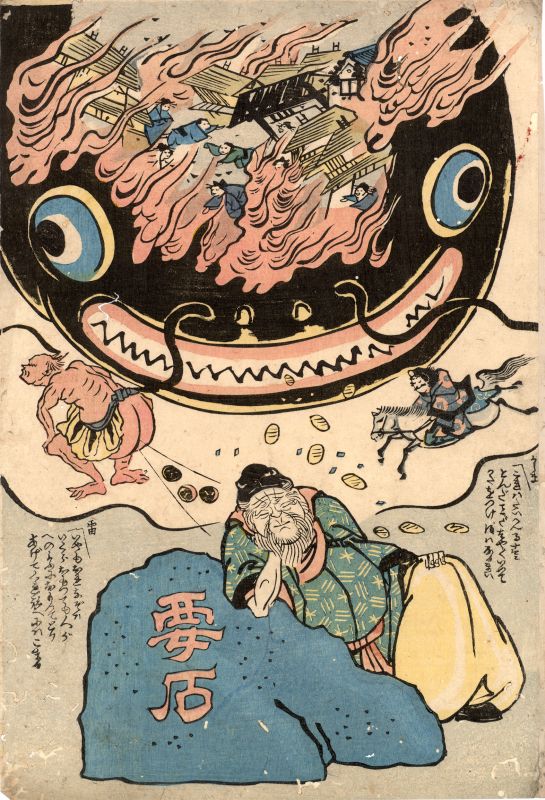
In Japanese mythology
 , Namazu is a giant catfish who lives in the mud on the ocean floor. The god Kashima restrains Namazu with a stone, but from time to time Kashima loses focus and Namazu wakes, thrashing around and shaking the ocean floor. This morning, 80 miles off the coast of Sendai, Japan, Namazu awoke.
An earthquake measuring 8.9 on the Richter Scale hit northern Japan just after midnight Eastern time. The resulting tsunami devastated coastal towns in Japan, and then made its way across the Pacific, hitting many island nations, Hawaii, and the west coast of the United States. While the loss of life in the U.S. is nothing compared to what has happened and continues to happen in Japan, the damage to ports and harbors is considerable.
This is the largest earthquake in Japanese recorded history. It is likely there has not been one this big in Japan for more than 1,000 years. This earthquake was almost 100 times stronger than the one that devastated the nation of Haiti in 2010. In a country that builds and practices and prepares for "the big one," this was the big one.
While I don't mean to minimize in any way the devastation in northern Japan, the lives lost, or the very real dangers still posed by emergencies at two nuclear power plants damaged in the earthquake, it's also important to recognize the strengths present in this situation. Japan's construction standards are clearly designed to take an event like this into consideration. If you compare the destruction and loss of life in Haiti, where no such building standards existed, to what we are seeing in Japan, it is clear that Japan was as ready as you can be for something like this. The first news report I heard on the radio this morning was from a reporter standing on a balcony overlooking Tokyo. Just the fact that there is a single balcony left in Tokyo tells you how well the Japanese prepared.
The horror we feel considering what has happened in Japan, then, is very different than what we experienced after the earthquake in Haiti. In Haiti, we saw roughly 230,000 people wiped off the planet by a natural disaster and by the unpreparedness and fragility of life in abject poverty. In the United States, we suddenly knew, in a way that many of us hadn't before, that Haiti was our neighbor and that we needed to step up and help.
The horror many of us feel today is different. Far fewer people have died. Japan is much farther away. And, as I've already said, they were prepared. At the same time, we generally regard Japan as being something "like us." While the culture of Japan may be different, it is a highly industrialized, modern country. We have high expectations for their ability to function in all kinds of circumstances. So we watch what is happening there and realize that if it could happen to them, it could happen to us. In Haiti, we felt guilty. In Japan, we feel scared.
Of course, this is not a one size fits all situation. If you have family in one of these countries, have traveled there, or feel some other connection, then one of these quakes may have hit you in a particularly poignant way. I have traveled to both places and have friends in each. Not surprisingly, as I wait for word about people I know in Japan, my mind drifts to worrying about folks in Haiti I haven't heard from in a while. That's the way it is sometimes. Namazu makes connections when he wakes.

Friday, September 24, 2010
The World Isn't Coming to an End -- It's Only an #X24

If you were killing time on Twitter around noon Eastern Time today, you might well have gotten the impression that there was something big going on in California. Shortly after noon, news filtered out of an earthquake measuring 9.2 on the Richter Scale near the Aleutian Trench, south of Alaska. A tsunami warning was issued, and a few minutes later a magnitude 7.2 earthquake hit California. Then came the tsunami. If you weren't paying close attention, you might have been alarmed, but none of it was real. It's part of an exercise running today and tomorrow called Exercise24, or X24.
The purpose of X24 is to test the use of various tools on the Internet in the event of a major disaster. X24 has been using Twitter (with the hashtag #X24 and clear warnings of "This is a test. This is not real." They have a page on Facebook. They are using Google Docs to exchange requests for aid and match providers with requesters. The idea is to see what works and what doesn't, and whether there are uses for social media and the Internet in such a situation that folks might not already have thought of.
Exercises like this one are used in emergency response organizations all over the world. Sometimes they are simulated using actors to portray victims or criminals, and sometimes they are done entirely virtually, merely sitting around a table and talking through what should happen next.
The idea is that having a great plan is wonderful, but you won't really know if you have a great plan until you try to use it. The problem is, if you need to use it, it's really too late to discover it's not all that wonderful. In addition, being taught or trained how to do something in an emergency is different than actually doing it. For example, if you had a choice between two surgeons with exactly the same education, one who had done your procedure five times this week and one who had only watched other people do it, who would you want? Simulations also serve as inoculation training for first responders. They introduce various traumatic possibilities to people in a relatively controlled way. When a real emergency hits, there are fewer elements that the responders' brains have never encountered before. This makes them more resistant to the effects of the trauma exposure, and more able to stay calm and do their jobs.
There are two truths about exercises like this. Truth #1 is that something will happen or not happen during the exercise that no one, in all of their planning, ever thought about. This is, in some sense, the entire point. By running a drill, you can discover what is missing from your plan. Truth #2 is that, no matter how extensive your drills are or how many you have, during an actual emergency something will happen that never happened during the drill. There are, in turn, two reasons for this. First, every emergency is different and you can't possibly simulate every possible scenario. Second, people behave differently in an actual emergency than they do if they know it's just for practice.
X24 is an interesting exercise because it uses the Internet -- and hence the whole world -- to practice in. The organizers should be cautious, however, in leaning too much on this exercise to answer specific questions about how the Internet would handle an emergency. I strongly suspect that the number of people retweeting the #X24 tweets and posting information to Facebook, as well as looking for information on emergency and news sites, during the exercise is a tiny fraction of the number who would do so if an actual tsunami hit California. You can tell from this exercise whether you can use Internet tools to share information, but until it actually happens we won't really know if those tools have enough capacity to make it a good idea.
Sunday, August 22, 2010
My Trip to Haiti -- Part VII
 |
| The Quarterback, Amelia and Hillary at the beach |
Thursday was beach day, and we were told we would be leaving at 9:30. It soon became evident that this meant 9:30 "Haitian Time," since the assembly didn't start until around 9:30. In addition to the usual prayers, the head counselor lead the children in prayer for their safety on the trip. I don't want to read too much into this, because I suspect the prayer was exactly the same one she would have offered any other summer. However, Eloise had told us that many parents were still quite skittish about sending their children to the beach. There was a small tsunami with the earthquake, not like the big one in southeast Asia
 a few years back but just big enough that if you happened to be standing on the beach or in the water when the earthquake happened you probably would have drowned.
At around 10:30, a school bus painted blue and white drove onto the field next to the gazebo, and the children began to pile on. There were about 125 kids and about 10 adults going on the trip, and any teacher will tell you that far exceeds the safe capacity of a school bus. The kids and regular counselors got on, and the volunteers were told we would take another bus.
After the kids had been on the bus for several minutes, I heard voices yelling my name. Christopher and Daniel were leaning out the window, and when they saw they had my attention, they motioned to me to come to the bus. I jogged over, and they asked me why I wasn't going to the beach. I explained that I was going separately with the other volunteers, and they seemed very happy.
 |
| Our tap-tap |
The "other bus" we were taking was not what would pass for a bus in the U.S. Haiti has an informal system of vans and converted pick-up trucks called "tap-taps" which function as somewhere between buses and taxis. They are brightly painted, and people stand on the side of the road and hail them, or you can call them if you and they both have a phone. People ride in, on and on top of these vehicles to get around. One had been called for us.
It was about now that we noticed that the school bus wasn't leaving. The kids had been on it for a good half hour, and we imagined the heat was horrible. The driver was now standing in front of the bus with the hood open. It had broken down. At about 11:10, we piled into the tap-tap, the bus driver got the bus going, and we headed towards the beach.
Having spent five days inside the grounds of the camp, it had been easy to forget that we were actually at ground zero for the earthquake. While the living conditions of survivors were in evidence daily, the destruction caused by the quake was not. As soon as we ventured out of the gates, however, it was back to reality. Rubble, empty foundations and collapsed buildings were everywhere. Where there weren't building remains, there were tent cities. Very few buildings were standing and undamaged. We continued through what, I suppose, had once been the center of town and out onto a dirt road which wound its way to the shore. At 11:30, we got out of the tap-tap and waited for the kids to arrive.
 |
| The remains of a building near the beach |
What was perhaps most striking about the beach was that it could easily have been on any island in the Carribbean. With all the poverty and misery in Haiti, it's easy to forget that it is, in fact, a beautiful tropical island. The beach had a lot of garbage and debris on it where the tap-tap let us off. There had been heavy rains for several nights in a row, and it probably wasn't that clean to begin with. Once the kids arrived, we headed down the beach to a much cleaner and nicer stretch, and to a house owned by Eloise which also had withstood the quake.
As soon as we arrived, the kids started taking off their clothes and putting on whatever they were going to swim in. A majority had bathing suits, although the two-piece suits didn't necessarily match. The smallest kids were mostly in underwear. Some kids wore shorts and t-shirts, or suits that obviously were too small or too big. No one cared. As soon as the counselors gave permission, everyone headed into the water. I took my time getting ready, and by the time I walked towards the beach, a little girl decided I was late and needed to be pulled into the water.
The scene in the water was unlike any that would be permitted at any camp or school trip in the U.S. Adults stood around the perimeter of a relatively small area of water. 125 children all squeezed into this area and jumped all over each other in what, in my experience, is "no horseplay or you're out of the pool" behavior at American venues. I asked one of the counselors how many of the kids knew how to swim. He had no idea. The motion of the children kicked up sand from the ocean floor, meaning that when children went under water they couldn't be seen. I spent most of my time praying I wasn't going to have to rescue
 or, God forbid, not rescue any children.
Once I had been yanked into the water, four or five kids at a time clung to me for dear life. While I understood the impetus, I was truly afraid they were going to send me under the water and I wasn't sure I'd be able to get back up with them on top of me. Add to this that Christopher and Daniel very much wanted to be around me, and showed their enthusiasm by leaping on top of the pile of kids who were already holding on to me.
After a swim it was time for lunch. Some men who appeared to be camping on the property brought out freshly picked coconuts
 and, while the kids played, the adult paid them 25 gourdes (about 60 cents) each to hack off the top of the coconuts with a machete so we could drink from them. It was fabulous.
The plan had been for Amelia and me to grab the three children who said they were thinking of suicide and talk to them sometime today. However, it was pretty clear we were not going to be able to do that in all the hubbub. This was difficult for me, since my training is certainly not to let it go when a child says they are suicidal. The fact that we had already let it go for 24 hours was disturbing enough, but there really wasn't a way to even find these kids (whom we did not know), let alone assess them. Finally, Amelia went and spoke to the head counselor, and we agreed we would talk to the kids before assembly the next day. After another swim, we headed back down the beach to the bus and the tap-tap, and back to camp. We were due back at 2:00. We arrived close to 3:30.
After dinner, Amelia asked Daniel if he would like to talk to us about the earthquake, and whether he thought some other kids would too. He said yes, and told us he would ask around to see who wanted to come. At about 8:00, we sat down on the porch to talk to Daniel, Christopher and Christopher's cousin, Marie, age 10. Each told us what had happened to them during the earthquake*. I asked each of them what they thought was happening, and they all had different ideas, but each of them mentioned that it had crossed their mind the island might be sinking into the ocean. This was not something that had even occurred to me, but then, I don't live on an island.
We discovered that none of them had much of an idea what causes earthquakes. This seemed important. Even though earthquakes can't be predicted reliably, I surmised that the idea that they "just happen" made their fear that it would happen again more pronounced. I was right. After a brief lesson in plate tectonics
 , all three of them visibly relaxed.
We spent some time talking about the definition of bravery. The kids, both this group and the many others, did not seem to feel they had been brave during the earthquake. They were using a definition of bravery that equaled not being scared, and they felt that no one had been brave. I asked them what they thought the most important thing to do during the earthquake had been, and they told me it was to get outside and away from buildings, to pray for survival and to find their families. I pointed out that that is exactly what they had managed to do. They may have been scared, but staying alive was their number one priority, and they had done it. I also told them that I knew it was hard to talk about this, and so the fact that they told us their stories and how scared they still were meant that they really were brave. They like that.
It was 10 PM, and Marie was visibly exhausted and wanted Christopher to walk her to her tent in the dark, so they left. I told Daniel he needed to go to sleep, but he refused. I asked him what time he went to sleep usually, and he said 11 or midnight. I asked him what time his mother wanted him to go to sleep, and he said 9, looked embarrassed, said goodnight and headed toward his tent. I went inside and, as I tried to sleep, contemplated something that another volunteer, a Haitian-American, had told me at the beach:
It's good that you're here. Only by coming here can you know that these children are human.* You might reasonably be expecting me to relate the children's stories at this point. I have struggled with how much to share, because what they say is supposed to be confidential. I have decided to strike a balance by only relating what I believe anyone who knows them already knows and what I said to them, rather than all of what they had to say.
Tomorrow -- The Work We Came Here to Do
Saturday, February 27, 2010
Tsunami Warnings in the Pacific
As I write this, we are less than an hour away from a predicted tsunami hitting the islands of Hawaii. An earthquake measuring 8.8 on the Richter scale struck off the coast of Chile last night and has sent waves as high as 8 feet across the Pacific. Hawaii is predicted to get something, although we don't know how bad it will be. A tsunami warning has been issued, and beaches are being evacuated. The west coast of the United States and Canada has a less dire tsunami advisory.
It has been said that the waiting is the hardest part. In this instance, it depends very much on whether a tsunami actually hits and how big it is whether that will turn out to be true. I can imagine this is fairly scary for small children, and depending on how well the evacuations are going, it might be pretty frightening to adults, too. Presuming there is a tsunami, there may well be some work for CISM teams in Hawaii later this week.
Let me say that again -- Critical Incident Stress Management may well be needed later this week. Not now. Probably not later today. After the tsunami hits, the damage is assessed and people can begin returning either to normal or a "new normal" it will be appropriate to address the traumatic stress. The only thing anyone CISM trained or not should be doing for people's mental health right now is making sure they are fed and housed and that the shelter they are in is as safe as humanly possible, and then reassuring them of that.
But wait, I just said that kids in particular were probably scared. Why shouldn't we be helping them deal with those feelings of fear? Why shouldn't we break out the crayons and paper and start them drawing the evacuation? Isn't early intervention a good thing?
The simple answer is that this traumatic incident isn't over. In fact, if a tsunami does hit Hawaii, the incident has barely begun. You can't help people process the experience of being afraid for their lives or their homes when they still have every reason to be afraid.
CISM is designed to help people who have been traumatized, not those whose traumatization is currently in progress. When I train school teams in CISM, I frequently tell them, "If there's a shooter in the school, I am not going to be asking you about your feelings. I'm going to be hiding under my desk and I suggest you do the same." Trying to process people's feelings right now is about as appropriate as going to the scene of a car accident where someone is bleeding profusely and trapped in their car and talking to them about coming to terms with their fear. If they could deck you, they would.
In an hour or so, we'll have an idea of what Hawaii is actually dealing with. Tomorrow I might have something to say about what CISM has to offer these folks. For now, I just hope everyone stays safe.
Thursday, October 1, 2009
Aiding Indonesia: Why Tents and Food are Not Enough

An estimated 1,100 people have died in Indonesia in the last few days, following an earthquake that measured 7.6 on the Richter scale and another today that measured 6.6. The number of dead is really more than we can truly wrap our minds around. After a certain number, it just registers as "many." Too many.
Many people, at this moment, feel an urge or an obligation to help the survivors. Money is pouring in to international rescue organizations to help people in Indonesia, Samoa, the Philippines and other countries recently hit by natural disasters. Survivors' most urgent needs right now are food, water, shelter and, to the extent possible, safety from further damage caused by aftershocks and the like. Most of us, if we can afford it, will chip in ten or twenty dollars for a blanket for a child in Indonesia without much hesitation.
Once the physical needs of people in Indonesia are met, which will take quite some time when you consider all the rebuilding that needs to happen, attention should turn to the psychological needs of survivors. Studies have indicated that between 40% and 50% of survivors of mass disasters will experience significant psychological impairment of their ability to function, including (but not limited to) PTSD or depression. When a disaster affects such a large swath of a country, as these earthquakes do, that is a significant reduction in the productivity and stability of the country.
So what are they going to do? I don't know about this particular disaster. The Red Cross and the United Nations, to name two organizations, do have mental health disaster response personnel, and at some point I would hope they will deploy. Teams from other countries may be brought in, although language barriers make that difficult. Still, this is work that has to be done.
So here is my question to you. If you would donate $20 for a blanket for a child in Indonesia, would you donate $20 for some mental health assistance for her? One might save her life. The other might make her believe that her life is worth living.
Look here for a partial list of relief organizations accepting donations for those affected by the recent flooding, earthquakes and tsunamis.
Wednesday, September 30, 2009
Earthquakes, Tsunamis and Typhoons, Oh My!

My husband and I have a theory. It posits that any given person, when contemplating earthquakes, hurricanes and tornadoes, is ok with one, has a healthy fear of another and is absolutely terrified of the third. Growing up, as he did, in the midwest, earthquakes are not such a big deal to him, but hurricanes scare him to death. I, on the other hand, grew up in New England, where hurricanes hit but not hard. What scares the daylights out of me is tornadoes.
To be fair, however, our theory is incomplete. While it is true that I have recurring nightmares about tornadoes, I also have recurring nightmares about being covered by waves of water. My husband points out that, when I have these, it probably means I need to go to the bathroom. My worst nightmares involve water spouts -- tornadoes over water. I don't have them very often, but they are very consistent and consistently scary.
You might think, then, that the tsunamis that hit Samoa yesterday and the typhoons in the Philippines and Vietnam, with all of their flooding, would be very scary for me to contemplate. In fact, they probably would be, if I could bring myself to contemplate them, but I can't. And this is how I know that my fear of giant waves and of unrestrained water is actually not pathological.
If this were truly a dangerous phobia, I would hear about a tsunami and find myself thinking about it all the time. I would "live" it in my mind. It would trigger more nightmares. But in fact, I know my fears and have control of them sufficiently that I know not to do that. I can bring myself to imagine what the earthquakes in Indonesia and Samoa must have felt like, or the rain and winds from the typhoon in the Philippines and Vietnam. I can contemplate the death and destruction in all three places. But when it comes to the flooding and the tsunamis, I simply cannot see them happening in my mind's eye. I cannot put myself there. My mind is very good at protecting itself.
I was recently involved in a Critical Incident Stress Debriefing (CISD) where some of the participants kept talking about how awful the incident must be for others. They were saying things like, "I just keep thinking what he must be going through" and "I imagine how awful it is for her and I just cry all the time." My partner for the CISD had what I thought was a terrific way of responding to this. During the teaching phase, he said, "Let me suggest to you that you do not have to try on other people's trauma."
I am horrified and yes, a little terrified by what I see on the news today. But I know enough to know that I don't have to try it on to care.
Subscribe to:
Posts (Atom)
Meet the Quarterback

- Naomi Zikmund-Fisher
- is a clinical social worker, former school Principal and a Crisis Consultant for schools and community organizations. You can learn more about her at www.SchoolCrisisConsultant.com

Subscribe


 Posts
All Comments