Showing posts with label incident completion. Show all posts
Showing posts with label incident completion. Show all posts
Wednesday, March 16, 2011
The Japanese Crisis: Assessing the Need Stateside


The attention of most of the country continues to be across the Pacific in Japan. The loss of life is horrific. The material damage is enormous. The fear regarding the radiation in Fukushima is mounting.
Now is not the time for a psychological crisis intervention in Japan. The situation is still unfolding, and there are still significant basic physical and safety needs to be met. The best that can be done from a mental health standpoint in Japan right now is managing people's fear. Both the Prime Minister and the Emperor appear, from this vantage point, to be doing a pretty good job at exercising resilient leadership. The consistent emphasis on coming together and getting through this is good practice.
What about folks in the U.S.? Is there anything we can or should be doing for people here? I think there is.
First of all, everyone in the world needs some decent information about the radiation risk
 . With the exception of nuclear scientists, most of us have very little understanding of how much radiation is too much, how the current accident will affect people in Japan and whether it will affect anyone anywhere else at all. The news media is doing a somewhat better job of bringing in experts to explain this to us, but I think it would help if they acknowledged that none of us like hearing that there's any radiation at all, and that the biggest impact here is from fear, not nuclear byproducts.
People here who have family and close friends in Japan, particularly in the area where the quake and tsunami were, need something a little more. I think you could further separate that group into two -- those who come from Japan and have roots there, and those who don't trace their roots to Japan but have family studying or visiting there. Last Friday was ghastly for both of these groups, and it would not be surprising if they're feeling the affects even now, presuming that they now know how their loved ones fared in the quake.
For those who come from Japan, this incident is not, in some ways, over. The pictures the rest of us see and think are horrible are more personal. They may have lost homes or other special places. They may not be ready, yet, to process through their feelings and try to put them away.
For those who had family visiting or living in Japan but are not themselves Japanese, the incident is largely over and they are probably ready for some intervention. It would be totally understandable if they are having some issues with feeling irritable, having trouble concentrating, not sleeping well or having intrusive thoughts about the quake and the agonizing wait to hear from loved ones. They need to know they're normal -- it's the situation that isn't.
Then there is that group that is somewhere in a no man's land in between. They are from Japan, every picture is personal, the situation is ongoing, and they also experienced the traumatic death of someone they love. For them, some understanding and moral support is in order until the dust can settle a little more and they can start to come to terms with all of this.
I wrote yesterday about my son's friend, Taro. When I wrote, I wasn't sure which category Taro fell into. Late yesterday we confirmed that he is in this last category. He lost his grandmother and his home. The only bright side, perhaps, is that young children don't really understand death and loss as permanent things. But his family does, like so many other families in Japan, here and elsewhere. The latest estimate I've heard is 10,000 dead. That's a lot of people in limbo, waiting for this to be over so they can grieve.


Friday, February 11, 2011
What Egypt Tells Us About Crisis Response

As you probably know, Hosni Mubarak stepped down today as President of Egypt following 18 days of street protests in Cairo and throughout the country. Others more informed than I will have intelligent things to say about what this means for the future of the country, the region, the world and democracy. And others less informed than I will have unintelligent things to say on these topics, I'm sure. A few things jumped out at me, however, from the point of view of crisis management and response.
During the protests last week, an apparently organized group of armed men in plain clothes, some riding camels and horses, attacked the protesters in Cairo's Tahrir Square

 . This received widespread coverage around the world, and widespread condemnation as well. At the same time, however, this incident was still part of the story. It did not become the story.
If you stop to think about it, that is truly remarkable. Can you imagine armed people attacking a march on Washington -- any march on Washington? The coverage would no longer be about gay rights or the Tea Party or whatever the march was about. It would be about the violence. But that didn't happen here, even though people died in the fighting. Why not?
I think the violence failed to take over the story because, in some real sense, the story was still unfolding. The "incident" here, to take a page from CISM, was the uprising. It was so unusual and so gripping and it captured everyone's attention. No doubt, had the violence ended the protests, as it did in Tiananman Square
in 1989, that would be the crux of the story. But it didn't, and one of the great principles of crisis response is that you have to wait until the incident is over. Last week, it just wasn't over. Today feels much more like an ending. Even though there is still tremendous uncertainty about what lies ahead for Egypt
 , there is a sense that this is the end of a chapter. So it is now that those most affected by the violence will start to feel it the most, and now that others will start to go back and find out the names of the dead, erect memorials to them, etc.
The other great connection I see between the events in Egypt and the principles of crisis response has to do with the actions of Mubarak
 and others in the government in the last 48 hours or so. If you listened to Mubarak's speech yesterday, the one where everyone expected him to resign and he didn't, it felt a little like you had stepped into the Twilight Zone
 . Was it actually possible that he thought that speech would placate the protesters? Did he really believe that if he said he was handing over some power but not all and working on the constitution that they'd pack up and go home?
During a crisis -- any crisis -- it is critically important that those in authority pay close attention to what people are asking for. I cannot tell you how many times I have seen the powers that be enter a room full of people who want to hear X and deliver an impassioned defense of Y. When you ask them why they do it, they say that Y is more important. Y is good and right and what people should care about. But during a crisis, people don't care about things just because you tell them they should. People care about what they care about, and the biggest mistake you can make is to ignore that.
Last night, Hosni Mubarak got up before a country -- or even a world -- that wanted him to say he was leaving and explained why he was staying. He had important reasons, reasons that seemed right and good to him. But he lost sight of the fact that what seemed right to him was not the point. He failed to address what people wanted to hear. Not only did he not say he was going, he didn't even acknowledge that that's what people were expecting.
Would it have made any difference? We'll never know. But I suspect the reaction might have been even a tad more positive if he had begun with, "I know you are expecting me to resign tonight, and I understand why, and you have a point. I will be going soon. But first we need to . . ." It wouldn't have been perfect, but it would have been a start.
And speaking of starts, the Egyptian people now have a fresh one. Their future is much less than certain, however. Let's hope they use this opportunity wisely.

Tuesday, May 25, 2010
Deepwater Horizon Memorial Service

Transocean
 , the company that operated the oil rig
 that exploded last month in the Gulf of Mexico, sponsored a memorial service today in Jackson, Mississippi for the 11 employees who are missing and presumed dead in that accident. Many of the 115 surviving workers from the rig, whose collapse triggered the massive oil spill still going on in the Gulf, were expected to travel from throughout the south to attend the service.
 I will admit to greeting this news with some cynicism. My first thought was that today -- five weeks after the accident -- was a little late to be holding a memorial service. The second was that, having allegedly tried to muscle its workers into signing waivers the day of the accident, the company had a lot of nerve inviting them to this service and saying they were a "community."
Let's take that second thought first. I still am skeptical that the executives at Transocean are very concerned with the wellbeing of this community of theres. Their past actions, at least as alleged in court documents, don't seem to support that. However, the fact that they allegedly did something really awful does not actually preclude the possibility that they're doing something good. Whatever their motivation -- be it altruism or pure PR -- bringing the workers back together and holding a memorial service is a good thing to do, and the executives at Transocean get some credit for it.
This brings us to the timing of the service. As memorial services go, this is pretty late. Depending on your religious tradition, services to honor the dead are usually held within a week or two of the death, and in some traditions with 24 or 48 hours. Funerals and memorial services give a sense of "closure" to survivors, which is not to say that they are somehow then "over" the death, but rather that the death itself as an event is over and the healing can, perhaps, begin. For the survivors of the Deepwater Horizon
, there has been no formal event to mark the end of the event. When they finished with the lawyers on the day of the explosion, they went to be with their families, some were still in the hospital, and they scattered to their home towns. At that point, the search was still on for the 11 missing men.By the time the search was called off, the hospitalized were out of the hospital and the dust had settled somewhat, the two week window for a service had passed. At that point, the easiest thing to do would have been nothing. Each of the 11 families undoubtedly held services according to their own traditions and beliefs in their own communities, and Transocean was not really obligated to do much other than possibly send a representative to those services.
Having a memorial service sponsored by the company, however, allows the survivors to come back together, to see each other, to be with others who understand what they went through, and to reach some kind of closure. It recognizes that the dead workers hailed not just from communities defined by their residences, but from a community of workers who were on the rig that day and most of whom were employed by Transocean.
It has been said that funerals are more for the living than for the dead. That is certainly my personal belief. In this instance, a delayed but well-planned memorial service offered comfort not just to the bereaved, but to the survivors. That is how it should be, and why Transocean chose to do the right thing is entirely beside the point.
Saturday, February 27, 2010
Tsunami Warnings in the Pacific
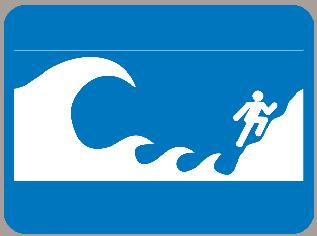
As I write this, we are less than an hour away from a predicted tsunami hitting the islands of Hawaii. An earthquake measuring 8.8 on the Richter scale struck off the coast of Chile last night and has sent waves as high as 8 feet across the Pacific. Hawaii is predicted to get something, although we don't know how bad it will be. A tsunami warning has been issued, and beaches are being evacuated. The west coast of the United States and Canada has a less dire tsunami advisory.
It has been said that the waiting is the hardest part. In this instance, it depends very much on whether a tsunami actually hits and how big it is whether that will turn out to be true. I can imagine this is fairly scary for small children, and depending on how well the evacuations are going, it might be pretty frightening to adults, too. Presuming there is a tsunami, there may well be some work for CISM teams in Hawaii later this week.
Let me say that again -- Critical Incident Stress Management may well be needed later this week. Not now. Probably not later today. After the tsunami hits, the damage is assessed and people can begin returning either to normal or a "new normal" it will be appropriate to address the traumatic stress. The only thing anyone CISM trained or not should be doing for people's mental health right now is making sure they are fed and housed and that the shelter they are in is as safe as humanly possible, and then reassuring them of that.
But wait, I just said that kids in particular were probably scared. Why shouldn't we be helping them deal with those feelings of fear? Why shouldn't we break out the crayons and paper and start them drawing the evacuation? Isn't early intervention a good thing?
The simple answer is that this traumatic incident isn't over. In fact, if a tsunami does hit Hawaii, the incident has barely begun. You can't help people process the experience of being afraid for their lives or their homes when they still have every reason to be afraid.
CISM is designed to help people who have been traumatized, not those whose traumatization is currently in progress. When I train school teams in CISM, I frequently tell them, "If there's a shooter in the school, I am not going to be asking you about your feelings. I'm going to be hiding under my desk and I suggest you do the same." Trying to process people's feelings right now is about as appropriate as going to the scene of a car accident where someone is bleeding profusely and trapped in their car and talking to them about coming to terms with their fear. If they could deck you, they would.
In an hour or so, we'll have an idea of what Hawaii is actually dealing with. Tomorrow I might have something to say about what CISM has to offer these folks. For now, I just hope everyone stays safe.
Sunday, September 13, 2009
Update: Annie Le

Earlier today I blogged about Annie Le, the Yale grad student who went missing five days before her wedding. I wrote about how hard it is to respond to an incident that does not have a clear end to it.
As you may have already heard, a body presumed to be Le was found in the walls of the building where she was last seen. Now the incident has an end, and the hard work of dealing with it falls to her fiance, family and friends. I wish them well, and send my deepest sympathies.
Annie Le's Wedding Day: Who Could We Help, and How?

Yale pharmacology graduate student Annie Le was supposed to get married today. Instead, her fiance is in New Haven, trying to help law enforcement officials figure out where she is and what happened to her. She was last seen outside the Yale medical school on Tuesday. Her keys, purse and cell phone were all left in her office. She doesn't have a car. Friday brought word that a Professor whose class she was to take Tuesday afternoon, and who canceled class abruptly on that day, was being interviewed. Evidence was removed from the med school building yesterday, and unofficial, unconfirmed reports say that evidence was bloody clothing found in the drop ceiling of the lab in which she worked. Police say they don't think she ran away.
This has got to be gut-wrenching for her fiance, family and friends. The twists and turns are coming quickly, but no resolution is in sight. While everything I've detailed here is true, it's entirely possible some or all of it is irrelevant. The reports regarding the clothes could be false, or they aren't hers. The Professor could have gotten the stomach flu. Clues give hope for figuring this out, but they don't make the waiting much easier.
From a crisis response point of view, this is also incredibly tricky. It's not that no one needs help, it's that it's not at all clear who we should be supporting or how we would go about doing it. We're supposed to respond after the event is over. This one isn't, but it's in a new stage. We've moved from "she'll turn up" to "something happened to her," but we don't know that for sure and we don't know what it was. We also don't know if she's alive. And worse, it could be we will never know. At what point do we decide that it's time to help out anyway? Or is this one of those incidents when help will never come, because there will never be a time we can say it's over?
What particularly gives me the creeps, however, is the notion that if, at some point, we decided it was time to try to offer some early crisis intervention to those affected -- and there have to be a lot of them, including everyone who goes to school or works there -- there is a significant possibility we'd be working with the person or persons responsible for her disappearance. Now, there are times when working with the person responsible for an event is more than appropriate. I'm thinking, for example, of the person who ran a red light and caused a fatal car accident. But there, their level of culpability is out in the open. Here, we'd be working with someone who is simply lying to us. And the thought that there would be the remotest possibility of learning something during the course of the intervention that the police did not already know is horrifying. We promise confidentiality, but privilege has not been established. I don't want to be in that position.
All this, I suppose, is why you wait until the event is over to respond. It's just much easier to do that when the event has a clear beginning, middle and end. The current endless middle is hard for us. It has to be a zillion times harder for Annie Le's friends and family and the Yale community. I hope they get their resolution soon, and I hope against hope that she comes home safe.
Subscribe to:
Posts (Atom)
Meet the Quarterback

- Naomi Zikmund-Fisher
- is a clinical social worker, former school Principal and a Crisis Consultant for schools and community organizations. You can learn more about her at www.SchoolCrisisConsultant.com

Subscribe


 Posts
All Comments
Posts
All Comments