Showing posts with label investigation. Show all posts
Showing posts with label investigation. Show all posts
Friday, December 11, 2009
Missing Utah Mom: All Women are Equal, But Some are More Equal than Others


Susan Powell, a 28-year-old mom in West Valley City, Utah, didn't turn up for work on Monday, and neither did her husband. By midday, her sister had called police and they had found that the whole family was gone, but Susan's keys, cell phone and car were still at her home. Around 5 o'clock, her husband turned up with the kids, ages 2 and 4, and said that he had been camping. He told police that he had last seen his wife about 12:30 that morning, as she was going to bed. He had then bundled his kids up in the middle of the night and taken them camping in temperatures below 20 degrees and forgotten that it was Monday, not Sunday.
Susan Powell is still missing, and her disappearance is being classified as "suspicious" by law enforcement. They aren't naming names, but I don't think you have to have a degree in criminal justice to figure out that her husband is a major suspect. Either he is very odd and innocent, or he is guilty and a very bad liar. Time will tell.
This story is all over the news today, four days after Susan Powell went missing. I do not begrudge her the media attention, and I hope it helps to find her. But I can't help but contrast this situation to the case of the 11 dead women who were found at a single house in Cleveland, Ohio. In that instance, some of them were gone for months before anyone reported them missing, and some were never reported at all. Certainly none of them got the kind of media coverage that Susan Powell is getting.
There are some practical reasons for the difference. Obviously the media will not cover the disappearance of someone who has not been reported missing. The victims in the Cleveland case were very disproportionately transient, homeless, or prostitutes -- the people who are poorly connected to the rest of society and, frankly, that society doesn't worry too much about. That makes reporting of their disappearance less likely.
Let's face it, though. Part of the reason Susan Powell is getting much more coverage than the Cleveland victims all did combined is that she is a white, middle class, young mother. She is the stuff crime shows are made of. The victims in Cleveland are the people who we accept, as a society, will go missing -- African-American women engaged in drugs or prostitution or living on the street. We don't worry about them when they're there, and we don't worry about them when they disappear.
We like to pretend that every human life is precious to us in this country. These two cases point out that that really isn't true. We'll prosecute the killers of anyone, yes. But there are some women on the fringes of society that we won't work too hard to protect.

Monday, December 7, 2009
Update: What Do We Tell Our Kids About the Pittsfield Township Shooting Now?

Late on Friday, the shooter in the Pittsfield Township shooting was released. Police are still investigating the case, but the key issue appears to be whether the shooter acted in self-defense. What we know is that the dead man had an unregistered gun with him but did not fire it. The two men were sitting in the shooter's car when the incident happened. Whatever else police know, they're not telling.
When I wrote about this incident last week, I suggested taking a straightforward approach in talking about this with children:
What you do tell them is that yes, this was scary. Yes, you understand they are upset. And then you offer them some perspective. These two men knew each other. No one is going around the neighborhood shooting -- this was a problem between those two people and only those two people. You remind them that the man who did the shooting is in jail until this gets sorted out. You tell them this is rare -- this has never happened before.But now we have a problem, which is that the man is not in jail anymore but this still hasn't been sorted out. Whatever went on in that car seems a little shady, and the adults are worried enough, let alone the kids.
So what do you tell your kids, when they say they're scared because the man isn't in jail anymore? You tell them that you understand why that would worry them, and you're glad they told you. Then, you remind them again that whatever happened was between these two men and no one else. The neighbor is the same person he was before this happened, and there is no reason at all to think that he is a danger to anyone in the neighborhood.
In the end, what we have to hope is that the police investigation will uncover enough information about what happened to put the neighbors' minds at ease, at least a little. Uncertainty is hard. Uncertainty when your neighbor has killed someone, it seems obvious, is harder.
Saturday, November 21, 2009
Gail Schoening Found After 12 Years: The End or the Beginning?

Gail Schoening was just shy of 36 in 1997 when she vanished on the way from her home in Plantation, Florida to the airport to fly to a job interview. She had struggled with depression, and her parents wondered if she might have driven off the road, on purpose or by accident. Despite repeated attempts to search nearby lakes, her body was never found. Never, that is, until August 18, when investigators using new technology located her car at the bottom of a lake about a football field away from her house. Her body was inside. It appears she drove through a narrow space between two cars and out into the lake. Her car flipped on the way into the water, trapping her inside.
We still don't really know what happened to Schoening. The original investigation didn't turn up any sign that a car had gone off the road where it did. Family and investigators are staying quiet on the question of whether this was an accident or a suicide. It's not clear if they know. Her family released a statement saying they were glad to know what happened but sad about the circumstances. A memorial service is planned for Christmas.
When a family member is missing and presumed dead, it can be very hard for the family to heal. No one wants to give up hope, but no one wants to deny reality, either. It seems like Gail Schoening's parents had made their peace with the idea that she was dead long before her body was found, to the extent that that is possible.
When a family suffers a traumatic loss, each new piece of information can compound a trauma when they come in rapid succession. In a case like this one, the discovery of the body could be a brand new trauma of its own. To the extent that Schoening's family had dealt with the idea that she was dead, they did not, until August, confront how she died. Before the discovery, they did not know they had driven around the lake where her body was numerous times, never knowing she was right there. If there are other details of the accident that the family has, those may be traumatic as well.
Everyone is there to support a family when something has just happened. I'm sure Schoening's family had friends surrounding them when she first disappeared, and hopefully they also got some early crisis intervention. The trouble with situations like this one is that those same, well-intentioned people, may expect them to feel "closure" with the finding of her remains. It's hard to believe you could be traumatized and grieving all over again after all these years, but you can, and if they are this family needs all the support they can get.
Tuesday, November 17, 2009
A Deadly House Fire, and Blame Gets in the Way
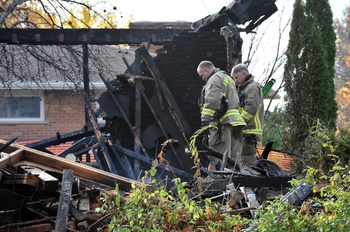
Last month, three adult members of a single family died in an early morning house fire here in Ann Arbor. When firefighters arrived, the house was fully engulfed in flame. They could not get in to rescue the occupants. The Alexandropoulos family was first reported as missing, and later in the day three bodies were found. From the beginning, this story seemed odd. Firefighters took more than 10 minutes to arrive, and the stated reason was that they were on the scene of another call. But the other call was around the corner and wasn't a fire at all. Something wasn't right.
Now the City Council has been briefed on a fuller version of the story. Apparently, neighbors a few blocks away awoke to the smell of smoke and went out into the neighborhood looking for the source. A large amount of smoke was coming out of a chimney in an unoccupied house, and they called 911 at 2:53 AM to report it. Meanwhile, neighbors on the same street as the fire, and west of the first callers, reported smoke coming from the east. Firefighters were dispatched to the house where the smoke was reported, but found it was not the source of the smoke. Finally, at 3:06 AM, a caller gave the correct location of the house, but it was too late.
Last night, the City Administrator, Roger Fraser, briefed the City Council and blamed confusion over the address for the slow response. Meanwhile, rumor has it that 911 operators did not know where the correct address was located even once they had it. Tapes of the calls have not been released. Everyone agrees that the house had no smoke detectors and there is some speculation that the house was fully involved before the first call was ever made. The local press quotes Fraser as saying,
Our request is that if you have such an incident that you're unfortunately involved with, please give us as specific information as you can when you call, because at that time, in the context of what was going on, our firefighters knew nothing more than the fact that that [wrong] address could have been the location that they were all talking about.
I think we can all agree that this fire is a tragedy. It is also natural that our minds turn to blame when something like this happens. The city blames the callers, the callers blame the city, and everyone blames the victims. I think, however, that Fraser is missing an opportunity to do some very helpful crisis communication. He is so busy circling the wagons to deflect any blame from the city, that he isn't actually helping anyone who is upset.
When something goes wrong, it is only natural that we want to prove that we didn't do it or weren't at fault. However, following a traumatic incident, what people most need to hear is not, actually, who is to blame, but rather what is being done to prevent it from happening to them. As much as our minds go to blame, they are really going to protection. If we can blame someone, we think we can prevent that someone from doing anything to us. How much better would it be if we knew that that someone is working on it themselves?
So here's what Fraser should have said:
We've discovered three factors that may have contributed to this tragedy: a lack of smoke detectors, confusing information about the address, and difficulty finding the house. Our job now is to work on each of these factors to try to make sure they don't happen again. We are stepping up our efforts to educate the public about smoke detectors. We are retraining our 911 dispatchers to make sure they ask for very specific information when they receive a call. And we are looking at our GPS systems and reverse 911 capabilities to see if anything can be done to improve our ability to find difficult addresses. We hope that the public will help us by installing smoke detectors and being very specific when they call 911. Together, we can prevent this from happening again.What we most need, at a time like this, is not to feel mad. It's to feel safe. This is a great example of how, so often, our public officials have the opportunity to do that for us, and don't.
Wednesday, November 4, 2009
Why Can't We Blame Those Who Most Deserve It?
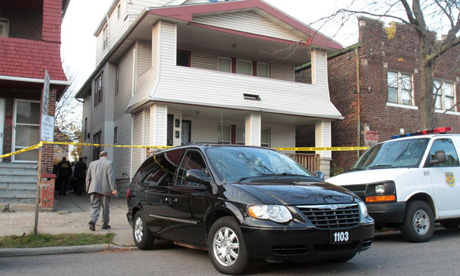
Two high profile cases are in the news today. The first is the kidnapping of Jaycee Lee Dugard, the 11 year old who was kidnapped, raped, and held in a California backyard for 18 years. The second is the discovery of at least 11 women's bodies at a house in Cleveland. If I asked you who is to blame for Dugard's kidnapping, you would probably say her kidnappers are. If I asked you who was to blame for the murders in Cleveland, you would probably pin them on the serial killer. Yet today's coverage points the finger squarely at law enforcement in both cases.
A report from the California Inspector General, which was issued today, says that parole officers had numerous opportunities to discover Dugard during the 10 years they were in charge of supervising her alleged captor. They failed to follow their own procedures in some cases, and in others failed to have decent procedures in the first place. In the Cleveland case, neighbors are coming forward to say that they reported assaults by the alleged perpetrator on their street, and the police did not take them seriously. They also say that there was an odor -- presumably of decomposing bodies -- coming from the property, which was reported but never addressed. At least today, it seems like the answer to whose fault these crimes were is not the perpetrators at all, but law enforcement officials.
So what's going on here? Why have we shifted from outrage at the people who did these things to outrage at the people who didn't catch them? I think what we're seeing is the evolution of people's world view as they try to cope with the horrible things that have occurred.
When the Dugard case first broke, for example, comments on blogs and news sites said things like, "I hope you rot in h*** you sick b*****d." This represented people confronting the idea that there are people out there who do evil things, and we don't know who they are. We heard about the case and conceived of the suspect as sick, twisted, mentally ill, or just plain evil. That scared us, because it seemed so random. If this man could be like this, couldn't anyone? If his neighbors didn't know, do we know about our neighbors?
If there are this sort of person, and/or the alleged murderer in Cleveland, in the world, and if we cannot know who they are, then the world is random. We don't like random. So, as we process these traumatic events, we must move on to the question of how this could have been prevented. If we can't know who is evil, we must rely on those whose job it is to know for us -- the police, the corrections department, etc. We may come to accept that evil people exist, but we don't want to accept that the police can't protect us from them. So now it is their fault.
It's not that there is no logic to investigating what went wrong in these cases. Obviously, we would like to prevent these things from happening again. But in our rush to investigate and prevent, we shouldn't take our eye off the fact that the people most to blame for these crimes are the people who commited them. No one else should suffer solely because we can't accept the randomness of what they did.
Tuesday, November 3, 2009
Fayetteville, NC: Murder is Murder

A well-respected real estate developer in Fayetteville, North Carolina shot and killed his wife and two teenage children on Monday before completing the act of suicide. As frequent Quarterbackers know, family annihilation murders, as this type of incident is called, are rare but news-grabbing. They follow a particular pattern in which the perpetrator is almost always male, and they may be the culmination of escalating domestic violence, or not.
I first read about this incident on CNN.com, before it was confirmed as a murder/suicide. The article quoted a news release from the Chief of Police which read, in part,
At this time, there is no reason to suspect foul play; however the investigation remains in its early stages.I had to go back and read this several times because I couldn't believe it. "There is no reason to suspect foul play." How could he possibly say that?
I would like to chalk this up to a slip of the tongue. What he meant, obviously, was that there was no reason to believe there was a suspect at large, and that makes sense. He meant that no one else was in danger. Fine. Except that this wasn't a slip of the tongue. It was a written press release. This leaves just two possibilities: that it was an incredibly sloppy job of writing the release coupled with poor or no editing (and this is why you should take your time when you are communicating in a crisis), or that he meant what he said. What if he really meant that a husband and father killing his wife and children does not count as foul play?
You may say that I'm overreacting, and maybe I am. All I have is this one snippet from the release. I don't know this man, nor has he been asked what he meant as far as I know. But I also think that little things like this add up, so that the death of one person seems less tragic, less violent, less important than another. It wasn't really a murder, it was, well something else. And that kind of rhetoric makes it that much easier to look the other way when a family is in trouble.
The New Oxford American Dictionary defines foul play as
unlawful or dishonest behavior, in particular violent crime resulting in another's death.This wasn't "just" a domestic dispute. It was a crime. The fact that the perpetrator is dead does not change that. There was foul play, and this wife and these children deserve the same respect and memorial they would get if they were killed by strangers. Murder is murder.
Sunday, October 18, 2009
Balloon Boy and the Punking of America

OK, I admit it. I got suckered. So did most of you. The Falcon Heene Balloon Boy story was a publicity stunt, and his parents are now looking at felony charges. We're all feeling pretty silly, especially those of us who blogged about this story, because now we can't very well pretend we knew all along. However, this is still a current event and that's what I blog about, so I'd like to explain exactly what is wrong with what the Heenes did, from a crisis intervention point of view.
First of all, I think their plan was doomed to failure. As a school Principal, I have been saying for years that I ought to write a book called "How to Misbehave in School" which would include such tips as, "Do not sign your own name to graffiti" and "When the Principal asks you if you know why she called you to the office, say no!" If I were writing a book called "How to Punk America" it would definitely include the tip, "Make sure your plan does not rely on a 6 year-old being able to keep a secret." That was a fatal flaw, in my humble opinion.
This also reveals something more serious, which is what this incident does to the children in the Heene family. One of the basic tenets of talking to children about traumatic events is that you should never lie to children. When you get found out, and you will get found out, they will have no reason to trust whatever you tell them next, and no reason to believe the comforting words you offer them when they're scared.
Now add to that the fact that, in this situation, the Heene boys themselves were told to lie, and they watched their parents lie. Falcon, at six, is still at an age where reality and fantasy sometimes merge, and certainly where it's hard to determine what in the world is really dangerous and what is a remote possibility. How is he supposed to know whether to trust his parents and siblings now, when they've shown such a willingness to lie? How is he supposed to trust them to keep him safe, as all kids must, when they were so willing to use him to achieve their own aims? When they tell him there are no such thing as monsters, or whatever he might fear, why should he believe them? Is it any wonder this kid was throwing up on Friday? Is it any wonder the charges against his parents include contributing to the delinquency of a minor?
The Heenes have also done a tremendous disservice to every parent who has ever had a child go missing, face real danger or die. When their real nightmare is trivialized by a publicity stunt, it makes us as a society that much less likely to be supportive of their traumatic reactions, not to mention less likely to believe what they tell us happened.
In addition, how many people died or were injured near the Heene residence on Thursday who might have had a better outcome but for the delayed response of rescuers who were stretched thin chasing a balloon? How many children could have been fed or clothed or saved from abusive situations with the money spent on this search?
I got punked. And yes, I'm embarrassed about that and I want someone to blame. It turns out that in this situation, there is someone to blame, and you'll excuse me if, in this one instance, I don't mind doing it.
Saturday, October 17, 2009
Assigning Blame in a Circular Firing Squad

In June of 2007, a University of Michigan Survival Flight crashed into Lake Michigan, killing the pilot, co-pilot and four members of a medical transplant team which was transporting human organs to patients in Ann Arbor, Michigan. The local community here in Ann Arbor, where U of M is a major fixture and a major employer, took this crash very personally. It was covered very much as "our story," and we all struggled to understand how something had gone so wrong with a medical provider who we all consider to be good, particularly when it comes to transplants.
This past Wednesday, the National Transportation Safety Board issued its findings on the crash. They found that the pilot mishandled a problem shortly after takeoff, the co-pilot was poorly prepared and got in the way of an emergency landing, the carrier did not address safety issues and the FAA did not properly force the carrier to address those issues.
On Friday, the pilot's family issued its own statement, fiercely rejecting the NTSB findings. They believe a mechanical problem caused the crash, and they are suing Cessna, the maker of the airplane. In a statement, they said,
the NTSB's depiction of Capt. William Serra reflects the myopic view often induced by the search for scapegoats rather than causes for accidents.
By way of disclaimer, I should say that I know absolutely nothing about the technical aspects of aviation. I know how to make a reservation and find the cheapest price for a flight, and I let the professionals handle the rest. What interests me about this story is the family's accusation that, in the wake of a crash, the NTSB is looking for someone to blame.
It is certainly the case that, following a tragedy, we naturally tend to try to find fault somewhere. We are naturally wired to find patterns in the world, and random events are extraordinarily uncomfortable for us. Random events cannot be predicted and cannot be avoided, and that terrifies us. So we look for someone to blame. If we can't find someone outside of ourselves, we will blame ourselves. So yes, the investigation of a crash is, in part a search for a someone to blame.
For the family of the pilot, the search for blame is a little different. They, too, are hoping to find a reason for what happened. But since their experience is that this event happened to their loved one, they are going to be extraordinarily reluctant to blame him for what happened. They have assigned fault to the manufacturer of the plane.
What's interesting to me is that the family is accusing the NTSB of looking for a scapegoat when, in fact, they appear to be doing the same thing. It's possible the NTSB is wrong. It's possible the family is wrong. It's possible both are wrong, and it's possible both are right. But it certainly is the case that both the NTSB and the family have very good, healthy reasons to be pointing fingers. Adding to that by accusing the other of simply wanting to blame someone is, in the end, the pot calling the kettle black.
Saturday, October 10, 2009
Surviving a Law & Order Episode
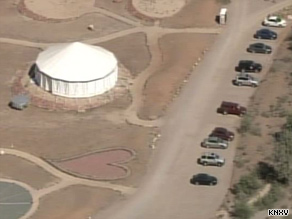
It reads like a TV drama. Sixty people are at a spiritual retreat. The organizer promises a journey of the spirit, but has participants sign a lengthy release of liability. The participants are inside a so-called "sweatbox," an imitation of a Native American ritual, when more than 20 fall ill and two die. Who is to blame? A criminal investigation begins. Were the participants fasting? In ill health? Who is this organizer? Did he know what he was doing? But it isn't a Law & Order episode. It's an AP news story. This actually happened last night at a resort near Sedona, Arizona.
So let's try reframing this drama, shall we? You have been working to better yourself and explore your spiritual side. You sign up for a retreat where they will be doing hiking, swimming, wilderness survival, and a sweatbox ritual of some kind. You've read enough to know that things like the sweat lodge can be very powerful in people's personal and spiritual development. So there you are, in the sweatbox, when people start passing out. You don't feel so well yourself. You go out of the lodge and the paramedics arrive. You see people being brought out. More than 20 are taken to the hospital. Two of the people you've been sharing this important life experience with are dead. No one knows what happened, the press are crawling all over the place, and the police are taking statements. This is not the life-changing event you had in mind.
I've written a lot in this space about the natural tendency to look for someone to blame when things go wrong. I've also written about how things seem more traumatic and get more media attention when they are unusual. Certainly, in this case, the lack of a clear cause makes people hunger for someone to blame, and the circumstances are unusual enough to get everyone's attention. But there is also a voyeuristic quality to the press coverage.
This isn't Law & Order. This was not ripped from the headlines, it is the headlines. Real people died. Real people saw them die. Real families are traumatized and grieving. So are real survivors. For those who chose to be at that resort this week, who chose this retreat and this way of bettering themselves, the scrutiny and attention being paid to the "this is weird" aspect of the story has to be complicating their processing. It's hard enough to question what you could have done or should have known, and to come to peace with the fact that others died while you watched and you lived, without also having to worry about whether the rest of the world thinks you're nuts.
I'm not suggesting in any way that it's not important to investigate this incident. Knowing what happened is important in helping the survivors cope and in preventing it from happening again. If someone is criminally negligent here, they should be held accountable. But in our rush to place blame, let's not lose sight of the real lives lost, and the difficult journey still ahead for those they left behind.
Thursday, October 8, 2009
Cause of Death Matters

Elizabeth Barrow was 100 years old and lived in a nursing home in Dartmouth, Massachusetts. She was in pretty good health, but it was hardly a surprise that she died last month. Hundred year old people die. What was a shock was how she died. She was strangled in her bed and a plastic bag was placed over her head and tied in place with a shoelace. When her family first learned of her death, they assumed that the bag had been placed there by someone trying to cover her body up, and that she had died of natural causes. The medical examiner suspected she might have killed herself. Now that it is clear that the cause of death was strangulation, a criminal investigation has been undertaken.
I don't think I've ever read about a situation that more clearly demonstrated the difference between trauma and grief. Obviously, Ms. Barrow's family was saddened by her death. She was a fixture in the family and they will miss her. But they were not shocked by her death initially. There was nothing particularly unexpected about a 100 year old person dying. As best as I can tell from various interviews that her son has given, the family experienced her death as a loss but also took time to celebrate her life, as we so often do when someone very old dies.
When the autopsy results ruled her death a homicide, the family was thrown out of the natural grieving process and straight into trauma reactions. Trauma also challenges what we think we know about life and death. In this case, that challenge was very literal -- the family thought they understood how Ms. Barrow had died, and then, all of a sudden, they didn't. It didn't help matters that the news that her death had been ruled a homicide was released to the press before the family, so the family learned of it from reporters. Several articles covering this story have used the word "reeling" to describe the family's reaction.
The reaction of the nursing home, while not terribly well worded, also hints at the way the cause of death in this case has thrown everyone for a loop. A statement released yesterday said,
We prepare for these eventualities as persons caring for the elderly who die of natural causes. This situation is especially tragic because the exact chain of events may never be known.And that is the heart of the matter. Yes, a death is a death. But a traumatic death offends our sensibilities, and we want to understand how it could happen. I hope the Barrow family gets their answers.
Thursday, September 17, 2009
Tashawnea Hill: Won't Somebody Think of the Children?

Some of the facts are not in dispute. Tashawnea Hill, a 35 year-old army reservist, was taking her 7 year-old daughter to dinner at a Cracker Barrel restaurant in Poulan, Georgia on the evening of September 9. A White man was coming out of the door when Hill, who is African-American, and her daughter were about to go in, and Hill believed that he almost hit her daughter in the face with the door. She exchanged words with the man, and he beat her in full view of her daughter.
The only facts in dispute are what exactly Hill said to the man, whether, as he alleges, she spit on him, and whether, as she alleges, he shouted racial and sexist epithets at her as he beat her. The FBI is investigating this as a hate crime, and the police say that witness statements and surveillance footage indicate the attack was unprovoked.
The man who beat Ms. Hill is charged with misdemeanor battery and disorderly conduct. He is also charged with cruelty to children even though everyone agrees he did not hit the daughter. Let's hear it for Georgia law enforcement for understanding that damage to children doesn't necessarily require physical contact.
The police report described the daughter's reaction in vivid terms. When officers arrived, she was
crying uncontrollably and her body [was] shaking/trembling.
This is a very typical reaction for a child -- and for an adult -- who has witnessed a traumatic incident. In addition to watching her mother be attacked, this girl has to have feared for her own safety. And where does a 7 year-old run when her mother is being beaten? Where does she believe is safe? Probably nowhere.
I've written a lot in this space about the way trauma violates our world view. In this instance, that is doubly the case. While Tasha Hill knew before September 9 that the world can be dangerous, but probably did not operate with that in the front of her mind day in and day out. Her daughter, at 7, was most likely at a stage where she believed her mother was powerful and would keep her safe. Little kids scare more easily than adults, but they also fundamentally think adults can protect them. When this girl saw her mother beaten, she was suddenly and shockingly exposed to the danger her mother was in and the fact that her mother could not keep that danger away from her. That's a big lesson for a little girl.
And of course, that's without dealing with the obvious other ways this incident will affect Ms. Hill's daughter. She not only saw her mother attacked, but she allegedly saw her attacked for being an African-American female. That has to have an impact on a little African-American girls' sense not only of safety but of self esteem and self worth. The bottom line is, if I were she, I'd be shaking too.
Wednesday, September 16, 2009
Driving a Desk

Before last June, there hadn't been an officer-involved shooting in Miami Beach, FL since 2003. In a single week in June, there were two. But that's not what makes this situation noteworthy. What's noteworthy is that the same police officer, Officer Adam Tavss, was involved in both shootings, which occurred just 4 days apart. Tavss was taken off the street for 72 hours following the first shooting. The families of both of the dead men are asking the Justice Department to investigate the situation, and why Tavss was allowed back on the street so quickly.
It might be a good idea, then, to review the thinking behind taking an officer off the street when there has been an officer-involved shooting. After all, if we don't understand why someone is taken off the street, it's hard to assess when they should go back. There are a number of reasons.
- Avoiding Lawsuits: There is a general understanding that if a police officer who has just shot someone shoots someone else, the department is opening itself up to legal scrutiny. That is exactly what happened in this case. Pragmatically, departments like to play it safe.
- The Officer Isn't Safe: Officers involved in a shooting, or any other traumatic incident, may experience memory loss, slow cognitive processing, depression and impaired decision making, just to name a few reactions. The person most at risk from this is the officer him or herself, since thinking slowly can be deadly on the street.
- Make Sure the Officer Isn't Trigger Happy: It is possible, although unlikely, that the officer really has impaired judgement to begin with, and that the first shooting was completely unjustified. The last thing you want is to put him back on the street and let him do it again.
- The Officer Might Scare Too Easily: If the officer is traumatized by the first shooting, which probably occurred because his life was in danger, he may be at a heightened state of alert and more likely to perceive that his life is in danger than someone who hasn't been through that. This may cause him to make the decision to use lethal force at a time when someone else would not.
Officer Tavss is under investigation, as is the department. A thorough investigation is always warranted when someone is killed, and it's worth asking whether Officer Tavss was ready to go back on the street when he did. But it bears remembering that keeping officers off the street after a shooting isn't just to prevent additional shootings, it's to protect the officer himself. It's always possible that the second incident was just a horrible coincidence, and still a justified shooting.
Sunday, September 13, 2009
Annie Le's Wedding Day: Who Could We Help, and How?

Yale pharmacology graduate student Annie Le was supposed to get married today. Instead, her fiance is in New Haven, trying to help law enforcement officials figure out where she is and what happened to her. She was last seen outside the Yale medical school on Tuesday. Her keys, purse and cell phone were all left in her office. She doesn't have a car. Friday brought word that a Professor whose class she was to take Tuesday afternoon, and who canceled class abruptly on that day, was being interviewed. Evidence was removed from the med school building yesterday, and unofficial, unconfirmed reports say that evidence was bloody clothing found in the drop ceiling of the lab in which she worked. Police say they don't think she ran away.
This has got to be gut-wrenching for her fiance, family and friends. The twists and turns are coming quickly, but no resolution is in sight. While everything I've detailed here is true, it's entirely possible some or all of it is irrelevant. The reports regarding the clothes could be false, or they aren't hers. The Professor could have gotten the stomach flu. Clues give hope for figuring this out, but they don't make the waiting much easier.
From a crisis response point of view, this is also incredibly tricky. It's not that no one needs help, it's that it's not at all clear who we should be supporting or how we would go about doing it. We're supposed to respond after the event is over. This one isn't, but it's in a new stage. We've moved from "she'll turn up" to "something happened to her," but we don't know that for sure and we don't know what it was. We also don't know if she's alive. And worse, it could be we will never know. At what point do we decide that it's time to help out anyway? Or is this one of those incidents when help will never come, because there will never be a time we can say it's over?
What particularly gives me the creeps, however, is the notion that if, at some point, we decided it was time to try to offer some early crisis intervention to those affected -- and there have to be a lot of them, including everyone who goes to school or works there -- there is a significant possibility we'd be working with the person or persons responsible for her disappearance. Now, there are times when working with the person responsible for an event is more than appropriate. I'm thinking, for example, of the person who ran a red light and caused a fatal car accident. But there, their level of culpability is out in the open. Here, we'd be working with someone who is simply lying to us. And the thought that there would be the remotest possibility of learning something during the course of the intervention that the police did not already know is horrifying. We promise confidentiality, but privilege has not been established. I don't want to be in that position.
All this, I suppose, is why you wait until the event is over to respond. It's just much easier to do that when the event has a clear beginning, middle and end. The current endless middle is hard for us. It has to be a zillion times harder for Annie Le's friends and family and the Yale community. I hope they get their resolution soon, and I hope against hope that she comes home safe.
Friday, September 4, 2009
The Georgia Murders

Last Saturday morning, a man called 911 in Brunswick, GA, and said that he had returned home to find 7 members of his family dead and two critically injured. One of the two died on the way to the hospital. The other is still on life support. Today, the caller was arrested for the murders.
It's hard to imagine something more horrific than this. It's difficult to imagine what brings a person to this level of violence, particularly against their own family. It's also hard to imagine how Diane Isenhower, whose ex-husband, four children, ex-brother-in-law and ex-sister-in-law, as well as her daughter's boyfriend, were all murdered and whose grandchild is in critical condition, moves on from something like this. Now her ex-husband's nephew is under arrest. That hardly makes things less complicated.
What particularly caught my attention in the coverage were a couple of comments that various people made about how those affected were coping. Isenhower's brother-in-law, Clint Rowe, expressed concern about the police officers:
They're the ones who walked in on that, so you know it wears on the police as well.I think it's remarkable that a member of this family would think of the police at this moment. It's not that, when you think about it, it's particularly surprising that police officers would be affected by working on a case like this, particularly if they were on scene when the bodies were first found. It's just remarkable that anyone from the family would think of it, given what they themselves are going through.
The Police Chief also commented on the burden of what the police are going through right now. Chief Matt Doering responded to some criticism that police have not released much information about the case, and said that releasing more information will not stop people from being afraid:
We, too, have that same fear. We're the ones that have to get out there and try to make people feel better as best that we can
I felt a personal connection with the Chief when I read this. As a school administrator, I have several times been in the position of having to keep things confidential in a crisis and under pressure, and to reassure people about safety when I wasn't feeling so safe myself. People get very upset when they feel they don't have all the information, but often that is more about directing their anxiety and anger towards the nearest available target than it is about anything those in charge have done wrong.
Information does help, but it doesn't change reality and sometimes it just can't be released. At the end of the day, even with all the information in the world, this community must come to grips with the fact that 8 people were brutally murdered, allegedly by one of their own. Knowing the intimate facts of the case will not make that much easier.
Thursday, August 20, 2009
The Ghosts of Virginia Tech

On April 16, 2007, a student at Virginia Tech University went on a shooting rampage and killed 32 people before completing his own suicide. Today, the records on the shooter from the Cook Counseling Center at Virginia Tech were released, with permission from his family. These records were apparently illegally removed from the center and only recently discovered at an employee's home.
What the school records show is that this student made some suicidal comments and gestures in 2005 and was hospitalized. They also indicate that he was not homicidal to the best of the Center's knowledge and that they did not believe him to be a current threat to himself or others, although he was depressed and having difficulty with the stress of college life.
I have every respect for the families and memories of those who died at Virginia Tech and for those who were traumatized by living through that experience. I also believe that lessons can and have been learned about campus safety and crisis communication at colleges. But I also have to question what end is now served by rehashing this man's psychiatric history.
As you frequent Quarterbackers all know, our minds go to blame very quickly when we are traumatized. We want someone to be at fault and we want them to have consequences. We want trauma to be preventable so we don't have to feel scared. And make no mistake about it, this shooting scared anyone who lives, works or knows anyone on a college campus.
At the same time, the person truly at fault here was the shooter. We can file lawsuits, change policies and stage inquiries, but human beings fundamentally have free will. Stopping someone who is hell bent on killing and who does not care if he dies too is always going to be devilishly hard. And what's more, no matter where we pin the blame, we will never know if someone doing things differently would have made any difference.
Let me say that again. We will never know if this shooter could have been stopped. In our quest for a feeling of safety and security and to place blame, we cannot achieve what we really want, which is to know this will never happen to anyone ever again. We are, again, reminded that there is no such thing as closure.
What I worry is that people looking back at records like these, knowing how the story ends, will want colleges and counselors and hospitals to clamp down on people who seem to be "like" this shooter. In the case of these particular records, that would probably mean mandatory counseling, hospitalization and/or expulsion for depressed college students who express suicidal ideation and seem to be having difficulty adjusting to college life. That's an awful lot of people, most of whom never go on shooting rampages or even have a psychiatric diagnosis. I count myself among them.
Something happened to this shooter between December of 2005 and April of 2007. We don't know what that was, really, and we can't ever know for sure. It may be that the system failed in this case, and it may be that this could have been prevented. But let's make sure, in our efforts to be more vigilant, that we don't wind up pegging everyone with a bad day as a killer.
Tuesday, August 18, 2009
The Trouble With "Closure"

The District Attorney in Westchester County has concluded the investigation into the crash that killed 8 people on the Taconic State Parkway in July. The crash was caused when a woman who was reportedly drunk and under the influence of marijuana drove her van with five children in the wrong direction on the Parkway and hit an SUV, killing three people in the SUV, four of the children and herself. The D.A. has announced that there will be no criminal prosecution in this case.
There has been a lot of backlash surrounding the lab reports that say the driver had a blood alcohol level of 0.19 (legally drunk is 0.08) and had chemicals from marijuana in her system. Her husband has said:
She did not drink. She was not an alcoholic. Something medical had to have happened. I never saw her drunk since the day I met her.He insists that he does not believe alcohol caused the crash that killed his wife and one of his two children, despite both the toxicology reports and the fact that a vodka bottle was found in the van.
Michael Bastardi, Jr., the son and brother of two of the men killed in the SUV, on the other hand, has this to say about the husband and his family:
I am appalled that they won’t face the facts that she was drunk and killed seven innocent lives and ruined the lives of so many people.The Bastardi family is planning a lawsuit.
So what is going on here? Is the husband in denial? Is Bastardi taking this tragedy out on the husband? Yes, and yes. Occam's Razor tells us that when you have two competing theories that have the same results, the less complicated one is true. In that case, the driver was almost certainly drunk. The husband is in denial.
So technically Bastardi is right, the husband "won't face the facts." But the word "won't" tends to imply "could if he really wanted to," and my guess is that he actually really can't right now. The facts are not just that his wife and daughter are dead. The facts are not just that his wife is at fault, or that 6 other people died too, or that everyone is angry at his wife, including him. Throw in there that his wife drank incredibly heavily and he didn't know it. I don't know if she did this a lot or this was a rarity, but it seems clear that her husband was clueless.
On the other side, the Bastardis are angry at the husband. They look at this situation and say that it is perfectly obvious that the wife was to blame, and since she's dead and her husband is defending her, he is a very convenient and obvious target for their natural rage. In tragedy, our minds go to blame. In this one, it doesn't have far to go.
The fact is also that both of these families are traumatized. They are trying to process a traumatic event of monstrous proportions. They won't be successful at doing that until all the investigating and suing and everything else is done, because all of that is retraumatizing. I'm not saying the Bastardis shouldn't sue -- I have no idea. I'm just saying that lawsuits tend to prolong the healing process.
At the same time, I cringe when I hear people say that families in a traumatic situation need to find "closure." That word implies that when all of this is over, this tragedy will be in a box and they can close the lid and move on. The fact is, while they are doing the hard work of processing what has happened, that box doesn't get closed and left behind. The work they are doing now is building a box into which this will fit, and then finding a space for it in their minds. That means moving some other stuff around, and their minds will never be quite the same. They may be healthy. They may be happy. But this will always be a part of them.
At some point, the husband is going to find a place for his wife's substance use/abuse in that box. At some point, Michael Bastardi, Jr. will find a place for anger and blame. Maybe they will "get over" their denial and anger. Maybe today's decision not to charge anyone will help, maybe a lawsuit will, maybe both will hurt. But there will be no closure. The only way to close the box is to bring the dead back to life and make this never have happened. Short of that, for both families, the lid will stay open.
Saturday, August 15, 2009
Why I Don't Usually Update Stories
Some of my readers have asked why I often don't post ongoing information about investigations into the critical incidents I blog about. First of all, it's not true that I never update stories. I posted additional information about the Steve McNair murder/suicide and the Ed Thomas murder, for example. However, I have not posted available information uncovered by the investigations into the Disney monorail crash or the plane/helicopter crash over the Hudson, as counterexamples.
My rule of thumb is to write an additional post if the new information will fundamentally change or add to the discussion from a crisis response point of view. In the case of Steve McNair, for example, the information that his death was, indeed, a murder/suicide gave the opportunity to talk about suicide, suicide prevention, and crisis intervention following suicide.
Often, the new information gained in the investigation of an incident tells us who investigators believe is to blame for the incident. Sometimes the nature of the event is fundamentally changed by this, as it was when we learned that Ed Thomas' alleged murderer was a former student and that he had apparently been prematurely released from psychiatric care. More often, however, knowing who may be at fault doesn't really change anything except possibly where the blame is being pointed -- and there is always blame.
While this blog is a current events blog, it is a crisis response blog as well. Feeding blame is not something I, as a crisis responder, believe is particularly useful unless it serves some other purpose, so I choose not to do it. There are certainly cases where I make the wrong call -- where a piece of information actually really does change the perspective on the event or where I say it does when it doesn't. We're all human, even us Quarterbacks.
My rule of thumb is to write an additional post if the new information will fundamentally change or add to the discussion from a crisis response point of view. In the case of Steve McNair, for example, the information that his death was, indeed, a murder/suicide gave the opportunity to talk about suicide, suicide prevention, and crisis intervention following suicide.
Often, the new information gained in the investigation of an incident tells us who investigators believe is to blame for the incident. Sometimes the nature of the event is fundamentally changed by this, as it was when we learned that Ed Thomas' alleged murderer was a former student and that he had apparently been prematurely released from psychiatric care. More often, however, knowing who may be at fault doesn't really change anything except possibly where the blame is being pointed -- and there is always blame.
While this blog is a current events blog, it is a crisis response blog as well. Feeding blame is not something I, as a crisis responder, believe is particularly useful unless it serves some other purpose, so I choose not to do it. There are certainly cases where I make the wrong call -- where a piece of information actually really does change the perspective on the event or where I say it does when it doesn't. We're all human, even us Quarterbacks.
Monday, August 10, 2009
What Makes an Incident a "Bad One"

I know it when I see it.
Supreme Court Justice Potter Stewart famously used that line to try to define hard-core pornography. That's how it feels sometimes trying to define a critical incident. That's particularly true when you're dealing with first responders -- cops, EMS, firefighters -- who see this stuff every day and can't possibly be traumatized by all of it. What makes one incident particularly bad?
I know it when I see it.
Yesterday, California Highway Patrol attempted to stop a car on a traffic violation in Dinuba, California. The car wouldn't stop and the police chased it for about four miles. Then the car ran a stop sign and hit a pickup truck carrying 5 children. As of this writing, 8 people -- 5 children and all 3 adults from the car -- are dead. Four of the children, ages 1,3,4 and 7 were ejected from the truck and died at the scene.
I know it when I see it.
There are certain rules of thumb about critical incidents. There are certain types of things that are likely to impact a first responder -- line-of-duty-death or serious injury, officer-involved shooting, trauma involving children, and multiple casualties all raise red flags. And yes, this was a multiple casualty incident involving children. But that's not what makes me, and probably you, say that this is a "bad one."
You just know it when you see it.
This one would probably be a big one even without the police chase. An accident involving multiple dead children offends our sense of how the world should be and, if we are parents or have children close to us, makes us feel uneasy about their safety. I don't know about you, but one of my first reactions was also to question how five children could possibly be riding safely in a pickup truck, and whether the fact that they were ejected means they weren't wearing seat belts or were riding in the back. Someone has to be to blame. Then you add in the car running a stop sign, and you have someone else to blame. It makes me angry -- it probably makes you angry too.
And then you add the police chase, which means there were officers on the scene who are now asking themselves what they could have done to stop that car or whether they should have given up the chase, and who witnessed the accident and were first on the scene to see the carnage. The Fresno Bee already indicates some people are blaming them for the crash. So now there's going to be an investigation, on top of the guilt. And that's in addition to being mad at the driver and mad that those children weren't safe and afraid for their own children.
I know it when I see it. It looks like that.
Saturday, August 1, 2009
Update: Suspect in Provost Murder Completes Suicide
 The suspect in the murder of Seaman August Provost III completed a suicide in his cell at Camp Pendleton yesterday. He had been charged on July 23 (and I apologize for not bringing that to you -- I was on an Amtrak train with no internet access).
For those of you just joining this story (feel free to read the previous Quarterbacking on this topic), Provost was standing sentry at Camp Pendleton in the wee hours of June 30 when he was shot and his body set on fire. His family suspected a hate crime, since Provost was either bisexual or homosexual, depending on which article you read, and he had complained to them of being harassed both because of his sexual orientation and because of his race. The Navy said there was no evidence of a hate crime. They also failed to tell his family how he died -- they heard about it on the news.
The official story is that the suspect went on a really bad trip from hallucinogens sometime in May, and it was all downhill from there. He broke into a sailor's home and stole a gun and an xbox, and was pulled over in mid-June for driving while intoxicated. Provost allegedly confronted him as he was trying to set fire to a Navy landing craft, although there was no apparent motive for him wanting to set that fire. The Navy has said it was "part of a crime spree."
And now the suspect is dead. You might think that Provost's family would be glad he was dead -- an eye for an eye, a tooth for a tooth. But victims and their families rarely feel that way. They may well want to see the perpetrator put to death, but death without a conviction is symbolically difficult, because it means he will never officially have been punished for what he did. In this instance, the family also will not have the opportunity to find out whether there was a race- or sexuality-based motive. From their point of view, the truth died with the suspect. And I'm sure there are conspiracty theorists out there who find the suicide of the suspect just a little too convenient for the Navy.
I am not one of them. I believe that most people have a conscience, and that living with that conscience when the drugs or the alcohol or the rage wears off is pretty difficult. I have no difficulty believing that this suspect felt he couldn't live with himself. Now his family, as well as the Provost family, are left with the aftermath.
(Two notes on usage: I use the term "completed the act of suicide" or "completed a suicide" because it most accurately describes what happened. If you think about it, "completed" is the natural extension of "attempted," which we commonly use to describe someone who tried to kill him or herself and did not die. The more common "committed suicide" is somewhat euphemistic, and I try whenever possible to use plain language, particularly when dealing with issues around death. I also try to avoid the terms "successful" or "unsuccessful," because they imply that suicide is a goal to be attained, and I never say "took his own life" because, again, that is euphemistic -- where did he take it?
You may also have noticed that I never name suspects or perpetrators in this blog. This represents my value that those who kill others should not in any way be made the center of the story, particularly in a blog about trauma.)
Tuesday, July 14, 2009
You Can't Contain the Facts: The Murder of August Provost, Part 2
To refresh your memory, Provost was murdered while standing sentry. He was shot three times, bound, gagged, and set on fire. He was African-American and, depending on which report your read, either gay or bisexual. He complained of being harassed by fellow service members, and his family believes his murder was a hate crime. The Navy, on the other hand, has said there is no evidence of a hate crime and referred to this murder as a "random act of violence."
The way the Navy has chosen to deal with this situation is unfortunate, and is probably making things worse for both themselves and the family. It turns out that when the Navy notified Seaman Provost's family of his death, they told them he was found unconscious on sentry duty and later died. They failed to mention that he was murdered, let alone share the details. Provost's mother found out he had been shot and burned from the television coverage.
This violates some very, very basic principles of how institutions should behave in a crisis. I wish I could say it was unusual, but unfortunately it is all too common. Institutions -- whether it's a school, the military, a business or the government -- like to clamp down on information. We have this naive notion that all that will become public is what we say, so we don't say much.
But facts exist whether we talk about them or not, and they have a way of making it into the public arena. Instead of asking, "What facts do we want people to have?" institutions should be asking, "If we don't share this fact, how will it look when it does become public." It's almost always better for people to hear bad news immediately, directly and completely.
The two rules I always share with staff in my school and other schools about sharing bad news with children are very simple:
- Tell the truth, the whole truth, and nothing but the truth (which also means no guessing) and
- Make sure that every known fact they will hear comes from you, and that no rumors do.
The minute you violate either of those rules, no matter how well-meaning you are, you lose all trust and credibility, and the same rules go for adults. As soon as it is known that you withheld information, gave inaccurate information or left facts to be revealed by the media or the rumor mill, no one will trust what you say and you will be completely ineffective in being supportive following the incident. People naturally want to blame others following an incident, and you will be the target whether you deserve it or not.
I wonder how this situation would have played out if the Navy had told the family how Seaman Provost died, had acknowledged the possibility of a hate crime even if they didn't think it was one, and had been honest with the Congressman on the base that day. I have to imagine that there would be a whole lot fewer conspiracy theories floating around.
Subscribe to:
Posts (Atom)
Meet the Quarterback

- Naomi Zikmund-Fisher
- is a clinical social worker, former school Principal and a Crisis Consultant for schools and community organizations. You can learn more about her at www.SchoolCrisisConsultant.com

Subscribe


 Posts
All Comments
Posts
All Comments