Showing posts with label Cleveland. Show all posts
Showing posts with label Cleveland. Show all posts
Friday, December 11, 2009
Missing Utah Mom: All Women are Equal, But Some are More Equal than Others


Susan Powell, a 28-year-old mom in West Valley City, Utah, didn't turn up for work on Monday, and neither did her husband. By midday, her sister had called police and they had found that the whole family was gone, but Susan's keys, cell phone and car were still at her home. Around 5 o'clock, her husband turned up with the kids, ages 2 and 4, and said that he had been camping. He told police that he had last seen his wife about 12:30 that morning, as she was going to bed. He had then bundled his kids up in the middle of the night and taken them camping in temperatures below 20 degrees and forgotten that it was Monday, not Sunday.
Susan Powell is still missing, and her disappearance is being classified as "suspicious" by law enforcement. They aren't naming names, but I don't think you have to have a degree in criminal justice to figure out that her husband is a major suspect. Either he is very odd and innocent, or he is guilty and a very bad liar. Time will tell.
This story is all over the news today, four days after Susan Powell went missing. I do not begrudge her the media attention, and I hope it helps to find her. But I can't help but contrast this situation to the case of the 11 dead women who were found at a single house in Cleveland, Ohio. In that instance, some of them were gone for months before anyone reported them missing, and some were never reported at all. Certainly none of them got the kind of media coverage that Susan Powell is getting.
There are some practical reasons for the difference. Obviously the media will not cover the disappearance of someone who has not been reported missing. The victims in the Cleveland case were very disproportionately transient, homeless, or prostitutes -- the people who are poorly connected to the rest of society and, frankly, that society doesn't worry too much about. That makes reporting of their disappearance less likely.
Let's face it, though. Part of the reason Susan Powell is getting much more coverage than the Cleveland victims all did combined is that she is a white, middle class, young mother. She is the stuff crime shows are made of. The victims in Cleveland are the people who we accept, as a society, will go missing -- African-American women engaged in drugs or prostitution or living on the street. We don't worry about them when they're there, and we don't worry about them when they disappear.
We like to pretend that every human life is precious to us in this country. These two cases point out that that really isn't true. We'll prosecute the killers of anyone, yes. But there are some women on the fringes of society that we won't work too hard to protect.

Wednesday, November 4, 2009
Why Can't We Blame Those Who Most Deserve It?
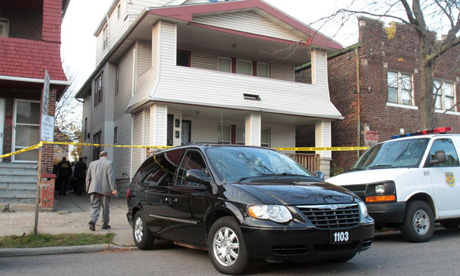
Two high profile cases are in the news today. The first is the kidnapping of Jaycee Lee Dugard, the 11 year old who was kidnapped, raped, and held in a California backyard for 18 years. The second is the discovery of at least 11 women's bodies at a house in Cleveland. If I asked you who is to blame for Dugard's kidnapping, you would probably say her kidnappers are. If I asked you who was to blame for the murders in Cleveland, you would probably pin them on the serial killer. Yet today's coverage points the finger squarely at law enforcement in both cases.
A report from the California Inspector General, which was issued today, says that parole officers had numerous opportunities to discover Dugard during the 10 years they were in charge of supervising her alleged captor. They failed to follow their own procedures in some cases, and in others failed to have decent procedures in the first place. In the Cleveland case, neighbors are coming forward to say that they reported assaults by the alleged perpetrator on their street, and the police did not take them seriously. They also say that there was an odor -- presumably of decomposing bodies -- coming from the property, which was reported but never addressed. At least today, it seems like the answer to whose fault these crimes were is not the perpetrators at all, but law enforcement officials.
So what's going on here? Why have we shifted from outrage at the people who did these things to outrage at the people who didn't catch them? I think what we're seeing is the evolution of people's world view as they try to cope with the horrible things that have occurred.
When the Dugard case first broke, for example, comments on blogs and news sites said things like, "I hope you rot in h*** you sick b*****d." This represented people confronting the idea that there are people out there who do evil things, and we don't know who they are. We heard about the case and conceived of the suspect as sick, twisted, mentally ill, or just plain evil. That scared us, because it seemed so random. If this man could be like this, couldn't anyone? If his neighbors didn't know, do we know about our neighbors?
If there are this sort of person, and/or the alleged murderer in Cleveland, in the world, and if we cannot know who they are, then the world is random. We don't like random. So, as we process these traumatic events, we must move on to the question of how this could have been prevented. If we can't know who is evil, we must rely on those whose job it is to know for us -- the police, the corrections department, etc. We may come to accept that evil people exist, but we don't want to accept that the police can't protect us from them. So now it is their fault.
It's not that there is no logic to investigating what went wrong in these cases. Obviously, we would like to prevent these things from happening again. But in our rush to investigate and prevent, we shouldn't take our eye off the fact that the people most to blame for these crimes are the people who commited them. No one else should suffer solely because we can't accept the randomness of what they did.
Subscribe to:
Posts (Atom)
Meet the Quarterback

- Naomi Zikmund-Fisher
- is a clinical social worker, former school Principal and a Crisis Consultant for schools and community organizations. You can learn more about her at www.SchoolCrisisConsultant.com

Subscribe


 Posts
All Comments
Posts
All Comments