Showing posts with label serial killer. Show all posts
Showing posts with label serial killer. Show all posts
Tuesday, March 9, 2010
Bachelor Number 1


Back in 1978, a woman named Cheryl Bradshaw was on the TV game show "The Dating Game." For those of you who are younger than I, this show entailed a "bachelorette" interviewing three eligible bachelors whom she could not see. At the end, she picked one to go out with. Cheryl Bradshaw picked bachelor number 1, although reports indicate she didn't go out with him. It turns out that he already had a felony conviction for raping an 8 year-old girl (something, one presumes, that Bradshaw didn't think to ask about on the show). The year after his appearance, he embarked on a career as a serial killer, murdering four women and a girl. The closing arguments in the penalty phase of his trial were today.
The "Dating Game" angle to this story came to light because one of the other bachelors came forward to share his recollections of bachelor number 1. He refers to him as "creepy" and says there was something about him, even then, that made him want to get away. It's hard to know how much of that reaction was real 32 years ago and how much is a projection based on current knowledge. It's also hard to know whether the other bachelor is motivated purely by what he perceives as newsworthy information or by self-promotion.
The person I'd really like to hear from, however, is Cheryl Bradshaw. News reports indicate that she refused to go out with the bachelor she picked, and I'm guessing she's pretty glad about that now. She had a brush with death 32 years ago without knowing it.
We all make choices every day that affect the outcome of our lives. It's not at all unusual to look back at past romantic interests and wonder what might have been different had you made a different choice. I have a cousin who, in her college days, turned down a fellow student named Barry Obama for a date. Imagine the possibilities.
In fact, it's impossible to know what might have been. Had my cousin made a different choice, she might be first lady today. She might also have gone out with him once and decided he wasn't for her. Or he could have, with a different choice of mate, gone in a totally different direction with his career, never entering politics at all.
The same uncertainty exists for Bradshaw. If she had gone out with bachelor number 1, she might be dead. She might have entered a life of crime herself. She might have left it at one date and it would have made no difference. He might have mended his ways. We will never know, and there isn't a whole lot of point in speculating.
I can only imagine, however, that learning what this man went on to do has given her a little bit of pause, and I think we can all forgive her for thinking about what might have been, no matter how pointless it may be. Her connection to this man has to at least give her a passing shiver.

Friday, December 11, 2009
Missing Utah Mom: All Women are Equal, But Some are More Equal than Others

Susan Powell, a 28-year-old mom in West Valley City, Utah, didn't turn up for work on Monday, and neither did her husband. By midday, her sister had called police and they had found that the whole family was gone, but Susan's keys, cell phone and car were still at her home. Around 5 o'clock, her husband turned up with the kids, ages 2 and 4, and said that he had been camping. He told police that he had last seen his wife about 12:30 that morning, as she was going to bed. He had then bundled his kids up in the middle of the night and taken them camping in temperatures below 20 degrees and forgotten that it was Monday, not Sunday.
Susan Powell is still missing, and her disappearance is being classified as "suspicious" by law enforcement. They aren't naming names, but I don't think you have to have a degree in criminal justice to figure out that her husband is a major suspect. Either he is very odd and innocent, or he is guilty and a very bad liar. Time will tell.
This story is all over the news today, four days after Susan Powell went missing. I do not begrudge her the media attention, and I hope it helps to find her. But I can't help but contrast this situation to the case of the 11 dead women who were found at a single house in Cleveland, Ohio. In that instance, some of them were gone for months before anyone reported them missing, and some were never reported at all. Certainly none of them got the kind of media coverage that Susan Powell is getting.
There are some practical reasons for the difference. Obviously the media will not cover the disappearance of someone who has not been reported missing. The victims in the Cleveland case were very disproportionately transient, homeless, or prostitutes -- the people who are poorly connected to the rest of society and, frankly, that society doesn't worry too much about. That makes reporting of their disappearance less likely.
Let's face it, though. Part of the reason Susan Powell is getting much more coverage than the Cleveland victims all did combined is that she is a white, middle class, young mother. She is the stuff crime shows are made of. The victims in Cleveland are the people who we accept, as a society, will go missing -- African-American women engaged in drugs or prostitution or living on the street. We don't worry about them when they're there, and we don't worry about them when they disappear.
We like to pretend that every human life is precious to us in this country. These two cases point out that that really isn't true. We'll prosecute the killers of anyone, yes. But there are some women on the fringes of society that we won't work too hard to protect.
Friday, December 4, 2009
Indiana Boy Murdered By His Brother: How Can This Happen?

Conner Conley, an Indiana 10 year-old, was murdered last Saturday night. He was strangled, apparently by his 17 year-old brother, who later turned himself in. He compared the feeling of killing Conner to fulfilling a craving for a hamburger. He said he identified with Dexter Morgan, the serial killer on Showtime's "Dexter." The brother pled not guilty today, but his parents weren't in court. They were at the funeral home for the visitation.
Stories like this make us look a little sideways at our own children. Every one of us believes, when our child joins our family, that he or she is perfect. We are disabused of that notion in many small ways early on, but the fundamental belief is there. These are our kids, and they are good. Conner's brother was a baby once. His parents saw him the same way. What went wrong between then and now? And how sure are we that whatever it is won't happen to our child?
The easiest place to lay blame here is on the television program. This boy said he watched the program, said he identified with the killer on the program, and killed his own brother. The show must be to blame. But it's probably not that simple. While the show may not have helped anything, no sane, well adjusted, rational person not under the influence of any substances will watch the show and suddenly be beset with the urge to kill their brother. Even if they were, they wouldn't do it. This boy says he's fantasized about killing someone since 8th grade, but "Dexter" didn't start airing until he was in 9th. It is far more likely that he was drawn to the show because he was thinking about murder, rather than the show giving him ideas.
In my experience, it is very rare for something like this to happen completely out of the blue. Conner's parents left him in his brother's care, so obviously they were not expecting this exact thing to happen. At the same time, however, it's unlikely that they had no inkling that their older son had some problems. Investigators describe him as calm and emotionless about the murder. That means he probably has no or little conscience. It's hard for someone not to notice that anything is amiss in a kid like that.
So what went wrong? We may never know. How sure are we that our own kids won't go wrong? Not very. But we can be assured that turning into a teenager who kills his brother does not happen overnight, and that there are chances along the way to stop it from happening, or at least take precautions. If it's going to happen, there may be signs. We can't be 100% sure, but then we never are when it comes to our children.
I can't even bring myself to write about what Conner's parents must be going through right now. I know all you Quarterbackers join me in sending our best and most supportive wishes to them.
Sunday, November 15, 2009
Goodbye to the D.C. Sniper

The adult half of the team of criminals known as the "D.C. Sniper" or the "Beltway Sniper" was executed by the Commonwealth of Virginia this week. His accomplice, who was 17 at the time of the murders, was ineligible for the death penalty and is serving a life sentence. From a specially fitted car trunk, they sited a rifle and shot 10 people in 17 days throughout the Washington, DC area. Their victims were chosen at random as they walked through parking lots, pumped gas, or otherwise went about the mundane business of day-to-day life. The entire Washington area was captivated and terrified. The rest of the country was pretty scared too. Prosecutors claimed it was all part of a scheme to terrorize the country and extort money from the government, although something I read recently said it was actually an unfinished plot to kill one of the sniper's ex-wives and mask the fact that she was the one real target.
Whatever the reason, for 17 days in 2002 people were afraid to go about their normal business. Soon, we were all -- even those of us who didn't live anywhere near Washington -- on the look out for a white utility van. I had never realized how ubiquitous white utility vans are until these murders happened, and every deliver truck made me jump. And of course, it turns out the shooters didn't even have a white utility van -- it's just that there was one at almost every murder scene because these vans are everywhere.
Then, as quickly as the shooting started, it stopped. Two suspects were under arrest, and our attention turned from our own safety to questioning why on earth anyone would do this and what could have or should have been done to stop them. That is the news cycle of a serial killer or a mass murder -- we fear, we capture, we wonder, we blame. We see it happening now with the alleged shooter at Fort Hood. Most of us aren't scared anymore, but we are at best curious and at worst really, truly angry.
And yet, something bothers me about this case and about this natural news cycle we seem to go through again and again. These cases scare us because they point out that our lives are always somewhat precarious. We go through our day with the assumption that the person next door, or next to us in line, or in the next car, is not a homicidal maniac. We do what we can to avoid obvious perils, but we can't avoid the danger posed by the truly imbalanced and determined killer, who could strike at any time. We just ignore it.
Then a string of murders or a single mass murder happens, and we realize how much at the mercy of these people we truly are. We realize that when we get into an elevator with someone we don't know, we're trusting that he or she isn't going in there with the idea of killing us. We realize that we pump our gas on the presumption that no one has a sniper rifle aimed at us. So we're scared. Then they catch whoever it was this time, and we breathe a sigh of relief. Now the crazy person is no longer out there in circulation. We can go back to normal.
Here's the thing, though. If we really thought it through, we might realize that in fact there is nothing truly preventing someone else from doing exactly what the killer did. The day after the snipers were caught, it wasn't any harder to be a sniper in the D.C. area than it was the day before. And the day after the snipers were caught, the odds of someone doing what they did were exactly the same as we believed they were the day before they started shooting. So either we ought to be terrified all the time, or we ought to be relatively calm all the time. The only thing that really changes is how much the danger has come to our attention.
During the D.C. Sniper killings, mystery author Patricia Cornwell wrote in the New York Times (in a piece they reran on their website this week) about the fear caused by serial killers. She wrote of a question she asked the mother of the victim of a serial killer in Louisiana:
We live in a world of terrorist cells, or serial killers, of spree snipers, and as hard as we try, we can't seem to catch them. What can we do? "Get involved," she answered. "People should notice a strange car or truck or person in their neighborhood. People need to be neighbors again and care for each other. You can't hole up in a house and not get dressed and not go out."
This was good advice in 2002, and it still is.
Wednesday, November 4, 2009
Why Can't We Blame Those Who Most Deserve It?
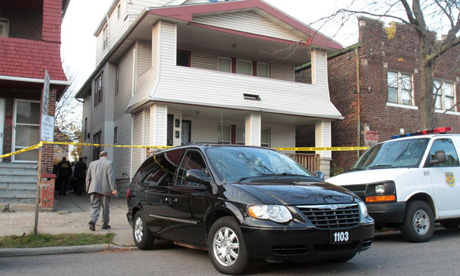
Two high profile cases are in the news today. The first is the kidnapping of Jaycee Lee Dugard, the 11 year old who was kidnapped, raped, and held in a California backyard for 18 years. The second is the discovery of at least 11 women's bodies at a house in Cleveland. If I asked you who is to blame for Dugard's kidnapping, you would probably say her kidnappers are. If I asked you who was to blame for the murders in Cleveland, you would probably pin them on the serial killer. Yet today's coverage points the finger squarely at law enforcement in both cases.
A report from the California Inspector General, which was issued today, says that parole officers had numerous opportunities to discover Dugard during the 10 years they were in charge of supervising her alleged captor. They failed to follow their own procedures in some cases, and in others failed to have decent procedures in the first place. In the Cleveland case, neighbors are coming forward to say that they reported assaults by the alleged perpetrator on their street, and the police did not take them seriously. They also say that there was an odor -- presumably of decomposing bodies -- coming from the property, which was reported but never addressed. At least today, it seems like the answer to whose fault these crimes were is not the perpetrators at all, but law enforcement officials.
So what's going on here? Why have we shifted from outrage at the people who did these things to outrage at the people who didn't catch them? I think what we're seeing is the evolution of people's world view as they try to cope with the horrible things that have occurred.
When the Dugard case first broke, for example, comments on blogs and news sites said things like, "I hope you rot in h*** you sick b*****d." This represented people confronting the idea that there are people out there who do evil things, and we don't know who they are. We heard about the case and conceived of the suspect as sick, twisted, mentally ill, or just plain evil. That scared us, because it seemed so random. If this man could be like this, couldn't anyone? If his neighbors didn't know, do we know about our neighbors?
If there are this sort of person, and/or the alleged murderer in Cleveland, in the world, and if we cannot know who they are, then the world is random. We don't like random. So, as we process these traumatic events, we must move on to the question of how this could have been prevented. If we can't know who is evil, we must rely on those whose job it is to know for us -- the police, the corrections department, etc. We may come to accept that evil people exist, but we don't want to accept that the police can't protect us from them. So now it is their fault.
It's not that there is no logic to investigating what went wrong in these cases. Obviously, we would like to prevent these things from happening again. But in our rush to investigate and prevent, we shouldn't take our eye off the fact that the people most to blame for these crimes are the people who commited them. No one else should suffer solely because we can't accept the randomness of what they did.
Subscribe to:
Posts (Atom)
Meet the Quarterback

- Naomi Zikmund-Fisher
- is a clinical social worker, former school Principal and a Crisis Consultant for schools and community organizations. You can learn more about her at www.SchoolCrisisConsultant.com

Subscribe


 Posts
All Comments
Posts
All Comments