Showing posts with label personal connection. Show all posts
Showing posts with label personal connection. Show all posts
Monday, November 7, 2011
Homicide Watch and Victim Identification

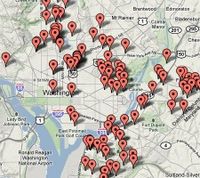
This week, the NPR show On the Media had an interview with Laura Amico, the founder of a website called Homicide Watch D.C. This website tracks every homicide in Washington, DC from the time the crime is committed through the investigation, trial and sentencing. It's a big job in a city that has already experienced 95 murders in 2011 (down from 106 at this point in 2010).
One of the things that makes Homicide Watch interesting is that they often publish information that has not been made public by the police department. Most notably, they publish victim's names before they have been released. The interview on NPR today focused on how they are able to do that.
If you think about it, it actually isn't all that hard. The fact of the matter is that, unless the person is truly unidentified, a large number of people know the identity of the victim immediately after a homicide. Friends, relatives, neighbors, colleagues, classmates etc. hear about it very quickly. These people, in turn, do two things: they go online looking for information about the crime, and they go online to talk about it.
When these folks go looking for information, they don't realize that public information tends to be very meager and come out very slowly. Chances are that they themselves already know more about what happened than is available in the media. They're looking, nonetheless. So immediately after the murder of John Smith, his friends and relations start googling terms like, "murder John Smith Washington November 7." One of the sites they are most likely to find themselves directed to is Homicide Watch D.C., even though it doesn't have any information for them.
Meanwhile, the folks over at the website have a preliminary police report that a male victim died of stab wounds on XYZ street. All of a sudden, the analytics for their website start showing that people are googling "murder John Smith Washington November 7." So the website folks go on Twitter and Facebook, looking for things like "RIP John Smith." When they find it, they can also often find additional information. For example, the full tweet might read, "RIP John Smith, stabbed to death tonight." That's a good clue that the victim is John Smith. Even better, they may be able to find John Smith's Facebook page, where people may be posting memorials and comments about the murder.
At this point, they know the victim's name and they publish it, hours and sometimes days before the police release it. But should they? After all, the police hang onto that information for a reason, and if they have a good reason shouldn't the website have the same reason?
Let's start with why the police are slow to release the name. They want to be absolutely certain they have it right, and they want to be absolutely certain that no close relative will hear about the crime from the media before they are officially notified. The techniques the police department uses to identify victims and the standards they use for "absolutely certain," however, are very different than what Homicide Watch is using.
The police may be waiting on fingerprint confirmation. At a minimum they're waiting for a family member to come down to the morgue and identify the body. Homicide Watch presumes that if the family is tweeting and facebooking about it, they've already identified the body for their own purposes, if not for the police department's, and that's good enough for them. Homicide Watch also relies on the fact that if the murder has made it to Twitter and Facebook there is very little chance that any close relatives don't already know. Another way of looking at it is this -- the police wait until they have identified the victim to their satisfaction. Homicide Watch waits until they see evidence that the victim's family has identified them to the family's satisfaction.
In the end, I actually think publishing the name before it's released officially is something of a service to the relatives and loved ones of the victim. If you have ever been involved in a traumatic event, you have probably experienced the odd feeling that comes when you realize that your world has stopped turning and the rest of the world doesn't know it. Reading media that has no coverage of your event, or inaccurate or minimalist coverage, feels just plain wrong. At least with Homicide Watch, the next time someone googles for information, they will find some confirmation that yes, this awful thing did happen and yes, someone noticed. On balance, I think that's a good thing.


Sunday, September 11, 2011
How I Spent My 9-11

I've lived in this neighborhood
For twenty-seven years
I know where to get good bagels
And exotic beers
The favorite sidewalk cafes
Where locals like to eat
But I never paid attention to
The firehouse on this street
My house is about half a mile from our main township fire station. I'm particularly glad about this given that, because of zoning regulations, our area does not have fire hydrants, it's somewhat reassuring to know that the tanker truck is right nearby. The one time we had to call an ambulance the firefighters got here really, really fast.
Last week, driving by, I noticed the station had put up its 9-11 memorial banner. It's a white banner with a red, white and blue lapel ribbon and the words, "We remember 9-11-01." My son, who is 6 and has no knowledge of the attacks, asked about it.
I explained that 10 years ago there was a terrible tragedy in New York where many firefighters were killed. All the firefighters all around the country were scared and sad, and all the people in the country were scared and sad too. The sign says that the firefighters here are remembering, because the 10th anniversary of that day is coming up.
Neighbors lit votive candles
Laid flowers at the door
Baked casseroles and homemade breads
But wished they could do more
And the guys inside were grateful
But preferred to grieve alone
Though trained to save the lives of others
They could not save their own
Laid flowers at the door
Baked casseroles and homemade breads
But wished they could do more
And the guys inside were grateful
But preferred to grieve alone
Though trained to save the lives of others
They could not save their own
I decided bringing something to the firefighters today would be a good and appropriate way to commemorate the anniversary and involve the kids. We had a massive Tollhouse Cookie fest this morning and made probably six dozen or more cookies. Every surface of the kitchen and every surface of my son was coated in flour and dough. The whole family helped, which was a nice bit of togetherness and unity.
This afternoon, my son and I took a huge plate of cookies over to the firehouse (important tip -- the total capacity of a single Chinette dinner plate is close to, but not quite, 6 dozen cookies if you stack them really carefully and then wrap in foil). There are two firefighters on duty at all times there, one in the other station in town, and nine total.
I'm not sure what I expected. Half of me was afraid this would be the 47th plate of cookies they got today. Another piece was afraid they'd look at me like I was crazy. Neither was true. The two guys on duty were quite appreciative and very touched. They kept saying "you didn't have to do this. You really didn't." But both of them acknowledged this was a really hard day. They said they were trying to keep busy and not turn on the TV.
The guys let my son wear one of their helmets and get his picture taken in front of the engine with him standing on the front bumper and the two firefighters below. They let him sit in the driver's seat. He was in heaven. We said goodbye and thank you, they said come by anytime.
I'm glad we went. And it was heartbreaking. I don't think it could possibly have been otherwise.
This afternoon, my son and I took a huge plate of cookies over to the firehouse (important tip -- the total capacity of a single Chinette dinner plate is close to, but not quite, 6 dozen cookies if you stack them really carefully and then wrap in foil). There are two firefighters on duty at all times there, one in the other station in town, and nine total.
I'm not sure what I expected. Half of me was afraid this would be the 47th plate of cookies they got today. Another piece was afraid they'd look at me like I was crazy. Neither was true. The two guys on duty were quite appreciative and very touched. They kept saying "you didn't have to do this. You really didn't." But both of them acknowledged this was a really hard day. They said they were trying to keep busy and not turn on the TV.
The guys let my son wear one of their helmets and get his picture taken in front of the engine with him standing on the front bumper and the two firefighters below. They let him sit in the driver's seat. He was in heaven. We said goodbye and thank you, they said come by anytime.
I'm glad we went. And it was heartbreaking. I don't think it could possibly have been otherwise.
Maybe next year the pain
Won't be as sharp
As it is today
Though it will never
Completely go away
We will talk in terms of
'Before' and 'after' the attack
And wish that more than anything
We could bring those brave men back
Reality sliced cleanly through
That slender thread of hope
The digging just went on and on
Some snapped
Most of us still cope
The photos of the missing men
Are missing from the glass
Of the red door where
We say a prayer
Whenever we walk past
Won't be as sharp
As it is today
Though it will never
Completely go away
We will talk in terms of
'Before' and 'after' the attack
And wish that more than anything
We could bring those brave men back
Reality sliced cleanly through
That slender thread of hope
The digging just went on and on
Some snapped
Most of us still cope
The photos of the missing men
Are missing from the glass
Of the red door where
We say a prayer
Whenever we walk past
Note: The lyrics interspersed in today's post are from the song "Firehouse " by Christine Lavin, off her album "I Was in Love With a Difficult Man
 ." It was written for the men of Ladder 25 on the Upper West Side of Manhattan. Every singer-songwriter wrote a song about 9-11. This one, in my humble opinion, is the best for many reasons, but mostly because it so well captures the common experience of 9-11 in all of its many facets, as well as the experience of the first responders who lost their brothers and sisters that day.
" by Christine Lavin, off her album "I Was in Love With a Difficult Man." It was written for the men of Ladder 25 on the Upper West Side of Manhattan. Every singer-songwriter wrote a song about 9-11. This one, in my humble opinion, is the best for many reasons, but mostly because it so well captures the common experience of 9-11 in all of its many facets, as well as the experience of the first responders who lost their brothers and sisters that day.
Tuesday, August 9, 2011
When the Going Gets Tough, the Tough Do Mapping
One of Ed's particular talents is gather information from all over the place and compiling it in one place. He's particularly great at maps. During a power outage in central Ann Arbor last year, Ed invited people to let him know if their power was out. He mapped it on Google maps. The result was a very clear visual of where the outage was, where it wasn't, and what might be the cause (it turns out there's a substation right in the middle of it).
Last night, Ed's blog was about the rioting in London. He begins:
There is an instinct, when things go bad, to want to make sense of the situation by putting the fragments of information that you have on a map. Things are going badly around London tonight, and several people are making sense of it the best they can with maps of what is being reported on Twitter as #londonriot.I thought this was an interesting observation. Why do we want to see maps in a crisis?
I think what Ed is referencing is actually a small piece of a much larger phenomenon. In a crisis, we try desperately to maintain our own sense of safety. There are all kinds of ways we do this, many of which you've heard me talk about before. We convince ourselves that those doing the "badness," as well as its victims, are not like us or are doing things we would not be doing. We place blame for it not being prevented or feel guilt that we allowed it. All of these are predicated on the idea that whatever has gone badly either has nothing to do with us (and hence could not happen to us) or that it was preventable (and hence we or others will prevent it from happening to us).
Ed's observation adds another dimension. We look for maps because we want to understand not just that what and who the event is do not concern us, but that where it is does not concern us either. As Ed points out, mapping helps us "make sense" of an incident. Reading that there is "rioting in London" doesn't actually tell us much. London is a big place with lots of people. Is there rioting all over, or just in a few places? Is it confined to the incident that initially sparked it, or is it spreading? Is it affecting the places I know about in London? How exactly am I supposed to feel about this?
When we look at a map of an incident, the badness goes from being generally "out there" to being very specific in its location. If it's not near us, we feel safe. And if we are there, we can see that it's not everywhere. There is a place where this is not happening. That means that the time is foreseeable when it will not be happening to us. In a crisis, good information, in whatever form, may be all we have to hold onto. That's why it's great to have an Internet savant like Ed on your side.
Friday, August 5, 2011
Serial Rapist in Ann Arbor: This Time It's Personal
 Between July 15 and 26, six women walking alone at night in Ann Arbor were sexually assaulted. Two were raped, including one in the elevator of a parking garage. Police have released two composite sketches, which I've posted here, of the suspect(s). They are pretty sure they're looking for no more than two people, but they may be looking for one.
I have written in this space before about the low crime rate in Ann Arbor and environs. People around here do not expect this kind of thing to happen. This is a pretty safe town.
Over the weekend, the local media ran a story about crime in Ann Arbor in light of the recent attacks. It turns out the number of major crimes in all categories is actually down in Ann Arbor this year. That's right. Rape is down. Last year, there were 30 rapes reported between January 1 and July 30. This year there have been 23.
There are two aspects of this statistic that catch most of us by surprise, whether they should or not. The first, of course, is that rape is down at a time when women are very concerned for their safety. The second is that there have 23 rapes this year, 21 of which did not make the news. Why? Because the vast majority of rapes, like the vast majority of other crimes, happen between people who know each other. They are not the stranger in the dark alley, they are the friend or acquaintance in the living room, or the ex-boyfriend, or the estranged husband, or the current boyfriend or husband.
Someone really has been lurking in dark alleys in Ann Arbor, and that really is bad, don't get me wrong. Right now, the risk of being raped at random is elevated. But the reason it's news is because it's a stranger in a dark alley. When this guy is caught, it will barely put a dent in the sexual assault rate in this town. We'll still be a town where 21 rapes occur, instead of 23.
And yet that other town, the one with 21 attacks, felt so much safer. By about the third attack, I was sitting down with my teenage daughter and talking frankly about the attacks and about her safety. I told her that we generally trust her common sense not to do something obviously dangerous, and we didn't let her walk around downtown alone at night anyway. But until this guy is caught, I told her, she needed to regard some things that common sense might say was safe as not being safe, including getting into an elevator with one other person at any time of day downtown.
Last Friday afternoon, I drove to an appointment downtown in the mid-afternoon. I drive to this area often and feel quite secure. But on Friday, I noticed myself having feeling very anxious about where I was going to park. Even as I got more nervous as I approached my destination, I was also aware that this made no sense. I always find parking. If there's nothing on the street, there's something in the structure half a block away. That's when it hit me. I wasn't nervous about finding a spot. I was afraid to park in the structure.
As soon as I realized this, I got mad. Mad that someone out there is singlehandedly holding me and every other woman in this community hostage. Mad that men in our society are so much less likely to be sexually assaulted, certainly by a stranger. Mad at a society that fails to see this as an issue that is, at its core, about sexism.
A week later, this guy has still not been caught. I'm still mad. I hope, however, that when he is caught I still remember to feel mad on behalf of those other 21 women, and that I'm not just relieved that I can go back to believing that this is something that happens to other people.
Note: I make it a usual practice never to post the picture of the perpetrator of a crime so as not to give them any "glory." However, since this one is still out there, and somebody must know who he is, I have posted the composite sketches above. Please, if you recognize him, call the AAPD at 734-794-6939.
Thursday, July 14, 2011
Leiby Kletzky, May His Memory Be for a Blessing

Leiby Kletzky won't be home for Shabbat dinner tomorrow night. He won't be home next week, or the week after, or for any Shabbat or holiday or regular dinner ever again. Leiby was 8 years old when his parents let him walk alone, for the first time, from his summer camp in Brooklyn, NY to meet them a few blocks away on Monday. He took a wrong turn and asked a stranger for directions. Leiby Kletzky is dead, and that stranger has reportedly confessed to killing him and dismembering his body.
There are news stories that upset me. There are news stories that scare me. There are news stories that make me angry. There are very few news stories that make me physically ill. This is one of them.
I've been trying to identify just what it is that has made me feel like I was going to throw up since the moment the details of this case came to light. I've been doing crisis work for a long time, and I've heard some pretty awful stories. The murder of children is always particularly poignant, but this one is different.
I think there are two aspects to this case that cause me to feel that connection in a particularly personal way. The first is that, this week, I sent my own 6 year-old son on a plane as an unaccompanied minor to visit his grandparents in Washington, DC for the first time. We've done this countless times with his oldest sister and it has always gone smoothly.
We are careful, or so we think. We make sure not just that the airline has the information they need to keep the kids safe, but that they know what to do if someone isn't there to pick them up, if their seatmate is bothering them or making them uncomfortable, if they get lost or if someone other than an airline employee offers to take them someplace. We trust that these precautions, coupled with the help of the airline and the common sense of our kids, will keep them safe. Leiby Kletzky's parents thought there wasn't much that could go wrong, too. They were a few blocks away. He would walk right to them. What could go wrong?
Today, when I went to pick my son up at the airport, I got stuck in traffic. His plane arrived early. The line to get a security pass to go to the gate was slow. The security line was long. I knew that he was off the plane, and I found myself in a panic. We had a plan for this. All he had to do was stay with the airline employees. But what if he didn't?
One of the deeply held beliefs about the world that we have as parents is that we can keep our children safe. My kids will tell you that I often say that that is my most important job as a mom -- keeping them safe. Leiby's parents were doing that job as best they could with the information they had. And it wasn't enough. That shakes my own belief in a world that will work the way it should.
The other poignant piece of this case for me was that it occurred in a Hasidic community in Brooklyn. I am not Hasidic and have never been. I lived for a while in a heavily Jewish section of Pittsburgh, PA that had many Hasidim, and as a Jew I feel a connection to that part of my roots. Hasidic communities are famously close knit. You can see this in the sheer number of people who turned out within an hour or two after Leiby went missing to look for him. It may be Brooklyn, NY, but it is a small shtetl in many ways. This isn't supposed to happen. The fact that the accused killer is also an Orthodox Jew, albeit not a Hasid, makes it even worse.
Of course, no one should do this to anyone else. The fact that Leiby was Jewish or Hasidic doesn't make his death any more or less important than that of any other child. But just as it would affect me if it happened on my street more than two miles away, I feel that sense of shock not just that a child was murdered, but that it happened in "our" community. Reading the comments on various blogs around the net, I realize that there is a cultural context to this case that I can't put into words and the commenters clearly don't get. This perpetrator was able to do what he did to this boy precisely because they had a connection and a similar understanding of what their community was like. This didn't just violate the law and human decency, it violated a communal sense of trust. I can't explain it any better than that.
Leiby won't be home for Shabbat tomorrow. In Judaism, we say that the memory of the righteous is for a blessing. May his family be comforted among the mourners of Zion.
Thanks to frequent Quarterbacker Jim for suggesting that my take on this might be a little different than others and that I should blog about it. I needed the noodge.

Tuesday, July 5, 2011
The Murder of Larry King Finally Goes to Trial
We tend to pay attention to news stories that resonate with us in some personal way. You've heard me say that before. We follow them because we want to understand how something happened to someone else and whether it could happen to us, or to convince ourselves that it couldn't happen to us. Someone just like us winning the lottery gives us hope. Someone just like us being the victim of a crime scares us. We are them, and they are us.
Today in California, a trial will begin in a case that resonates with me on many levels.
Here's what everyone agrees on: Larry King was 15 years old and living in a shelter in Oxnard, California. He was openly gay, and sometimes wore nail polish and what most would call "girls' clothes." In February, 2008, he was sitting in his classroom when an 8th grade classmate, aged 14, walked in, sat down behind him, took out a handgun and shot him twice, killing him, before getting up and walking out of the room. The only question in this trial was whether this was a premeditated anti-gay hate crime or a crime of passion, carried out by a kid who didn't know what to do about his "humiliation" that Larry King had said repeatedly he was attracted to him.
I think this defense, used in hopes of getting the shooter convicted of manslaughter instead of murder, is horrifying. What if the victim in this case was female, and had expressed attraction for a boy. Would we actually even entertain this as a mitigating factor which "caused" the boy to kill her? Would we allow the news coverage to refer to this as the shooter being "provoked?" The fact that a lawyer is even willing to try this defense strategy speaks volumes about the amount of prejudice that exists against people who are anything other than 100% certified heterosexual in our society.
I feel so strongly because I worked in schools for almost 20 years. I know something that the defense and the shooter apparently missed, which is that 15 year-old gay kids with flamboyant clothes and crushes on people of the same sex are, first and foremost, 15 year-old kids. They, like all kids that age, are doing the best they can figuring out what it means to be them in this world. Being 15 is hard enough without throwing being gay, and everyone's reactions to it, in there. For Larry King, throwing that in there got him kicked out of his house -- that's why he was living in a shelter.
I am the mother of a kid going into 8th grade next fall, so a piece of my reaction is also about my hopes and fears for my own children. I have a great deal of confidence that my child would not murder a classmate for any reason, and certainly not for their sexual orientation. I like to imagine that nothing about her would push another child's buttons so hard they felt justified in killing her. But that part's not as clear. I know my child and I know she has generally competent parents. I don't know other families nearly as well.
Apparently there are families out there, like the shooter in this case, who are exposing their children to drugs and violence day after day. There are kids, like this shooter, who are enamoured of white-supremacist teachings, have access to handguns, and find certain groups, or at least their behavior, so awful that they don't believe their members deserve to live. This doesn't make me feel better about the safety of my nice Jewish girl.
Larry King and his killer did not exist in a vacuum. Someone -- an adult or a child -- knew there was trouble. They probably thought it wasn't a big deal. Maybe they thought Larry brought it on himself.
It's been three years since Larry King was murdered. One thing I know for sure is that today, more than one parent is going to hear their kid or one of their kids' friends talk trash about the "f****t" they know, and how they want to "kick his a**." How many of those parents are going to step in and say we don't talk about other human beings that way, and how many are going to decide that kids are kids, and besides that kid they're talking about is a little fruity and probably deserves it? How many more Larry Kings are going to die, by murder or suicide, before we decide that maybe the problem isn't them, their clothes, their nail polish, or who they have a crush on? We have met the problem, and it is us.
 |
| Murder Victim Larry King |
Today in California, a trial will begin in a case that resonates with me on many levels.
Here's what everyone agrees on: Larry King was 15 years old and living in a shelter in Oxnard, California. He was openly gay, and sometimes wore nail polish and what most would call "girls' clothes." In February, 2008, he was sitting in his classroom when an 8th grade classmate, aged 14, walked in, sat down behind him, took out a handgun and shot him twice, killing him, before getting up and walking out of the room. The only question in this trial was whether this was a premeditated anti-gay hate crime or a crime of passion, carried out by a kid who didn't know what to do about his "humiliation" that Larry King had said repeatedly he was attracted to him.
I think this defense, used in hopes of getting the shooter convicted of manslaughter instead of murder, is horrifying. What if the victim in this case was female, and had expressed attraction for a boy. Would we actually even entertain this as a mitigating factor which "caused" the boy to kill her? Would we allow the news coverage to refer to this as the shooter being "provoked?" The fact that a lawyer is even willing to try this defense strategy speaks volumes about the amount of prejudice that exists against people who are anything other than 100% certified heterosexual in our society.
I feel so strongly because I worked in schools for almost 20 years. I know something that the defense and the shooter apparently missed, which is that 15 year-old gay kids with flamboyant clothes and crushes on people of the same sex are, first and foremost, 15 year-old kids. They, like all kids that age, are doing the best they can figuring out what it means to be them in this world. Being 15 is hard enough without throwing being gay, and everyone's reactions to it, in there. For Larry King, throwing that in there got him kicked out of his house -- that's why he was living in a shelter.
I am the mother of a kid going into 8th grade next fall, so a piece of my reaction is also about my hopes and fears for my own children. I have a great deal of confidence that my child would not murder a classmate for any reason, and certainly not for their sexual orientation. I like to imagine that nothing about her would push another child's buttons so hard they felt justified in killing her. But that part's not as clear. I know my child and I know she has generally competent parents. I don't know other families nearly as well.
Apparently there are families out there, like the shooter in this case, who are exposing their children to drugs and violence day after day. There are kids, like this shooter, who are enamoured of white-supremacist teachings, have access to handguns, and find certain groups, or at least their behavior, so awful that they don't believe their members deserve to live. This doesn't make me feel better about the safety of my nice Jewish girl.
Larry King and his killer did not exist in a vacuum. Someone -- an adult or a child -- knew there was trouble. They probably thought it wasn't a big deal. Maybe they thought Larry brought it on himself.
It's been three years since Larry King was murdered. One thing I know for sure is that today, more than one parent is going to hear their kid or one of their kids' friends talk trash about the "f****t" they know, and how they want to "kick his a**." How many of those parents are going to step in and say we don't talk about other human beings that way, and how many are going to decide that kids are kids, and besides that kid they're talking about is a little fruity and probably deserves it? How many more Larry Kings are going to die, by murder or suicide, before we decide that maybe the problem isn't them, their clothes, their nail polish, or who they have a crush on? We have met the problem, and it is us.
Friday, April 22, 2011
Anniversaries: Bombs in Littleton, Colorado
Wednesday was the 12th anniversary of the shootings at Columbine High School near Littleton, Colorado. For those of you much younger than I or living under a rock, on April 20, 1999 two students went through the school shooting, killing 12 students, one teacher and, eventually themselves. The original plot was for propane bombs to explode outside the cafeteria, sending people running directly into the line of fire. The bombs failed to go off.
On Wednesday, April 20 this year, a fire broke out near the food court of a mall in Littleton, Colorado. When it was extinguished, firefighters found two explosive devices nearby. They had not, thankfully, detonated. The mall was evacuated and the schools placed on lockdown.
Anniversaries of traumatic events are tricky things. From a distance, there is no particular reason that the anniversary of an event is any better or worse or more or less related to the event than any other day. But we don't live at a distance. Our culture tells us that one rotation of the earth around the sun is an important length of time, and each successive rotation is also important. If we had no concept of a calendar, we might not care that this week's incident coincided with the anniversary of the massacre at Columbine. Most of the time we're glad we have that concept. This week, perhaps not so much.
I first learned about the mall incident on Thursday morning from a friend's Facebook post. She noted that she has family who love to shop near there, and another friend commented that she has family there too. This is the sort of personal connection we all tend to make at moments like this. The thing is, it really doesn't make a whole lot of sense. On Wednesday two bombs did not go off at a mall near where bombs were placed and shootings occurred 12 years ago. Why, on Thursday, do I care that I have family that was in the area but not at that mall on Wednesday?
We notice these connections, as distant as they may seem, because of a very natural and automatic response we have to danger. When a threat is detected -- whether because we see or hear it ourselves or we simply hear about it -- our automatic response is to ask whether it affects in any way. I imagine us sending little office workers into the files in our mind to find out if we have anything filed where the danger is. If the threat is near us -- say an oncoming car -- those little people come back pretty fast with "yes!!" and we try to get out of the way. Most of the time, they come back with "no."
Once in a while, however, they come back with the news that we have stuff in a related file but it's not clear how important the relationship was. They looked under "Littleton, Colorado
 " and found the "Columbine" file. For my friends, they found the "shopping" and "family" files. Even though the answer to whether the threat affects us is still "no," it takes us a little longer to decide that. Even though we know we and everyone we love are OK, we are left with that nagging feeling that "no" isn't the whole answer. And so we post on Facebook and say, "This could have affected someone I care about but it didn't."
 The interesting thing about such loose and tangential connections is that, when we post them, our friends all know how we feel. We've all been there, and the little office workers are just doing their job.

Wednesday, March 16, 2011
The Japanese Crisis: Assessing the Need Stateside

The attention of most of the country continues to be across the Pacific in Japan. The loss of life is horrific. The material damage is enormous. The fear regarding the radiation in Fukushima is mounting.
Now is not the time for a psychological crisis intervention in Japan. The situation is still unfolding, and there are still significant basic physical and safety needs to be met. The best that can be done from a mental health standpoint in Japan right now is managing people's fear. Both the Prime Minister and the Emperor appear, from this vantage point, to be doing a pretty good job at exercising resilient leadership. The consistent emphasis on coming together and getting through this is good practice.
What about folks in the U.S.? Is there anything we can or should be doing for people here? I think there is.
First of all, everyone in the world needs some decent information about the radiation risk
 . With the exception of nuclear scientists, most of us have very little understanding of how much radiation is too much, how the current accident will affect people in Japan and whether it will affect anyone anywhere else at all. The news media is doing a somewhat better job of bringing in experts to explain this to us, but I think it would help if they acknowledged that none of us like hearing that there's any radiation at all, and that the biggest impact here is from fear, not nuclear byproducts.
People here who have family and close friends in Japan, particularly in the area where the quake and tsunami were, need something a little more. I think you could further separate that group into two -- those who come from Japan and have roots there, and those who don't trace their roots to Japan but have family studying or visiting there. Last Friday was ghastly for both of these groups, and it would not be surprising if they're feeling the affects even now, presuming that they now know how their loved ones fared in the quake.
For those who come from Japan, this incident is not, in some ways, over. The pictures the rest of us see and think are horrible are more personal. They may have lost homes or other special places. They may not be ready, yet, to process through their feelings and try to put them away.
For those who had family visiting or living in Japan but are not themselves Japanese, the incident is largely over and they are probably ready for some intervention. It would be totally understandable if they are having some issues with feeling irritable, having trouble concentrating, not sleeping well or having intrusive thoughts about the quake and the agonizing wait to hear from loved ones. They need to know they're normal -- it's the situation that isn't.
Then there is that group that is somewhere in a no man's land in between. They are from Japan, every picture is personal, the situation is ongoing, and they also experienced the traumatic death of someone they love. For them, some understanding and moral support is in order until the dust can settle a little more and they can start to come to terms with all of this.
I wrote yesterday about my son's friend, Taro. When I wrote, I wasn't sure which category Taro fell into. Late yesterday we confirmed that he is in this last category. He lost his grandmother and his home. The only bright side, perhaps, is that young children don't really understand death and loss as permanent things. But his family does, like so many other families in Japan, here and elsewhere. The latest estimate I've heard is 10,000 dead. That's a lot of people in limbo, waiting for this to be over so they can grieve.

Tuesday, March 15, 2011
Japan -- The Kid Version

As many of you know, I have a 5-year-old son. As you may also know, I believe strongly in talking to children about traumatic events if they affect your family, if they are going to hear about them from somewhere else, or if you are very affected by them. Since my husband, my 12-year-old and I are talking a lot about Japan and it is all over the news, I have been talking to my 5-year-old as well. This seemed especially important since he has a little friend in his kindergarten class whose family is from Japan. I'll call him Taro.
My son knows about earthquakes. He heard about the one in Haiti, and that learning was reinforced when I went to Haiti to do some intervention work with kids last summer. His class also recently learned a little about plate tectonics, and his science fair project involved modeling how mountains form using sheets of lard floating in a pan of water. So we had a starting place.
On Friday, I explained that there had been a very huge earthquake in Japan. He immediately exclaimed, "Taro comes from Japan!" He was happy about this -- he had a personal connection to a grownup thing. That's a big deal when you're five. We then talked about tsunamis, which he has also heard of from a children's book called The Magic Fan
 in which the hero saves the town from a tsunami because he has built a giant bridge over the village. We talked about how the earthquake starts a big wave, and how, just like water sloshing in the tub, it sloshes one way and then sloshes the other. In this case, it sloshed all the way to Hawaii and California.
Interestingly, my son seemed to completely miss the idea that this was a scary thing. He's in the stage of his life where science is very cool and big things moving in the earth are even cooler. He does not connect that real people just like him live where all this is happening. It's like a cartoon to him, and that's probably just as well. His comment after I explained all of this was, "On Monday, I will tell Taro that there was a big earthquake and tsunami in Japan." I suggested that Taro might already know.
Over the weekend, my son asked what a nuclear accident is. This feeds into another parenting principle -- if they're asking, you need to answer. But explaining nuclear power to an adult is hard enough, let alone a kid. I explained it this way:
There are lots of different ways to make electricity. A lot of times, to make electricity you need something very hot. Often they use fire by burning coal or gas. Another way to make something very hot is called nuclear reaction. They take two chemicals and they bang them together, and it makes a whole new chemical and it gets very hot. The chemicals are dangerous, so they keep them in a strong container so they won't make anyone sick. After they use the chemicals to make the electricity, they're still hot, so they put water around them to cool them down.
In Japan, they had a very smart system. As soon as there was an earthquake, the chemicals stopped banging together. That was really good thinking. But the earthquake broke the part that puts water around the chemicals to cool them down. So they are really, really hot and people are worried because they might melt the strong container and let some of the chemicals out, and people could get very sick from that.
This explanation is not very precise, but I thought it wasn't bad for a five-year-old's purposes, and my son seemed satisfied.
This morning, I asked him if he had talked to Taro about the earthquake. He replied, somewhat dejectedly, "Yeah, he already knew about it." I said I wasn't surprised, and that I guessed Taro's family was very worried. I said (and kicked myself for not saying earlier), "A nice thing to say would be, 'I heard about the earthquake. I hope your family is OK.'" Then, out of nowhere, my son said, "Taro says his grandmother was swept away in the tsunami. He also says that his house is gone and he doesn't know where he will live when he goes back to Japan."
Now, let me say up front that I have no idea if this is true. I don't know if Taro said it, and if he did, I don't know if he meant it. It is not at all unusual for kids -- either Taro or my son -- to "try on" a tragedy to experiment with what it would feel like or mean if it were true. Of course, it might be true. My son said that this was a discussion he had with Taro after school at daycare, so it wasn't at all clear to me that the adults knew about it. I put in a call this morning to my son's teacher and left her a message to let her know, in case she didn't, that either this family has suffered a terrible loss or that the kids are trying this trauma on for size. This triggers yet another principle -- if the kids are talking about it, you need to be talking about it too.
My son is still not too phased by the situation. He knows about it, and he knows it touches his friend. It certainly matters to him. But it's about at the level of the extinction of the dinosaurs in his mind. It happened, but it so remote from his experience that there's no real need to worry about it. I don't know about you, but I find myself wishing I could feel that way sometimes, too.

Friday, March 11, 2011
Namazu Wakes: The Japanese Earthquake
In Japanese mythology
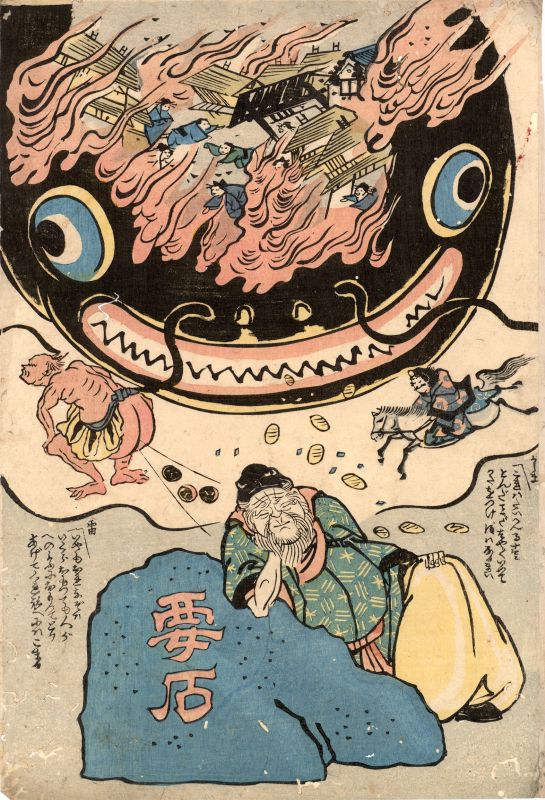
 , Namazu is a giant catfish who lives in the mud on the ocean floor. The god Kashima restrains Namazu with a stone, but from time to time Kashima loses focus and Namazu wakes, thrashing around and shaking the ocean floor. This morning, 80 miles off the coast of Sendai, Japan, Namazu awoke.
 An earthquake measuring 8.9 on the Richter Scale hit northern Japan just after midnight Eastern time. The resulting tsunami devastated coastal towns in Japan, and then made its way across the Pacific, hitting many island nations, Hawaii, and the west coast of the United States. While the loss of life in the U.S. is nothing compared to what has happened and continues to happen in Japan, the damage to ports and harbors is considerable.
This is the largest earthquake in Japanese recorded history. It is likely there has not been one this big in Japan for more than 1,000 years. This earthquake was almost 100 times stronger than the one that devastated the nation of Haiti in 2010. In a country that builds and practices and prepares for "the big one," this was the big one.
While I don't mean to minimize in any way the devastation in northern Japan, the lives lost, or the very real dangers still posed by emergencies at two nuclear power plants damaged in the earthquake, it's also important to recognize the strengths present in this situation. Japan's construction standards are clearly designed to take an event like this into consideration. If you compare the destruction and loss of life in Haiti, where no such building standards existed, to what we are seeing in Japan, it is clear that Japan was as ready as you can be for something like this. The first news report I heard on the radio this morning was from a reporter standing on a balcony overlooking Tokyo. Just the fact that there is a single balcony left in Tokyo tells you how well the Japanese prepared.
The horror we feel considering what has happened in Japan, then, is very different than what we experienced after the earthquake in Haiti. In Haiti, we saw roughly 230,000 people wiped off the planet by a natural disaster and by the unpreparedness and fragility of life in abject poverty. In the United States, we suddenly knew, in a way that many of us hadn't before, that Haiti was our neighbor and that we needed to step up and help.
The horror many of us feel today is different. Far fewer people have died. Japan is much farther away. And, as I've already said, they were prepared. At the same time, we generally regard Japan as being something "like us." While the culture of Japan may be different, it is a highly industrialized, modern country. We have high expectations for their ability to function in all kinds of circumstances. So we watch what is happening there and realize that if it could happen to them, it could happen to us. In Haiti, we felt guilty. In Japan, we feel scared.
Of course, this is not a one size fits all situation. If you have family in one of these countries, have traveled there, or feel some other connection, then one of these quakes may have hit you in a particularly poignant way. I have traveled to both places and have friends in each. Not surprisingly, as I wait for word about people I know in Japan, my mind drifts to worrying about folks in Haiti I haven't heard from in a while. That's the way it is sometimes. Namazu makes connections when he wakes.

Saturday, January 15, 2011
Two Personal Notes from the Tucson Shootings
Aside from what I had to say last week and today, and will have to say tomorrow, about this horrible event, I wanted to share two tidbits that are important, but neither of which stands on its own as a blog post.
The first is that I'd like to extend my prayers and well-wishes to fellow blogger Ashleigh Burroughs. I don't know Ashleigh personally, but she and I are both part of the BlogHer network, which sponsors our blogs and links the writing of female bloggers (supposedly quality writing, but then they include me so who knows) across the Internet. From time to time my sidebar includes links to her blog, "The Burrow," and hers to mine. When my traffic statistics show people coming here from ashleighburroughs.blogspot.com, I always think, "Thanks, Ashleigh!" even though I know the link was automatically generated.
Ashleigh was at the front of the line to shake Gabrielle Gifford's hand last Saturday when the shooting started. She was shot three times but, thankfully, survived. I wanted to publicly recognize Ashleigh and her family, and the difficult road they are on right now. Life has a funny way of linking people, and I take Ashleigh's shooting more personally than any of the other victims. It adds a "that could have been me" aspect that is both scary and tender. I'm keeping Ashleigh and her family in my prayers today and hope that you will, too.

*********************
The first is that I'd like to extend my prayers and well-wishes to fellow blogger Ashleigh Burroughs. I don't know Ashleigh personally, but she and I are both part of the BlogHer network, which sponsors our blogs and links the writing of female bloggers (supposedly quality writing, but then they include me so who knows) across the Internet. From time to time my sidebar includes links to her blog, "The Burrow," and hers to mine. When my traffic statistics show people coming here from ashleighburroughs.blogspot.com, I always think, "Thanks, Ashleigh!" even though I know the link was automatically generated.
Ashleigh was at the front of the line to shake Gabrielle Gifford's hand last Saturday when the shooting started. She was shot three times but, thankfully, survived. I wanted to publicly recognize Ashleigh and her family, and the difficult road they are on right now. Life has a funny way of linking people, and I take Ashleigh's shooting more personally than any of the other victims. It adds a "that could have been me" aspect that is both scary and tender. I'm keeping Ashleigh and her family in my prayers today and hope that you will, too.
************************
The second is that I'd like to share with you what I think is the best commentary on the shooting out there. It might come as no surprise, given the polarization and dumbing down of our public remarks these days that it comes from Jon Stewart of the Daily Show. I urge you to watch it, if only to aid in the healing of this wound to our collective psyche. (The clip begins with a rather amusing bit by John Oliver -- stick with it through that to get to the commentary.)
of the Daily Show. I urge you to watch it, if only to aid in the healing of this wound to our collective psyche. (The clip begins with a rather amusing bit by John Oliver -- stick with it through that to get to the commentary.)
Saturday, January 8, 2011
Rep. Gabrielle Giffords Shot, U.S. District Court Judge John Roll Killed

You don't have to be a fan of Speaker John Boehner to appreciate that he got it exactly right today when he reacted to the attack on Congresswoman Gabrielle Giffords in which six others, including U.S. District Court Judge John Roll and a child, were killed and Giffords was critically wounded.
An attack on one who serves is an attack on all who serve.Eighteen additional people were injured in the shooting, which occurred outside a grocery store in Tucson during a public event hosted by Giffords. The alleged shooter is a 22-year-old man who, in various social media, talks about himself as the "mind controller" and lists Mein Kampf
 andThe Communist Manifesto
 among his favorite books.
I'm not from Arizona and, like many Americans, I knew nothing about Rep. Giffords before today's attack. Yet the story grabbed my -- and the country's -- attention almost instantly. If it were just me we could chalk it up to the subject matter of my blog. After all, my family no longer says, "Did you hear this horrible news?" when something bad happens. They say, "Do you need a blog topic?" But it isn't just me. As I write this than four and a half hours after the shooting, Google News is listing nearly 4,000 news articles online about this event.
To me, this raises two questions of the sort where you think you know the answer until you try to articulate it. The first is, why do we care about the shooting of someone we've never heard of? The second is, if we have a reason to care, why do we focus on the fact that Rep. Giffords was shot and not on the death of another public servant, Judge Roll?
The answer to the first question, I think, goes back to Speaker Boehner's remarks. Understandably, he feels a personal connection when someone targets a member of Congress. By the same token, we as citizens feel a personal connection because, as the title suggests, congressional representatives represent us. They are our voice in government, whether we love them or hate them. When someone attacks a member of Congress, we know on a gut level that they are attacking the people that person represents, or at least the people who voted for them. Whether we ever heard of Gabby Giffords before today or not, the position she holds makes us assign particular and personal significance to her shooting, what it means to us as individuals, and what it means to our system of government.
That having been said, what about Judge Roll? He was a public servant. His job was to ensure equal and fair protection of the law for all. He had received death threats over a recent immigration case, and surely we should worry for our system of government if judges cannot rule without worrying about their lives. Why aren't we focused on him?
I think there are a couple of reasons. First of all, eyewitness accounts seem to indicate that Giffords was the first one shot and the original intended target. In the chaos that followed, she was the only person shot whom everyone knew had been shot. The news of Judge Roll's death came several hours later, and the story had already been "branded" as being about Giffords.
Still, I suspect that even if Roll had been the target and Giffords had not been there, this would not be as big of a news story. And I think that's largely because your average person on the street doesn't have a very clear idea of what a District Court judge does. We understand judges in general, and we understand Supreme Court justices, but we don't have a good mental image of the importance of mid-level federal judges and their day-to-day impact. We also don't elect federal judges, so we don't feel the connection that we do to members of Congress. No one out there is thinking, "I know who John Roll is. He's my judge."
Intellectually, I think that we should care very much about the assassination of Judge Roll, at least as much as the attempted assassination of Rep. Giffords. But reactions to traumatic events are not about what we think, they're about what we feel in that fleeting moment before our thinking brain takes over. So my gut is focused on Rep. Giffords and her family. My brain, and the heart that sometimes follows it, also expresses horror and condolences to the family of Judge Roll and the other five people who died in Tucson today.

Sunday, July 18, 2010
Girl Dies on Spanish Amusement Park Ride

A 15-year-old girl died Saturday evening at the Tibidabo amusement park in Barcelona, Spain when a mechanical arm on "El Pendulo" ride broke and the basket holding passengers fell onto another ride below. Three other people were injured, two of them seriously.
It happens that on Saturday evening I was at the home of some good friends who are major theme park enthusiasts. In fact, we spent part of the evening watching excerpts from "Bert the Conqueror," a show on the Travel Channel featuring a man who travels the country trying out various challenges and local thrills. Very often this includes riding scary amusement park rides, and that's mostly what we watched last night. In an episode where he visits Cedar Point
 (which is as close to a "local" theme park as we have here in the Ann Arbor area), he sizes up a particularly terrifying ride and says, "They have regulations, right? It has to be safe."
That line was ringing through my head as I read about the Barcelona accident today. Those of us who enjoy the occasional thrill ride rely on the fact that reputable amusement parks inspect their rides carefully. That is what enables us to enjoy the death-defying feeling of the rides while still being confident that we will, in fact, defy death.
El Pendulo was inspected in June and judged to be safe. Obviously, by yesterday, it wasn't safe anymore. This is exactly what is not supposed to happen at amusement parks. If death on thrill rides was all that common, very few people would ride them. The industry relies on this sort of thing not happening for its very existence.
This young lady is not the first person ever to die on a ride at an amusement park, and she unfortunately will not, most likely, be the last. So where does that leave folks who like amusement parks? How do we manage to get on the more extreme rides and enjoy them when something like this can happen?
There are two possibilities. First, we can decide that it's not worth it, or that a particular type of ride which we perceive as being particularly dangerous is not worth it. There are rides I still won't go on because my mom wouldn't let me go on them following an accident when I was a child. I know that was 30 years ago and changes have been made, but the imprint that certain rides are dangerous remains.
The second possibility is that we can take this single incident and add it to the mental model we have of amusement park safety. If we do that well, we recognize that a single death does not tilt the scales all that much when you consider the millions of people who don't die at amusement parks every day. Death on a thrill ride is possible, but it is not likely. According to the International Association of Amusement Parks and Attractions, the chances of a serious injury on a "fixed-site" (as opposed to mobile carnival) ride is about 1 per 21 million rides taken.
The second possibility may be the logical one, but it is not the one you should expect of yourself the day after an accident like this. That's particularly true if you are contemplating riding a ride very similar to El Pendulo, if you're at the Tibidabo park, and certainly if you witnessed the accident. Trauma messes up our gut instincts about what is possible and what is likely. It's very natural to start out going with the first possibility -- deciding that it isn't worth it. Most of us move to the second, perhaps without the actual statistics but with a general understanding, in time.
Wednesday, June 23, 2010
Dallas Police Chief's Personal Agony

Police officer Craig Shaw of Lancaster, Texas, about 20 miles south of Dallas, was shot and killed on Sunday while responding to a shooting at a local housing complex. Another officer returned fire, killing the suspect, who had, in turn, shot Jeremy McMillan. The shooter turns out to be the son of Dallas Police Chief David Brown, and McMillan appears to have been targeted at random. His two young children were in the car with him when he was shot, and emerged covered in their father's blood but unhurt.
We know that the death of a police officer in the line of duty represents a major and complicated critical incident. Even for those in law enforcement in other jurisdictions, line of duty deaths can be very personal and very traumatic. The death of Officer Shaw would probably have an impact -- possibly a big one -- on Chief Brown by itself. The death of his son obviously would, by itself, as well. And the notion that his son killed someone, too, would be a big deal. Now Chief Brown has all of these things to contend with at once.
Last week, I spent some of this space trying to get inside the mind of a mother whose daughter killed her son. While Chief Brown's situation isn't exactly the same, it's not far off. When someone you love commits murder, it severely tests what you believe about family loyalty. It's hard to be "loyal" to a family member who has done something so awful, but it takes a big person to reach out to the family of the victim in this situation. When the victim is themselves someone you care deeply about, your loyalties are torn even further. And when your loved one, the one who committed murder, is dead themselves, it's hard to know which way to turn.
It's both important and very difficult to remember that, while Chief Brown's son may be at fault for this entire situation, Chief Brown himself is not, nor is his family. People never know what to say when tragedy strikes a family. That is only compounded many times over in this situation. The tendency will be for people to put their energies elsewhere, figuring that comforting the Shaws and the McMillans are much more important than comforting the family of a murderer. However, this is as much of a tragedy for the Browns as for the two other families.
We don't like morally ambiguous situations. We want it to be the case that either we are glad that the shooter is dead or we're not. If we're reflective in this situation, however, most people will come to the conclusion that there are two conflicting truths in this situation. The first is that the shooter's death was necessary to prevent further violence (and some of us might say he got what he deserved). The second is that the death of Chief Brown's son is a terrible loss to his family. It's hard to hold those two things in our minds at the same time. I hope enough people close to the Chief can do so to provide comfort and support
 following this awful incident.
Thursday, May 20, 2010
Jacksonville, Florida Mosque Bombing and the Othering of American Muslims

Last Monday, a pipe bomb combined with gasoline exploded in back of the Islamic Center of Northeast Florida in Jacksonville. Sixty people were worshiping inside at the time. No one was injured, although the building suffered minor damage and filled with smoke for a short time. A $20,000 reward has been offered for information leading to the arrest and conviction of the bomber, who was captured on surveillance camera. He appears to be a middle aged white male.
The national media has not picked up the story of the Jacksonville mosque bombing to any great extent. If you do a Google News search for "Jacksonville Mosque" you will turn up numerous stories from the Florida press, as well as an assortment of national blogs discussing the fact that the national media has ignored this story, but not much else. Most of these national blogs note the implied prejudice of major news outlets failing to pick up what certainly appears to be an attempted terrorist attack that could have killed 60 people, but whose victims are Muslim.
I don't disagree with these bloggers. However, I think even they are guilty of what scholars sometimes call "othering
 ." They are outraged at the act itself, and at the media for failing to cover it. But they don't go as far as to express empathy with the community that was attacked. They are reacting to the politics, but not to the impact of the attack itself. Someone has attacked those "other" people, and we (presumably "typical") people are outraged by the attack and outraged at the media. But we aren't caring for the victims.
For the religiously affiliated among you, try to imagine how you might feel if your church or synagogue were attacked. How safe would you feel at the next service? How confident would you feel parking in the parking lot? How much sleep would you lose? How much grief might you feel for actual damage done? And how much anticipatory grief might you feel at the thought of damage that might yet be done?
Now imagine that the bulk of those who support your congregation expressed that support by insisting that the news cover the incident. Surely you'd appreciate that. There's nothing wrong with taking a firm stand that such attacks are unacceptable regardless of who the victims are, and that media should report them without bias. But wouldn't you want some of those same folks to stop by your church or synagogue or your house? Wouldn't you want them to try to understand your fear and how very personally you took this attack? Wouldn't you want people to stand up, not just for you, but also with you?
I have nothing against the bloggers who have pointed out the media's bias. It needs to be done. But it is only the first step. I challenge my blogging brethren not just to cover the politics of this attack and its coverage, but to really try to understand how it feels to be a victim of it, and bring that experience to their readers. Until we are able, as a blogosphere, to see victims of anti-Islamic violence as "us" rather than "them," it will continue to be easy for people to turn that othering to violence.
Wednesday, May 19, 2010
Trauma in Slow Motion from the Gulf Oil Leak

It has been a month since the Deepwater Horizon
 oil well started spewing millions of gallons of oil into the Gulf of Mexico. A few days ago word came that they had managed to start capturing some of the oil, but they haven't managed to stop the spewing -- this is a temporary solution. Now part of the spill appears to be rounding Florida and heading up the east coast.
A critical incident is usually defined as any event which has the potential to overwhelm usual coping skills and cause significant distress and impairment. A trauma is a deeply emotionally or physically distressing event. While it's not part of the definitions, the events that tend to be identified as critical incidents or traumas are also very sudden. The suddenness is often part of what overwhelms us. It all happens so fast that we don't have time to process things as they happen.
Aside from the folks on the oil rig that exploded itself, this spill is not a sudden event. There was plenty of time between when the well started leaking and when the oil started to impact people's lives on shore. No one in Louisiana, for example, was killed or maimed by the sudden oil spill that came out of nowhere. Folks on the east coast, who may be about to be impacted, have plenty of time to prepare.
So is this a critical incident? Is it a trauma? I think, for at least a subset of the population, it is. There is a reason that suddenness is not part of the official definitions. If you think about it, there are other traumas that are not sudden. People may know for days or even weeks, for example, that a hurricane is headed their way. That time to prepare may mitigate the impact of the storm, but the storm still can be traumatic -- just look at Hurricane Katrina
 . Traumatic incidents can also happen over a long period of time, as happens with childhood abuse. Critical incidents don't have to come out of nowhere.
Returning to the oil spill, if you are a fisherman in the Gulf of Mexico, the fact that when the well started leaking you knew you were in big trouble didn't help a whole lot. If your livelihood has been wiped out by this disaster over the last month, it is relatively little consolation that it was oil contaminating the ocean over a few weeks rather than, say, a sudden storm that destroyed your boat. You did not start the year expecting this to happen, and it happened in a way that was utterly destructive to your ability to earn a living. In addition, there is a pretty good possibility that you were just getting back on your feet from Katrina when this happened. Watching it happen in slow motion might make it easier to deal with, or it might make it harder. But this spill certainly has the potential to overwhelm your usual coping mechanisms.
For people on the east coast, this might even be a little more traumatic. That's because people whose livelihood depends on clean water in the Atlantic saw this spill happen and thanked their lucky stars it wasn't near them. They identified with those on the gulf coast, but they also separated themselves from them. This was happening to "them" not "us." Now, they are us, and most people on the eastern seaboard have probably not used the intervening time to figure out what to do.
Others with more expertise than I can expound on the causes of this catastrophe and the implications for future energy policy, the environment, and the like. When the damage is tallied, the monetary losses to the fishing and tourism industries and others that rely on the ocean will be included. I hope that those in the know will include, somewhere in there, the psychological damage to the people in those industries and communities who may very well lose their entire way of life.
Tuesday, May 11, 2010
Kent State, 40 years and One Week Later

On May 4, 1970, members of the Ohio National Guard opened fire on unarmed students during a protest at Kent State University against the United States' invasion of Cambodia. They fired 67 shots, wounding 9 and killing 4. Eight Guardsman were subsequently indicted, but the case was dismissed.
On May 4, 1970, my mother was pregnant. The baby was due on May 15. My parents lived in Concord, Massachusetts, but my mother was slated to deliver the baby at Mt. Auburn Hospital in Cambridge, about 20 miles away. My father also worked in Cambridge. Their last baby had come rather quickly, so my mother spent the last days of her pregnancy at my father's office so that, if she went into labor during the day, she would be close to the hospital and my father would be with her.
On May 4, 1970, my father walked into his office and found my mother sitting by the radio, distraught. News of the Kent State shootings had been reported. She told my father, "We can't bring a baby into this world." My father, in his ever-helpful way, responded, "It's a little late for that."
On May 11, 1970, their baby was born. For the record, although the 11th was a Monday, the extra precaution of my mother going to work with my dad turned out to be unnecessary. She went into labor on Sunday, Mother's Day, and the baby was born less than half an hour after midnight on Monday morning.
As in many families, the story of the day each child was born was told and retold as I was growing up. Different people told different versions with different emphasis. The story about my mother listening to the radio in my father's office was often part of the tale.* Growing up, "Kent State" was not a university in my mind, but an event, and because it was part of a family birth story it was, somehow, our event.
Last week marked the 40th anniversary of the Kent State shootings. Anniversaries of traumatic events are hard for the survivors and family members -- most people recognize that. In its own way, this anniversary was hard for the collective consciousness of the country, as we wonder what, if anything, we learned 40 years ago.
I found myself oddly affected by the news stories about the anniversary last week. On the one hand, the shootings did not affect me or my family directly. At the same time, Kent State is part of my family, part of our lore. So today, May 11, 2010, I honor the students who died at Kent State, 40 years and one week after my mom heard of their deaths on the radio and wondered about having this baby, and 40 years after she did, in fact, bring me into the world.
* As with many family stories, this one has been filtered through the years. I undoubtedly have parts of it wrong, and no doubt someone in my family will let me know about it.
Monday, May 10, 2010
Do You Remember Sandra Cantu?

Just over a year ago, an 8-year-old girl named Sandra Cantu disappeared. Today, her killer pleaded guilty to her murder. I know that I, along with many of you, followed Sandra Cantu's disappearance and the arrest of her killer carefully when it happened. In the intervening year, however, the details have faded to the point where the name Sandra Cantu only vaguely rang a bell when I saw it in the headline. I knew I knew something about her, but couldn't place it. I'm guessing many of you can't, either.
Let me help you out. Sandra Cantu lived in Tracy, California trailer park. On the day she disappeared, surveillance cameras captured images of her skipping through the neighborhood. Ten days later, her body was found a few miles away in a suitcase in an irrigation pond on a dairy farm. The woman arrested was a former Sunday school teacher and the mother of one of Sandra's friends. In addition to her kidnapping and murder, the killer was charged with various counts of sexual assault. These were dropped as part of the plea deal.
If you, like me, are now saying, "Oh, yeah, I remember her," it suggests an obvious question: how could we know so much about this case and forget it in a relatively short time? How could this story capture our attention so thoroughly and then let it go almost as quickly?
First of all, part of what captured our attention in the first place was the mystery of what happened to this little girl. While the search was still going on, we paid attention because we were waiting for new information. Once the body was found and an arrest made, we still paid attention because we wanted more information about what had happened. But after a while, we stopped getting new information. We knew who had killed her and what they had done, and we realized we weren't going to get any more details about the motive or the killer, so we stopped paying attention and the media stopped reporting. Without the daily dose of new details, we lost interest and started to forget.
Another part of why we were interested initially is that the case scared us personally. Whether you were a parent concerned for your own child or just a person who wondered what on earth the world was coming to, as long as Sandra Cantu was missing or her killer was "out there," the world didn't seem very safe. Once her killer had been caught, and once the initial shock that it was a woman and a neighbor had worn off, we weren't scared anymore. The boogie man wasn't out there, and she wasn't a man. She was a woman in jail, and we could go back to pretending that bad people don't exist.
This is, in fact, a fairly adaptive response. As I'm fond of saying, we live our lives based on what is likely, not what is possible. Sandra Cantu's murder made us acutely aware of what was possible. But we can't go through life like that, and so, when the initial hubbub died down we allowed ourselves to put this case to the side. The alternative would be to look suspiciously at everyone we know and keep our children locked in the house all the time. With the exception of those who lived in the same trailer park as Cantu and her killer, we recognize that that would be an overreaction. A little forgetting is good.
So, now the Sandra Cantu case is over. Her killer faces 25 years to life in jail. A case that took up so much of our collective attention a year ago now ends with more of a whimper than a bang. Perhaps that's how it should be. Perhaps this footnote on her death will allow those who loved her to remember her not as much for how she died, but as we all wish to be remembered -- for how we lived.
Sunday, May 2, 2010
Not a Drop to Drink -- We Mean It
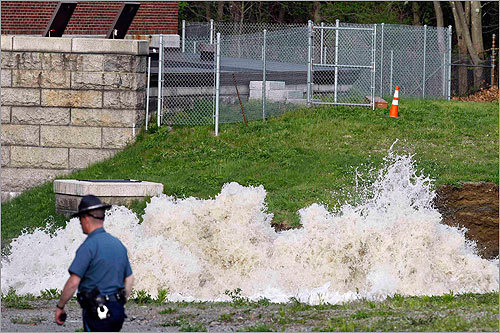
About two million people in the greater Boston area are under a boil water order for the second night tonight, after a massive water main break in Weston, about 15 miles west of the city. The vast majority of communities in the Boston area are part of the Massachusetts Water Resources Authority (MWRA), which provides water and/or sewer service through a centralized system. All communities in the MWRA east of I-95/Route 128 were affected by yesterday's break. The backup reservoirs that are being used while the break is fixed are not as large as the one that usually feeds the system, and are largely untreated, so in addition to the water being unsafe to drink, people are also being asked to minimize their water usage.
In the history of catastrophes, certainly there are many more catastrophic than this one. It is unlikely anyone will die from this water emergency, at least if they follow the boil order. At the same time, this kind of story grabs our attention, or at least it grabs my attention. As a native of the Boston area, I feel a particular connection to this situation. In a more general way, however, this is also impressive because of the sheer number of people affected. It draws our attention to how much we take for granted the phenomenon of turning on the faucet and getting drinkable water. It also serves as something of a dry run for a truly life-threatening emergency. We all figure we'd manage if something failed at our house -- we could always go to the neighbors or a hotel or the next town over. Something like this makes you realize what happens when everyone is affected at the same time.
Because this isn't a life-threatening disaster, it's easy to think that people shouldn't be too upset. That might sound logical, but the human mind isn't all that logical. There are all sorts of signals -- from the tone of the news reports to the disruption of normal routines -- that something big has happened, and it's understandable that a lot of people find themselves feeling hyped up for what seems like no good reason. Some people will even find themselves disappointed that this wasn't scarier or bigger or more important. That's understandable, too, because they're actually wishing that events would justify their gut reactions.
There is something about a situation like this one that brings people together. This is the sort of thing where people will say, "Do you remember the great water crisis of 2010?" and people will swap their stories. In that sense, there is something of the feeling of adventure to this type of incident. It is just serious enough to make us really pay attention, but not so serious that it will be too scary to reminisce about it.
The last such that fits this description for me was the Northeast Blackout of 2003. A massive succession of failures in the power grid on August 14, 2003 blacked out much of the mid-Atlantic and southern New England, as far west as Lansing, Michigan. I bring this up because not only is it the same kind of event, but, for my family, it had a similar effect. We live in a township without access to municipal water, so our water comes from a well in our backyard via a pump -- an electric pump. With no electricity, we had only the water in our pressure tank, and no idea how long we would have to make it last.
I have great stories about those couple of days. There are some about neighbors helping neighbors. Some about the crazy things that people did to get what they needed. Some that would embarrass my child if I told them publicly. That's how this sort of thing goes. When this is over, the people of Eastern Massachusetts will have good stories, too. In the meantime, they've got a major nuisance to deal with, and possibly a gut reaction to it that seems embarrassingly strong. They might be surprised to know how many of their neighbors have that reaction, too.
Monday, April 19, 2010
Death on Patriots' Day

Today is April 19, and it is a very important day in the history of the United States. Most people around the country remember this date as the anniversary of the bombing of the Alfred P. Murrah Federal Building in Oklahoma City
 , in which 168 people died. For those of us born and raised in the great town of Concord, Massachusetts, however, April 19 is Patriots' Day, a state holiday commemorating the beginning of the American Revolution
 with the battle of Lexington and Concord in 1775.
Patriots' Day is part of the fabric of my childhood. As a young child, one of my earliest vivid memories was of waking in the wee hours of the morning to go to the dawn cannon salute for the American bicentennial. For us, the bicentennial was in 1975, not 1976. Every year we went downtown for the Patriots' Day parade. Reenactors recreated the battles of the day, and still do. To me, a flag with 13 stars
 in a circle was completely normal. I was horrified recently to discover that my daughter wasn't quite sure what happened on April 19, and what year it happened. I haven't lived in Massachusetts for 19 years, but it still doesn't feel quite right to have school on April 19.
Frequent Quarterbacker Abe is an 18th century reenactor who lives in Concord. He and his family are part of a French regiment in neighboring Sudbury, although of course on April 19 they do not reenact as French because the French had not joined the war yet. He also happens to be my brother.
This evening, Abe forwarded along a story that certainly jumped out at him and jumped out at me as well. Early this morning, as the reenactors of the Bedford (Massachusetts) Minutemen marched the five or so miles from Bedford to the Old North Bridge in Concord, 61 year-old Neil Hill collapsed of a heart attack and was pronounced dead at the hospital. Abe writes,
Can you imagine marching in a parade after experiencing this? We actually saw the ambulance come through the center of town, although of course we didn't know that's why it was coming.Oddly, my first reaction to this death was that it somehow desecrated the Patriots' Day celebration. My gut reaction was, "People aren't supposed to die on Patriots' Day." On the face of it, this actually makes no sense at all. Of course people die on Patriots' Day. First of all, people die every day. Second, this celebration commemorates a battle. The notion that people aren't supposed to die on a day dedicated to a war is a little silly. At the same time, I think my feeling is understandable. Patriots' Day is part of my childhood, and, like many things from our childhoods, I have idealized it. In the perfect celebration of my youth -- or my imagination -- people didn't die.
Abe's reaction is also understandable, and really another side of the same coin. If you are an 18th century reenactor in Massachusetts, today is the biggest day of the year. Presumably, you do reenactments because they are fun and interesting, and today is more fun and more interesting than many. For someone to die on April 19 adds a dose of real life to an otherwise joyous and highly symbolic occasion. Somehow having a parade doesn't seem right. At the same time, however, the parade goes on in part out of a realization that while years from now people may still remember who died today, their significance will more likely lie in their life than their death. I hope that day comes sooner rather than later for the Bedford Minutemen and the family of Neil Hill.
Subscribe to:
Posts (Atom)
Meet the Quarterback

- Naomi Zikmund-Fisher
- is a clinical social worker, former school Principal and a Crisis Consultant for schools and community organizations. You can learn more about her at www.SchoolCrisisConsultant.com

Subscribe


 Posts
All Comments
Posts
All Comments