Showing posts with label fire. Show all posts
Showing posts with label fire. Show all posts
Friday, April 22, 2011
Anniversaries: Bombs in Littleton, Colorado

Wednesday was the 12th anniversary of the shootings at Columbine High School near Littleton, Colorado. For those of you much younger than I or living under a rock, on April 20, 1999 two students went through the school shooting, killing 12 students, one teacher and, eventually themselves. The original plot was for propane bombs to explode outside the cafeteria, sending people running directly into the line of fire. The bombs failed to go off.
On Wednesday, April 20 this year, a fire broke out near the food court of a mall in Littleton, Colorado. When it was extinguished, firefighters found two explosive devices nearby. They had not, thankfully, detonated. The mall was evacuated and the schools placed on lockdown.
Anniversaries of traumatic events are tricky things. From a distance, there is no particular reason that the anniversary of an event is any better or worse or more or less related to the event than any other day. But we don't live at a distance. Our culture tells us that one rotation of the earth around the sun is an important length of time, and each successive rotation is also important. If we had no concept of a calendar, we might not care that this week's incident coincided with the anniversary of the massacre at Columbine. Most of the time we're glad we have that concept. This week, perhaps not so much.
I first learned about the mall incident on Thursday morning from a friend's Facebook post. She noted that she has family who love to shop near there, and another friend commented that she has family there too. This is the sort of personal connection we all tend to make at moments like this. The thing is, it really doesn't make a whole lot of sense. On Wednesday two bombs did not go off at a mall near where bombs were placed and shootings occurred 12 years ago. Why, on Thursday, do I care that I have family that was in the area but not at that mall on Wednesday?
We notice these connections, as distant as they may seem, because of a very natural and automatic response we have to danger. When a threat is detected -- whether because we see or hear it ourselves or we simply hear about it -- our automatic response is to ask whether it affects in any way. I imagine us sending little office workers into the files in our mind to find out if we have anything filed where the danger is. If the threat is near us -- say an oncoming car -- those little people come back pretty fast with "yes!!" and we try to get out of the way. Most of the time, they come back with "no."
Once in a while, however, they come back with the news that we have stuff in a related file but it's not clear how important the relationship was. They looked under "Littleton, Colorado
 " and found the "Columbine" file. For my friends, they found the "shopping" and "family" files. Even though the answer to whether the threat affects us is still "no," it takes us a little longer to decide that. Even though we know we and everyone we love are OK, we are left with that nagging feeling that "no" isn't the whole answer. And so we post on Facebook and say, "This could have affected someone I care about but it didn't."
 The interesting thing about such loose and tangential connections is that, when we post them, our friends all know how we feel. We've all been there, and the little office workers are just doing their job.


Saturday, March 5, 2011
In Loco Parentis -- the Houston Daycare Fire

On February 24, a kitchen fire destroyed a home day care in Houston, Texas, killing four children and injuring the other three there. All were less than three years old. The day care operator was unharmed, which is not surprising given that surveillance video shows she was shopping at Target when the fire started. She has since fled the country.
The death of a child -- any child -- for any reason is horrific. Incidents involving children are one of the types of traumatic events that automatically trigger the response of a Critical Incident Stress Management team in many fire and police departments simply because the chances are so big that the first responders will be seriously emotionally impacted by them. Children aren't "supposed" to die. That's how we believe the world works, and when they do die it shakes us up.
This event, of course, is made infinitely worse by the fact that it appears to be directly caused by someone's negligence. As much as we believe children don't die, we also believe that everyone protects children. And we certainly believe that people whose job it is to protect children at least try. If the death of a child in a car accident shakes up our worldview, the death of a child due to the gross negligence of a caregiver explodes it.
Or does it? When children are killed by their parents we are horrified, but we are not, at least from a distance, as traumatized. That's because when parents kill their children, most of us analyze the situation and judge that our own children are safe. We know that the same thing won't happen to our family because we know we will not murder our children. It's horrible, but it's easily prevented.
Which brings us around to this particular situation. Those of us with children in day care or school drop our children off each day and leave them with others who act in loco parentis, meaning "in the place of the parents." We give those caregivers the right and the responsibility to behave as parents to our children, and we believe that those caregivers will do at least a rough approximation of what we would do with regards to our kids and their well-being.
Those of us who work in schools or day cares, on the other hand, know that sometimes the expectations of parents can be unreasonable. When something goes wrong and the parents are not present, they are likely to blame us, even if, in reality, they would have done the exact same thing we did. If a child is playing in their back yard and falls and breaks their arm, the parents feel bad but recognize it as an accident. If it happens on the playground at school, they are much more likely to blame the school staff. That's because we confuse acting in loco parentis with preventing all harm to children. The former is the law. The latter is impossible.
But in this case, it wasn't impossible. Could this fire have started had the day care provider been with the children? Quite possibly. Fires happen. It could have happened in a child's home, too. Could one or more of the children have been injured or killed in such a situation? Also possible. Kids are hurt in fires under the best of circumstances. Despite our best efforts, children die.
But this wasn't the day care provider's best efforts. We will never know if that fire would have started had she been doing her job, or whether the kids would have survived it if it did. She didn't try. When we drop our kids off at day care, we do so with the belief that the person acting in loco parentis is a responsible person. We wouldn't leave them if we didn't believe that. I can only imagine the horror of finding out this way that you were wrong.

Sunday, September 12, 2010
After the San Bruno Explosion, What are You Scared Of?

Thursday night, a giant explosion ripped through a neighborhood in San Bruno, California
 . The blast and subsequent fire, apparently caused by a ruptured gas line, leveled 38 homes and killed at least 7 people. Six more are missing.
 I don't know about you, but if you gave me an hour to list all the horrendous things that could happen to me I could come up with a pretty long list, but I doubt a gas explosion destroying my neighborhood would be on it. It certainly wouldn't be on the top. We all know, in the back of our minds, that there are certain things that could happen to us -- car accidents, homicide, natural disasters (different ones, depending on where you live) -- but there are other things that just don't make the list because they are so rare we don't know about them. Gas leaks? Sure. Gas explosions? Maybe. The entire neighborhood detonating? Not so much.
I'm not sure whether that makes the typical person's reaction to this better or worse, but it does make it different. When we hear about, say, a horrible car accident that killed multiple people, it may make us more afraid to drive. We may lose our own sense of safety on the road. We may imagine what it would be like to be a family member getting that call, or to be on the road and witness or be involved in the crash.
Our reaction when something so bizarre happens is a little bit different. Yes, we probably are more sensitive to the smell of gas or more careful not to leave the stove on. We probably don't spend a lot of time imagining what it would be like to be in the incident itself, largely because we just can't. Even once it's happened somewhere, our minds can't yet process fully how such an event would play out.
The most important difference is the quality and amount of fear we may feel. When we hear about a car accident, if we feel afraid we feel afraid when we drive, or when our loved ones drive. The fear is specific to the incident. An extraordinary incident like the San Bruno explosion, however, can cause two different kinds of reactions: either it seems so unlikely that even though it's happened it doesn't seem possible, or it seems so random that the entire world seems less safe. Our fears, if we have them, are not specific to gas lines or even to sitting in our homes. They are about something completely random coming out of nowhere and hurting us. We don't react to the sudden discovery that a specific situation is not safe, we react to the discovery that the world is not safe.
Most of us experienced this kind of reaction nine years ago, after the 9-11 attacks
 . The fear we felt and the reactions we had were not necessarily about flying or working in an office building or even about the type of person we presumed to be the terrorists. It was fundamentally about the notion that a day could start as normally as that day did, and turn into such a nightmare without warning. Our worldview was violated not because we used to think flying was safe and now it wasn't, but because we used to think that life was safe and we found out maybe we were wrong. The people of San Bruno found that out again this week, and in some small way, so did the rest of us.
Saturday, April 3, 2010
Does Ann Arbor Have a Fire Bug?
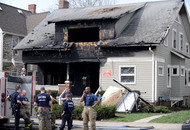
Overnight last night, there were three fires in Ann Arbor. All began outside student housing. All are under investigation. The most serious, which began on the porch of a rental house, sent three people to the hospital. One, Eastern Michigan University senior Renden LeMaster, subsequently died. To put this in some perspective, during 2006 (the most recent statistics I could find), the Ann Arbor Fire Department responded to 322 fire calls, less than one a day, and many of these were for situations that did not require them to put out a fire (e.g. burnt toast). So three is a lot, and someoned dying is a very big deal.
There are two pieces of context that are important in understanding how people are thinking about this. The first is that yesterday afternoon and evening the National Weather Service had issued a Fire Weather Watch for southeast Michigan. The weather was unseasonably warm and dry with high wind, meaning that conditions were ripe for fires to start and for small fires to become big ones. The other is that about 50 miles away in the city of Flint, as I wrote earlier this week, there have been about 40 arson fires in the last three weeks.
Either one of these two factors could stand alone and swing how we feel about the fires last night. If there was the weather alert and no situation in Flint, people might be thinking this was a string of terrible accidents exacerbated by the weather. If there were a firebug in Flint and no weather alert, we might be sure this was arson. As it is, we have both of those things, so you might expect people to reflect a balance in their thinking.
If that's what you expected, you would be wrong. The news coverage has made no mention of the weather alert at all. It has been fairly restrained, on the other hand, in pointing to arson. However, all of the news stories mention that the fires are "under investigation" and that one of them -- not the house fire, but one in which the fire started with a car that had not been driven in a few days -- is considered suspicious. A commenter posted something about the fires in Flint almost as soon as the first story about last night's fires in Ann Arbor went up. The University of Michigan has issued a crime bulletin which, paradoxically, describes "several fires" as being "under investigation," but then tells community members to make sure their cigarettes are fully extinguished.
So, why isn't there more balance in people's thinking? In the hours after an incident, balance is not what we're wired for. We are wired to consider the worst. This is a survival instinct. When something awful happens, we don't want to miss something that might point out that there is more danger ahead, so we are skittish. If someone has been shot, every car backfiring or door slamming sounds like a shot. If there has been a car accident, every driver seems a little erratic. And if there has been a fire, every fire might be arson. Add in the media's natural tendency to go for the sensational, and we don't have a prayer of having any sense of perspective on this.
It's entirely possible these were all arson fires. It's much more likely that one or two were and the other(s) were accidental. It is very unlikely that there is a new serial firebug in Ann Arbor, as there is in Flint, although of course time will tell. It's a good time to remember to check smoke detectors and escape routes, but it's also a good time to remember that while a rash of arson fires affecting us personally is possible, it still isn't likely.
Thursday, April 1, 2010
Arson and Layoffs in Flint

On March 24, the city of Flint, Michigan announced that it would be laying off 23 firefighters and 46 police officers the next day. Within minutes of the press conference, an arson fire broke out in a vacant building. In the nine days since, there have been nearly 40 such fires, including five last night alone. Three firefighters have been injured. Flint has asked for mutual aid, a system under which cities and towns agree to help each other in an emergency, from other county fire departments. Now those departments are starting to cancel their mutual aid agreements because they, too, are stretched thin.
No one knows for sure who is starting the fires. Many have speculated that they are a protest against the layoffs. Some have gone further and accused firefighters of setting them. The head of the firefighter's union has said he is truly insulted by that accusation, and that he does not believe the layoffs and the fires are connected at all. It is always possible that this is a horrible coincidence.
Layoffs can be very distressing to people in any profession. In a profession, like firefighting, where colleagues are closely knit, it is especially difficult. Unless you know or are a firefighter, it's difficult to imagine how much these men and women rely on each other and bond together. Layoffs represent a separation of one or members of, essentially, the family. It's a grotesque understatement to say that that is bad for morale.
On the other hand, you might expect that firefighters don't mind a string of fires. After all, putting out fires is what they do. Most firefighters will tell you, however, that while they like their work and are glad to be able to help the community, they don't actually want there to be a lot of fires. Like most emergency workers, they like being able to make a difference, but they wish they didn't have to. What's more, every fire represents a danger to the firefighters who respond. Any fire could become dangerous or even lethal. In that sense, every one of the arson fires in Flint is an intentional assault on the fire department.
In addition to the double-whammy of layoffs and the fires, we now have other departments saying that they will not come to Flint to help. I'm certainly not in a position to criticize those decisions -- every city has to do what makes sense for their people and their community. To the Flint fire department, however, this just adds insult to injury. People who go through critical incidents often feel helpless. The sense of not being able to do anything is horrible. Asking for help and not getting it greatly complicates the situation. Imagine someone who is assaulted in broad daylight while passersby ignore it. Their reaction may have as much to do with being ignored as with the assault. Now the Flint firefighters are being assaulted repeatedly, and neighboring cities are saying they will no longer help.
I don't know who's setting the fires in Flint, or what their motivation is. I will say that if they are motivated by support for the firefighters and protest of the layoffs, their actions are truly counter productive. They have taken a situation that would be hard under the best of circumstances, and escalated it severely. With friends like this, the firefighters in Flint sure don't need enemies.
Monday, December 28, 2009
The Heroism Instinct at Work on Flight 253

The passenger accounts of what happened when a man tried to set off an explosive on Northwest flight 253 last week are quite consistent. When the fire started, people started running up the aisle and across the plane to get away from the flames. Jasper Schuringa, a 32 year-old from Amsterdam who was seated behind and across the plane from the fire, jumped across the plane and over several people to tackle the perpetrator, get the melting syringe he was holding away from him, and subdue him.
Schuringa is being hailed as a hero, and he certainly is one. Unlike some heroes in other situations, Schuringa is not using the usual "anyone would have done what I did" line, however. At the risk of taking the wind out of his sails, I'm going to say it for him, at least to a small extent.
Most of us are familiar with what is called the "fight or flight" response. This refers to the physical and psychological reaction to perceived danger that comes from a very old, primitive place in our minds. Like animals stalked by a predator, our bodies and minds prepare to either fight back or run away. To be complete, we really should refer to the "fight, flight or freeze" response, because we also have an instinct to stand very still -- like the proverbial deer in the headlights -- as a way of self-preservation.
When the fire started, the people closest to it reacted instantly with the "flight" part of the response. They were in immediate danger from the fire itself. Their instinct, which if you think about it is a pretty good one, was to get away from the flames, and they did. So why did Schuringa act differently?
When Schuringa saw the fire, the immediate danger he perceived was not the flames. Remember, he was across the plane and was not about to be burned. From his perspective, the immediate danger was the plane going down. His instinct, because there is no running away from a crashing plane, was the "fight" part of the response. The same urge towards self preservation that made others run away made him jump on the bad guy.
Now, you could argue that there were others at similar distances from the fire who didn't do what Schuringa did, and of course that's true. Some of those people were experiencing the "freeze" response. Others were not physically capable of doing what he did. Still others did not perceive the threat to the plane but instead were concerned, as those close to it were, with the fire, and were assessing whether they needed to run. I seriously doubt that anyone was thinking, "Someone should stop that guy, but not me."
I do not mean to take anything away from Schuringa. We should all be grateful for his quick actions. All I'm suggesting is that what he did was just as instinctual for him as running away was for others. He can feel proud of what he did. No one else, however, should feel ashamed that they didn't.
Wednesday, December 9, 2009
Seabrook, Texas Shelters In Place
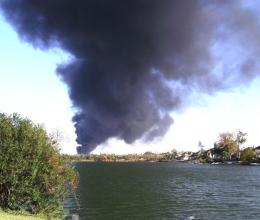
At about 8:45 this morning, a tank at the American Acryl chemical plant in Seabrook, Texas exploded, releasing a massive amount of black smoke and fumes into the air. The blast shook buildings throughout the town and as far away as Houston, 30 miles away. The fire was out within about an hour, and the only injuries were two workers who inhaled some fumes. Local residents and all of the schools in the surrounding area were asked to shelter in place following the explosion.
This raises an interesting question. Do you know what sheltering in place is? If you got an order to do it, would you know what to do? If you're not in emergency management, crisis response or a first responder, you may well not. And that's a problem because, unfortunately, emergency managers don't always speak plain English when they're giving information. The clear directive to shelter in place may seem obvious to them, but it isn't necessarily to us.
In case you're still wondering, sheltering in place is a lot like what it sounds like. It means staying where you are and not going outside. Depending on the circumstances, it might also mean going to the lowest level of the building or to the highest levels (in the case of chemical agents that are settling down). It may or may not involve locking and securing doors and windows, depending on whether the hazard is something like a chemical spill or something like a bank robber running through the neighborhood.
Sheltering in place may not seem like a big deal, and it probably isn't if you only have to do it for an hour or two. In Michigan, we are actually required to practice sheltering in place at least once a year, which basically entails telling everyone to come inside, locking the doors and taking attendance. We can imagine situations, however, where people have to shelter in place for several days -- for example, if a chemical plant is burning and the fire isn't put out quickly.
Most homes are pretty poorly equipped to shelter in place for any length of time. Most of us have enough food for several days, but most of us don't have enough water if the water supply is contaminated. Schools are even worse -- most schools don't have even one day's supply of food and water for all staff and students, let alone facilities for sleeping. I can imagine nothing much worse, as a Principal, than having to keep students overnight. In fact, when I teach CISM classes I use such a scenario as a training exercise. It's that bad.
I'm glad the fire is out in Seabrook and the danger seems to have passed. I'm glad all those kids got to go home at the regular time and sleep in their own beds, and the residents are going about their daily business. But I wonder how long it will be before something like this happens and really shuts down a school district or a county. I know for sure, we're not really ready.
Sunday, December 6, 2009
The Children of Our Bravest: Some Thoughts on Nightclub Fires

A fire broke out at a crowded nightclub in Russia on Friday night, killing 112 people. Faulty fireworks are being blamed, and a number of people are under arrest. Most of the dead breathed toxic fumes from the fire. Reports from those who were inside indicate there was a stampede which wound up blocking everyone's way out.
This may sound familiar to Americans, who remember the fire at the Station Nightclub in West Warwick, Rhode Island in 2003. In that fire, pyrotechnics ignited foam installed around the stage, causing a fast moving fire. A stampede ensued, completely blocking the main entrance where most of the patrons headed even though there were four exits. 100 people died.
I had the privilege of taking a class with Dr. Anne Balboni, one of the CISM responders to that awful event. She described in gruesome detail the piles of bodies that firefighters had to remove, one corpse at a time. She also described their surprise after removing the bulk of one pile at finding a man who was alive and uninjured on the bottom. He had rolled on his side as he fell, protecting himself from being crushed, and the bodies above and beside him had protected him from the fire and smoke.
Perhaps the most riveting story, though, came when she talked about working with the children of the firefighters after the Station Nightclub tragedy. She invited all of them to draw a picture of their firefighter parent in whatever clothes they liked -- dress uniform, gear or whatever. One child drew a picture of his father and said, "He's in regular clothes. I'm going to be a firefighter so he doesn't have to anymore."
When something awful happens, we focus on those who died, those who were hurt, those who survived and all of their families. If we're astute, we remember to focus on the first responders, too. This story, however, illustrates vividly an important aspect of any event. Everyone affected brings their stress and associated symptoms home with them. That in turn impacts their families, leading at best to strain, and at worst to the breakup of families. I imagine somewhere in Russia there's a small child saying he wants to be a firefighter so his dad doesn't have to. I hope both of them get some support.
Notes: The fact that everyone headed for the main entrance at the Station Nightclub is a lesson for all of us. No matter where you are, always look around and figure out where the nearest exit is. If we all did that, fewer people would die in incidents such as this.
Also, I'd like to apologize to Anne Balboni if any of the details of this story are incorrect. The thrust of it is basically right, but I can't say with certainty that the particulars are 100% correct.
Tuesday, November 17, 2009
A Deadly House Fire, and Blame Gets in the Way
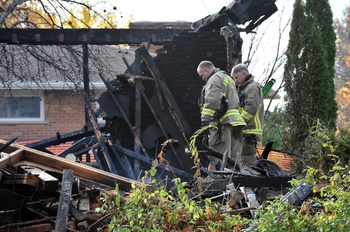
Last month, three adult members of a single family died in an early morning house fire here in Ann Arbor. When firefighters arrived, the house was fully engulfed in flame. They could not get in to rescue the occupants. The Alexandropoulos family was first reported as missing, and later in the day three bodies were found. From the beginning, this story seemed odd. Firefighters took more than 10 minutes to arrive, and the stated reason was that they were on the scene of another call. But the other call was around the corner and wasn't a fire at all. Something wasn't right.
Now the City Council has been briefed on a fuller version of the story. Apparently, neighbors a few blocks away awoke to the smell of smoke and went out into the neighborhood looking for the source. A large amount of smoke was coming out of a chimney in an unoccupied house, and they called 911 at 2:53 AM to report it. Meanwhile, neighbors on the same street as the fire, and west of the first callers, reported smoke coming from the east. Firefighters were dispatched to the house where the smoke was reported, but found it was not the source of the smoke. Finally, at 3:06 AM, a caller gave the correct location of the house, but it was too late.
Last night, the City Administrator, Roger Fraser, briefed the City Council and blamed confusion over the address for the slow response. Meanwhile, rumor has it that 911 operators did not know where the correct address was located even once they had it. Tapes of the calls have not been released. Everyone agrees that the house had no smoke detectors and there is some speculation that the house was fully involved before the first call was ever made. The local press quotes Fraser as saying,
Our request is that if you have such an incident that you're unfortunately involved with, please give us as specific information as you can when you call, because at that time, in the context of what was going on, our firefighters knew nothing more than the fact that that [wrong] address could have been the location that they were all talking about.
I think we can all agree that this fire is a tragedy. It is also natural that our minds turn to blame when something like this happens. The city blames the callers, the callers blame the city, and everyone blames the victims. I think, however, that Fraser is missing an opportunity to do some very helpful crisis communication. He is so busy circling the wagons to deflect any blame from the city, that he isn't actually helping anyone who is upset.
When something goes wrong, it is only natural that we want to prove that we didn't do it or weren't at fault. However, following a traumatic incident, what people most need to hear is not, actually, who is to blame, but rather what is being done to prevent it from happening to them. As much as our minds go to blame, they are really going to protection. If we can blame someone, we think we can prevent that someone from doing anything to us. How much better would it be if we knew that that someone is working on it themselves?
So here's what Fraser should have said:
We've discovered three factors that may have contributed to this tragedy: a lack of smoke detectors, confusing information about the address, and difficulty finding the house. Our job now is to work on each of these factors to try to make sure they don't happen again. We are stepping up our efforts to educate the public about smoke detectors. We are retraining our 911 dispatchers to make sure they ask for very specific information when they receive a call. And we are looking at our GPS systems and reverse 911 capabilities to see if anything can be done to improve our ability to find difficult addresses. We hope that the public will help us by installing smoke detectors and being very specific when they call 911. Together, we can prevent this from happening again.What we most need, at a time like this, is not to feel mad. It's to feel safe. This is a great example of how, so often, our public officials have the opportunity to do that for us, and don't.
Sunday, October 25, 2009
The Puerto Rican Earthshattering Kaboom
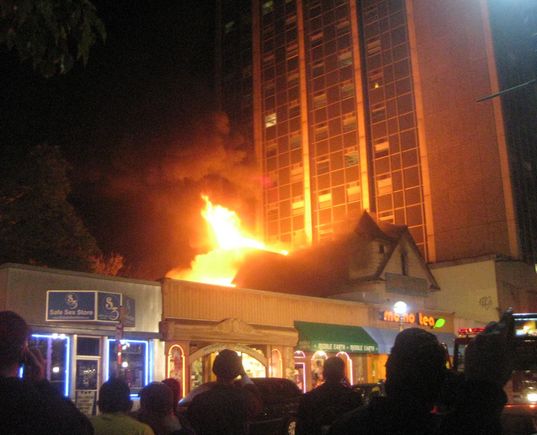
Last night, I asked a friend, "Did you hear about the explosion in Puerto Rico?" He hadn't. About 1500 people near San Juan have been displaced by an explosion at a Caribbean Oil storage facility in the wee hours of Friday morning. The explosion registered 2.8 on the Richter scale, which isn't much for an earthquake but is one heck of an explosion. Yesterday brought fears of increased casualties as the wind brought the cloud of smoke over San Juan, but so far no major injuries have been reported and the wind has shifted in the other direction, although the fire is still burning out of control, almost 60 hours after it started.
This morning, that same friend asked me, "Did you hear the news?" He wasn't talking about the fire in Puerto Ri
The fact that the Caribbean Oil fire hasn't gotten all that much coverage in the mainland US should not be surprising. As I've often said, we pay attention to things that are horrible, unexpected, and happen in places and to people we identify with. It will give you some idea how much we in the United States identify with Puerto Rico that CNN.com has been running its coverage in its "World" section, not in its "U.S." section. As they say in the musical "West Side Story,"
Nobody knows in AmericaThe Washington Post has this story in the Nation Digest, so at least they've located it properly. It's the third story in the digest. Balloon Boy is number one.
Puerto Rico's in America
Both of these fires are exciting. To the people who are right there, they are also probably traumatic. One man in Puerto Rico was quoted as saying,
I didn't expect to see a mushroom cloud from my houseFor most of us, though, these stories are attention grabbing if we live nearby or know the area, and mildly interesting otherwise. That's because we know that fires happen, we hope they don't happen to us, and no one was seriously injured in either blaze. We love stories like this. We can sit back and watch, admire the power of fire to destroy and its beauty in the night sky, and not really worry about it. We are voyeurs at heart, and in these cases, we can do it with impunity.
Subscribe to:
Posts (Atom)
Meet the Quarterback

- Naomi Zikmund-Fisher
- is a clinical social worker, former school Principal and a Crisis Consultant for schools and community organizations. You can learn more about her at www.SchoolCrisisConsultant.com

Subscribe


 Posts
All Comments
Posts
All Comments