Showing posts with label arson. Show all posts
Showing posts with label arson. Show all posts
Saturday, April 17, 2010
Ann Arbor Firebug? The answer is yes.


Two weeks ago in this space I asked if Ann Arbor had a firebug. There had been several suspicious fires overnight, including one that killed a 22 year-old resident. The causes of those fires are still under investigation. Last night, there were four car fires in the area surrounding the University of Michigan campus, all of them intentionally set. Yes, Virginia
 , we have a serial arsonist.
 We often find ourselves saying, about things like this, "It has to stop before someone gets hurt." But someone already has gotten hurt, and whether that particular fire was set intentionally or not, you might think that the death of Renden LeMaster would cause whoever is responsible for those that are arson to think twice. Apparently you would be wrong. It is way outside of my paygrade to try to explain why someone would do this, especially given that someone has died, but obviously someone is.
So, what does this mean for people who live in Ann Arbor? How do you live life knowing that there is someone intentionally burning things next to buildings (all of the fires have started in cars or trash adjacent to inhabited apartment buildings or houses) and that not only could this be dangerous, we know it already is? Should you be scared, and if so, how scared is appropriate?
This situation lends itself to a feeling of helplessnes. Someone out there, we don't know who, may or may not be about to do something which may affect us, and if they do it's really bad but there's no way to know. The antidote to helplessness is action, and so this is a good time to follow the adage, "Prepare for the worst and hope for the best."
Now is the time for Ann Arbor residents to do what we all know we should do anyway but few of us actually do, and that is develop and practice a safety plan for our homes for fires. Every person in every home should know at least two ways out of the house and where to meet after evacuating. We should check our smoke detectors
 every 6 months. We should tell our children to drop to the floor and crawl when they hear the alarm and feel the door before opening it, and also that, no matter how scared they are, never ever to hide during a fire -- kids naturally do this, and firefighters report that a large number of child fatalities in fires occur in closets and under beds where the rescuers cannot find the children.
Once that is out of the way, it's time to try to put things into some perspective. Ann Arbor has a population of about 114,000 people, and thus far five of them have had their home burned down in the current string of fires, with one fatality. That is five and one too many respectively, and obviously this is not a small deal for those people. However, it also represents four thousandths of one percent of the population. The chances of any one family being the victim here are still incredibly small.
So, how scared should you be? However scared you are. Some people will have no concerns, and some will have a lot. That depends on you, your temperment, your past experience with fires, your overall anxiety level, and many other factors. However scared you are, that's how scared you are. There is no point stressing over whether you should be stressed. Put that to the side, do what you can do to keep yourself and your family safe, remind yourself of the tiny odds involved, and give yourself a break. Eventually, this will pass. In the meantime, we're all entitled to feel a little nervous, or not.

Saturday, April 3, 2010
Does Ann Arbor Have a Fire Bug?
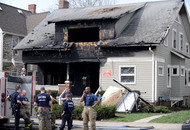
Overnight last night, there were three fires in Ann Arbor. All began outside student housing. All are under investigation. The most serious, which began on the porch of a rental house, sent three people to the hospital. One, Eastern Michigan University senior Renden LeMaster, subsequently died. To put this in some perspective, during 2006 (the most recent statistics I could find), the Ann Arbor Fire Department responded to 322 fire calls, less than one a day, and many of these were for situations that did not require them to put out a fire (e.g. burnt toast). So three is a lot, and someoned dying is a very big deal.
There are two pieces of context that are important in understanding how people are thinking about this. The first is that yesterday afternoon and evening the National Weather Service had issued a Fire Weather Watch for southeast Michigan. The weather was unseasonably warm and dry with high wind, meaning that conditions were ripe for fires to start and for small fires to become big ones. The other is that about 50 miles away in the city of Flint, as I wrote earlier this week, there have been about 40 arson fires in the last three weeks.
Either one of these two factors could stand alone and swing how we feel about the fires last night. If there was the weather alert and no situation in Flint, people might be thinking this was a string of terrible accidents exacerbated by the weather. If there were a firebug in Flint and no weather alert, we might be sure this was arson. As it is, we have both of those things, so you might expect people to reflect a balance in their thinking.
If that's what you expected, you would be wrong. The news coverage has made no mention of the weather alert at all. It has been fairly restrained, on the other hand, in pointing to arson. However, all of the news stories mention that the fires are "under investigation" and that one of them -- not the house fire, but one in which the fire started with a car that had not been driven in a few days -- is considered suspicious. A commenter posted something about the fires in Flint almost as soon as the first story about last night's fires in Ann Arbor went up. The University of Michigan has issued a crime bulletin which, paradoxically, describes "several fires" as being "under investigation," but then tells community members to make sure their cigarettes are fully extinguished.
So, why isn't there more balance in people's thinking? In the hours after an incident, balance is not what we're wired for. We are wired to consider the worst. This is a survival instinct. When something awful happens, we don't want to miss something that might point out that there is more danger ahead, so we are skittish. If someone has been shot, every car backfiring or door slamming sounds like a shot. If there has been a car accident, every driver seems a little erratic. And if there has been a fire, every fire might be arson. Add in the media's natural tendency to go for the sensational, and we don't have a prayer of having any sense of perspective on this.
It's entirely possible these were all arson fires. It's much more likely that one or two were and the other(s) were accidental. It is very unlikely that there is a new serial firebug in Ann Arbor, as there is in Flint, although of course time will tell. It's a good time to remember to check smoke detectors and escape routes, but it's also a good time to remember that while a rash of arson fires affecting us personally is possible, it still isn't likely.
Thursday, April 1, 2010
Arson and Layoffs in Flint

On March 24, the city of Flint, Michigan announced that it would be laying off 23 firefighters and 46 police officers the next day. Within minutes of the press conference, an arson fire broke out in a vacant building. In the nine days since, there have been nearly 40 such fires, including five last night alone. Three firefighters have been injured. Flint has asked for mutual aid, a system under which cities and towns agree to help each other in an emergency, from other county fire departments. Now those departments are starting to cancel their mutual aid agreements because they, too, are stretched thin.
No one knows for sure who is starting the fires. Many have speculated that they are a protest against the layoffs. Some have gone further and accused firefighters of setting them. The head of the firefighter's union has said he is truly insulted by that accusation, and that he does not believe the layoffs and the fires are connected at all. It is always possible that this is a horrible coincidence.
Layoffs can be very distressing to people in any profession. In a profession, like firefighting, where colleagues are closely knit, it is especially difficult. Unless you know or are a firefighter, it's difficult to imagine how much these men and women rely on each other and bond together. Layoffs represent a separation of one or members of, essentially, the family. It's a grotesque understatement to say that that is bad for morale.
On the other hand, you might expect that firefighters don't mind a string of fires. After all, putting out fires is what they do. Most firefighters will tell you, however, that while they like their work and are glad to be able to help the community, they don't actually want there to be a lot of fires. Like most emergency workers, they like being able to make a difference, but they wish they didn't have to. What's more, every fire represents a danger to the firefighters who respond. Any fire could become dangerous or even lethal. In that sense, every one of the arson fires in Flint is an intentional assault on the fire department.
In addition to the double-whammy of layoffs and the fires, we now have other departments saying that they will not come to Flint to help. I'm certainly not in a position to criticize those decisions -- every city has to do what makes sense for their people and their community. To the Flint fire department, however, this just adds insult to injury. People who go through critical incidents often feel helpless. The sense of not being able to do anything is horrible. Asking for help and not getting it greatly complicates the situation. Imagine someone who is assaulted in broad daylight while passersby ignore it. Their reaction may have as much to do with being ignored as with the assault. Now the Flint firefighters are being assaulted repeatedly, and neighboring cities are saying they will no longer help.
I don't know who's setting the fires in Flint, or what their motivation is. I will say that if they are motivated by support for the firefighters and protest of the layoffs, their actions are truly counter productive. They have taken a situation that would be hard under the best of circumstances, and escalated it severely. With friends like this, the firefighters in Flint sure don't need enemies.
Subscribe to:
Posts (Atom)
Meet the Quarterback

- Naomi Zikmund-Fisher
- is a clinical social worker, former school Principal and a Crisis Consultant for schools and community organizations. You can learn more about her at www.SchoolCrisisConsultant.com

Subscribe


 Posts
All Comments
Posts
All Comments