Showing posts with label witness. Show all posts
Showing posts with label witness. Show all posts
Friday, November 11, 2011
We Are Penn State


By now, you probably know what happened. At least eight young boys were allegedly sexually assaulted and/or raped in State College, Pennsylvania over the course of 15 years. The alleged perpetrator was an assistant coach for the Penn State football team, which, let's face it, is the only reason those of us outside of the area even know about it.
If the allegations aren't enough to outrage you, throw in the fact that two administrators were also arrested for allegedly covering it up and lying about it to the grand jury. They never even bothered to find out the name of the kid they knew had been assaulted. Joe Paterno, the head football coach, has lost his job for knowing about it, reporting it, but never questioning why nothing was done. The President of the college is out, too, for knowing something was up and not bothering to find out what.
If you have a strong stomach, you might want to read the grand jury report in its entirety (linked here). It gives you an understanding that "eight boys were molested" fails to capture. Two different people actually witnessed boys being raped and reported it, and nothing was done. The question in my mind, and probably a lot of yours, is not just how you can witness that and not stop it, but how you can sit back, knowing you've reported this, and, when nothing ever happens about it just keep it to yourself.
We're glued to this story because it's Penn State football. We're also glued to it because we want so badly to know that this couldn't happen if we were around. If we had seen it, if we had known, we would have stopped it. If it were our coworker, we would have stood up. If it had been our kid . . . it couldn't be our kid.
But let's look at the statistics. Estimates are that between 5% and 15% of men and between 15% and 25% of women were sexually abused as children. If you think about your circle of friends and acquaintances, however, it's unlikely you can think of that many who you know are survivors. That's because this is a crime of shame. Sexual assault -- on adults as well as on children -- is a crime that leaves the person who has been assaulted believing that there is something wrong with them. It is a crime of humiliation and degradation. So people don't tell.
We like to think, however, that telling is enough, and that's part of why the Penn State situation is so disturbing. If the secrecy is what let's this crime go on, then someone knowing about it should make it stop.
And yet, it can be a fine line. There are people who are creepy and inappropriate, who may well be abusers, but we don't have proof, or they're not abusers yet. And you can't ruin someone's life for being creepy. Being creepy is not a crime. Those cases, I know from personal experience, are agonizing.
In this case, though, it wasn't a fine line at all. People saw it happen. But the fact of the matter is, this situation -- that someone knew and nothing was done -- is far from an isolated incident.
I work with a lot of sexual abuse survivors. Whether by temperament or by training, I can listen to their stories with empathy without usually being traumatized myself. It doesn't generally get to me. But what gets to me, what I struggle with, is their stories about what happened when they tried to tell:
My mother told me to tell my father, but he was asleep so that was it.Time after time after time, people tell me that their safety was sacrificed for family cohesion, reputation, the safety of others or simply someone else would not have to deal with the unthinkable.
My grandmother asked me what I did to make it happen?
My dad said I must have wanted it.
My pastor said I was going to hell for talking about sex.
My mom slapped my face and told me never to lie again.
My mother let him do it to me so he wouldn't go after my little brother and sister.
My mother put me in foster care because she didn't want to leave him.
And is what happened at Penn State so different? People knew but did not want to know. They played a gigantic round of the game "telephone," downplaying a little more as the report went on, to the point that they convinced themselves not to do anything. They sacrificed the safety of young boys for the reputation of the University, its athletic program and its coaches.
We, all of us, need to know that not only can this happen in our neighborhoods, it is happening in each of our neighborhoods, and we can stop it. We need to believe that no reputation or family togetherness or peace of mind is more important than the life of a child. Let us all look back on this incident, on this week, and say that this was the time the silence and complicity ended, not just at Penn State, but everywhere.

Saturday, September 10, 2011
Why 9-11?

So, are you feeling like dog poop yet? Sick of the coverage? Want to talk about something -- anything else? Welcome to the 10th anniversary of 9-11, and to being a human who has experienced trauma. If you didn't read what I had to say yesterday about getting through this in a healthy way, I highly suggest it -- that one was more important than what I've got to say today.
What is it about 9-11 that holds such power over us? More Americans have died, after all, in Iraq and Afghanistan than did during that one day. There have been other big, national events -- Pearl Harbor, the Kennedy assassination, the Oklahoma City bombing -- that got our attention when they happened but don't seem to affect us quite the same way. Why?
First of all, I think there is an argument to be made that each of these events affected our society significantly. Certainly the Kennedy assassination did. While I won't put all of the '60s on that event, it was a catalyst. Each generation seems to have their "big thing," and 9-11 was ours.
But something does separate the September 11th attacks in our consciousness. If it wasn't worse, it was different. It is different.
PTSD is unusual in its diagnoses because, unlike most disorders, the cause is part of the diagnosis. You can be diagnosed with depression, for example, without having something obvious causing your depression. But in PTSD, there are particular criteria the trauma has to meet.
First, the person must have witnessed an event that they sincerely believed had the possibility to threaten the life or physical integrity of or cause serious injury to themselves or others. September 11th? Check.
Second, the person must have responded, at the time, with feelings of intense fear, horror or helplessness. September 11th? Check.
Of course, the Kennedy assassination, for those who saw it or saw the footage, met those same criteria. But there is one key difference.
On September 11, 2001, we as a country all witnessed an event that killed over 3,000 people. But more than that, we experienced an event that we sincerely believed had the possibility of killing us. We didn't just have intense horror or helplessness. We had intense fear. We don't like to admit it, and maybe it seems a little silly looking back, but the simple fact that someone was out there targeting Americans simply for being Americans, coupled with the idea that regular folks went off to regular jobs and never came back, was and is really scary.
My daughter was 3 years old on 9-11. She didn't know what was going on, but slowly, over the following weeks, she asked questions about the things she noticed -- flags in windows, singing the "Bless America" song (as she called it). We answered the questions she asked and nothing more. But she knew it was bad. After one such conversation where I had to reassure her of her own safety as I tucked her in, I remember coming out of her room and saying, "The good news is, our daughter now feels perfectly safe. Now who's going to tuck me in and make me feel safe?"
The real truth is, no one is. We can't go back to thinking it can't happen. All we can do is acknowledge that it's there and it's scary, and remind ourselves that it's still really, really, really unlikely that any one of us will become a victim of a terrorist attack. If we can channel our inner toddler, maybe that will be enough.

Friday, May 13, 2011
What Exactly Do We Think an Emergency Looks Like?

Usually in this space I write about people's natural, typical reactions to stressful events. Often, these are reactions that appear, at first glance, to be overreactions. We are affected by things that we think perhaps we should not be. And of course, my "moral of the story" is almost always that the ways that we are affected actually make a lot of sense. What I'd like to share today, however, is a little difference. I encountered a stressful experience during and after which I understood my own reaction, but not that of others.
I spent a few hours this morning in a local coffee shop. I should have been doing work, but honestly at the time this occurred I was playing a game on Facebook. Sue me. At any rate, I suddenly became aware of raised voices at the counter. More specifically, a man was yelling about wanting his money from the barista. The first that I "tuned in" to what was being said, he was saying something about a card being worth $500 and the barista was saying something about it being $5. My immediate, gut impression, without hearing anything more, was that the man was mentally ill in some way. I don't know where I got that, and I couldn't see him, but there was something about the interaction.
Soon, the man's words escalated. He was swearing and saying he wanted his money, and that the barista "always slips out the back door." She was asking him, calmly, to leave. Her coworker asked him to leave. I could see him now -- a well dressed but somewhat poorly groomed man in a suit and tie, about my age.
At this point you could hear what he was yelling clearly throughout the store. I had put down my computer and was watching carefully, wondering if it was my place to call 911. I had just decided that I would if he actually threatened the barista or became physically aggressive, when he said, "If I had a knife! Not a little knife! A chef's knife! I should get a chef's knife!" I reached for my phone just as the coworker picked up hers and called 911.
The man was pleased that the police had been called. He said they would settle this. He calmed down and sat in a chair for a while. I continued to watch. And I became aware that not one other person in the store had changed what they were doing at all. The woman in the next chair over from me was still talking to a friend on her cell phone, and not about this. The men having a business meeting were continuing their meeting.
I don't get it. I understand not wanting to get involved. I understand not wanting to overreact. Maybe this encounter was more disturbing to me than it needed to be. Maybe the police didn't need to be called. Those are all judgment calls. But how could you sit in the coffee shop this morning and not think that this warranted your attention. A very quiet establishment in a relatively quiet town has a man yelling about getting a knife and refusing to leave, and you don't even look up? Really?
The only thing to which I can attribute this is people's tendency to think that danger is more obvious than it ever is. For example, your kid will probably tell you they're not supposed to talk to strangers. But if a nice woman with a puppy starts chatting them up on the playground, most kids will still talk to her. She's not a stranger, she's a woman with a puppy. Similarly, I did a training for a school yesterday in which we used a scenario regarding an out-of-place backpack. There was some debate about whether that could constitute a "suspicious package." The thing is, suspicious packages don't come labeled as such.
I don't want to invoke stereotypes, and I don't know the whole story here. But it seems to me there was a man not completely in touch with reality threatening violence, and that such a person is somewhat more likely than average to carry out violence. Yes, he's wearing a suit. Yes, the chances are still on the small side. But it might be worth pricking your ears up. Deranged gunmen don't wear t-shirts that say, "Kiss me, I'm a deranged gunman."
The police took a long time coming, and the man left in the meantime. I offered to talk to the police but they said they had the information they needed. Another day on the job. Another day for most of the patrons at the coffee shop. I'm left shaking my head.

Tuesday, September 7, 2010
Calm Under Fire at the Discovery Channel

Last week, a man walked into the lobby of the Discovery Channel building in Silver Spring, Maryland and took three people hostage. He was heavily armed and had what appeared to be explosives strapped to him. The building was locked down and then evacuated. When the incident was over, the hostages were unharmed and the perpetrator was dead, shot by a law enforcement sniper.
So, imagine you're at work and a man with a gun and explosives comes in, yells a lot, tells people not to move, and you run. You call 911, from inside the building or from outside. What do you imagine you would say, and what would you sound like saying it? I'm not asking what you should say, or how you should act, but how do you imagine you would actually behave? I know I've had to call 911 for much less serious situations which were much less threatening to me personally, and while I say what needs to be said I am pretty agitated and upset.
Over the weekend, the 911 tapes from the Discovery Channel
 incident were released. Clips were played on various television news broadcasts, and summaries were printed in the press. What is truly remarkable to me in listening to these is that the callers uniformly sound calm and are able to give extremely detailed descriptions of what is going on, what the man has in terms of weaponry, and how he acted when he entered the building. No one is crying. No one is screaming. No one is yelling for police to hurry. They say what needs to be said, they appear to be very accurate, and they remain calm.
To what can we attribute this calm and accuracy on the part of people who had just narrowly escaped being killed? There are probably a number of things at work here. First of all, the man who was responsible for this was a known quantity. He had been arrested outside the building before and, until two weeks before, was under a court order to stay away. His picture was posted around the building as someone to look out for. This means that when people called 911 and described him, they weren't only working from what they had just seen, but also from pictures they had seen and information stored in their long-term memory.
Having pictures of this man posted around the office also served another purpose. On some level, everyone who worked at the Discovery Channel and saw those pictures had considered the possibility that something like this might happen some day. They may not have believed it, and they may not have imagined the specific details, but the thought that this man was dangerous and could harm them had already crossed their mind. When it actually happened, they didn't have to process something brand new. Instead of thinking, "Something horrible is happening and I don't know what to do with it," they could think, "The horrible thing that I feared is happening." That left more brain power available to notice the details.
My daughter also points out another important fact*. When we're scared, our senses are heightened and our memory for what we perceive is also heightened. This can turn out not to be very helpful, because we often remember the wrong things. In this case, however, it seems that people remembered the right things.
Finally, it's important to note that feeling out of control and acting out of control are not the same thing. We can imagine that, under these circumstances, we'd be scared out of our minds. And certainly being scared out of our minds can affect how we act. But people often experience a remarkable ability to do what needs to be done in an emergency, and fall apart later. Bravery does not mean not being scared. It means doing what you need to do even though you're scared. I think we can all agree, there are a lot of brave people over at the Discovery Channel.
* You know you're bringing your work home when your 12-year-old child can analyze a crisis situation and come up with insightful commentary!
Ross Douthat at the New York Times
 had an excellent piece yesterday about what we should -- and should not -- draw from the politics of the perpetrator in this incident. I highly recommend it.
Monday, July 5, 2010
Horses Rampage at a July 4th Parade

Twenty-four people were injured and one killed yesterday at the Bellevue, Iowa, Independence Day parade when two horses pulling a carriage in the parade trampled onlookers. It appears that the horses bumped heads and the bridle came off of one, spooking the horses and spurring the stampede. The dead woman is Janet Steines, the wife of the carriage driver and a passenger, who was thrown when the carriage collided with a street sign. Four people remain hospitalized. Many of the injured were children who were picking up tossed candy in the street.
Yesterday, I myself was in a July 4th parade here in Ann Arbor. I walked alongside a school bus and tossed candy with some colleagues, while various kids and adults rode the bus and threw candy from the windows. A gemtleman from the local chapter of the Jaycees, the sponsoring organization, told us several times that the bus riders were tossing candy too close to the bus and encouraged us to throw it over, not at the crowd. Frankly, we thought he was sort of annoying, although I did see a child or two dart too close to the bus to retrieve some candy and worried about a low-speed crash.
July 4th parades are one of those "supposed to be" events. They're supposed to be fun. They're supposed to wholesome. They're supposed to be safe. We all believe those things and don't really question them. We feel the same way about July 4th fireworks, or at least about the official, professional fireworks displays. Anyone who lives with a small child has spent lots of time reassuring them that the fireworks are loud, but they won't hurt you. The horses are big, but they're friendly. This is all good fun.
On July 3rd, if I had asked you or, for that matter, the people of Bellevue, Iowa, whether it was remotely possible that horses in the Independence Day parade would bolt and injure someone, you and they would have said yes, it was possible. You also would have said it was possible that a firework from a professional display would misfire into a crowd of people, but not terribly likely (it did, in Palmyra, Pennsylvania) or that a child would be hit by a schoolbus (this, thankfully, did not happen). But unless someone asked you about it, you wouldn't have thought much about it. Life is full of dangers we don't choose to think about. Their likelihood seems so remote.
Here's the interesting thing. Next July 4th, if you go to a parade that has horses, it is possible that you will think back to this incident and feel a little anxious. We would consider it truly out of proportion, however, for most adults to be so nervous in such a situation that they couldn't attend such a parade. On the other hand, if you're from Bellevue and witnessed yesterday's incident, you would get a pass if the horses scared you. And yet, it is no more likely for a horse to trample spectators in Bellevue than in New York or Ann Arbor or Atlanta.
So why is it OK for people in Bellevue to be more worried? Basically, because we recognize that people who have not experienced a trauma tend to somewhat underestimate its likelihood, and people who have experienced one tend to overestimate it. If we're kind, compassionate people we leave space for that overestimation, recognizing it as a typical stress reaction, and expect it to diminish, but perhaps not go away, over time.
Coming up tomorrow: Why there seem to be so many freak accidents on Independence Day. Check back!
Sunday, June 27, 2010
In Central Park, the Sky Really Is Falling

Yesterday afternoon, a branch fell off a tree just outside the seal lion exhibit at the Central Park Zoo
 in New York. It was not windy or raining, and no one really knows why it fell. About thirty feet below, Gianna Ricciutti, aged six months, was having her picture taken by her father, Mike, while being held by her mother, Karla Del Gallo. It was part of a visit from their home in New Jersey. The branch hit Gianna and her mother, leaving Gianna dead and Karla in critical condition.
This is the sort of story that makes you gasp and exclaim how awful it is. The sheer randomness of this event, coupled with the death of a tiny child, seems especially horrible. As we start to think about it, we wonder why it doesn't happen more often. After all, parks are full of tall trees, and branches fall off trees, so it was just a matter of time, we suppose, before this happened. And if it happened once, it can happen again.
If that's how we feel, imagine what it would be like to be just outside sea lion exhibit at the Central Park Zoo and suddenly hear a loud noise and see a woman and her baby crushed by a falling tree limb. Gianna's father witnessed his baby's death and his wife's serious injury, completely powerless to stop it. There were certainly others, perhaps not as focused on that particular pair, who saw the accident or arrived shortly thereafter.
A security guard at the scene was interviewed by the New York Times
. The Times reports his experience as,he heard a loud crack, like a thunderclap, and saw the branch plummet. After the mother fell, members of her family shrieked, the guard said, and her husband began screaming and jumping around. “He was going crazy,” the guard said.The phrase "going crazy" really bothers me in this context. First of all, what, exactly, is our expectation for rational behavior when you have just seen two of the most important people in your life critically injured in a freak accident? How do we expect this man to act under the circumstances? Is screaming and jumping around really that odd?
The second problem I have with this description is that the number one thing I talk to people who have been traumatized about is the sense they have that they are going crazy. I would say that at least 80% of what I do is assure people that there reactions are typical and understandable. They are not crazy, the situation is. Behavior and reactions that would be totally bizarre on a regular day or in reaction to regular stress make total sense when the world has turned upside down.
At the same time, I can't blame the guard too much. He just witnessed something awful as well, and frankly I wish the press wasn't so eager to get quotes from people in situations like this. I doubt very much that the security guard actually thinks Mike Ricciutti's reaction was so out of whack. He was describing the scene, and he used a turn of phrase that was unfortunate. Under the circumstances, I can more than forgive him.
I really hope everyone who was in that part of the park yesterday gets some support. It's going to be hard to walk under trees for a while, not because trees really are, statistically, all that dangerous, but because they seem that way. I also hope all of those people have a chance to talk to each other at some point. They need to know they aren't crazy, that this really was awful, and that the others around them didn't think their reaction was nuts. It's easy, at moments like this, to feel like you're the only one reacting the way you are. It might help them to know that others are gasping and exclaiming how awful it is, too.
Sunday, May 30, 2010
Murder-Suicide at NC Target

Guadalupe Rosas, 59, was working at her register in an Apex, North Carolina Target store this morning when a man she had once been involved with walked in and shot and killed her. When police arrived and confronted him, he shot and killed himself. About 150 people were in the store at the time of the incident. The Target corporation
 issued a statement this evening and said that the store would be closed tomorrow "so that we can focus on taking care of our team."
 Certainly there is plenty of work for counselors to do in this incident. Aside from the obvious fact that this is a violent death, it is the death of someone at work. While Ms. Rosas may not have been a public safety professional in the line of duty, she was nonetheless part of a team that worked together, and she, unlike her colleagues, did not survive her shift. This will make for a more complicated set of reactions in her coworkers, from wondering if "it could have been me" to anger that she put everyone at risk to guilt that they even entertained such a thought.
In addition, there are 150 people from all walks of life who were not sure they were going to survive their shopping trip this morning. News reports include statements from people who hid in a storage room, a man who was shopping with his young son, people who were smashed up against the doors in the panic, and someone who reported seeing flipflops and sandals strewn in the parking lot where people had run out of their shoes. Many people ran to a nearby Lowes
 store where staff tended to those injured in the evacuation and waited under lockdown for police to arrive. Every one of those Target patrons, as well as those staff and customers at Lowes who helped, potentially will have intrusive sensory images from the incident, whether they find themselves picturing the sandals in the parking lot or the shooter pointing a gun at them. Many of those people thought they were going to die, and that is a serious risk factor for post-traumatic stress disorder.
Then there are the police officers on the scene. Everyone is different, of course, and undoubtedly at least some of them will have no regrets that the shooter killed himself. He was, after all, a "bad guy." Others, however, will be troubled by the visual image of actually seeing him do it, and by the knowledge that they were right there but powerless to stop him.
This is another one of those times when having multiple different trained crisis teams responding and supporting people could be very beneficial. Ideally, Target has either its own team or an Employee Assistance Provider with trained CISM providers available. The police department, we can hope, has its own team with trained cops and mental health professionals and maybe a chaplain. If we're really lucky, there's also a community response team to support the customers and the folks from Lowes. Of course, this not being an ideal world, it's entirely possible that Target is sending in a couple of company psychologists with no trauma training at all, the police department will tell its people to "buck up," and no one will do anything for the customers at all. That happens all the time. I just hope folks are a little more prepared to recover in Apex.
Monday, April 26, 2010
Death in NYC: Can Empathy and Condemnation Go Hand in Hand?

Several years ago, a teacher in my school district, at a different school, was disciplined for using duct tape to fasten a student to a chair. The day after this hit the newspaper, the staff room was abuzz with teachers saying, "What was she thinking?" "I can't imagine what she was thinking." "Does anyone know what she was thinking?" There was a lull in the conversation, and one of the most senior teachers said, "Let's be honest. Is there anyone who actually doesn't know what she was thinking?"
I am reminded of this episode today because an item has hit the news regarding a homeless man who was killed in New York City a week ago. Hugo Alfredo Tale-Yax, 31, was stabbed as he intervened in an early morning altercation between a man and a woman on a Queens sidewalk-- some reports say it was a mugging. In a scene captured by a surveillance camera, Tale-Yax then walked down the sidewalk, collapsed, and lay there for about an hour as numerous pedestrians walked by. One took a picture of him. Another shook him and lifted him up far enough to see a pool of blood. By the time authorities arrived, he was dead.
What were those passersby thinking? You may find yourself reminded of the storied case of Kitty Genovese
 , the woman who was stabbed to death in 1964 outside a Queens apartment building. Her death became symbolic of people's uncaring attitude towards others, after it was reported that the killer returned for three separate assaults, 38 people had witnessed the attack, and no one had called the police. Forty-five years from now will be we be talking about the Tale-Yax case in the same way we talk about Kitty Genovese?
It turns out, however, that the Genovese case wasn't all that simple. In their recent book SuperFreakonomics
 , Steven D. Levitt and Stephen J. Dubner argue that the attack on Kitty Genovese was not witnessed by as many people as reported, not as obviously a murder in progress as reported, and in fact at least one person did call the police. There were two attacks, not three, and they were in two different locations. Several people did yell out their windows to the killer to leave her alone, and, when they did, he appeared to leave and she appeared to get up. They thought it was over. Is it possible that the Tale-Yax case also has some shades of gray?
I think we can all agree that, in an ideal world, anyone who knew he was injured should have tried to help him and/or called 911. So, why didn't they? Did Mr. Tale-Yax have the misfortune to be injured in the one place in America where everyone doesn't agree on this? Probably not.
When we say that people should have called, we are doing so with much better information than people had at the time. We know now that Mr. Tale-Yax was dying, and that failure to call an ambulance probably cost him his life. The people walking by, on the other hand, were not met with that certainty. They had to weigh out the probability that this man needed help against the chances that he didn't, and also the chances that if they tried to help him they would wind up regretting it.
At least some of the pedestrians presumed that Mr. Tale-Yax was asleep. The sight of a homeless man sleeping -- or passed out -- on the sidewalk in Queens is not that unusual. It is certainly far more common than someone bleeding to death on a sidewalk in Queens. These people weighed the probabilities and went with the one that was far more likely.
Other passersby, though, clearly knew he was hurt. The person who shook him and picked him up certainly did. The person who took his picture appears to talk with a companion about the situation before they leave. We all assume that we, in the same situation, would have called 911. Why didn't they?
First of all, somebody did. There were a total of three 911 calls. The first, which appears to have come during the initial altercation, reported a woman screaming but gave the wrong address. The second reported a man lying in the street and also gave the wrong address. The third brought emergency personnel, who found Mr. Tale-Yax dead.
Let's just say, however, for the sake of argument, that there was at least one person who walked by, saw Tale-Yax, realized he was injured, and didn't call. Should they be condemned for it? Or can we muster some empathy for them? I think the answer may be both.
Someone failed to help a dying person. That can't be OK in our society. At the same time, I can imagine 100 reasons why they didn't, from being a wanted criminal or an undocumented immigrant themselves, to simply failing to grasp what they were seeing, to convincing themselves that if he was really hurt someone would have already called. Think about it -- have you ever seen a car on the side of the road and not called for help? You probably have -- I know I have -- because you figured someone else had already called.
Empathizing with the passersby does not require condoning what they did. Understanding and accepting are not the same thing. We know that the people who walked by Hugo Alfredo Tale-Yax should have helped him. Chances are, they know it too. And really, if we think about it, is there anyone who doesn't know what they were thinking?
Thursday, April 1, 2010
Arson and Layoffs in Flint

On March 24, the city of Flint, Michigan announced that it would be laying off 23 firefighters and 46 police officers the next day. Within minutes of the press conference, an arson fire broke out in a vacant building. In the nine days since, there have been nearly 40 such fires, including five last night alone. Three firefighters have been injured. Flint has asked for mutual aid, a system under which cities and towns agree to help each other in an emergency, from other county fire departments. Now those departments are starting to cancel their mutual aid agreements because they, too, are stretched thin.
No one knows for sure who is starting the fires. Many have speculated that they are a protest against the layoffs. Some have gone further and accused firefighters of setting them. The head of the firefighter's union has said he is truly insulted by that accusation, and that he does not believe the layoffs and the fires are connected at all. It is always possible that this is a horrible coincidence.
Layoffs can be very distressing to people in any profession. In a profession, like firefighting, where colleagues are closely knit, it is especially difficult. Unless you know or are a firefighter, it's difficult to imagine how much these men and women rely on each other and bond together. Layoffs represent a separation of one or members of, essentially, the family. It's a grotesque understatement to say that that is bad for morale.
On the other hand, you might expect that firefighters don't mind a string of fires. After all, putting out fires is what they do. Most firefighters will tell you, however, that while they like their work and are glad to be able to help the community, they don't actually want there to be a lot of fires. Like most emergency workers, they like being able to make a difference, but they wish they didn't have to. What's more, every fire represents a danger to the firefighters who respond. Any fire could become dangerous or even lethal. In that sense, every one of the arson fires in Flint is an intentional assault on the fire department.
In addition to the double-whammy of layoffs and the fires, we now have other departments saying that they will not come to Flint to help. I'm certainly not in a position to criticize those decisions -- every city has to do what makes sense for their people and their community. To the Flint fire department, however, this just adds insult to injury. People who go through critical incidents often feel helpless. The sense of not being able to do anything is horrible. Asking for help and not getting it greatly complicates the situation. Imagine someone who is assaulted in broad daylight while passersby ignore it. Their reaction may have as much to do with being ignored as with the assault. Now the Flint firefighters are being assaulted repeatedly, and neighboring cities are saying they will no longer help.
I don't know who's setting the fires in Flint, or what their motivation is. I will say that if they are motivated by support for the firefighters and protest of the layoffs, their actions are truly counter productive. They have taken a situation that would be hard under the best of circumstances, and escalated it severely. With friends like this, the firefighters in Flint sure don't need enemies.
Friday, March 5, 2010
The Other Victim of the Pentagon Shooter

As you probably know, a man with a history of mental illness, a strong belief in conspiracy theories and a serious animosity towards the United States government approached two police officers at the Pentagon Metro station last night and opened fire. The officers returned fire, mortally wounding him. They suffered relatively minor injuries. Whether your classify this as random violence, a failure of the mental health system, or terrorism, it's clear that this was a relatively minor incident as these things go, and while the death of the shooter is a tragedy for his family this obviously could have been much worse.
You might not have heard, in the stories about this incident, about Dan Namisi. Mr. Namisi is a native of Uganda and a resident of Virginia who happened to be nearby when the shooting started. He hit the ground as fast as he could, which aside from being a natural reflex is also a relatively good way to avoid being shot in a situation like this. Officers responding to the shots immediately approached him, handcuffed and searched him and placed him in a police car. He was held for three hours.
Mr. Namisi tells the Associated Press that he thinks he aroused suspicions because, when he dropped to the ground, he cut his hand. He was near the shooting and appeared to be injured, and he therefore appeared to be involved. I will say that I think Mr. Namisi is more charitable in his interpretation of what made him a suspect than I am, but really the main issue is that he was right there when the incident occurred. It took the police a while to make sure they had figured out what had happened.
Mr. Namisi says he is traumatized. It's easy to let that remark go by if you're not reading carefully. After all, who wouldn't be traumatized by having to hit the pavement due to a shooting right next to you? But he isn't referring to the shooting. He's referring to the experience of being taken into custody by the police.
In fact, I suspect that the trauma here is actually both things. Being suspected of something really terrible that you really didn't do, particularly if you come from a country where the justice system is not known for its fairness or good treatment of suspects, is traumatizing by itself. Being a witness to a shooting where you fear that your own life is in danger is traumatizing by itself. Having both things back to back is probably worse than the sum of its parts.
All the physical and emotional responses to trauma were already going for Mr. Namisi when the police handcuffed him. That means that his body and mind were that much less able to cope with the new trauma when it happened. Not only did he not have an opportunity to come down from the surge of stress hormones that occurred when the first shots were fired, he got a second surge on top of it. At a minimum, he's got to be exhausted.
I am in no position to judge whether the police were reasonable in suspecting Mr. Namisi and holding him as long as they did. I don't know how many, if any, other bystanders experienced the same thing, or what circumstances went into the police officers' decisions. I do know that Dan Namisi had a really bad evening yesterday, and I hope someone took a moment to thank him for his time and apologize for the inconvenience.
Wednesday, December 2, 2009
Shooting in Pittsfield Township: What Do You Tell the Kids?
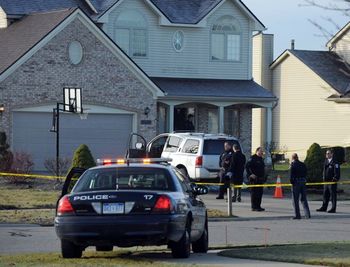
This morning at about 8:30, a man was shot in the driveway of a home in a quiet subdivision of Pittsfield Township, the township right next to Ann Arbor, Michigan. He was shot by a resident of the house whose driveway it was, and it is not at all clear what led to the shooting. The resident then went inside and called 911 himself.
In a town like Ann Arbor, where murders happen once or twice a year, this is big news. It is especially big news because about 20 children were standing at the bus stop adjacent to the house when the shooting happened. All of them heard the shots, and some of them witnessed the shooting.
We can probably all agree that children shouldn't see things like that. We can also imagine that we ourselves would be shaken by witnessing such an incident, and it is that much worse for children. So what do you tell them? How do you assure children they are safe when their neighborhood is a murder scene and their neighbor is the shooter?
First of all, here's what you don't say. You don't say, "don't worry about it." They are already worried about it. Telling them not to worry really tells them that you don't want to talk about it, and while that might be the case it is not what they need right now.
What you do tell them is that yes, this was scary. Yes, you understand they are upset. And then you offer them some perspective. These two men knew each other. No one is going around the neighborhood shooting -- this was a problem between those two people and only those two people. You remind them that the man who did the shooting is in jail until this gets sorted out. You tell them this is rare -- this has never happened before. That might seem obvious, but kids don't have a good sense of what is likely as opposed to what is possible. You let them draw while they talk -- it has a way of getting tongues moving. You let them sleep in your room for a night or two if they want to. This is an OK time for them to regress, and it's not permanent. You keep their day as normal as you can.
At my school, we connected with this incident in a slightly different way. Three of our families live in the next subdivision over, maybe 600 feet from where the shooting occurred. One parent heard the shots. Their children were at school when the shooting happened. One of them asked me today, should she tell her children?
The answer to this, like the answers to most tricky questions, is that it depends. My advice was that if they were likely to hear about it from someone else, then yes, you should tell them. If they see police cars or helicopters or reports and ask what's going on, you should tell them. If you yourself are upset enough about it that you're going to be talking a lot about it behind closed doors, you should tell them because they are going to know something is going on and feel like it's not OK to ask, and what they imagine is much worse than what actually happened. If none of those things are true, you probably don't need to tell them. If none of those things are true, then this isn't any different than a crime across town or across the country. And as with all things in parenting, you play it by ear. This isn't a science, it's an art.
Note: Because it is not clear how this incident transpired and whether there was any element of self-defense involved, I have chosen not to name either the shooter or the person who was shot, in keeping with this blog's policy not to name perpetrators.
Subscribe to:
Posts (Atom)
Meet the Quarterback

- Naomi Zikmund-Fisher
- is a clinical social worker, former school Principal and a Crisis Consultant for schools and community organizations. You can learn more about her at www.SchoolCrisisConsultant.com

Subscribe


 Posts
All Comments
Posts
All Comments