Showing posts with label suicide. Show all posts
Showing posts with label suicide. Show all posts
Friday, December 23, 2011
Suicide Among Our Finest


The story unfolded in the local media, posted on my Facebook page this afternoon. A major street was closed due to police activity. Police were investigating a possible suicide. A note had been found and the family called police. Officers on the scene were seen wiping their eyes. And finally, the news that the Chief of Police at Eastern Michigan University killed himself today.
This man was well known in the law enforcement community. In addition to the Eastern police force, he had been an officer in Ann Arbor for many years and quite recently did a brief stint at University of Michigan as their police chief. It's likely that most if not all of the responders to this scene knew him personally. My heart goes out to them.
The suicide rate among police officers is, depending upon whom you ask, either higher or lower than in the general population. A study in 2006 found that while the suicide rate for law enforcement was 52% higher than the general population, if you controlled for race, gender and age it was actually 26% lower than the general population. The discrepancy is caused by the fact that police officers are very disproportionately white males between 25 and 55, and that demographic has a suicide rate about twice the population average.
Not surprisingly, most cops who kill themselves do so with a firearm. Most civilians in that demographic do too. That's why men are so much more likely to kill themselves than women -- the method of choice is almost always lethal. Suicide is most common in groups with easy access to lethal weapons, cultural bias against asking for help and a lack of severe cultural bias against suicide. That last factor is what differentiates black males from white males.
Men don't like to ask for help. Cops really don't like to ask for help. So do a favor tonight, would you? If you know and love a cop, ask them how they're doing. If they're fine, fine. At least you've told them you're willing to have the conversation.
If you are having thoughts of suicide, please call, 24 hours, 7 days a week: 1-800-273-TALK (veterans press 1 at the prompt). Help is available. You just need to ask.


Wednesday, October 19, 2011
What if a Wolf Should Come Out of the Forest?
 |
| A dead lion on the Ohio game preserve. |
My first impression when I heard this story was that someone had murdered the preserve owner had been murdered by someone who then thought it would be a good idea to let the animals out, perhaps to cover his tracks. Upon reflection, I don't know why I thought this. Certainly that was not in any way what the media reported. But I think all of us, at these moments, become "experts" based on the many crime novels and cop TV shows we've been exposed to over the years.
One article this morning, however, reports that initial indications are that the owner killed himself. This would imply that he released the animals himself in an unusual twist on a murder-suicide.
I will not pretend to understand what causes someone to decide not only that they would be better off dead but that they should take other people with them. I suppose I vaguely understand, although of course do not agree with, people who believe they've messed up their and other's lives so badly that it's best to put everyone out of their misery at once.
But this type of case is different. In this situation, someone decided that others have made their lives unlivable, and that the others need to be punished with death at the same time that they themselves stop living. That's not just depression, that's a level of rage I simply can't imagine.
This is of course just one facet of the story. These animals did nothing wrong at all and will now be killed to protect human life. I get it, it's probably necessary, but it's wrong. And kids are locked in with their parents out of fear of a wild animal eating them. It feels like a scene out of "Peter and the Wolf." The kicker is that this is the second death of a wild animal keeper this year in this area -- another man choked to death in what the press delicately termed a "voluntary sex act" in July. I'll spare you the details.
If we went with that fictional crime expertise we all seem to posess, this would all be part of a bizarre plot, perhaps on the part of radical animal rights activists, to murder wild animal preserve owners and free the animals. The defense would try to convince the jury that the action was necessary to save the lives of hundreds of animals. Perhaps Jessica Fletcher would crack the case after her nephew was falsely accused by the bumbling local law enforcement authorities.
Unfortunately, this is real life, and real life can be just plain weird sometimes. I hope more of these animals can be tranquilized rather than killed now that daylight is here, and I hope that happens before anyone gets hurt. I also hope we all remember that, no matter what incomprehensible thing he did, this owner was someone's son, brother and/or friend, and they are hurting in private somewhere today. Coming to grips with this is not going to be easy.
* The title of today's post comes from Prokofiev's "Peter and the Wolf," about a boy who encounters a wolf after being warned not to play outside. The link above is to a really fun version illustrated by Bono of U2 fame. It's my favorite, and proceeds benefit Irish Hospice.
Wednesday, July 6, 2011
Policy Change: President to Send Condolences Following Suicides
President Obama announced today that he would change the long-standing practice, in existence at least since the Clinton administration, that the President does not send a letter of condolence to families of servicemen and women who die by suicide, even in a combat zone. Obama will begin to send such letters, just as he does to families of military members who are killed in action. Obama said he was making the change to emphasize that people who need mental health care in the military are not weak and should not be stigmatized.
I first wrote about this issue in November, 2009, when the drive to change the policy was relatively new. Since then, I have begun working with veterans with PTSD directly, and have a lot more first-hand knowledge of what the state of mental health care and stigma is in our armed forces. When I went back to read my thinking from 18 months ago, however, I found that it really hasn't changed much. There were pros and cons then, and there are pros and cons now. So I'm reprinting my original post, below.
I want to make it absolutely clear that I fundamentally believe that deaths by suicide are, without question, service-related and/or combat-related deaths. My ambivalence about this policy comes not out of any desire to stigmatize these families or lessen the importance of the sacrifice, but rather out of my number one priority, which is to prevent as many of these deaths as we can.
**********************************
Wednesday, November 25, 2009
Should the President Send Condolences When a Soldier Kills Himself?
 If your loved one dies while serving in the United States Military, whether they are killed in action or by accident, you will receive a letter of condolence from the President. Presidents have been doing this since Abraham Lincoln. If your loved one serves in the military and kills themselves, however, you will get many of the same things that other families get, but you will not receive a letter from the Commander in Chief. That has been true at least since the Clinton administration.
There is a push on from some military suicide survivors to change that policy. They argue that their loved ones died in service of their country, certainly as much as someone who was killed in an accident. The injuries they suffered were not visible, but they were certainly service related. Their families deserve the same consideration from the President as anyone else's, and to do so would go a long way towards reducing the shame that has for so long been associated with death by suicide, particularly in the military.
This is one of those issues which, spun the way these families and the press coverage are spinning it, seems pretty clear cut. Of course being a suicide survivor should not have stigma associated with it. These families are grieving just as much as any other, and deserve all the support we can give them.
There is a problem, however. One of the rules of thumb in responding to a suicide and memorializing people who die by suicide is that you in no way want to glorify the act of killing yourself. When you have grand ceremonies to honor their memory, you run the risk that someone else who is considering suicide will, consciously or unconsciously, view killing themselves as a means to get that kind of attention for themselves and their families. This is probably more of an issue with teenagers, who aren't fully able to appreciate the consequences of any action because their brains are not yet fully developed, but it remains an issue for others, too.
I don't know that I have a good answer for this. On the one hand, families who are survivors of military suicides should not be treated with any kind of stigma. They deserve our honor and support in a very, very difficult and complicated time. On the other hand, there is an argument to be made that even what is already done for these families -- receiving a folded flag, a 21 gun salute at the funeral -- let alone a letter from the President might look pretty appealing to a soldier considering suicide. They might think that in death they can bring honor to their family that they feel they could not bring in life.
Taking away the stigma associated with suicide in the military may well save lives by making soldiers more willing to seek help. The question is, by honoring grieving families properly, how many lives will we lose?

Thursday, March 10, 2011
If Your Friends Told You to Jump Off a Bridge, Would You Do That Too?

We've all heard or participated in this quintessential argument between a parent and a teen.
Parent: No, you can't go to the partyThis is supposed to be the final blow to the teenager -- an irrefutable analogy that will make them see the error of their logic. However, today's news brings into focus the simple fact that teens don't always see the world the way adults do.
Teen: But everyone else is going!!!
Parent: If everyone was jumping off a bridge, would you do that too?
A student at Windsor High School in Sonoma County, California, was with about 45 other kids on a field trip to the Golden Gate Bridge
 today when a classmate dared him to climb over a four foot barrier and jump off the bridge. While classmates cheered and at least two tweeted, the boy climbed over the edge and jumped 220 feet. He suffered only minor injuries and was rescued by nearby surfers. His major problem at this point is that he may well be arrested for what he did.
What possesses kids to think that things like this are a good idea? Why would anyone dare another person to jump off the Golden Gate Bridge, the most frequent place for suicides in the entire world? When well over 1,200 people have died doing something, wouldn't you think that might be a clue it's a bad idea? And what comes over those watching that they cheer rather than try to stop something like this?
This is just another in an endless string of examples that illustrate the major danger posed by the brain development of teenagers. They are big enough and independent enough to do what they want, but the frontal lobe of their brains is not developed sufficiently to think through the potential consequences of their actions. If you ask a teenager who has done something stupid why they did it, more often than not they'll tell you it seemed like fun. The possibility of the not fun consequence comes later.
This is also one of the reasons that teenagers are at high risk for suicide. Not only do they have hormonal shifts and a high rate of depression, but they have a difficult time thinking through all the implications of their death. What's more, what might be intended as a non-lethal self-injurious action or a cry for help can easily go wrong. They don't necessarily think about that possible consequence either.
Teenagers make mistakes. They are impulsive, and every one of them will do something at some point that makes their parents cringe simply because they can't think all the way through the consequences. As parents, we know this is inevitable. What we hope is that the stupid decision our child makes will not be one that kills them. This young man came a little too close for comfort.

Wednesday, January 5, 2011
Two Administrators Shot at Omaha, NE High School

There are two things I often say about school shootings. The first is that, if someone enters a school hell bent on killing the first person they see, then the first person they see is going to die. The second I sometimes say to teachers when we talk about lockdowns -- most people who come into the school mad are not going hunting for you. They're going hunting for me.
Today, a 17-year-old student at Millard South High School in Omaha, Nebraska, bore this out. At about 12:40, he shot both the Principal and the Assistant Principal. He then drove off in his car and, sometime less than an hour later, killed himself. Both administrators are in the hospital, one in critical and one in serious but stable condition. The shooter was a recent transfer student to the school whose father is an Omaha police officer. He apparently used his father's gun.
What are we to make of an incident like this? People's reactions are pretty predictable. Here are a few that might seem familiar: There needs to be stricter gun control. Kids see too much violence on TV. Our schools aren't safe. It's poor parenting. There must have been signs. Kids today have no respect for adults. He shouldn't have been able to get anywhere near those administrators with a gun. We need metal detectors in schools. These statements all fit rather nicely into two basic categories:
Category #1: This must be preventable and someone is to blame that it wasn't prevented.
While it is of course possible that this was preventable and that someone messed up, it is also entirely possible that everyone was as prepared and aware as they possibly could have been, and the signs just weren't there and all the procedures in the world wouldn't have stopped it. You can install metal detectors, but that won't stop shootings in the parking lot or the foyer. Criminals will find ways to get guns. Good parents have messed up kids.
We want to blame somebody because the alternative is awful. We can't really wrap our minds around the idea that something this scary could happen even when everything is done right, because that means that none of us is safe. Which brings us to our next category:
Category #2: I'm scared for my children's safety.
This is an interesting one, because, in fact, no children other than the shooter himself were injured in this shooting. However, it's not much of a stretch to imagine why a parent would feel their child was in danger if someone is shooting people in the school office.
Most parents have a pretty skewed understanding of how dangerous schools
 are. School shootings
 , when they happen, are all over the news. This makes them seem much worse and more common than they truly are. The reality is that kids are safer for the six or so hours they're in school than they are any other time of the day.
Good parents also view protecting their children as one of their primary responsibilities. Even though schools are, on the whole, very safe, they are the one place that parents have little control. When parents drop off their babies (and yes, even the high schoolers are their babies) at school, they are taking a leap of faith that the school will do for those children what the parents would do in an emergency. When there is violence in schools, it preys on the fears and insecurities of parents not because schools are so dangerous, but because parents aren't there. Parents overestimate the chances that they would be able to protect their children if they were present. The fact is, they couldn't do a better job in most cases, and in a lot of cases they would be worse.
All of this wends us back to my second stock comment about school shootings -- the shooters aren't going for the teachers or kids, they're going for the administrators. I haven't seen many statistics on that issue. It's certainly true in some cases, as it was in Omaha today. However, by no stretch of the imagination is school administration the profession where you are most likely to be assaulted on the job
 . You might be surprised to know that it isn't law enforcement, either. It's actually health care. How many of us think, "I don't want to become a nurse, it's too dangerous?" Yet another example of how bad we are at estimating our actual risks.
My heart goes out to the families and staff at Millard South. School is closed tomorrow, and that makes the healing process harder in a lot of ways. It's hard to open school in the middle of a police investigation, however, so one can hardly blame them. Walking back through those doors is going to be really hard. And a lot of school administrators in other schools are going to be a little more jumpy at work tomorrow.

Sunday, January 2, 2011
David Senft: A Foreseeable Suicide that Wasn't Foreseen

The New York Times
 ran an article today about Staff Sgt. David Senft, who died in Afghanistan in mid-November. All indications are that Senft killed himself with his roommate's firearm. This was at least his third attempt at suicide.
Senft was on his second tour of duty in Afghanistan, and had also done one tour in Iraq. It seems that everyone who knew him knew he was depressed and traumatized by his experiences in the wars, most notably responding to the site where a helicopter carrying wounded servicepeople had been shot down in Iraq. After one of his previous attempts to kill himself, Senft admitted himself to a psychiatric hospital and his deployment to Afghanistan was delayed. In Afghanistan, his superiors were concerned enough about his suicide risk that they took away his weapon.
Senft family wants to know why, if everyone knew he was in this much trouble, he was allowed to deploy to Afghanistan and why, if he was enough of a danger to himself to take away his weapon, he wasn't sent home. These are decent questions, and the army says they have three different investigations into Senft's death going on.
I have no idea who, if anyone, screwed up here. I am, as the name implies, just a Monday Morning Quarterback. However, I do know that it is much easier after the fact to look back and see what might have been done differently than it is to make predictions looking forward. Anyone -- in the military or not -- who ever comes into contact with someone who may be at risk of suicide has to make a judgment about how big the risk is. It's easy to look back now and say Senft was a big risk -- obviously, since he killed himself -- but what is obvious now was not necessarily obvious then.
Could this have been prevented? Probably. In fact, we could probably eliminate most of the suicides in the military if we disarmed all military personnel, stripped them naked and locked them in empty rooms. Everyone recognizes that we don't want to do that. But where is the line? How many other soldiers like Senft came across however he did and turned out to be OK? How do we balance the risk of a suicidal soldier with the risk of severely restricting someone who doesn't need those restrictions?
After a suicide, it's very typical to start pointing fingers about who should have or could have done something differently. In this case, the finger is being pointed at Senft's superiors. No doubt they're pointing fingers at themselves, too. Maybe they deserve it. Or maybe, this is a case where although they could have done something differently, no one at the time thought they should have. Sometimes, you just can't know.

Monday, August 23, 2010
My Trip to Haiti -- Part VIII
 |
| The kids with perfect attendance get their crowns. |
Day 7 -- Friday, August 13, 2010
While the property where we were staying in Leogane was not really a farm, there were a smattering of farm animals hanging around. Cows and goats were on the field to one side, and most of them belonged to people from the area who brought their animals to graze. There were two or three roosters and a family of ducks that roamed free throughout the property, and the occasional dog, cat or pig happened by. Each morning as the sun came up, I was awakened by one of the roosters crowing. It bothered me the first night, but after that I got used to it and went back to sleep each day.
On Thursday night, however, something was different outside. Some dogs appeared to be getting into a fight of some kind directly outside the bedroom window. They were barking and growling for what seemed like hours, and I had a terrible time going to sleep. No sooner had they stopped, it seemed, when a rooster and one of the dogs appeared to get into a heated argument. The rooster would crow, the dog would bark, the rooster would crow again, the dog would bark louder, the rooster would crow louder, and on it went. Once in a while a cow would chime in from the field, making for a scene that would have been downright funny had it not been the middle of the night and had I not been trying to sleep. I finally gave up around 5 AM, and so I was quite tired and downright cranky as I entered my last full day in Haiti.
The plan was to grab the three kids we were most worried about before the assembly started that morning, but there was general chaos and disorganization, and we weren't able to do it. The entire morning was devoted to the last day assembly, during which the various groups of children reported on their activities, performed music, dancing and skits, and generally had a good time. Hillary had some Burger King
 crowns she had gotten donated for a craft project, and the kids with perfect attendance got crowns. Soon, everyone, even the adults, was wearing a Burger King crown. This might not have gone over very well in the United States, but in a place where Burger King does not exist, the difference between a BK crown and some other kind of crown is nonexistent, and the kid were very happy.
Sometime around 11:30, I hit the wall. I could not keep my eyes open any more, so I snuck back into the guest house and laid down. While the music from the assembly was substantially louder than the livestock from the previous night, I was able to put some white noise
 on my iPod
 next to my head and go to sleep for about 45 minutes. When I woke up, the festivities were still underway but almost over.
Amelia got hold of the head counselor for the older children and made it clear that we needed to talk to some of the kids before they left. Her first thought was to get all 16 kids who had scored high on the assessment, but in the time we had I felt it was most important to reach the children who were suicidal. Two of the three of them were there that day, and we took them aside together.
I explained that we wanted to talk to them because they were two of the children who said they had thought about killing themselves, and we were very worried about them. I gave them the choice to talk to us together or apart, and they both wanted to be apart. One of them, Olivia, waited off to the side while we spoke to the other, Nicole. As it turned out, while Nicole was clearly upset and depressed, she was not currently suicidal. She was 18 and had lost both of her parents in the earthquake. She was one of the few kids who had a house, but she had no family and no way of supporting herself. We spent some time problem solving with her, trying to come up with ways she could make sure she had food and was able to go to school, and ways she could find adults to talk to and confide in. I was not at all sure we had really helped her much when we moved on to Olivia.
Unlike Nicole, Olivia was clearly suicidal
 . I went down the usual assessment questions with her: How often do you think about killing yourself? What do you think about doing? Would that be hard or easy to do? What do you think are the chances you will actually do it? This girl was straight out of a textbook on suicide, and she was at tremendous risk. While we were talking to her, her mother came along and she gave us permission to bring her mom into the conversation.
  |
| A Doctors Without Borders clinic in Port-Au-Prince |
I have no idea whether the mother took her daughter there, or whether Doctors Without Borders had any way of helping Olivia. It was the best we could do to make the referral and to tell Olivia she was important, that we understood how much pain she was in, and that there was help for her if she could just hold on. She seemed to believe us. As I went back into the house for lunch, I said to Amelia and Hillary, "That is the work I came here to do." While I was worried for Olivia, I also knew that this, unlike any other problem I had worked on all week, was a situation where I had specialized knowledge that could make a difference. I just hope it did.
After lunch, Daniel attached himself surgically to my hip. He knew that this was my last day in Haiti, and he clearly wanted to be around me. The feeling was mutual. We sat on the porch for the entire afternoon and into the evening, sometimes just us and sometimes with Christopher, playing cards, drawing in my journal and playing Doodle Jump on my iPod.
My confidence in my ability to communicate with Daniel in French had improved over the week, even though my French itself probably had not. Still, I ventured into some heavier topics with him. We talked about my family, his family, and our respective religions, and about stereotypes of Haiti and of black people that are common in the United States. We talked about his school, and I told him about how important it was for him to do well in school. We even discussed the possibility of him going to college on scholarship some day. He asked if it was difficult to come to the United States, and if he could come visit me someday. I gave him my contact information and email address, and he and Christopher gave me the email address of Christopher's uncle, who also lives on the property, to use to contact them.
As the night drew to a close, I gave Daniel my battery-operated fan
 , my flashlight
 , my extra batteries
 for both and an extra bottle of bug repellent
 . I gave Christopher my cards
 , which he was constantly playing with, and promised him I would leave my other bottle of repellent for him when I left in the morning. Daniel admitted he was sad that I was leaving, and I certainly was as well. He asked me if I would return to Haiti, and I told him the truth -- I didn't know. I told him that if I did, I hoped he had a house when I returned. He said he wanted one too, but that he really wanted a telephone and a DVD player
 . He is, after all, thirteen. In my lousy French, I summed up the trip, and our newfound friendship, before I headed off to bed:
Before I came here, I didn't know that I loved Haiti. Now I know that I love Haiti and I have people I love in Haiti, so maybe I will come back.Tomorrow -- The Journey Home
Saturday, August 21, 2010
My Trip to Haiti -- Part VI
 |
| Kids getting ready for our group. |
Today, Amelia and I planned to go through the assessment at the back of the workbook with the kids. First of all, Amelia had been told by our coordinator that if nothing else we had to do the assessment, and second, we figured that given that there were so many kids and time was short, this would give us a good idea of where to concentrate our efforts.
The assessment is essentially a checklist in two parts. The first has to do with what the child experienced before, during and after the earthquake, with each thing given a certain point value. Some items are factors that put the child at psychological risk. For example, having a parent who had died before the earthquake is worth +15 points. Having a parent killed in the earthquake is +35. Other factors are protective. For example, having reliable housing within one month after the earthquake is -5. Having daily access to the people close to them is -10. The second part of the checklist is a list of post-traumatic stress reactions the child is currently experiencing and which are new or have gotten worse following the earthquake. These also are given a point value. Difficulty sleeping is +5. Thoughts of suicide are +35.
The instructions for the checklist are adamant about two things. First, the checklist is to be filled out by an adult who is familiar with the child, and second, any child who scores more than 100 points is to have a medical evaluation. Those of you closely following our heroine, however, may notice two problems. First, we had 50 kids and limited time. Second, we had no medical personnel on our team.
Amelia and I decided the best way to do this, which was suboptimal but probably sufficient, was to go systematically through the checklist with the whole group, asking kids to self-report on each item. We told them not to worry about the numbers, just write yes or no (or, more accurately, either "oui" (French) or "wi" (Kreyol) or "non") and we would score it later. Of course, the questionnaire was not worded in what we in the education biz call "kid-friendly language
 ," so for each question, I would explain the French and Kreyol questions in their books in English developmentally appropriate language and Amelia would translate my explanation back into Kreyol.
 The first thing we noticed was that a large handful of kids were not responding to the questions at all. The second thing we noticed was that a fairly large number of kids said that they had not had one parent die before the earthquake, but had had both parents die before the earthquake, which was both not possible (you can't have two dead parents without having one) and not true (these were uniformly kids with two living parents). Eventually, she started trying to help kids better understand questions individually while I continued on, using Krystal, a Haitian-American woman who was there with another volunteer group, as my translator.
When we were done, which took absolutely forever, I took the stack of questionnaires back to the guest house to score them before lunch. I was stunned. Of the 45 children who answered the whole checklist (some had left in the middle), 16 had scored above the magic 100 point threshold, and 3 said they were thinking about killing themselves. Every single one of the 45 said they had multiple stress symptoms, seven months after the earthquake.
I need to emphasize that these kids did not appear, to the casual observer, to be troubled in any way. I had watched them play and work for three days, and while I didn't know what they had been like before, I would not have pegged this as a group of kids with "issues," and I certainly could not have picked the highest scoring 16, or even the 3, out from the others. The level of suffering they said they were enduring was tremendous. At the same time, I knew that they had had a lot of trouble understanding some of the questions, so it was possible that some of the scores were artificially high or, I hated to think it, artificially low.
Amelia and I talked about what to do after lunch. We had discovered, at the end of the camp day, that there was a beach field trip planned for the whole camp for Thursday, and we already knew that Friday would be devoted to a big celebration for the last day of camp. That meant that, effectively, we had no more time to work with the kids. At the same time, we had 16 kids who might be in significant distress, and three who might well be in imminent danger.
One of my CISM instructors used to say, "Do what you know you can do well, and get out of there." With that in mind, we decided there were two things we could do. One was to try to help some of the kids who were staying on the property, since we could work with them outside of camp hours. The second was to try to assess how much danger the three who said they were suicidal were actually in. We hatched a plan to do both of these things on Thursday, and I went to bed.
Tomorrow: When Fun Gets in the Way of Trauma
Tuesday, August 3, 2010
Plenty of Trauma to Go Around in Manchester Warehouse Shootings
 A driver for Hartford Distributors, a beer distributor in Manchester, Connecticut
 , opened fire in the warehouse this morning around 7 AM. He killed 8 people and wounded two others. Police responded, and as they closed in on the gunman, he killed himself. That much, everyone agrees on. I think most if not all of us would also agree that, regardless of his motives, this kind of violence cannot be justified.
This story is not nearly as clean as that storyline would appear, however. The driver had just been in a disciplinary hearing in which he was shown a video allegedly depicting him stealing from a company truck. He was given the choice to resign or be fired, and he chose to resign. He began shooting essentially as soon as the meeting was over.
As if that weren't complicating enough, the shooter was allegedly being harassed by coworkers because of his race. He was one of two African-American employees, and his family says he showed them pictures of racial epithets and a stick figure being hung by a noose, taken in the company restroom. He also reported being referred to by the "N word." After he shot the other employees but before he killed himself, he reportedly called his mother and told her "I shot the five racists." Then he shot himself.
This situation is messy on many levels, and messy situations have a lot of impact and need a careful response. In this instance, I imagine the following groups need support:
- the survivors, who have experienced believing they were going to die
- the families of the dead, who have lost a loved one violently and suddenly
- the families of the survivors, who will have lasting fears for their loved ones' safety
- the family of the gunman, who must come to terms with what he did and grapple with the two disparate versions -- that he was being fired for misconduct and/or that he was the victim of racial harassment
- the administration of the company, who have lost employees "on their watch" and may feel guilt, either because they fired the gunman or because they didn't respond appropriately to harassment complaints
- the union, which would have represented him in the meeting this morning and which may have had harassment reported to them
- anyone who actually harassed the gunman, who may now feel responsible (or may now feel his actions prove them "right" in their racism)
Add to this the fact that there are likely to be one or more lawsuits flying in various directions, and everyone knows it. This means that anyone who feels guilty -- whether it's their fault or not -- is going to be pretty uncomfortable talking about those feelings for fear that what they say winds up in court.
I hope this workplace has access to a good crisis response team of some kind. I hope that team has an excellent coordinator. They're going to need to assign people carefully and make sure they have enough to cover all the bases, because no one in this situation is going to be able to support more than one group, and in some cases perhaps only one individual. They sure have their work cut out for them.
Thursday, June 3, 2010
The British Perspective on Mass Shooting
A 52-year-old taxi driver in Cumbria, England
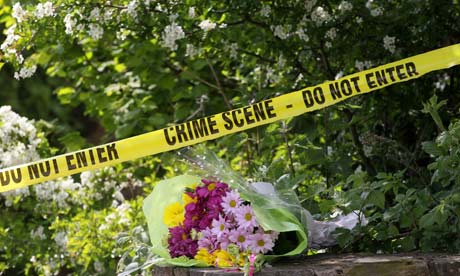
 , shot and killed his twin brother, the family lawyer and 10 other people, wounded 25, and finally killed himself yesterday in a rampage that lasted almost three hours. News reports say that the gunman was upset about what he perceived as an unfair distribution of his father's estate and sure that his brother and the attorney were conspiring to do the same with his mother's. In addition to his brother and the lawyer, he shot at fellow cabbies and drove down the street shooting at random strangers.
This is a horrible incident in any country. A lot of the questions being raised in the British press are the same ones we would expect if this happened in the United States: Were there warning signs missed? Why did it take police so long to catch him? As is natural after an incident like this, people are searching for someone to blame, because they need some way to reassure themselves that this sort of violence can be stopped. Who knows, maybe this could have been.
One question that is coming up rather prominently is a little different than you would expect in the United States, however. How did he get the guns? The United Kingdom has notoriously strict gun control laws
 . Even police officers are not automatically given permission to carry firearms, and most of them don't. In order to get a permit for a gun, you have to have a legitimate reason (self defense is not considered a legitimate reason), a letter from your doctor, two character witnesses, not have been imprisoned for three years or more, have a face to face interview and have a personal inspection of where you are going to keep the gun.
I heard an interview on NPR yesterday with a local journalist about the question of where the guns came from. Towards the end of the interview, the questions turned to the provenance of the guns. She said that police would be investigating whether the shooter was licensed to have a gun, and that "if he wasn't, that will be very bad."
Can you imagine someone saying that in the United States -- that it would be very bad to learn that a shooter didn't have a permit for a gun? I doubt it. We are used to the idea that people who are not supposed to have firearms have them anyway.
When this journalist says that finding out the shooter didn't have a permit would be "very bad," she's not talking about it being bad for the police or the government. She's not talking about it looking bad. What she's saying is that finding out that this man could get a gun illegally would mean that others can get them too. That would be dangerous, and it would represent a complete shift in how Britons think about gun violence in their country
 . In England, you don't generally worry that everybody is packing heat. If this shooter could get a gun, it would mean that things are a lot more dangerous than they thought they were. It would be very bad.
We all live with the knowledge that we are in a certain amount of danger. If you live in a war zone, you make your peace somehow with that so you can sleep at night. If you live in the United States in a relatively quiet town, the amount of danger you have to make your peace with is much less, but it's not zero. If you live in Cumbria, England, there are various ways you could be subjected to violence or sudden injury or death, but being shot, until yesterday, was not something you had to worry about a whole lot. Today, they're very worried.
The good news, such as it is, is that it turns out the shooter did indeed have a license for his guns. On the one hand, that means that a potential mass murderer was licensed, which increases the calculation of the odds that someone else is out there, licensed and ready to crack. On the other hand, it also means that there isn't a hole in the wall keeping guns out of everybody's hands, and so maybe the people of Cumbria, at some point, will be able to return to not worrying about it quite so much.
Tuesday, June 1, 2010
Substance Abuse, Waiting for the Worst, and the Death of Andrew Koppel

Andrew Koppel, 40, was found dead early this morning. He apparently had gone on an at least day-long drinking binge, bar hopping throughout New York City. He finally wound up, with his drinking buddy, at the apartment of one of the buddy's friends. He went to sleep it off, and never woke up. Among others, he leaves his girlfriend, a child, and his famous father, newsman Ted Koppel
 . The cause of death has not been determined. He had a history of alcohol abuse.
This story is in the news because Andrew Koppel's father is famous. But deaths like this one are, unfortunately, not at all unheard of. People who live with or love alcoholics and other substance abusers live with the knowledge that, if they don't successfully stay away from their substance of choice, someday it may very well kill the people they love. Overdose -- in this case, apparently alcohol poisoning -- is only one of a seemingly endless number of ways that people can die from substance abuse. Motor vehicle accidents, falling or jumping from tall buildings, or picking a fight with the wrong person are a few of the others.
It's likely that the phone call the Koppel family got this morning was shocking. It's also likely, if stories about Andrew's drinking are true, that they knew such a phone call was a possibility. At the same time, no one can ever really be prepared for a phone call like that. Every family hopes that the addict they love will straighten out or sober up before they hit bottom, and the phone call informs them that their hopes are over.
This type of death brings with it a difficult mishmash of themes for those left behind. Of course they are sad. They are also angry, because the person who died "did this to themselves." Unlike a suicide, however, the person didn't do it to themselves on purpose, or at least not as clearly on purpose as if they had completed a suicide. Those left behind are mad that they didn't stop in time and mad that they couldn't. They feel guilty because they couldn't save them, and blame others -- the person's friends or other people in the family -- because they didn't. The drinking or drugs often go hand in hand with mental illness or other complicating factors, and it's hard to know what or who to blame for the result. In short, it's a mess.
I don't know what kind of relationship Ted Koppel had with his son. Maybe they were estranged, maybe they were close. Frankly, it's none of our business. No father holds his baby and imagines that someday he will bury his son. No father should have to, no matter how much he may have prepared for the possibility.
Sunday, May 30, 2010
Murder-Suicide at NC Target

Guadalupe Rosas, 59, was working at her register in an Apex, North Carolina Target store this morning when a man she had once been involved with walked in and shot and killed her. When police arrived and confronted him, he shot and killed himself. About 150 people were in the store at the time of the incident. The Target corporation
 issued a statement this evening and said that the store would be closed tomorrow "so that we can focus on taking care of our team."
 Certainly there is plenty of work for counselors to do in this incident. Aside from the obvious fact that this is a violent death, it is the death of someone at work. While Ms. Rosas may not have been a public safety professional in the line of duty, she was nonetheless part of a team that worked together, and she, unlike her colleagues, did not survive her shift. This will make for a more complicated set of reactions in her coworkers, from wondering if "it could have been me" to anger that she put everyone at risk to guilt that they even entertained such a thought.
In addition, there are 150 people from all walks of life who were not sure they were going to survive their shopping trip this morning. News reports include statements from people who hid in a storage room, a man who was shopping with his young son, people who were smashed up against the doors in the panic, and someone who reported seeing flipflops and sandals strewn in the parking lot where people had run out of their shoes. Many people ran to a nearby Lowes
 store where staff tended to those injured in the evacuation and waited under lockdown for police to arrive. Every one of those Target patrons, as well as those staff and customers at Lowes who helped, potentially will have intrusive sensory images from the incident, whether they find themselves picturing the sandals in the parking lot or the shooter pointing a gun at them. Many of those people thought they were going to die, and that is a serious risk factor for post-traumatic stress disorder.
Then there are the police officers on the scene. Everyone is different, of course, and undoubtedly at least some of them will have no regrets that the shooter killed himself. He was, after all, a "bad guy." Others, however, will be troubled by the visual image of actually seeing him do it, and by the knowledge that they were right there but powerless to stop him.
This is another one of those times when having multiple different trained crisis teams responding and supporting people could be very beneficial. Ideally, Target has either its own team or an Employee Assistance Provider with trained CISM providers available. The police department, we can hope, has its own team with trained cops and mental health professionals and maybe a chaplain. If we're really lucky, there's also a community response team to support the customers and the folks from Lowes. Of course, this not being an ideal world, it's entirely possible that Target is sending in a couple of company psychologists with no trauma training at all, the police department will tell its people to "buck up," and no one will do anything for the customers at all. That happens all the time. I just hope folks are a little more prepared to recover in Apex.
Thursday, May 13, 2010
Are You at Risk for a Violent Death?

The Centers for Disease Control has just come out with a comprehensive 16 state review of violent deaths in 2007. This may sound about as thrilling to you as watching pain peel off a barn (or perhaps a comprehensive study of paint peeling off a barn), but there's actually some very interesting information contained in this report. In particular, it challenges some of our assumptions about people who die violently. This is interesting (at least to me), because part of what helps us deal with the threat of violence is convincing ourselves that it happens to other people. On the flip side, to the extent that we believe it does happen to people like us, it raises our anxiety level quite a bit. This report allows us to work off of facts rather than assumptions, which is generally a good thing.
One of the first things that lept out at me from this report is the fact that you are less likely to die by murder than you are by suicide. I guess as I think about it that makes sense, but it certainly wasn't my gut-level prediction. Most of us see suicide as a risk we can avoid -- we probably overestimate how much this is true. We see murder as something that just happens, and that scares us. But this report tells us that the thing we think we can control is actually more likely. This may give some of us a (perhaps false) sense of security.
Another thing that struck me is that people who die by both suicide and homicide have about a 1 in 3 chance of having alcohol in their system when they die. People who kill themselves, however, are about 250% more likely than people who are murdered to have other drugs in their systems. Again, these are risks that we can control -- don't drink, don't do drugs, and maybe you won't die.
Not surprisingly, people who kill themselves have a very high incidence of mental illness, with more than 40% of them having a depressed mood before they died. What might surprise you is that about 30% of people who die by suicide are taking antidepressants, compared to about 4% of those who are murdered. Does this mean that antidepressants cause suicide? Not necessarily. People who are depressed are at risk for suicide. People who are depressed are also more likely to be taking antidepressants. That doesn't mean antidepressants are a risk for suicide.
Perhaps the most startling finding in this study has to do with the age at which people are most likely to be murdered. The highest risk age group for men is 20-24. Men are, overall, 3 times more likely to be murdered than women, so, generally, being female is a protective factor. What is shocking (at least to me) is that the highest risk age group for females is less than one year. The time of a woman's life when she is most likely to be murdered is in infancy. She is twice as likely to be murdered then as when she is in her 20's. That very much goes against the core belief many of us have that children don't die and that people don't hurt children. Apparently, they really do.
Finally, the look at precipitating factors for homicide in this report brings home rather strongly that murder is not, in fact, random. For men, the most common precipitating factor to their murder is an argument or other conflict about something other than money. For women, more than half of murders are the result of violence by their partner. Arguments about money or property, gang violence, and even drug violence are much less likely. About 1/3 of murders happen as part of another crime such as robbery. Random violence accounts for less than one percent of homicides.
So, now that you've read all about the peeling paint, why does this matter? It matters because we make assumptions every day about what is dangerous in the world and what is not. We pick which neighborhoods we will or won't walk through at night and how many locks to have on our doors based on our perception that the danger will come to us if we make the wrong choices. Certainly, doing things like these lessens our risk. We spend much less time and psychological energy, however, thinking about how to protect ourselves from the much more likely dangers -- the people we live with or spend time with, the substances we consume, and our own mental health. Maybe it's time for a little attitude adjustment.
Sunday, May 9, 2010
What Philip Pagano Teaches Us About Suicide

Philip Pagano, age 60, of Crystal Lake, Illinois, died on Friday. He intentionally walked in front of a Metra Commuter Rail train in one of the many suicide-by-train incidents that occur every year on our nations tracks. This is sufficiently common, actually, that it might not have made the news outside of the Chicago area at all were it not for two factors. First, Philp Pagano was under investigation for giving himself a $56,000 bonus at work. Second, his job was Executive Director of Metra
 .
.Some would say it is ironic that Pagano killed himself with one of his company's own trains. Others might call it some kind of poetic justice. Both of these characterizations treat Pagano's method of suicide as random, but of course it was not. He chose to kill himself using a Metra train. That choice was neither ironic nor poetic. There are, however, at least two possible explanations for it.
First of all, people who die by suicide
 tend to choose methods that are easily available to them. The most glaring example of this is that police officers who kill themselves very disproportionately use firearms, with the attendant result that police officers who attempt suicide very disproportionately die. People who do not have access to guns do not kill themselves with guns. Very few people go out and buy a gun to kill themselves with. Police officers wear a highly lethal method of attempting suicide on their belt every day.
Similarly, people who do not ride commuter trains or live near a track are unlikely to kill themselves by stepping in front of one. Pagano, on the other hand, rode the train to work every day and was around them at work all the time. He had been placed on leave and so was not riding the train on Friday, but he knew when and where that particular train would be because, until the end of April, he rode it every day. Being in the business he was in, furthermore, he had lots of exposure to suicide by train. It's hardly surprising that, when he chose to kill himself, he chose a method so easily available and with which he was so familiar.
Secondly, conventional wisdom suggests that people, at least sometimes, choose a method and/or place to kill themselves as a way to send a message. The most obvious examples of this are terrorists who use their death as a political statement by killing themselves and taking others with them. The man who flew his plane into an IRS office earlier this year clearly had a statement to make.
People don't necessarily have to have something political to say when they choose how to kill themselves, however. Many people who attempt suicide give quite a bit of thought to who will probably find them and how they will feel about it. It's not uncommon for people to choose to kill themselves in a particular location as a way of showing how negative they feel about that place and the people in it. On the other hand, it's also not uncommon for people to choose to kill themselves away from the people they love in an effort to spare them some anguish. This is not always true, certainly -- sometimes people kill themselves in a place that is convenient for them without any particular message -- but it undoubtedly happens. It's not too much of a stretch to imagine that Pagano had some kind of negative message for Metra or the people there which he conveyed by using a Metra train to kill himself, or that he wanted to say, "This train was responsible for my successes and my failures, and now it's responsible for my death."
Philip Pagano had a wife, children and grandchildren. He chose not to kill himself at home, and, in fact his wife was out of town. Perhaps he wanted to spare her in some small way. If there is any irony in these situations, it is that not only is that probably small comfort to her and the rest of his family, it may actually make things worse. It is one of the hardest things about suicide that someone could think their actions through enough to know they shouldn't die where their family is, but not enough to know they shouldn't kill themselves at all.
Wednesday, March 17, 2010
Suicide High Above Cayuga's Waters

In the last month, three students at Cornell University in Ithaca, New York have killed themselves by jumping off bridges into the gorges that mark the campus. Two died on consecutive days last week. The total number of suicides at Cornell this year now stands at six, with four additional deaths from other causes, on a campus of roughly 20,000 students. If that sounds high to you, it is. The suicide rate nationally for college students is roughly 7.5 per 100,000 per year, which would give a school the size of Cornell a predicted rate of 1.5 suicides per year. They're at six, and it's still March.
So, what is going on at Cornell? First of all, as the college points out, their average number of suicides per year is still about 1.4, so if whatever is going on is Cornell-specific, it is specific to this year. One might posit reasons why Cornell students might be at higher risk than other students. Cornell is a relatively high pressure school. Ithaca is way off the beaten path, which may isolate some students from natural support systems. And the system of gorges and bridges represent a particularly convenient and lethal way to attempt suicide, so those who attempt it might be more likely to complete it. On the other hand, none of those things is new, and before this year Cornell hadn't had a suicide in four or five years. So what is going on?
Those who study suicide will tell you that suicide is, in some sense, contagious. People whose relatives complete a suicide are more likely to attempt one themselves, and people who have friends, or even just close peers, who complete a suicide are also more likely to try. The reasons for this are complex. It's not as simple as someone learning that someone close to them has killed themselves and "getting the idea." In some cases, people who have already contemplated suicide think "if they can do it I can too." They identify with the person who died and how they were feeling, and the example they set by killing themselves tilts others decision making in that direction. In other cases, the reaction to the suicide of a loved one is so complex and severe that it promotes suicidal actions from others. There is also some component of this phenomenon caused by the fact that someone who completes a suicide makes others aware that that particular method works, so people who might otherwise have tried something less lethal are more likely to complete their suicide.
There are absolutely things that institutions can do in an effort to be caring that can make things worse. The most common is to over-honor and over-memorialized the person who died. Particularly in adolescence and young adults, whose brains are not fully developed and hence don't think things through very well, watching a peer get the full attention of the school or community in death may encourage them to kill themselves in a misguided attempt to get that attention for themselves.
Given the complexity of the problem, the response of Cornell this week has been pretty impressive. They have put in place two initiatives that have grabbed headlines, perhaps even more than the suicides themselves. The first is that they have placed staff at the bridges over the various gorges on campus, and placed suicide hotline information on the bridges. This is a relatively small and short-term fix, but in a community that has demonstrated that it is at increased risk, taking away the method of choice for suicide is not a bad idea.
If that were all Cornell were doing, it would be inadequate. However, they are also having staff members knock on the door of every single student in the residence halls, check on their welfare and engage them in conversation. This may seem like a small thing, but it is a really good idea. It prevents anyone on campus from being completely isolated, and it breaks the silence that often surrounds suicide and depression in our society. It invites every single student, individually, to talk about how they are doing.
I once heard a fellow CISM person describe people contemplating suicide as fish drowning in a bowl of water. Everything they need is right there, but they can't make use of it. If that is true, Cornell is doing two things: making it hard for the fish to jump out of the water, and providing individual assistance in figuring out how to use the water they're in. I sure hope it works.
Monday, March 1, 2010
Why We Should Leave the Osmonds Alone

Marie Osmond's 18 year old son died this weekend. He apparently jumped from an apartment building in downtown Los Angeles, where he attended school. He left a suicide note behind. Various media reports indicate that he had been in rehab in the past, that he suffered from depression, and that his mother thought he was doing better before his death. The autopsy was "inconclusive" pending toxicology results. Marie Osmond is described as devastated.
People are asking all sorts of questions about this situation. Why did he do it? Did he tell anyone he was going to, and if so who and what did they do? Was he intoxicated? Were there warning signs? What was in the suicide note? I have one simple answer to all of these questions: None of your business. I don't mean to be rude, but why on earth do we imagine we are entitled to this information?
When someone kills themselves, they always leave behind unanswered questions. These are very difficult for family and friends, who always wonder what they missed or what they could have done differently. Sometimes there are answers in the form of background information or the contents of a note, and sometimes not. When there is information, the family often chooses to keep it private. If you've ever worked with family or friends of someone who has killed themselves, you know that the themes all revolve around "woulda, coulda, shoulda."
The questions that the public is asking about Marie Osmond's son right now are questions I would not presume to ask my best friend if (God forbid) a family member completed a suicide. If the family wants people to know, they will tell us. Otherwise, all we are doing is drawing the family's attention repeatedly to the most painful aspects of this death -- the nagging questions of what could have been done differently and whether this could have been prevented. We are truly rubbing salt in what has to be a large and open wound.
Marie Osmond is a public figure. As such, some would argue that she gives up some measure of privacy. Her son, however, was not a public figure. You probably don't even know his name, or at least you didn't before this weekend. He never agreed to surrender his privacy, and his mother didn't surrender it on his behalf. Is this a news story? Sure. It's worth a brief notice that this happened, and fans can express their condolences. Demanding additional information, however, isn't just nosy -- it's mean.
Friday, February 19, 2010
Amerithrax

The FBI officially ended its investigation into the 2001 anthrax attacks today, after determining that a single Army scientist, acting alone, was responsible. He suffered from significant mental illness and had worked on the vaccine against anthrax. The letters included in the mailings, which at first blush appeared to be from a radical Muslim terrorist group, contained elaborate code that referenced two colleagues with whom he was obsessed. There will be no arrest and no trial in this case. The scientist the FBI says is responsible killed himself in 2008.
The mailer, as I'm sure you recall, wreaked havoc on the country, and particularly on the government and media outlets, by sending two batches of letters laced with anthrax through the postal system. Five people died and 22 more were infected. The majority of those infected were not targets themselves, but postal workers or people whose mail was contaminated as it passed through a contaminated facility. Buildings were evacuated for anthrax contamination, both real and suspected, and Americans were literally frightened to touch their mail for weeks.
Given that, I suppose we should feel relief that we have gotten to the bottom of this and found that one person, who is no longer a threat to us, is responsible for the chaos of the fall of 2001. He acted alone, he is dead, and we are not in danger.
I suspect I'm not alone, however, in finding this ending most unsatisfying. We are used to big news stories having big conclusions. It doesn't seem right that someone could single-handedly hold the entire country hostage, and even less right that he will never be brought to justice. That's not how it plays out in the movies.
There is more than a need for dramatic closure in our news stories, however, driving this feeling of letdown. There is also a sense that, although this case has been brought to an end, and with it the accompanying feeling that we are in danger from the anthrax mailer, a conclusion like this actually leaves us feeling still unnerved.
The fact is, a single person did terrorize our country. The fact is, if he could do it there are probably other people out there who could, too. That makes this neither an isolated incident nor a coordinated campaign which we might be able to learn to live with, but a truly random act of violence which could occur, or not, at any time. If there is one thing our minds do not like is unpredictable danger. It leaves us always vaguely afraid and on edge. In that sense, this single, seriously ill scientist has pulled off one of the most successful terrorist attacks in United States history.
Thursday, February 18, 2010
The Austin Plane Crash

A man with years of tax troubles and disputes with the IRS crashed a small plane into the building that houses the IRS office in Austin, Texas this morning. Two people were injured and one is unaccounted for. It's not clear from the current coverage what happened to the pilot, although it seems likely that he is dead. Before crashing the plane, he had set fire to his home and left a six page letter/blog on the Internet explaining his actions.
Authorities have announced that this appears to be an isolated incident and that there is no ongoing threat. The Department of Homeland Security released a statement that said,
We do not yet know the cause of the plane crash. At this time, we have no reason to believe there is a nexus to terrorist activity. We continue to gather more information, and are aware there is additional information about the pilot's history.Press coverage has also emphasized the description of this as a suicide, and most outlets are referring to his writing as a suicide note and using words like "rambling" and "incoherent" to describe it.
I find this spin absolutely fascinating. Towards the end of his letter, the pilot wrote,
It has always been a myth that people have stopped dying for their freedom in this country. . . . I also know that by not adding my body to the count, I insure nothing will change. . . . I can only hope that the numbers quickly get too big to be white washed and ignored.If you read his writing all the way through (you can download it here), you will disagree with his conclusions but you will not find it hard to understand at all. It is not incoherent. He is very clear that he is angry at the government, why he is angry at the government, and that he is about to do this to draw attention to his grievances, cause other people to pay attention to his thinking and inspire others to also kill themselves in similar attacks.
Let's suppose you didn't know anything about this story. Suppose someone told you that a man, angry at the United States government and believing that its citizens should rise up against it, killed himself by flying an airplane into a building housing a government office. He left behind writing detailing his belief that the government is corrupt and encouraging others to similarly die for the cause of freedom. What is your mental image? Mine is not of a computer engineer. It's of a terrorist.
So why does DHS say this isn't terrorism? And why is the media reporting it as an incoherent suicide? Why does it seem so important to portray this person as crazy, while others, such as the Fort Hood shooter, are terrorists?
The practical difference is that this man has no links to any organized group that anyone can tell. When DHS says this isn't terrorism, they really mean this isn't organized terrorism, and they are right. There is also, frankly, and element of religious and/or racial profiling. Terrorists are Muslim and come from the Middle East, southern Asia or Northern Africa. Americans can't be terrorists.
The other reason it's important to us to maintain this distinction, however, is that it makes us feel safe. We have an image of terrorists that is truly frightening and represents an ongoing danger. The thing that keeps us from being scared out of our minds is that, for the most part, we believe them to be "over there" and not here. Those who may be here fit a certain profile and hence are easy to catch.
This pilot, on the other hand, isn't "over there." If he's a terrorist, then there's a much greater risk of terrorism than we would like to think about. There is no way to keep them out, because they're already in, and there is no way to figure out who they are. So we tell ourselves that this guy was crazy and suicidal. We know such people exist, and even that there is some danger from them, but they don't represent anything near the threat that terrorists do. They are isolated incidents.
A certain amount of psychological self-preservation is a reasonable thing. We do all sorts of things to prevent ourselves from being paralyzed by fear, and that is what allows us to function. Sometimes, however, it pays to take a step back and ask whether we are protecting ourselves from fear or simply being oblivious to the truth.
Friday, January 22, 2010
The Death of Montana Lance

Montana Lance died yesterday. He apparently hung himself in the nurse's bathroom of his school in The Colony, Texas. A staff member found him and emergency personnel responded, but he was pronounced dead at the hospital. His school was Stewart's Creek Elementary School. Montana Lance was 9 years old.
We all have somewhere in our minds, whether the front or the back, the knowledge that people kill themselves. We probably try not to think about anyone we know completing suicide, and certainly not our offspring. But even though we know that this is something that can happen, I doubt that any of us, when we imagine a person who would even attempt suicide, imagine a 9 year-old child. The result is that this story seems at one and the same time truly horrific and truly surreal.
That surreal feeling is reflected in the comments readers have been leaving on news stories about this tragedy. A blog post from the Dallas Morning News website has numerous comments from people who flatly refuse to believe that this was a suicide. They say that no problem this child could possibly experience at this young age could lead him to kill himself. Implicitly, they are saying what we all want to be true, which is that we don't want the world to be such that a child kills himself.
The fact is, while suicide in pre-teen children is not nearly as common as in older children, it does happen. The rate of suicide among children under 12 is 0.8 per 100,000, compared to a rate of 7.7 per 100,000 for children aged 15-19. The reported rate of suicide for children under 12 has doubled since 1979. However, it is not clear how much of this represents an actual increase and how much represents people's willingness to acknowledge that a death is a suicide and to report it as such.
At 9, children have a limited understanding of death. Many have some grasp of the idea that it is final and irreversable, but others do not. They also do not fully grasp the consequences of their actions and often have difficulty thinking a difficult situation all the way through. What this means is that if a young child contemplates suicide and, as some do, "rehearses" it, he may end up dying when that was not actually his intent.
We all want to believe that the world is kind to children. We do not know, and probably never will know, enough about Montana Lance to know in what way the world was cruel to him. It seems likely, though, that there is a backstory to this news -- there usually is. And without knowing that backstory, it really isn't responsible to say that he cannot have completed suicide. It seems, from all evidence, that he did.
As an educator, I have heard children as young as 7 threaten to kill themselves. Blessedly none of them has made a serious attempt, and we've always been able to get appropriate help for them. The staff at Stewart's Creek was not so lucky, and I feel for the person who discovered Montana in that bathroom. That is a sight they will never forget and will take a long time getting over.
Subscribe to:
Posts (Atom)
Meet the Quarterback

- Naomi Zikmund-Fisher
- is a clinical social worker, former school Principal and a Crisis Consultant for schools and community organizations. You can learn more about her at www.SchoolCrisisConsultant.com

Subscribe


 Posts
All Comments
Posts
All Comments