Showing posts with label Ann Arbor. Show all posts
Showing posts with label Ann Arbor. Show all posts
Monday, January 30, 2012
U of M Child Porn Case: A Study in Crisis Communication


In a story that made everyone's blood run cold, a resident physician specializing in pediatrics at the University of Michigan was arrested in December after investigators found child pornography on his computer. If that wasn't bad enough for you, it now turns out that another doctor found child pornography on a thumb drive at the hospital last May, determined to whom it most likely belonged, and reported it to her superiors, who assured her it was being dealt with according to protocol. It wasn't reported to the police until November.
So, let's get the righteous indignation out of the way first. If you're thinking, "Penn State," you're not alone. There seems to be a complete inability or unwillingness in certain circles to recognize that you report this sort of thing not because you are absolutely sure who did it or to whom, but because you want the police to try to make sure they don't do it to anybody again. Child porn is not a victimless crime. Not reporting it because you're not completely sure whose it is is like not reporting a burglary because you didn't see the burglar.
One of the huge mistakes leaders and organizations tend to make at moments like this is to think solely about what information they want to transmit, without thinking about what the recipient needs to hear. In this instance, the University could have issued a statement that said, "We were not required to report this under Michigan law. We followed procedures. We are now reviewing our procedures to see if they need to be revised." All of that would be true, and it would only serve to make people more angry.
But Michigan did something different. They appear to have recognized that, in addition to factual information, the public needs to know that the University knows this was wrong. Today, the CEO of the University of Michigan Health System wrote a blog post addressed to employees. In part, she wrote:
Early findings have identified significant problems with how initial reporting of these allegations was handled. . . . In situations like this when there are mistakes in how such a situation was handled, human nature makes us want to quickly identify and resolve the problem. However, jumping to quick conclusions and making assumptions with partial information isn’t the answer. That’s why the University is engaged in a comprehensive review into what went wrong in this particular case. This review and taking appropriate action are top priorities. . . . We will make improvements to prevent this from happening again.This is crisis communication done right. It doesn't make excuses. It doesn't say we were right and the public is wrong. It doesn't try to downplay the significance of the problem. It takes responsibility and gives a plan for future action. It includes both what they want to say and what we need to hear.
I can't excuse this situation, and neither can the University of Michigan. It makes me nervous that someone suspected of having child pornography was treating children, in the hospital my family uses, for 6 months after the suspicion first occurred. But let me tell you, I'd rather bring my kids to a hospital that knows that was a mistake and is working to fix it than to one that doesn't.
Go blue.


Friday, December 23, 2011
Suicide Among Our Finest

The story unfolded in the local media, posted on my Facebook page this afternoon. A major street was closed due to police activity. Police were investigating a possible suicide. A note had been found and the family called police. Officers on the scene were seen wiping their eyes. And finally, the news that the Chief of Police at Eastern Michigan University killed himself today.
This man was well known in the law enforcement community. In addition to the Eastern police force, he had been an officer in Ann Arbor for many years and quite recently did a brief stint at University of Michigan as their police chief. It's likely that most if not all of the responders to this scene knew him personally. My heart goes out to them.
The suicide rate among police officers is, depending upon whom you ask, either higher or lower than in the general population. A study in 2006 found that while the suicide rate for law enforcement was 52% higher than the general population, if you controlled for race, gender and age it was actually 26% lower than the general population. The discrepancy is caused by the fact that police officers are very disproportionately white males between 25 and 55, and that demographic has a suicide rate about twice the population average.
Not surprisingly, most cops who kill themselves do so with a firearm. Most civilians in that demographic do too. That's why men are so much more likely to kill themselves than women -- the method of choice is almost always lethal. Suicide is most common in groups with easy access to lethal weapons, cultural bias against asking for help and a lack of severe cultural bias against suicide. That last factor is what differentiates black males from white males.
Men don't like to ask for help. Cops really don't like to ask for help. So do a favor tonight, would you? If you know and love a cop, ask them how they're doing. If they're fine, fine. At least you've told them you're willing to have the conversation.
If you are having thoughts of suicide, please call, 24 hours, 7 days a week: 1-800-273-TALK (veterans press 1 at the prompt). Help is available. You just need to ask.

Friday, August 5, 2011
Serial Rapist in Ann Arbor: This Time It's Personal
 Between July 15 and 26, six women walking alone at night in Ann Arbor were sexually assaulted. Two were raped, including one in the elevator of a parking garage. Police have released two composite sketches, which I've posted here, of the suspect(s). They are pretty sure they're looking for no more than two people, but they may be looking for one.
I have written in this space before about the low crime rate in Ann Arbor and environs. People around here do not expect this kind of thing to happen. This is a pretty safe town.
Over the weekend, the local media ran a story about crime in Ann Arbor in light of the recent attacks. It turns out the number of major crimes in all categories is actually down in Ann Arbor this year. That's right. Rape is down. Last year, there were 30 rapes reported between January 1 and July 30. This year there have been 23.
There are two aspects of this statistic that catch most of us by surprise, whether they should or not. The first, of course, is that rape is down at a time when women are very concerned for their safety. The second is that there have 23 rapes this year, 21 of which did not make the news. Why? Because the vast majority of rapes, like the vast majority of other crimes, happen between people who know each other. They are not the stranger in the dark alley, they are the friend or acquaintance in the living room, or the ex-boyfriend, or the estranged husband, or the current boyfriend or husband.
Someone really has been lurking in dark alleys in Ann Arbor, and that really is bad, don't get me wrong. Right now, the risk of being raped at random is elevated. But the reason it's news is because it's a stranger in a dark alley. When this guy is caught, it will barely put a dent in the sexual assault rate in this town. We'll still be a town where 21 rapes occur, instead of 23.
And yet that other town, the one with 21 attacks, felt so much safer. By about the third attack, I was sitting down with my teenage daughter and talking frankly about the attacks and about her safety. I told her that we generally trust her common sense not to do something obviously dangerous, and we didn't let her walk around downtown alone at night anyway. But until this guy is caught, I told her, she needed to regard some things that common sense might say was safe as not being safe, including getting into an elevator with one other person at any time of day downtown.
Last Friday afternoon, I drove to an appointment downtown in the mid-afternoon. I drive to this area often and feel quite secure. But on Friday, I noticed myself having feeling very anxious about where I was going to park. Even as I got more nervous as I approached my destination, I was also aware that this made no sense. I always find parking. If there's nothing on the street, there's something in the structure half a block away. That's when it hit me. I wasn't nervous about finding a spot. I was afraid to park in the structure.
As soon as I realized this, I got mad. Mad that someone out there is singlehandedly holding me and every other woman in this community hostage. Mad that men in our society are so much less likely to be sexually assaulted, certainly by a stranger. Mad at a society that fails to see this as an issue that is, at its core, about sexism.
A week later, this guy has still not been caught. I'm still mad. I hope, however, that when he is caught I still remember to feel mad on behalf of those other 21 women, and that I'm not just relieved that I can go back to believing that this is something that happens to other people.
Note: I make it a usual practice never to post the picture of the perpetrator of a crime so as not to give them any "glory." However, since this one is still out there, and somebody must know who he is, I have posted the composite sketches above. Please, if you recognize him, call the AAPD at 734-794-6939.
Monday, June 20, 2011
Dawn Fital -- A Victim Who Doesn't Fit the Profile

Last week, word filtered out through what is left of the media here in Ann Arbor, Michigan, that police were looking for a woman from Pittsfield Township named Dawn Fital. Pittsfield is the township just southeast of Ann Arbor, between Ann Arbor and Ypsilanti. Like many areas around here, the homicide rate is incredibly tiny. The Michigan State Police searchable database for 2006 (the most recent year included) shows that there were no homicides. In 2009 (the most recent year for county-wide statistics) there were 9 homicides in the entire county.
At any rate, Dawn Fital went missing on Monday from the apartment she shared with her boyfriend and ex-husband. Police in Indiana picked up her boyfriend on Tuesday after he was spotted digging a hole behind a bank, and he apparently told him he had killed his girlfriend. Her body was found on Thursday in a pond near where the boyfriend was arrested. He has been charged with open murder.
Over the four days between when this story first hit the news on Wednesday and the arraignment on Saturday, there were approximately 12 stories in our local news outlet about it. As much as I'd like to tell you that that's because we are all so stunned that anyone would be killed in our neck of the woods, and while that is not completely irrelevant, I think it is incomplete.
Dawn Fital, a White woman, was allegedly murdered in her own home by someone she lived with, a White man. She was not a criminal, a drug dealer, or a gang banger (and yes, we do have those in Washtenaw County as well). She was not African-American, and she was not male. She was not "supposed" to be a homicide victim around here.
But think about that for a moment. Because if Dawn Fital was not "supposed" to be murdered, that implies that someone else was. The fact that Fital does not meet the typical statistical profile of a homicide victim may be notable, but it should not make her death more important than that of any other person. Everyone who is murdered has a family and friends. Everyone is a human being.
The thing that strikes me -- or perhaps triggers me -- about Dawn Fital's death is that I can count on one hand the number of female homicide victims in Washtenaw County in the 9 years I have lived here. Every one of them was a victim of domestic violence. So in that sense, I guess Fital does fit the profile. The problem is the existence of the profile, and a society that in any way condones a pattern where Black men are disposable as victims of violence in general, and women are disposable as victims of violence by their partners.

Friday, May 13, 2011
What Exactly Do We Think an Emergency Looks Like?

Usually in this space I write about people's natural, typical reactions to stressful events. Often, these are reactions that appear, at first glance, to be overreactions. We are affected by things that we think perhaps we should not be. And of course, my "moral of the story" is almost always that the ways that we are affected actually make a lot of sense. What I'd like to share today, however, is a little difference. I encountered a stressful experience during and after which I understood my own reaction, but not that of others.
I spent a few hours this morning in a local coffee shop. I should have been doing work, but honestly at the time this occurred I was playing a game on Facebook. Sue me. At any rate, I suddenly became aware of raised voices at the counter. More specifically, a man was yelling about wanting his money from the barista. The first that I "tuned in" to what was being said, he was saying something about a card being worth $500 and the barista was saying something about it being $5. My immediate, gut impression, without hearing anything more, was that the man was mentally ill in some way. I don't know where I got that, and I couldn't see him, but there was something about the interaction.
Soon, the man's words escalated. He was swearing and saying he wanted his money, and that the barista "always slips out the back door." She was asking him, calmly, to leave. Her coworker asked him to leave. I could see him now -- a well dressed but somewhat poorly groomed man in a suit and tie, about my age.
At this point you could hear what he was yelling clearly throughout the store. I had put down my computer and was watching carefully, wondering if it was my place to call 911. I had just decided that I would if he actually threatened the barista or became physically aggressive, when he said, "If I had a knife! Not a little knife! A chef's knife! I should get a chef's knife!" I reached for my phone just as the coworker picked up hers and called 911.
The man was pleased that the police had been called. He said they would settle this. He calmed down and sat in a chair for a while. I continued to watch. And I became aware that not one other person in the store had changed what they were doing at all. The woman in the next chair over from me was still talking to a friend on her cell phone, and not about this. The men having a business meeting were continuing their meeting.
I don't get it. I understand not wanting to get involved. I understand not wanting to overreact. Maybe this encounter was more disturbing to me than it needed to be. Maybe the police didn't need to be called. Those are all judgment calls. But how could you sit in the coffee shop this morning and not think that this warranted your attention. A very quiet establishment in a relatively quiet town has a man yelling about getting a knife and refusing to leave, and you don't even look up? Really?
The only thing to which I can attribute this is people's tendency to think that danger is more obvious than it ever is. For example, your kid will probably tell you they're not supposed to talk to strangers. But if a nice woman with a puppy starts chatting them up on the playground, most kids will still talk to her. She's not a stranger, she's a woman with a puppy. Similarly, I did a training for a school yesterday in which we used a scenario regarding an out-of-place backpack. There was some debate about whether that could constitute a "suspicious package." The thing is, suspicious packages don't come labeled as such.
I don't want to invoke stereotypes, and I don't know the whole story here. But it seems to me there was a man not completely in touch with reality threatening violence, and that such a person is somewhat more likely than average to carry out violence. Yes, he's wearing a suit. Yes, the chances are still on the small side. But it might be worth pricking your ears up. Deranged gunmen don't wear t-shirts that say, "Kiss me, I'm a deranged gunman."
The police took a long time coming, and the man left in the meantime. I offered to talk to the police but they said they had the information they needed. Another day on the job. Another day for most of the patrons at the coffee shop. I'm left shaking my head.

Sunday, August 1, 2010
When You Say All the Right Things, and You're Wrong
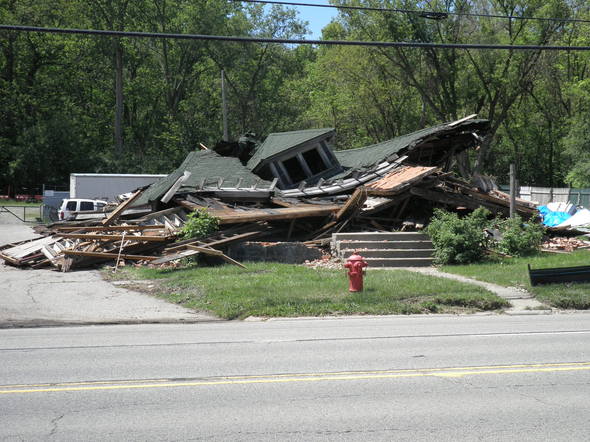
On the route home from the school where I work and my daughter attends, there has been, for many years, an old, somewhat dilapidated house. It's not a terribly residential neighborhood, and the house neither added nor subtracted much from the area. It was just there. Then, towards the end of May, we drove past and the house that was "just there" wasn't there anymore. Where it had been was a pile of debris, obviously the physical materials that had made up the house.
My daughter gasped when she saw it. "Look, Mom! That house just collapsed!!" I was quick to respond. I assured her that the house didn't just collapse, that it had certainly been demolished to make room for something else and we just happened by in between the demolition and the removal of the debris. "That's good," she replied, "because a house just falling over like that would be pretty scary."
As the days went by, we drove past the spot every day. Soon yellow caution tape went up around the debris pile, but the debris itself didn't move. If we had, indeed, just happened along in between the demolition and the cleanup, clearly we had had ample opportunity. After about a week, a story appeared on our local news website. The headline read:
Vacant house on North Main Street collapses; cleanup awaits city permitAs it turns out, the house was indeed slated for demolition, and the owner had applied for a demolition permit. However, before one was issued, according to the owner, the house collapsed.
It just collapsed.
Not only was I wrong when I told my daughter it hadn't just collapsed (and she will tell you this was hardly the first time I was ever wrong!), but I had reassured her by making her believe something that, as it turns out, wasn't true. This is a big no-no when you're talking to kids who are worried about something. You never lie or hide the truth when they ask a question, because they need to know they can trust you. But, inadvertently, I had told her something that wasn't true. It wasn't a lie, it was a mistake. But it shook the basis of why she wasn't supposed to worry about houses collapsing nonetheless.
Even though it was unintentional, I actually did bring this problem upon myself. When we talked about it initially, I didn't say that a controlled demolition was "my best guess" or "probably" or "most likely" what happened. I said it "certainly" was what happened. I spoke in absolutes about something I didn't actually have the facts about. That's another big no-no. And now we see why.
So what could I do? First, I thanked my lucky stars that this wasn't something that my daughter was really distressed about, so the damage was minimal to none. Second, I acknowledged that I had been wrong. I said,
I know I said that the house didn't collapse, but now we found out that it did. It had been empty for a long time and was in very bad condition, and in fact the owner was getting ready to tear it down. So yes, it 'just collapsed,' but it didn't happen all of a sudden out of the blue.That was good enough for her. And it is some version of what I should have said in the first place. Mistakes
 happen, and while it's best to avoid them, it's second best to admit them. Believe it or not, that preserves kids' trust in adults, because they know we're doing our best.
 For more about talking to kids about traumatic events, check out last week's post about the murder of two kids in Texas, and this list of tips from my website.
Friday, July 16, 2010
Recovering from the Traumatic Death of a Child

A two-year-old child died in my township this week. A relative was watching the boy and several other children with another adult when he disappeared. They called 911, then called back to say they had found him -- in the swimming pool
 . He was pronounced dead at the hospital.
Generally speaking, when people react to a story like this, they go in one of two directions. The first is what I'll call the "safety first" direction. People take this opportunity to remind others (or themselves) to keep a close eye on little ones around water. The extreme form of this is blame -- how could someone have a pool outside and not be watching it or the kids around it? The second, and perhaps more compassionate, response is what I'll call the "I can't even imagine it" response. This takes the form of "How awful," "How sad," and the perhaps most honest, "I don't think I'd ever get over it" responses.
While the latter response is more compassionate, and therefore maybe less actively harmful, it actually isn't all that helpful, either. "I don't think I'd ever get over it" is not what a parent needs to hear in what is, for obvious reason, their darkest moment. It's somewhat like going to the doctor and telling her about this terrible stomach pain you have and her responding, "Yep, sucks to be you!!" Sympathy and empathy are nice, but they don't solve much. This may seem a little harsh on my part, and if so, I apologize. It is absolutely true that people don't know what to say at moments like this, and I can hardly blame them for that.
I was recently asked to expound on why we, as a society, don't more fully embrace early trauma response for mental health care. Why isn't it part of what automatically happens, as first aid and calling 911 are for early intervention in physical trauma? The answer to this is complex. It has a lot to do with how we view medical care and mental health in general, and the stigmas we still attach to these topics. But I also think you can trace the lack of early care for traumatized people directly to people saying, "I don't think I'd ever get over it."
If you honestly don't believe you could ever recover from a traumatic incident, then there is no purpose to early trauma intervention. The fact that we as a society do not envision recovery from critical incidents means that we don't set up systems to help that recovery happen. We expect people to fall into two categories -- those who are unaffected by trauma (and we think way too many people "should" be in this category) and those who will be permanently debilitated by it. In physical trauma, we imagine there are those who will be seriously injured, recover and, while perhaps not be the same as before, be in reasonably good shape. We have no vision of this middle group when it comes to mental health.
There are two things I find myself saying the most often to people following critical incidents. The first is some form of "what you are feeling is typical and you are not crazy." The second is, "you will not always feel as awful as you do right now." Can I imagine coping with the traumatic death of a toddler child? No, I can't. Do I know exactly how I would recover from it? No, I don't. The key distinction, however, is that I know that somehow I would. It would be awful. It would be painful. And I would survive. So will these parents. Someone needs to tell them that.
Monday, July 5, 2010
Horses Rampage at a July 4th Parade

Twenty-four people were injured and one killed yesterday at the Bellevue, Iowa, Independence Day parade when two horses pulling a carriage in the parade trampled onlookers. It appears that the horses bumped heads and the bridle came off of one, spooking the horses and spurring the stampede. The dead woman is Janet Steines, the wife of the carriage driver and a passenger, who was thrown when the carriage collided with a street sign. Four people remain hospitalized. Many of the injured were children who were picking up tossed candy in the street.
Yesterday, I myself was in a July 4th parade here in Ann Arbor. I walked alongside a school bus and tossed candy with some colleagues, while various kids and adults rode the bus and threw candy from the windows. A gemtleman from the local chapter of the Jaycees, the sponsoring organization, told us several times that the bus riders were tossing candy too close to the bus and encouraged us to throw it over, not at the crowd. Frankly, we thought he was sort of annoying, although I did see a child or two dart too close to the bus to retrieve some candy and worried about a low-speed crash.
July 4th parades are one of those "supposed to be" events. They're supposed to be fun. They're supposed to wholesome. They're supposed to be safe. We all believe those things and don't really question them. We feel the same way about July 4th fireworks, or at least about the official, professional fireworks displays. Anyone who lives with a small child has spent lots of time reassuring them that the fireworks are loud, but they won't hurt you. The horses are big, but they're friendly. This is all good fun.
On July 3rd, if I had asked you or, for that matter, the people of Bellevue, Iowa, whether it was remotely possible that horses in the Independence Day parade would bolt and injure someone, you and they would have said yes, it was possible. You also would have said it was possible that a firework from a professional display would misfire into a crowd of people, but not terribly likely (it did, in Palmyra, Pennsylvania) or that a child would be hit by a schoolbus (this, thankfully, did not happen). But unless someone asked you about it, you wouldn't have thought much about it. Life is full of dangers we don't choose to think about. Their likelihood seems so remote.
Here's the interesting thing. Next July 4th, if you go to a parade that has horses, it is possible that you will think back to this incident and feel a little anxious. We would consider it truly out of proportion, however, for most adults to be so nervous in such a situation that they couldn't attend such a parade. On the other hand, if you're from Bellevue and witnessed yesterday's incident, you would get a pass if the horses scared you. And yet, it is no more likely for a horse to trample spectators in Bellevue than in New York or Ann Arbor or Atlanta.
So why is it OK for people in Bellevue to be more worried? Basically, because we recognize that people who have not experienced a trauma tend to somewhat underestimate its likelihood, and people who have experienced one tend to overestimate it. If we're kind, compassionate people we leave space for that overestimation, recognizing it as a typical stress reaction, and expect it to diminish, but perhaps not go away, over time.
Coming up tomorrow: Why there seem to be so many freak accidents on Independence Day. Check back!
Thursday, June 24, 2010
Do Not Become a Casualty Yourself

Anyone who's ever had any kind of emergency training at all has heard some version of the same speech. "Before you try to help," it goes, "make sure that you yourself can assist safely. Do not become a casualty yourself." In a Red Cross CPR
 class, this comes in the form of the reminder to "Check, Call, Care," that is, check to make sure it's safe before you do anything else. In a lifesaving swim
 class, it takes the form of "Reach or throw, don't go," meaning don't get into the water if you can help the struggling swimmer any other way. CISM has a similar principle, usually expressed along the lines of, "If the incident is personal for you, get someone else."
I bring this up because on Tuesday I was assisting with a response and became a casualty myself, although not, perhaps, in the way you would think.
Earlier this week, a family from Ann Arbor was involved in a major car accident in Virginia. The mother, Theresa Supica, and one of the daughters, Samantha, were killed, and two other daughters are in the hospital. The girl who was killed was a student at Slauson Middle School in Ann Arbor, where I am the training coordinator for the CISM teams. Tuesday night, the team leader for that part of the district had organized a crisis management briefing and general get together for the middle school community as well as the associated elementary schools and the high school the sisters attend. It was outside on a large patio in front of the middle school. She asked me to attend as one of the supporting members of the team, which I was happy to do.
Tuesday was a pretty hot and humid day in Ann Arbor. After work I went to a weight lifting class and, despite the air conditioning, we were all sweating profusely. About three quarters of the way through the class I started to feel somewhat nauseous, so I sat out in the hallway (where it was a little cooler) for the end of class and felt much better. I hopped in my car and headed towards Slauson, about 10 minutes away.
Half way there, my stomach started to feel icky again. I realized I probably should stop driving, and that I wasn't going to be much use at the CMB. My cell phone was dead, so I thought I'd get to Slauson and find someone I knew to call my husband to come get me. I pulled into the parking lot, got out of the car, sat down in the grass near my car and, not seeing anyone I knew in the immediate vicinity, flagged down a stranger who was just arriving.
I don't know what I looked like at this point, but it can't have been good, because the woman immediately looked alarmed and said, "What's wrong?" I asked her to call my husband, and she went to get her cell phone out of her car. By the time she returned, I was vomiting in the grass, breathing very heavily and losing feeling in my hands. The woman called 911.
At this point I was pretty much doing a face plant in the grass. I could hear everyone and I knew what was going on, but I couldn't move and felt just ghastly. I could hear the woman trying to give directions to where we were, estimating my age ("middle aged" -- I was a little disheartened) and asking if I'd ever had a stroke "before." When the paramedics arrived and got me onto the stretcher, I was shocked to see that quite a crowd had gathered. It hadn't occurred to me that I was causing such a ruckus.
To make what is already a long story a little shorter, after 5 hours in the ER and all sorts of tests, the only thing wrong with me was dehydration. I should know better. Apparently, however, I don't. I was embarrassed to have caused such a scene.
More than anything, however, I knew that I had caused a scene in a place where people did not need more drama. A community reeling from the sudden death of one of its own does not need the image of a relatively young (OK, middle aged), relatively healthy person being wheeled into an ambulance. They don't need to hear sirens. They are working on believing that the world is a safe place once again, and my little episode underlined that maybe it isn't.
To the friends, neighbors, teachers and family of Samantha Supica, I send my heartfelt apologies. I became a casualty myself. You have my deepest sympathies and my sincerest regrets. Thank you for helping me when I should have been helping you.
Monday, May 3, 2010
The Big Story of the Weekend (no, not that one)
This weekend someone packed a bunch of explosive and flammable material into an SUV and parked it in Times Square in New York. The investigation of this is the number one most popular story on Google News today, and I am not going to blog about it. President Obama gave the commencement speech at the University of Michigan here in Ann Arbor, and I'm not blogging about that either. Thousands of gallons of oil are threatening the Gulf Coast, and I probably will blog about that tomorrow. Massachusetts is still without drinking water, and I blogged about that yesterday. You probably knew about all of these things (perhaps not the U of M
 story, but you would if you lived here).
Early this morning, Detroit police officers responding to shots fired in a vacant apartment were ambushed. Four were wounded, one was killed. Officer Brian Huff became the first line of duty death in the Detroit Police Department
 since 2004. The national press barely covered it. The Ann Arbor press, 40 minutes from Detroit, didn't cover it at all. Neither did the Michigan-wide public radio affiliate.
Certainly a lot more people are affected by the Massachusetts water situation and the oil spill in the Gulf. The President speaking in town is pretty rare. The bomb in Times Square affected a lot of people directly, and scares a lot of people vicariously. All of these things are important.
In a typical year, there are less than 70 police officers nationwide that are killed by suspects. Michigan has had two this year, but had none last year. This isn't terribly common. It may not affect as many people as some of the other stories, but those it does impact are affected much more severely. Frequent Quarterbackers may recall that there is a whole Critical Incident Stress Management course just on responding to the 5 most serious types of incidents. Not only is death in the line of duty one of those, but there is actually an additional course just on that.
So why did Officer Huff's death and his colleagues' shootings get so little attention? I think there are two reasons. First, there was a lot of news affecting a lot of people this weekend, which meant that this story had to more actively compete for coverage. Second, Detroit has a lousy reputation for high crime. In other words, people think that this sort of thing is about par for the course in Detroit. This is especially ironic since, although Detroit's crime rate is high, its rate of line of duty deaths for police officers isn't. By any objective standard, this ought to be a big story. We just don't make those judgments by objective standards.
There is no community in this country for which a police officer shot in the line of duty feels normal. The Detroit press is covering this story closely. It's the rest of us, outside (but not all that far outside) of Detroit that are turning a blind eye. We think "those people" in "that city" expect this sort of thing. Unfortunately, we think wrong.
Saturday, April 24, 2010
Mama Bears Comment on a School Fight
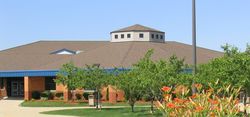
On Tuesday, a sixth grader at Heritage Elementary School in Saline, Michigan
 , south of Ann Arbor, was rushed to the hospital after a fight on the playground. He was unconscious and having convulsions. It appears that he was pushed from behind and possibly kicked by two or three other students while other children watched.
This story hit the news this morning, and I've already had it emailed to me by more than one parent. People are upset by the story, and they are also upset by the comments they see posted by readers of the story. These comments can be divided into a few major categories:
Category 1: What is the world coming to?
This behavior is beocming [sic] an everyday event. What has happened to our children? They are violent and seem to have little respect for life. The bigger question is, why are grade schoolers beating another child to a point that a child is put into a hospital? What are they thinking? What are their parents doing? Who is teaching humanity?Category 2: It's no different than it always was.
NEWSFLASH- Children fight on playgrounds! Please where did you people grow up. Saline grad here k-12, and a playground fight is not really news. I've seen a student knocked out before and plenty of fights. As children age it tapers off- more fights in younger grades but they don't knock each other out. There is no one to blame -its called growing up, and its the same in every public school.Category 3: It's the school's fault.
What has the school done to protect him? How come there was no teacher in sight? Maybe the first punishment was not strong enough to show the previous and current attackers that the school is serious about protecting students in school and that their acts would not be tolerated at all. All these questions need to be answered by the School principle [sic], obviously he/she failed to have any adequate planning in protecting the kids at school. The previous punishment failed to send a clear message to all students about bullying other fellow students at school that it will not be tolerated under any circumstances. This should not be brushed easily aside, we need answers and responsible people to provide education and safety for our kids in Michigan schools. Unless this is properly addressed, it will most likely be repeated.
None of these commenters, as far as I can tell, have any more information about the incident than the sketchy details from the news article, but they all are making assumptions about what happened before, during and/or after this incident. Some of the parents who are emailing me, furthermore, want to know what we are "doing about this" at our school, in a different town and a different district. Why is this eliciting these reactions?
This story has all the makings of a triggering event -- one with which people have strong emotional associations. It took place in a setting that almost everyone has experience with -- a school playground. For we Ann Arborites, it took place not too far away. It involves school violence which, on some level, we all also had experience with.
Perhaps most importantly, this incident not only involves children, but it involves children in a setting where their parents are particularly powerless. We can watch our kids at the mall or the grocery store or our own yard, but when we drop them off at school we have to trust that they are going to be OK. When something happens that indicates that kids are not safe at school, we parents become like mama bears protecting their cubs. Don't mess with us.
The categories of comments on the news article indicate where people's anxieties and biases -- about the world, their children and schools -- already were before they read the article. If you firmly believed that school personnel were somewhat incompetent yesterday, then when you read about this today you saw evidence of that. If you believed that the world is going to Hell in a handbasket, here's your proof. And if you yourself were a fighter and turned out OK, or if you deal with the fact that you can't protect your kids at school by telling yourself you don't have to, you'll say that kids will be kids.
Who knows what the backstory on this incident is. Did the child have an undiagnosed medical condition? How long did the fight last? Who was the aggressor, and what previous problems have they had? I know from having my own school incidents covered in the press that there is always, no matter what, some side of the story that does not make the paper and which I think is very important to understanding the whole picture. In the end, however, these comments aren't about the whole picture and they're barely about this incident. They're about the people who write them, and we can tell a lot about the authors just by reading them.
Saturday, April 17, 2010
Ann Arbor Firebug? The answer is yes.

Two weeks ago in this space I asked if Ann Arbor had a firebug. There had been several suspicious fires overnight, including one that killed a 22 year-old resident. The causes of those fires are still under investigation. Last night, there were four car fires in the area surrounding the University of Michigan campus, all of them intentionally set. Yes, Virginia
 , we have a serial arsonist.
 We often find ourselves saying, about things like this, "It has to stop before someone gets hurt." But someone already has gotten hurt, and whether that particular fire was set intentionally or not, you might think that the death of Renden LeMaster would cause whoever is responsible for those that are arson to think twice. Apparently you would be wrong. It is way outside of my paygrade to try to explain why someone would do this, especially given that someone has died, but obviously someone is.
So, what does this mean for people who live in Ann Arbor? How do you live life knowing that there is someone intentionally burning things next to buildings (all of the fires have started in cars or trash adjacent to inhabited apartment buildings or houses) and that not only could this be dangerous, we know it already is? Should you be scared, and if so, how scared is appropriate?
This situation lends itself to a feeling of helplessnes. Someone out there, we don't know who, may or may not be about to do something which may affect us, and if they do it's really bad but there's no way to know. The antidote to helplessness is action, and so this is a good time to follow the adage, "Prepare for the worst and hope for the best."
Now is the time for Ann Arbor residents to do what we all know we should do anyway but few of us actually do, and that is develop and practice a safety plan for our homes for fires. Every person in every home should know at least two ways out of the house and where to meet after evacuating. We should check our smoke detectors
 every 6 months. We should tell our children to drop to the floor and crawl when they hear the alarm and feel the door before opening it, and also that, no matter how scared they are, never ever to hide during a fire -- kids naturally do this, and firefighters report that a large number of child fatalities in fires occur in closets and under beds where the rescuers cannot find the children.
Once that is out of the way, it's time to try to put things into some perspective. Ann Arbor has a population of about 114,000 people, and thus far five of them have had their home burned down in the current string of fires, with one fatality. That is five and one too many respectively, and obviously this is not a small deal for those people. However, it also represents four thousandths of one percent of the population. The chances of any one family being the victim here are still incredibly small.
So, how scared should you be? However scared you are. Some people will have no concerns, and some will have a lot. That depends on you, your temperment, your past experience with fires, your overall anxiety level, and many other factors. However scared you are, that's how scared you are. There is no point stressing over whether you should be stressed. Put that to the side, do what you can do to keep yourself and your family safe, remind yourself of the tiny odds involved, and give yourself a break. Eventually, this will pass. In the meantime, we're all entitled to feel a little nervous, or not.
Saturday, April 3, 2010
Does Ann Arbor Have a Fire Bug?
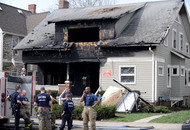
Overnight last night, there were three fires in Ann Arbor. All began outside student housing. All are under investigation. The most serious, which began on the porch of a rental house, sent three people to the hospital. One, Eastern Michigan University senior Renden LeMaster, subsequently died. To put this in some perspective, during 2006 (the most recent statistics I could find), the Ann Arbor Fire Department responded to 322 fire calls, less than one a day, and many of these were for situations that did not require them to put out a fire (e.g. burnt toast). So three is a lot, and someoned dying is a very big deal.
There are two pieces of context that are important in understanding how people are thinking about this. The first is that yesterday afternoon and evening the National Weather Service had issued a Fire Weather Watch for southeast Michigan. The weather was unseasonably warm and dry with high wind, meaning that conditions were ripe for fires to start and for small fires to become big ones. The other is that about 50 miles away in the city of Flint, as I wrote earlier this week, there have been about 40 arson fires in the last three weeks.
Either one of these two factors could stand alone and swing how we feel about the fires last night. If there was the weather alert and no situation in Flint, people might be thinking this was a string of terrible accidents exacerbated by the weather. If there were a firebug in Flint and no weather alert, we might be sure this was arson. As it is, we have both of those things, so you might expect people to reflect a balance in their thinking.
If that's what you expected, you would be wrong. The news coverage has made no mention of the weather alert at all. It has been fairly restrained, on the other hand, in pointing to arson. However, all of the news stories mention that the fires are "under investigation" and that one of them -- not the house fire, but one in which the fire started with a car that had not been driven in a few days -- is considered suspicious. A commenter posted something about the fires in Flint almost as soon as the first story about last night's fires in Ann Arbor went up. The University of Michigan has issued a crime bulletin which, paradoxically, describes "several fires" as being "under investigation," but then tells community members to make sure their cigarettes are fully extinguished.
So, why isn't there more balance in people's thinking? In the hours after an incident, balance is not what we're wired for. We are wired to consider the worst. This is a survival instinct. When something awful happens, we don't want to miss something that might point out that there is more danger ahead, so we are skittish. If someone has been shot, every car backfiring or door slamming sounds like a shot. If there has been a car accident, every driver seems a little erratic. And if there has been a fire, every fire might be arson. Add in the media's natural tendency to go for the sensational, and we don't have a prayer of having any sense of perspective on this.
It's entirely possible these were all arson fires. It's much more likely that one or two were and the other(s) were accidental. It is very unlikely that there is a new serial firebug in Ann Arbor, as there is in Flint, although of course time will tell. It's a good time to remember to check smoke detectors and escape routes, but it's also a good time to remember that while a rash of arson fires affecting us personally is possible, it still isn't likely.
Sunday, March 28, 2010
The Michigan Hutaree FBI Raids

FBI agents conducted raids in Ohio, Indiana and Michigan this weekend, arresting several members of a Christian militia group called the Hutaree. The details of what exactly the raids had to do with and how many people have actually been arrested are somewhat sketchy, but the Detroit News is reporting that it relates to threats made against Muslim organizations. The group is based in Adrian, MI, about 50 miles from my house.
The existence of militia groups in Michigan is not by any means a secret. The "Michigan Militia" got some attention nationally in the 1990's when it was erroneously linked to Timothy McVeigh following the Oklahoma City bombings. Soon after I moved to southeast Michigan someone joked that I had moved into the heart of militia country -- Ann Arbor. While Ann Arbor isn't, rural southeast Michigan might be. It's one of those things we know about and don't spend a lot of time worrying about. There are towns not far from here that I find downright scary, and a handful of those my friends who are people of color will not drive through. Hate groups and militias are not synonymous, but they do intersect.
I had never, however, heard of the Hutaree until late last week, when our local news outlet reported about a local township calling upon militia members to help with missing person searches. In that article, the Hutaree were put right next to the Michigan Militia, seemingly as the next county over's equivalent organization. Today the press coverage is very different, with the head of the Michigan Militia disavowing connection between the two groups and calling the Hutaree a "cult."
Why does this matter? Probably it doesn't. There are people out there who resort to violence to support their political and religious views, and we knew that already. What has changed is simply the emphasis. Now these people "out there" are pretty much right here. If I were a purely rational being, this would change nothing in my outlook on the world. But humans are not purely rational. When we imagine "out there" we actually mean "out there in lots of places that aren't here." So news like this actually shifts our world view and raises our mental estimation of the likelihood of these people affecting our own lives.
There's a house not too far from mine which, if you look at a satelite picture, looks for all the world like an armed compound. I happen to know it's a local farmer with some junked trucks, but I didn't always. We used to joke that the area was the militia headquarters for our little neighborhood. It was funny before. Today, it doesn't feel so funny anymore.
Thursday, March 25, 2010
What Do We Tell the Kids?

After my last post about preparing my staff for bad budget news, Frequent Quarterbacker Jim wrote,
My father-in-law is in the hospital right now, probably not overly serious... but you never know. After reading this post, I plan to tell my son about it, and risk the initial worry that he might have.Aside from it being gratifying that a) someone other than my mother is reading this and b) something I wrote might have been helpful to someone, Jim also brings up a really important issue that, frankly, most of us instinctively get wrong. When something awful is looming on the horizon, what do we tell the kids?
The ways to get this wrong are pretty much endless, but I will share a few key examples.
Method #1: TMI
Several years ago, a handful of schools in Ann Arbor "locked down." There was a man barricaded in his house with a gun near an elementary school. The police told that school to lock down, they called the administration, and someone made the decision to lock down every school on that side of the city. Most teachers did a masterful job of being honest with kids without scaring them, saying things like,
The police are working on something in the neighborhood, and until they are done they want to make sure everyone is safe by keeping us all inside.One teacher, however, decided the best way to allay the fears of her young students was to emphasize how far away from their school the incident was. This is not a bad idea, except that in emphasizing that she forgot to deemphasize some other things. She told her class, "There's just some crazy guy with a gun, but he's far away from here." Not surprisingly, they were not reassured.
Method #2: It could always be worse
When I was still a teacher, a student at the elementary school where I worked disappeared over a weekend and was found murdered on Monday night. Many kids were, understandably, afraid to leave the house and come to school the next day. One little girl had a pretty bad case of school-phobia to begin with, and this didn't help. Her father managed to get her into the building, but she didn't want him to leave without her -- either he had to stay or she was going with him. He started out saying all the right things.
You're very safe here. I would not leave you here if I wasn't sure it was safe. The adults here will protect you and make sure you're ok. I trust them. You should trust them too.So far so good. Unfortunately, he didn't stop there. He continued,
After all, you're much safer here than I am when I leave here. I could get hit by a car, I could get shot . . .Now the student was completely hysterical. She had gone from being worried about herself to being worried about her dad.
Method #3: What they don't know won't hurt them
By far the most common way to get this wrong is to assume that, if something will upset a child, they are better off not knowing it. I have heard of instances in which a teacher died unexpectedly and the staff was notified but none of the students were -- not even the teacher's own class. This might seem like a simple solution to school staff, but it absolutely destroys the relationships between adults and children. Kids will find out at some point, and when they do they'll be mad that they weren't told and they'll be upset at the loss of their teacher but not feel like they have permission to talk to adults at school -- after all, the adults obviously didn't want to talk to them about it.
So, how do you strike the balance? How do you know how much information to share and how much to keep to yourself? It of course depends on the situation and the age of the child. But there are two key indicators you can use as guidelines: yourself and the child.
Using yourself as an indicator means checking in with yourself and your own level of fear and upset about a situation. If you are substantially worried, the kids will pick up on it. In the absence of information, they will fill in the blanks, and what they imagine will be worse than reality. That's a good indication that you need to initiate a conversation with them sooner rather than later. This is especially true if there is a good possibility that things will get to a point where they can't be ignored. In Jim's case, if he or his wife are worried about Grandpa and/or there is any likelihood that Grandpa could die, they need to have a conversation.
Using the child as an indicator means sharing a small, succinct, but complete set of information with the child and then opening the discussion up for their thoughts and questions. In Jim's case, this might mean saying, "I wanted you to know that Grandpa is in the hospital. He's sick, but we are pretty sure the doctors will be able to make him better." Enough said. Now the child can ask why he's sick, or what happens if they can't make him better, or where the hospital is, or when "Sesame Street" is on. This is his conversation, and wherever he needs to go with it is just fine.
Kids don't come with an owner's manual, and knowing how to talk to kids skillfully about upsetting situations takes some learning. The payoff, in terms of confident kids and trusting relationships with adults, is more than worth it. I'm sure Jim knows that already, and I wish his father-in-law a speedy recovery.
Tuesday, March 23, 2010
Mom's on the Roof and We Can't Get Her Down

Tomorrow night, the Superintendent of the Ann Arbor Public Schools, where I am a school Principal, will make budget recommendations for next year to the Board of Education. Next year's budget is about $20 million in the red, and so the recommendations will involve substantial cuts. In a school district, where 85-90% of the budget is spent on people, $20 million is a lot of jobs.
There's an old joke my family likes to tell that goes something like this:
A man is on vacation and his brother is taking care of his cat. The man calls his brother to check in and asks, "How is the cat?" The brother says, "The cat's dead." The man is distraught. He says, "You can't just tell me like that. You have to ease me into it. The first day, you tell me the cat's on the roof and you can't get her down. The second day, you tell me the cat fell and she's in a coma. Then on the third day you can tell me the cat died." The brother apologizes profusely. Then the man says, "It's ok. Don't worry about it. How's mom?" The brother responds, "Mom's on the roof and we can't get her down."
It's only a joke, and perhaps (depending upon your sense of humor) not that funny of one. At the same time, however, it illustrates an important point, and one I've been trying to keep in mind as our district goes through this painful process: Whenever possible, people should have warning of bad news. That doesn't mean we need to artificially prolong the sharing of news, as the man in the joke would have us do. But it does mean that, when we can see that something bad is possibly looming, it's a kind gesture to let those affected know.
This is the same principle that lies behind doing inoculation training for critical incidents. Inoculation training is simply giving people some exposure to what a crisis might be like, what they might experience, and what they can expect. The principle is that people will be more resistant to stress and more resilient from it if, when the crisis happens, this is not the first time they've considered its possibility. That's why train engineers are prepared for crashes, and that's why our district is using grant money to have me walk every school's staff through how a crisis in their school would unfold.
Which brings us back to the budget. We have known since November that big cuts were on the horizon. I have tried hard to talk candidly with my staff about what those cuts might entail, particularly with our less senior staff whose jobs might be on the line. We have taken a "we're all in this together" approach to talking about it, even though we know that we won't all bear the burden equally. I've tried to answer as many "what if" questions as I know the answers to, and I've tried to acknowledge the stress that the uncertainty is causing for everyone.
Tomorrow night, when the Superintendent makes his recommendations, there may well be bad news for a lot of people. I hope I am correct in saying that there will not be anything that is a brand new surprise to my staff, however. That doesn't make everything OK, but with any luck it will make it just a little bit easier.
Wednesday, January 20, 2010
California's Apocalyptic Weather

Yesterday afternoon, a headline appeared on Google News that read, "Parts of LA Under Tornado Warning." This did not particularly grab my attention, so I was surprised when, a few minutes later, a list of the most popular stories also included this one. What, I wondered, could possibly be so interesting about a tornado warning in Louisiana? Then I looked more closely at the sources for the various articles and realized that, in this case, LA was not the postal abbreviation for the state of Louisiana, but the acronym for Los Angeles.
Context is everything. I read the headline as being about Louisiana simply because it was much more plausible. Louisiana has tornadoes. Southern California has earthquakes and wildfires. That's how the world works. If I was thrown for a loop by yesterday's weather in Los Angeles, I can only imagine what Angelenos themselves are thinking. Today is bringing another storm and mudslides with attendant evacuations.
Storms like this are never fun, no matter where you are or how often they come around. But if you live in an area that gets them a lot, tornado warnings and the like become a part of life. Even here in southeast Michigan, where we have at most three tornado warnings a year, school children drill for them and my own kids know exactly where the "safe room" in our house is. We are used to severe thunderstorms and flooded basements in the spring and summer, and bitter cold and snow in the winter. That's how the world works.
A tornado in Los Angeles, on the other hand, feels about as likely as a major earthquake in Michigan -- it could happen, but nobody thinks it will. After the Eureka earthquake I wrote about how whether an earthquake is "big" depends a lot on your previous experience with earthquakes (and of course, little did I know that I'd soon be blogging about another big, much more devastating one). Whether or not a tornado warning feels particularly scary or traumatic, similarly, has a lot to do with whether you have them all the time.
A kid in Los Angeles isn't as likely to know where the safe room is or to have practiced for severe weather in school. On the other hand, my children haven't a clue what to do in an earthquake and would be terrified by even a modest tremblor. So, in addition to being more and less accustomed to certain things, we also are more and less prepared for them. Preparation gives a sense of safety and lessens the traumatic impact of a crisis -- it's much more scary to have a tornado nearby if you first have to figure out what to do and only then can take cover.
We all have expectations for how the world works. The more those expectations are violated, and the less we are prepared, the more traumatizing an incident is going to be. So if it's all the same to Mother Nature, let's keep the earthquakes in Los Angeles and the tornadoes in Michigan. That's the way the world works.
Tuesday, November 17, 2009
A Deadly House Fire, and Blame Gets in the Way
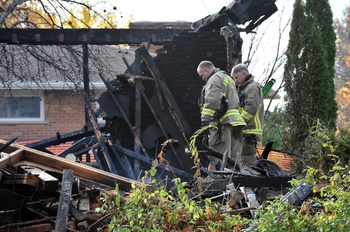
Last month, three adult members of a single family died in an early morning house fire here in Ann Arbor. When firefighters arrived, the house was fully engulfed in flame. They could not get in to rescue the occupants. The Alexandropoulos family was first reported as missing, and later in the day three bodies were found. From the beginning, this story seemed odd. Firefighters took more than 10 minutes to arrive, and the stated reason was that they were on the scene of another call. But the other call was around the corner and wasn't a fire at all. Something wasn't right.
Now the City Council has been briefed on a fuller version of the story. Apparently, neighbors a few blocks away awoke to the smell of smoke and went out into the neighborhood looking for the source. A large amount of smoke was coming out of a chimney in an unoccupied house, and they called 911 at 2:53 AM to report it. Meanwhile, neighbors on the same street as the fire, and west of the first callers, reported smoke coming from the east. Firefighters were dispatched to the house where the smoke was reported, but found it was not the source of the smoke. Finally, at 3:06 AM, a caller gave the correct location of the house, but it was too late.
Last night, the City Administrator, Roger Fraser, briefed the City Council and blamed confusion over the address for the slow response. Meanwhile, rumor has it that 911 operators did not know where the correct address was located even once they had it. Tapes of the calls have not been released. Everyone agrees that the house had no smoke detectors and there is some speculation that the house was fully involved before the first call was ever made. The local press quotes Fraser as saying,
Our request is that if you have such an incident that you're unfortunately involved with, please give us as specific information as you can when you call, because at that time, in the context of what was going on, our firefighters knew nothing more than the fact that that [wrong] address could have been the location that they were all talking about.
I think we can all agree that this fire is a tragedy. It is also natural that our minds turn to blame when something like this happens. The city blames the callers, the callers blame the city, and everyone blames the victims. I think, however, that Fraser is missing an opportunity to do some very helpful crisis communication. He is so busy circling the wagons to deflect any blame from the city, that he isn't actually helping anyone who is upset.
When something goes wrong, it is only natural that we want to prove that we didn't do it or weren't at fault. However, following a traumatic incident, what people most need to hear is not, actually, who is to blame, but rather what is being done to prevent it from happening to them. As much as our minds go to blame, they are really going to protection. If we can blame someone, we think we can prevent that someone from doing anything to us. How much better would it be if we knew that that someone is working on it themselves?
So here's what Fraser should have said:
We've discovered three factors that may have contributed to this tragedy: a lack of smoke detectors, confusing information about the address, and difficulty finding the house. Our job now is to work on each of these factors to try to make sure they don't happen again. We are stepping up our efforts to educate the public about smoke detectors. We are retraining our 911 dispatchers to make sure they ask for very specific information when they receive a call. And we are looking at our GPS systems and reverse 911 capabilities to see if anything can be done to improve our ability to find difficult addresses. We hope that the public will help us by installing smoke detectors and being very specific when they call 911. Together, we can prevent this from happening again.What we most need, at a time like this, is not to feel mad. It's to feel safe. This is a great example of how, so often, our public officials have the opportunity to do that for us, and don't.
Sunday, October 25, 2009
The Puerto Rican Earthshattering Kaboom
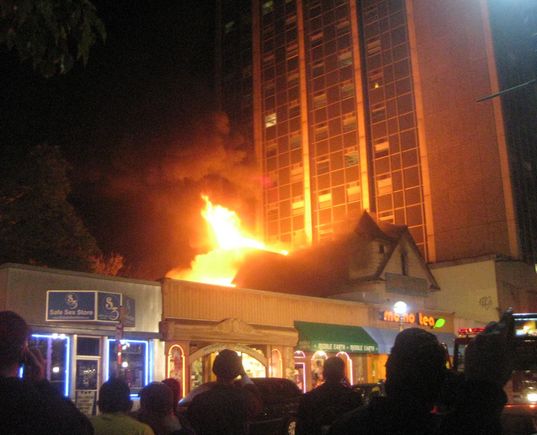
Last night, I asked a friend, "Did you hear about the explosion in Puerto Rico?" He hadn't. About 1500 people near San Juan have been displaced by an explosion at a Caribbean Oil storage facility in the wee hours of Friday morning. The explosion registered 2.8 on the Richter scale, which isn't much for an earthquake but is one heck of an explosion. Yesterday brought fears of increased casualties as the wind brought the cloud of smoke over San Juan, but so far no major injuries have been reported and the wind has shifted in the other direction, although the fire is still burning out of control, almost 60 hours after it started.
This morning, that same friend asked me, "Did you hear the news?" He wasn't talking about the fire in Puerto Ri
The fact that the Caribbean Oil fire hasn't gotten all that much coverage in the mainland US should not be surprising. As I've often said, we pay attention to things that are horrible, unexpected, and happen in places and to people we identify with. It will give you some idea how much we in the United States identify with Puerto Rico that CNN.com has been running its coverage in its "World" section, not in its "U.S." section. As they say in the musical "West Side Story,"
Nobody knows in AmericaThe Washington Post has this story in the Nation Digest, so at least they've located it properly. It's the third story in the digest. Balloon Boy is number one.
Puerto Rico's in America
Both of these fires are exciting. To the people who are right there, they are also probably traumatic. One man in Puerto Rico was quoted as saying,
I didn't expect to see a mushroom cloud from my houseFor most of us, though, these stories are attention grabbing if we live nearby or know the area, and mildly interesting otherwise. That's because we know that fires happen, we hope they don't happen to us, and no one was seriously injured in either blaze. We love stories like this. We can sit back and watch, admire the power of fire to destroy and its beauty in the night sky, and not really worry about it. We are voyeurs at heart, and in these cases, we can do it with impunity.
Subscribe to:
Posts (Atom)
Meet the Quarterback

- Naomi Zikmund-Fisher
- is a clinical social worker, former school Principal and a Crisis Consultant for schools and community organizations. You can learn more about her at www.SchoolCrisisConsultant.com

Subscribe


 Posts
All Comments
Posts
All Comments