Do Not Become a Casualty Yourself


Anyone who's ever had any kind of emergency training at all has heard some version of the same speech. "Before you try to help," it goes, "make sure that you yourself can assist safely. Do not become a casualty yourself." In a Red Cross CPR
 class, this comes in the form of the reminder to "Check, Call, Care," that is, check to make sure it's safe before you do anything else. In a lifesaving swim
 class, it takes the form of "Reach or throw, don't go," meaning don't get into the water if you can help the struggling swimmer any other way. CISM has a similar principle, usually expressed along the lines of, "If the incident is personal for you, get someone else."
I bring this up because on Tuesday I was assisting with a response and became a casualty myself, although not, perhaps, in the way you would think.
Earlier this week, a family from Ann Arbor was involved in a major car accident in Virginia. The mother, Theresa Supica, and one of the daughters, Samantha, were killed, and two other daughters are in the hospital. The girl who was killed was a student at Slauson Middle School in Ann Arbor, where I am the training coordinator for the CISM teams. Tuesday night, the team leader for that part of the district had organized a crisis management briefing and general get together for the middle school community as well as the associated elementary schools and the high school the sisters attend. It was outside on a large patio in front of the middle school. She asked me to attend as one of the supporting members of the team, which I was happy to do.
Tuesday was a pretty hot and humid day in Ann Arbor. After work I went to a weight lifting class and, despite the air conditioning, we were all sweating profusely. About three quarters of the way through the class I started to feel somewhat nauseous, so I sat out in the hallway (where it was a little cooler) for the end of class and felt much better. I hopped in my car and headed towards Slauson, about 10 minutes away.
Half way there, my stomach started to feel icky again. I realized I probably should stop driving, and that I wasn't going to be much use at the CMB. My cell phone was dead, so I thought I'd get to Slauson and find someone I knew to call my husband to come get me. I pulled into the parking lot, got out of the car, sat down in the grass near my car and, not seeing anyone I knew in the immediate vicinity, flagged down a stranger who was just arriving.
I don't know what I looked like at this point, but it can't have been good, because the woman immediately looked alarmed and said, "What's wrong?" I asked her to call my husband, and she went to get her cell phone out of her car. By the time she returned, I was vomiting in the grass, breathing very heavily and losing feeling in my hands. The woman called 911.
At this point I was pretty much doing a face plant in the grass. I could hear everyone and I knew what was going on, but I couldn't move and felt just ghastly. I could hear the woman trying to give directions to where we were, estimating my age ("middle aged" -- I was a little disheartened) and asking if I'd ever had a stroke "before." When the paramedics arrived and got me onto the stretcher, I was shocked to see that quite a crowd had gathered. It hadn't occurred to me that I was causing such a ruckus.
To make what is already a long story a little shorter, after 5 hours in the ER and all sorts of tests, the only thing wrong with me was dehydration. I should know better. Apparently, however, I don't. I was embarrassed to have caused such a scene.
More than anything, however, I knew that I had caused a scene in a place where people did not need more drama. A community reeling from the sudden death of one of its own does not need the image of a relatively young (OK, middle aged), relatively healthy person being wheeled into an ambulance. They don't need to hear sirens. They are working on believing that the world is a safe place once again, and my little episode underlined that maybe it isn't.
To the friends, neighbors, teachers and family of Samantha Supica, I send my heartfelt apologies. I became a casualty myself. You have my deepest sympathies and my sincerest regrets. Thank you for helping me when I should have been helping you.

Chicago Gynecologist Charged With Rape: The Second Trauma of Not Being Believed

In August, 2002, a Chicago woman who was 8 months pregnant reported that her gynecologist had raped her. Forensic evidence, including a rape kit, was gathered, but no comparison sample was ever taken from the doctor. This wasn't the first allegation of sexual assault against this doctor nor, as it turns out, would it be the last. His license was suspended for several months last year after four women made allegations. On Thursday, the doctor was arrested in the 2002 case, almost 8 years after it happened, but less than two weeks after his DNA was finally tested against the rape kit.
Now, a few disclaimers. I don't know the alleged victim or the alleged perpetrator in this case, and obviously I don't know what happened that day in 2002. Everyone is presumed innocent until proven guilty, and that holds for this case as much as for any. However, for the sake of argument, I'm going to presume that this crime occurred exactly as described and the doctor is guilty. Again, I don't know if that's true, but let's imagine it is.
When most people hear the word "rape
 " they imagine someone jumping out of the bushes or a dark alley and accosting a woman. They imagine a weapon of some kind. They imagine that the perpetrator and the victim don't know each other. In fact, however, the rapist and victim are strangers to each other in only about 1 in 4 rapes.
Rape, regardless of the circumstance or relationship, is traumatic. Rape violates the victim's sense that the world is a safe place and that they are in control of and can protect their own bodies. Rape by someone you know and trust adds the extra violation of the victim's belief that they can judge character and that they are loved and cared for by those closest to them. In this instance, there is the additional factor that the victim was pregnant. While violence against pregnant women
 is certainly a known phenomenon, most of us hold the belief that pregnant women are sacrosanct, particularly towards the end of the pregnancy. Here, a woman was raped while pregnant, not just by someone she knew but by someone she trusted to help her pregnancy be safe. Obviously, that trust was violated in the worst way.
People who have experienced or been exposed to trauma often experience a sense of unreality, both during and after the incident. It's very common to hear people say, "This can't be happening" or "It isn't true." What they are actually saying, though, is that the fact that it is true is too much for them to bear. They can't process it. The only thing that helps that is time spent living with the notion that it did happen, and opportunities to process what that means for them. But in this case, as in too many cases of sexual assault, the people who were supposed to help this woman either didn't believe her or didn't care enough to follow up, or maybe they had some other motive.
Whether the victim was actually told this didn't happen, she certainly got the message that it didn't matter. That is an especially difficult message to receive, because it directly interferes with processing the original incident and coming to terms with it. People already worry that they are crazy for how upset they are and how a critical incident affects them. If they're told it didn't happen, while they still know it did they have entered another phase of the incident and their own disbelief -- not only was this woman raped, and she felt it couldn't be happening, she wasn't believed, which again must have felt unreal. If she was told it didn't matter, that just reinforced how crazy she was already feeling.
Reading about this case, I was reminded of an exam I had during my own pregnancy with my son. My doctor, who is male, and his physician's assistant, who is female, entered the room. I made some wise-crack about the PA being my bodyguard, and my doctor said very seriously, "She's not here to protect you, she's here to protect me." In fact, she was there to protect us both, and to attest that nothing inappropriate happened during the exam. I can only vaguely imagine what it would be like to be assaulted under those circumstances. I can't begin to fathom what it would do to me, after that, to not be believed.
Photo copyright istockphoto/jenjen42
The Everyday Crises We Can't Prevent

Yesterday afternoon we had a perfect storm
 at my school. The secretary was out sick. The clerk is in China. The lead teacher was out of the building. The nurse and all of the special education staff were in a meeting. One of the teacher's assistants, the one who works with our most medically fragile students, was picking up her ill child from another school. I was in my office with my boss having my evaluation conference. It's hard to imagine a worse time for a student to have a seizure in the lunch room.
In all likelihood, there were probably a total of 90 seconds between the start of the seizure and when I got there. The nurse was 30 seconds behind me. In this day and age, we were lucky she was even in the building -- she is only there one and a half days a week. Had everyone been in their usual places, it might have shaved 30 seconds off the entire thing. Those extra 30 seconds, of course, felt like an eternity to the lunchroom staff, and probably sounded like an eternity to the family when we spoke to them.
This child has a known seizure disorder and a written plan for what to do. I won't say my adrenalin didn't kick in at all when I started heading for the lunch room, but I will say I wasn't scared. We had a plan, the nurse was on her way, and I knew this child was susceptible to seizures. Stuff happens.
Once the nurse had taken over, I looked around at the lunchroom staff and realized that my reaction was not the same as theirs. The one who had first noticed the student seizing was beside herself wondering if she had done the right thing. Another one told me her brother, who died a couple of years ago, had died during a seizure. Most of them just were not at all convinced that this child was going to be ok. They work at the school 2 hours a day. They've never encountered this child having a seizure before, and it triggered all sorts of emotions for them, as you might expect. Those of us who have seen this before felt much better than they did.
I went back to my office and called the family. Then I returned to my evaluation conference, and joked with my boss that there must be somewhere on that evaluation form to notate that in fact that had gone pretty well.
We spend a lot of time and energy preventing things from happening in schools, from shootings to fires to kids tripping over their shoelaces. At the end of the day, however, you can't prevent everything. And while we couldn't prevent this seizure, we could make sure we were ready, and we can go back and review how everything unfolded and tweak our procedures. But even with these relatively "little" incidents, it's important to remember that, to someone on staff, this may not be little at all. Someone's brother died. Someone felt incompetent. When it's over, it's important to support them, too, and review to see how you might have protected them from the trauma -- with a small "t."
Mass Casualties from Kleen Energy Explosion
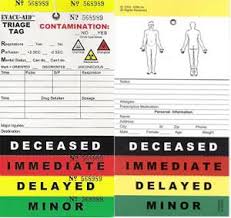
There was a massive explosion at a Kleen Energy Services gas power plant under construction in Middletown, Connecticut at about 11 o'clock this morning. Most recent reports suggest a gas leak may have been the cause, and that there were about 50 people working at the plant at the time. Police officials said that this was a "mass casualty event."
If you don't do this sort of thing for a living, the term "mass casualty event" probably sounds pretty bad. It probably sounds pretty bad if you do do this sort of thing for a living, too, but in a different way. Most of us, when we hear "casualty" think "death," but of course that's incorrect. Casualties include people who have been injured as well as people who have been killed. A mass casualty event (MCE) is an incident that is of sufficient size that it will stress the first response and health-care system locally. Different jurisdictions define how big something has to be to qualify as an MCE, and that also takes into account the capabilities of local responders.
Local hospitals in and around Middletown are reported to have activated their disaster plans. On the face of it, this may sound odd. We think of disasters as being earthquakes, tornadoes, floods and the like. For the purposes of responding to them, however, there really isn't a big difference between a massive accident and a massive tornado. If you work in the ER, you don't particularly care how all these people got hurt, but just that they did and how many of them there will be. A disaster plan enables the hospital (or whoever) to plan for a situation that is going to tax their capacity. It defines who does what when it's "all hands on deck."
Being injured in a mass casualty event as well as responding to one can have slightly different stressors. The biggest difference that most people notice right away is the use of triage. Responders have to choose who will get care first, and that means some people are going to have to wait. If you are injured when your car hits a tree, for example, you are going to get the full attention of first responders. If you are in a 50 car pileup, you will only get first attention if you are the most injured person that rescuers think has a chance of survival. Anyone who has ever gone to the emergency room on a busy day has experienced triage. You may be having the worst emergency of your life, but as long as someone else is having a worse one, you have to wait.
The triage involved in MCE's can become a predictable theme when responders and survivors work with crisis intervention personnel. Survivors express the fear and frustration of being seriously injured and having first responders walk right by them without helping. Responders report the horror of seeing multiple people in serious pain and having to leave them as they are rather than help. There is nothing quite like having to step over a dying person without offering even comfort in order to save someone else. These are choices none of us, even the highly trained, are used to making.
It will be a while before we know the full extent of the injuries at Kleen Energy. That's also one of the hallmarks of an MCE -- helping comes before counting the people who need help. As the dust begins to settle, this will be a big job for a CISM team, who will need to move in and help everyone recover from the difficult choices that had to be made today.
Hope is a Double-Edged Sword: Man With Locked-In Syndrome Misdiagnosed

In the early 1980's, Rom Houben, a Belgian 20 year-old, was in a horrific car accident. He was in a coma, and then diagnosed as being in a persistent vegetative state. For 23 years, his family refused to accept his diagnosis and insisted he was conscious and aware of his surroundings. Finally, with advances in brain scan technology, doctors were able to more thoroughly examine his brain and determine it was essentially normal. Over time, they were able to help him communicate using a single finger and a keypad.
Houben wasn't in a vegetative state at all, but rather suffering from "locked-in syndrome," a state where he was able to hear and feel and understand, but unable to move or speak. The medical journal article that detailed his story estimates that up to 43% of people diagnosed as being in a vegetative state are actually conscious.
I'm sure this case will be the subject of much political debate. The news coverage is rife with mentions of Terri Schiavo, the Florida woman whose husband's battle to remove her feeding tube made its way all the way to the United States Congress. I acknoweldge that this case raises ethical questions, and I also acknowledge that I am completely unqualified to discuss them.
This story also raises questions for the families of those diagnosed as being in persistent vegetative states. On the one hand, accepting the reality of their loved one's situation is important, regardless of what people decide to do about it. Holding out unrealistic hope can trap people in the common trauma reaction of feeling like the situation isn't real. On the other hand, if this study is accurate, about 4 times out of 10, it truly isn't real.
This story is very encouraging to those left behind by traumatic accident victims in vegetative states. I truly hope that as many of them can be "unlocked" as this story predicts. I just worry about the 6 out of 10 situations or more where this research will prevent survivors from accepting reality.
The CDC and H1N1: What if We Threw a Panic and Nobody Came?

The Centers for Disease Control is out with its weekly update on the H1N1 pandemic, and that means it's time for another round of alarmist headlines from our friends in the mainstream media:
- Reuters: "Swine Flu Means Worst Flu Season in 12 Years in U.S."
- CNN: "H1N1 death toll estimated at 3,900 in U.S."
- Associated Press: "CDC: Swine flu has sickened 22 million in 6 months"
- CBC News (Canada): "More H1N1 cases, deaths than thought in U.S."
- Wall Street Journal: "CDC Estimates H1N1 Has Killed 3,900"
H1N1 on Pace to Kill Far Fewer People Than Typical Seasonal Flu
So, here's what happened today. The CDC reported its statistical estimate of how many people have been infected with novel influenza A H1N1 in the United States in the 6 months since the first cases emerged last spring. Up until now, they have reported confirmed cases, hospitalizations, and deaths. Today they used the very same formulae that they use every year to figure out how many people have the flu, and came up with an estimate of 22 million cases of H1N1 and 3,900 deaths over the last 6 months. They also reported that the percentage of visits to doctors for influenza-like illnesses is now the highest it has been since they started counting back in 1997.
There are two angles from which you can look at these numbers. The first, and the one that the media seems to have jumped at, is that these numbers are significantly higher than what has been reported previously. In fact, this death toll is about quadruple the last death toll number that was announced. That makes it appear that H1N1 is much, much worse than anyone suspected before, and that's news. What's more, more people are going to the doctor than ever before for flu-like illnesses. H1N1 is making quite an impression out there.
The other angle from which you could view today's numbers is to consider exactly what it is that is being reported here, and how it compares to similar numbers we know about. Under this analysis, you are definitely still left with a very large number of doctors' visits for the flu. It isn't clear at all whether that means more people are actually sick or whether when people get sick they are more likely to go to the doctor this time around, but it does seem like the flu is a real problem out there. 22 million people have gotten H1N1. That's less than 10% of the population, which really isn't all that many people as these things go, although I haven't been able to find a decent number on how many people get the flu in an average year.
Furthermore, 3,900 people have died. And while that is 3,900 tragedies, it is also about 11% of the annual death toll from seasonal flu. In order for H1N1 to kill anywhere near the number seasonal flu does each year, more than 5,000 people are going to have to die every month from now through April. Oh, and the death toll didn't triple -- this is a totally different statistic than the previous reports. This is an estimate of the total. The lower numbers were the actual number they had counted.
So yes, you can look at the numbers and say they are much worse than anything we've heard before, or you can look at them and say they are much, much, much better than we feared. In fact, the thing that makes this flu season bad is not any of these numbers at all, but the fact that so many younger people are getting sick and even dying. But while we need to take H1N1 seriously and try to prevent its spread as best we can, I'm kind of wondering at what point the media and, to a lesser extent, the CDC will wake up to the fact that this just isn't the horrible crisis that was predicted. At what point will the evidence outweigh the need to have been right and to continue the high alert? Whenever that point is, it obviously isn't now.
Pediatric H1N1 Deaths: Compared to What?

Deaths of children due to Novel Influenza A H1N1 rose 20% in just the last week. So far 114 children have died. That's what Bloomberg is reporting this afternoon, following the weekly update on the CDC website. Bloomberg's coverage then continues with this penetrating commentary from Irwin Redlener, the director of the National Center for Disaster Preparedness at Columbia University:
This is very unsettling news for parents, particularly when coupled with the shortage of the vaccine. The situation is much more fluid and uncertain than the government expected and than the public is comfortable with.
So, let's face it. A lot of us very naturally look to the news to tell us how scared we should be. If something makes the news, we figure we should pay attention to it. If it's bad, we figure we should worry about it. In the case of something like a pandemic, the news is our major source of information. So a 20% rise in pediatric deaths in one week scares us, and now we have an expert telling us that this is unsettling news, so we feel, well, unsettled.
Bloomberg, as the press often does, is violating the Quarterback's 5th commandment of H1N1 communication:
Thou shalt put thy information in appropriate context so that thy public may understand the dangers they face with relation to other dangers, and not overreact to thy numbers.The fact of the matter is that nowhere do we have a sense of comparison between the number of pediatric deaths from H1N1 and other causes of death for children. We don't know how many children have H1N1 in the first place, so we don't know what the chances of any given sick child dying might be. We don't know how many children tend to die from seasonal flu, nor how many of these children were medically fragile and likely to die from something else if they hadn't contracted the flu.
The death of any child is a tragedy. The highly publicized death of a child is scary to parents. But the naked number "114" has no meaning whatsoever. And the statistic "20% in one week" is unbelievably misleading -- I certainly didn't think the number was going to be in the low three digits when I saw that.
Which brings me around to Professor Redlener, who really ought to know better. Not only does he tell us to be scared without any context at all (although, to be fair, he might have given context that was edited out), but he then goes on to tell us that this is much "more fluid and uncertain" than predicted. That is patently false. Back in August, the President's Council of Advisors predicted between 30,000 and 90,000 deaths from H1N1, which translates to between 5,400 and 16,200 pediatrict deaths. We've had 114. I would say that if we are more uncertain than we thought we would be, it's because the big shoes have yet to drop, not because there have been so many deaths.
Reporters are trying to sell newspapers, and fear sells papers. An honest headline this week like, "Yep, Still Lots of Swine Flu" would not sell papers, so that's not what Bloomberg picked up. They need to remember that hysteria is a lot more contagious than any flu can ever be.
The H1N1 Vaccine Shortage: Hate to Say I Told You So . . .
Here in Washtenaw County, Michigan, we've been told for months that there is going to be H1N1 vaccine for everyone who needs it. In my school district, three clinics were scheduled to vaccinate anyone who wanted it at the three biggest high schools in town during the first two weeks in November. Similar clinics were scheduled at a variety of school sights around the county.
Then a couple of weeks ago, the word went out that actually, not everyone was going to be able to get vaccinated. In fact, these clinics would now be limited to health care workers, pregnant women, caregivers of children under 6 months, children from 6 months through 4 years old, and children ages 5 through 18 with underlying health conditions. One of our district's three clinics was canceled.
Clinics were set to begin this past Tuesday. In the days leading up to the first clinic, the word went out that only 1,000 people would be vaccinated at the clinic on Tuesday. The idea, apparently, was to spread the vaccine around to the various locations. What was not shared was how many doses of vaccine were dedicated to all the clinics put together, just that it wasn't nearly as much as originally hoped, but more was trickling in.
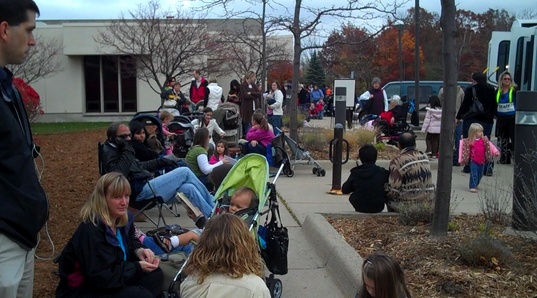
Monday's clinic, at our local Intermediate School District, was slated to run from 2:30 - 9:00 PM. The first person lined up at 9:30 AM. People parked 1/4 of a mile or more away from the building to get in line. By 5:00, the clinic was closed. My son was among the many people in the designated groups who planned (or whose parents planned) to get vaccinated that day who didn't even bother to get out of their cars.
That was Monday. By this morning, all of the school-based clinics had been canceled, and the convocation center at a local university is the location for a new, "mass vaccination clinic" for the same high risk groups next week. It suddenly seemed like a better idea to try to do as many people as possible all at once rather than have people go from clinic to clinic, hoping to be in line early enough to get their shot.
While the shortage of H1N1 vaccine may not have been predictable, scenes like this one certainly were. Anyone who's ever tried to get tickets for a popular rock concert can tell you what happens when you publicize that there is only a certain amount of something that people really want and that it will become available on a certain day, at a certain time, in a certain place. Its a wonder the Health Department didn't give out wrist bands ahead of time -- they might consider that in the future.
Back in July I predicted what a shortage of vaccine, or a prioritization of who can be vaccinated, or a rationing of health care during the pandemic, might do to people psychologically and how it might cause people to act. I'm not expecting that the powers that be read this blog, but if I can figure it out, so can they. Planning clinics based on the idea that you can vaccinate a certain number of people per clinic over a certain number of clinics over a certain number of days is all well and good, but you have to take into consideration how many people will want to be vaccinated each day. Around here, the Health Department seemed genuinely shocked by the notion that significantly more than 1,000 patients showed up for a 1,000 patient clinic.
This really shouldn't be that hard. You select which groups can be vaccinated based on which groups you think you can vaccinate without turning anyone away. You set up a mass clinic with lots of parking, and you publicize that everyone in those groups who wants to will be vaccinated. You allow people to make appointments, or get wrist bands, or something to spread out the crowds. And you hold the clinic until everyone who is entitled has had their shot. When more vaccine becomes available, you do it again. And you stop being shocked that the public's priorities and ideas about how to proceed do not include the convenience of the Health Department. That ship sailed a long time ago.
The Sound and the Fury of the H1N1 Emergency

President Barack Obama declared a national emergency for H1N1 today. Technically speaking, this allows the Health and Human Services Secretary to waive some bureaucratic requirements in an attempt to help states cope with the spread of the virus. This sort of declaration, along with declarations of states of emergency of various kinds, stems from regulations that say that the government can do certain thing if certain people determine that an emergency exists. This is the President saying, "Yep, sure looks like an emergency to me. Go forth."
These declarations always strike me as somewhat odd. They are always reported breathlessly on the news, but in fact, they are not a change in the state of affairs, they are a recognition of what already exists. The President's declaration of a national H1N1 emergency did not change the number of people who have the disease, the number of people who have died, the number of people who will get the disease, or the number of people who will die. It did not even represent the outcome of some set of information that he has and we don't. It literally is him looking at the same statistics we all have access to and deciding, as many of us have, that it looks bad.
Meanwhile, we have some jurisdictions and federal officials throwing around the word "peak" to describe what is happening in flu cases. That feels like just the opposite of an emergency. The peak means it's all downhill from here, at least to most people. Only that isn't what it means. When they talk about the "peak" in this instance, they are referring to previous seasonal flu seasons, when widespread flu activity in most states (right now it's in 46) represented the full force of flu season arriving. If you look at graphs of flu activity from previous years, sometimes the "peak" looks like a peak and sometimes it looks more like a rolling hill -- in other words, the peak can last for a pretty long time.
It's also impossible to know whether the shape of the graph for this year will look like other years, because we haven't had pandemic flu in a while and this one came at an odd time of year. Right now, flu activity is well past what was the peak of the 2007-2008 flu season (which was pretty bad) but not to the point of the peak of the 2002-2003 flu season. Yes, it's bad, but it could get worse. It could get better. We just don't know.
So, is this an emergency? Depends on what you mean. I'd say that if your child has secondary pneumonia right now and is in the hospital, this feels like an emergency. And if no one you know has been sick, or they have but not very sick, then it probably doesn't. For the first person, the emergency declaration is too little too late, and for the second it's likely to make them more nervous than they might need to be. It's easy for those "in the know" to forget that what they mean when they use words that are so emotionally charged is not necessarily what people understand when they hear them. Maybe it's time to reexamine how those words are used, at least in public.
H1N1: It All Becomes Real

Several months ago, I blogged about what I thought was going to happen when people who are used to getting what they want in health care were told that they couldn't get the H1N1 vaccine right away. That scenario completely failed to recognize the possibility that people actually wouldn't want the vaccine at all. It turns out that both are true. About half of the population does not intend to be vaccinated, and the other half is facing something of a shortage, at least in the short run.
Here in Washtenaw County, Michigan, the supply of vaccine is coming in slower than planned. This means that scheduled H1N1 vaccination clinics are being postponed or scaled back. My school district had intended to hold 3 clinics during the first 2 weeks of November and vaccinate anyone who wanted it. Today we got the word that one of those clinics was canceled and the other two would only vaccinate high priority subgroups.
This was, in almost all respects, a possibility I was prepared to deal with. I was not prepared, however, to deal with perhaps the hardest crisis communication audience I ever have to face: my daughter. My daughter is 11 and healthy. Her brother is 4. That means that he is a high priority for H1N1 vaccine, and she is in the next tier down. This means that, at the beginning of November, instead of the whole family going to the clinic for our vaccinations, we will just take my son.
My daughter has a mom who does crisis and crisis communication for a living. She's used to talking about some pretty heavy things around the dinner table, and to weighing some difficult ethical topics. She gets why my son gets the vaccine and she doesn't, at least intellectually. And yet, it's hard enough when your baby brother gets all the attention and the presents and gets away with everything and everyone says he's cute (at least that's how it seems sometimes). Now he is a higher priority for healthcare. This is a form of sibling rivalry few of us have experienced.
I am telling myself that I'm OK with not getting the vaccine right away, and with waiting to get it for my daughter. I also know we have two students at school who have secondary infections following presumed cases of H1N1. They are very sick, and they've been out for a long time. I know the numbers and the odds -- I write about them incessantly. But those two kids are much more real than all the numbers in the world, and I identify them much more with my own daughter. I'd be lying if I said I didn't want an extra dose, just for her.
The H1N1 Vaccine

The H1N1 vaccine began being shipped today. The nasal spray version (which is only for patients ages 2-49) is being given started today, and the injectable version should begin to be available later this week. I want to say at the outset that it is none of my business whether you choose to get the vaccine or to immunize your children. I would not presume to make that decision for someone else -- it is between you and your doctor -- and I would hope that others would give me that same courtesy.
I do, however, have a particular interest in how the roll-out is being handled, and some interesting patterns are already beginning to emerge. There seem to be three major issues rearing their heads:
1) People want the vaccine who cannot yet get it.
A story in today's New York Times indicates that doctors in the New York area -- and I doubt they are alone -- are getting swamped with calls from patients wanting the vaccine for themselves or their children. But the vaccine is not available to the general public, and what's more, the people who are calling for it are not going to be getting it in the first wave. If they think they can get it now, I can't imagine they're going to be thrilled when their doctor's office actually has it and they still can't get it.
2) The system for getting the vaccine is a mystery to most people, including doctors.
Did you know that the vaccine is free? On the other hand, did you know that if you get it from your local health department you probably won't pay at all, but if you get it for your doctor you (or your insurance) may pay for the administration of the injection but not the vaccine itself? The public health strategy is to get as many different places administering the vaccine as possible, but because when it will be available is somewhat up in the air, there is no systematic process for making sure that the people who need it all get it. Ironically, our health care system is ill prepared to use its non-single-payer structure to administer a single-payer vaccine.
3) There isn't a single, strong, systematic message about the vaccine coming from the government.
There are a number of conspiracy theories out there, which I won't bother going into. There is also a fair amount of misinformation (e.g. you can get the flu from the shot) in addition to some legitimate questions (e.g. has the shot been adequately tested? Are manufacturers responsible for the safety of the vaccine?) that are being raised. While there are public officials addressing these things as they come up, no one seems to be anticipating the controversy and trying to give a coherent, comprehensive message about the vaccine, its importance and its safety.
I think what has happened here is that we had a pandemic flu plan for a deadly flu strain. We imagined what it would take to get vaccine manufactured and out to the public to save thousands or hundreds of thousands of lives. What we didn't plan for was a pandemic of a fairly ordinary strain. As one commentator on the New York Times website said today, the difference is not the virus, it's the epidemiology of the virus. We did not anticipate having to convince people to get vaccinated. If this were killing the way the 1918 flu did, few people would resist vaccination. The government is way behind in its ability to talk to the American people intelligently about this vaccine.
In my school district, what started as a discussion of having children vaccinated during the school day has changed to a plan to hold three clinics in the district after hours for children and families. That is probably just as well -- the thought of immunizing children with an injection during school made staff's blood pressure go through the roof. My analogy was that this would be just like picture day, only with pain. What a logistical nightmare. Even the limited clinics that we have planned are controversial for some.
Again, it is none of my business whether people vaccinate themselves or their children. I just think that, if the government wants people to get vaccinated, they need to make it much simpler to do and easier to understand why they think you should do it, or a lot of people will be lost to poor information and logistical hassles.
Sometimes trauma has a Little t

My daughter tells me it wasn't a year ago, it was a year less 11 days, but to me it was exactly a year ago, because it was the day before Rosh Hashanah. My secretary walked right into a meeting in my office -- something she never does -- and told me that my daughter was on her way and had hurt her wrist. I walked into the main portion of the office and peeked out the window at my 10 year-old, whose cries I could already hear. I could see her walking with a friend, her arm poking out of her sweater with her wrist looking curved in all sorts of places that wrists are not supposed to curve. It was obviously broken. She had fallen off the monkey bars on the playground and landed on her arm. As it turned out, her arm was broken in the wrist and above the elbow. She required surgery that night and two days in the hospital, with me sleeping on the couch beside her.
Was this a critical incident? Hard to say. A critical incident is one which has the capacity to overwhelm your usual coping skills. This was certainly more obviously a trauma for my daughter than for me, but at the same time it was more emotionally distressing to me than it was to her. She wasn't scared so much as she was wanting the pain to stop. I was scared for her and coping with the violation of my belief that I could protect my children from harm.
The first clue that this incident overwhelmed my coping skills comes when we compare this incident to one that happened a couple of weeks earlier. Another child came in from the playground having fallen from a swing, his arm also obviously broken. While the office manager called the father, I worked with other staff to carefully immobilize the arm so dad could safely take the child to the hospital. When my own daughter was the victim, however, I simply grabbed my purse and ushered her to the car. I didn't assess the injury, I didn't splint it, and I left my keys on my desk inside. When the ER resident put her x-rays up for me to see I was horrified, both because of how graphic the elbow break was and because it was clear that I should not have driven her myself, and certainly not without immobilizing the injury.
Another hint that this was traumatic for me is the vivid sensory memories it holds. I can play it in my mind like a slideshow: the sight of her wrist . . . the sound of her begging me to touch her fingers in the car because she couldn't feel them . . . the feeling of lifting her into the wheelchair . . . the scene of them cutting off her sweater . . . the sight of the x-rays . . . the sound of her teacher on the phone saying, "if I could have flown across the playground, I would have caught her" . . . the smile on the doctor's face after surgery . . . the taste of the dinner my friend brought me . . . the sight of the "relaxation station" the hospital placed by her bed with gentle lights shining in the darkness.
If you ask my daughter about that day, she talks about it fairly calmly. If you ask me, I shudder visibly. It was worse for her physically, but for me emotionally. It's a good reminder that the people most impacted are not always who you might think, that sometimes trauma isn't Trauma, and also . . . be careful on the monkey bars.
May all the Quarterbackers out there be inscribed for a sweet, healthy, happy and trauma-free New Year.
Ready, Set, Swine Flu!

Tomorrow is the first day of school in the great state of Michigan and in many other places. In honor of this, the New York Times is running an article in its "Well" section tomorrow about what parents need to know about H1N1. It's a pretty good article and is full of practical information (e.g. when to call the doctor) placed in reasonable context.
I actually laughed out loud, however, when I read the first few sentences:
A few weekends ago, a mother I know called to ask about swine flu after her daughter complained of breathing trouble and other worrisome symptoms. Fortunately, my friend quickly reached her pediatrician, who reassured her about the child’s condition. But the conversation made me realize just how stressful this flu season is going to be for parents.My first reaction to this was, "Gee, ya think?!? What was your first clue?" How soon we forget the mass hysteria of just 4 months ago, when schools were closing at the first sniffle and emergency rooms were flooded by the not-that-sick and the worried well.
As I've discussed in this space, the quality of information coming from the Centers for Disease Control, the World Health Organization and local health departments has greatly improved since April. The dire warnings are still there, but they are placed in the context of both statistics from seasonal flu and the relative likelihood of the various scenarios. The media, on the other hand, seems, for the most part, not to have gotten the message, and is reporting outbreaks of H1N1 as though they are outbreaks of bubonic plague.
In the midst of all this, we educators are preparing for school and for H1N1. By far the biggest thing we are preparing for, at least in my district, is not death and destruction, it's absenteeism and parental over- and under-reaction. We are quickly getting up to speed on how to post educational activities on the web in ways that parents can access them, making sure that substitute plans are in place, and contemplating what will happen if enough staff are affected that we don't have enough subs to cover them all. We are learning the new mantra -- stay home if you've had a fever of 100 degrees or more in the past 24 hours -- and strategizing what to do about parents who send their children to school anyway. We are making sure all of our staff have the same information so that if an outbreak does occur we can give parents consistent, calm messages.
As laid back as this may all sound, I do have something to admit. When I pause to think about my own friends and family, I am a little stressed. I listen to the cough my son, who has mild asthma, has had for a few weeks and I worry that we missed something, even though I know we didn't. A friend who is undergoing cancer treatment has a suspected case of H1N1, and I not only worry about him but feel personally responsible for nagging him to get to the doctor (I'm sure he appreciates that). Which just goes to show you that preventing panic in others does not prevent stress in oneself. It's going to be an interesting flu season.
H1N1: When the News Isn't Scary, They Just Make it Up

The World Health Organization came out with its latest overview of H1N1 on Friday. Unlike many previous reports, this one didn't take the American media by storm. I suspect that has a lot more to do with the news cycle and funeral coverage for Senator Kennedy than anything else. The report is interesting to read, because, as one would expect, it takes a global perspective. It starts with an overview of recommendations for heightened surveillance and preparedness by regions of the world, and our region is about what we've heard before.
WHO is advising countries in the northern hemisphere to prepare for a second wave of pandemic spread.
OK, so we're preparing. But what else is in this report?
Mostly, this report is an overview of where we are and what countries in the southern hemisphere have experienced during their flu season. So you might think that American blogs and news organizations, if they covered it at all, would have headlines like WHO Shares Lessons Learned on H1N1. OK, you probably don't think that, but only because you know that American writers do not cover at all what they cannot sensationalize.
From a document of 1,087 words, writers have almost unanimously seized upon the following 134:
OK, so reasonably one could expect from this a headline that says something like WHO Urges ICU Preparedness for H1N1. After all, that is what this section of the report is about, and it is very much not about people dying from severe H1N1.Severe respiratory failure
Perhaps most significantly, clinicians from around the world are reporting a very severe form of disease, also in young and otherwise healthy people, which is rarely seen during seasonal influenza infections. In these patients, the virus directly infects the lung, causing severe respiratory failure. Saving these lives depends on highly specialized and demanding care in intensive care units, usually with long and costly stays.
During the winter season in the southern hemisphere, several countries have viewed the need for intensive care as the greatest burden on health services. Some cities in these countries report that nearly 15 percent of hospitalized cases have required intensive care.
Preparedness measures need to anticipate this increased demand on intensive care units, which could be overwhelmed by a sudden surge in the number of severe cases.
But of course not. A sampling of headlines from around the net includes:
- WHO Warns of Severe Form of Swine Flu Affecting Young and Healthy
- Doctors are Seeing “Very Severe” Types of H1N1 Flu Where Immediate and Sophisticated Treatment is Needed for Survival
- Doctors Report Severe Form Of H1N1
- WHO Cites Severe H1N1 Cases as Southern Outbreaks Wane
In related news, a new poll shows that the public's fear about H1N1 is growing. I hardly think this is a surprise. Perhaps if the media was not so hell bent on scaring us and actually shared the facts and the correct interpretation of those facts, we might have a fighting chance of reacting rationally. Yes, we're scared. And we're still going to be scared, even without sensationalism. But if it's all the same to you bloggers and journalists out there, we really don't need their help getting more scared than we already are.
Is 90,000 a Lot?

The President's Council of Advisors on Science and Technology came out with a new report on H1N1 yesterday. If you only read the headlines, what you will learn is that 90,000 people could die and 2 million be hospitalized this fall in the United States. I hope by now you know better than to only read the headlines. What the report actually does is posit a "plausible scenario" in which 30-50% of the population becomes infected, 20-40% of the population has symptoms and 10-20% of the population seeks medical care. This could lead to 1.8 million hospital admissions, 300,000 ICU beds used (which could be 50-100% of ICU beds at any one time), and 30,000-90,000 deaths.
The point of the report was to make some particular recommendations to the President about preparedness, and they all sound pretty good to me. I also appreciate the level of context they placed around the numbers they quote, something the press seems to be completely omitting in their coverage. This is in clear violation of Qarterback H1N1 Crisis Communication Commandment #5, "Thou shalt put thy information in appropriate context ." Obviously I lack the level of clout of some other commandment issuers.
The thing that I find most troubling about even the low end of the mortality estimate is the fact that the majority of those deaths will be in people under 50 years old. Children are going to die. And while we may be accepting of deaths among the elderly from influenza, we really aren't accepting of deaths among children from any cause, let alone from the flu. And, of course, the 90,000 number seems really high. But is it? Here are some things to compare it to:
- 30,000-40,000 people die every year from seasonal flu. The predicted number for H1N1 in this scenario is higher almost entirely because a greater percentage of the population is expected to get sick. That's because few if anyone currently has immunity, and the vaccine isn't ready yet.
- Over 121,000 people die in various kinds of accidents every year in this country (car accidents, falls, construction accidents, etc.)
- The top number of deaths in this scenario represents 3 out of every 100,000 people in the United States.
- If the current ratios of different age groups hold up, about 18% of these deaths will be people under 24, or 14,400 at most. That would represent 1.3 children and young adults out of every 100,000. There would still be more people under 24 killed by accidental injury than by H1N1.
I again find myself imploring the press not to pick naked numbers out of thin air and publish them as headlines. Unfortunately, few in the press corps appear to be listening to their Quarterback.
H1N1: Sound the Alarm! Or not . . .
 This weekend the New York Times ran a series of four op-ed pieces about Influenza A H1N1 "swine" flu. They asked four people with expertise in four different areas to comment on what needs to be done to get ready for what the Times calls "Swine Flu, Round 2." The articles covered schools, airlines, emergency rooms, and vaccine safety. (A big Quarterback shout out to my mother, hereinafter referred to as the "Quarterback Mum," who drew these articles to my attention)
Now, far be it from me to criticize others for sticking their nose into H1N1 preparedness issues. People who live in glass houses shouldn't throw stones. But at the same time I would be remiss if I didn't give their Monday morning crisis quarterbacking some MMCQuarterbacking of its own.
I would say the Times commentaries are two for two. Let's start with the good ones:
Arthur Allen's piece, "Prepare for a Vaccine Controversy," does quite a good job at looking at the other side of the coin that I talked about last week with regards to H1N1 vaccination. While I looked at the controversy that was likely to occur because people who wanted vaccine couldn't get it, Allen points out that there are likely to be those who the government thinks should get it but don't want to, and those who do get it who then get sick or die, either from the vaccine itself or by coincidence. He urges the government to get out in front of this and talk about vaccine safety, the importance of vaccination, and how to tell a dangerous vaccine from the random chance that something bad will happen to you whether you get the vaccine or not. All good points, well stated, and, if his advice is followed, likely not only to get people vaccinated but also to keep their panic level down.
Eric Toner wrote, "E.R.'s May be the First Victims" about the overload on emergency rooms that occurred during the initial outbreak and what could be done about it if there's another big one. He suggests such steps as educating people better about when to stay home vs. when to go to the ER, setting up flu clinics and adding staff at Emergency Rooms. Frankly, he sounds a lot like what I had to say on the subject so it's hard to find fault.
Then we come to two articles that made me scratch my head:
The first is entitled "Fly the Germ-Free Skies" by an emergency physician named Marc Gendreau. Gendreau's basic argument is that airlines should do more to stop the spread of disease on airplanes. I don't actually disagree with that, but his breathless and alarmist tone is really counterproductive. As one example of many, Dr. Gendreau notes that
on a recent full flight from Boston to Orlando, Fla., I was horrified to see that most of my fellow passengers failed to periodically wash or sanitize their hands.Really? Horrified? On what planet does Dr. Gendreau live where people are constantly sanitizing their hands in the course of daily life? This wasn't in a hospital, it was on a plane. And there's a big difference between saying, "people should probably wash their hands" and being "horrified" that they don't.
Keep in mind, thus far what is atypical about this virus is that it is new and it infected people in the spring and summer. Yes, it could come back around in a particularly virulent form during flu season. But we don't know that it will. What is causing everyone to worry is some combination of that possibility and the fact that initial reports out of Mexico City suggested that this virus was much more deadly than it appears to be now. Would Gendreau be "horrified" that people aren't sanitizing their hands on the way to Disney World during a typical flu season? I have no problem with a general campaign by airlines and airports to get people washing and sanitizing more often, but a little reminder to panic at the same time is not what we need.
Which brings us around to Dr. James C. King, Jr., a pediatrician who wrote "The ABC's of H1N1." King has a lengthy litany of things he believes schools and health departments should be doing, or preparing to do, during the coming flu season. He suggests that schools tell people to keep their kids home for 7 days if they are sick. He proposes schools have hand sanitizer dispensers installed. He thinks schools and health departments should work together to monitor flu activity and make sure preventative steps are taken. All of these things are good ideas. In fact, they are so good that schools started doing them in April at the latest -- some of them have been standard practice in many jurisdictions for years.
While there's no harm in making sure we school folk are doing what we're supposed to do, by putting these out as novel ideas it reinforces the notion among parents and the rest of the public that school don't know what they're doing. If April and May are any indication, the more measured and scientifically informed the steps that schools take, the more parents seem to believe we are not doing anything. What is needed is a unified message that schools are taking their lead from public health, period. King's article implies that cooperating with health departments is at best the exception, not the rule.
The kicker, to me, is that in the middle of his article, King throws out this gem:
In cases of a widespread outbreak — if, for instance, there are confirmed cases of H1N1 flu in half the regions of a state — it may be wise to close schools for a few weeks until most of the children have recovered.The problem is that this is not the current recommendation from the CDC, which now encourages schools to treat H1N1 the same as it would ordinary seasonal flu. Can you imagine if schools shut down anytime half the regions in the state have confirmed cases of seasonal flu? We might as well just plan to close for the winter. And again, the last thing we need is panicked parents saying, "Why aren't you closed? The New York Times thinks you should be."
My bottom line is this. Recommendations for what to do about flu when it happens should be based on what we know to be true. Preparations for worst case scenarios can take into account what might be. And responsible commentary needs to look at what is already being done. Words, particularly words in the newspaper of record, have power. I am very much opposed to covering up what needs to be shared with the public. But we need to anticipate the reactions people will have to what we say. While "don't panic" is insufficient, "go ahead and panic, we are unprepared" is irresponsible.
Vaccine Priorities are Out
 The Advisory Committee on Immunization Practices (ACIP) met today and issued guidelines on who should get the vaccine for H1N1 "swine" flu first. As you know, I have strong opinions about how these guidelines, or any guidelines, are going to affect people and how they will be received. So, now that they're out, let's see how we're doing at mitigating the impact up front.
I give Day 1 of this process a C-, max. Don't get me wrong -- I don't have any problem with what appear to be the new guidelines. What I have a problem with is that I can find well over 800 articles about them by googling "H1N1 vaccine guidelines," but the guidelines themselves are nowhere to be found.
All 800 articles have roughly the same information: the first wave of vaccinations will go to pregnant women, children and young adults 6 months to 24 years, healthcare workers, adult caregivers of infants and adults under 65 with other medical conditions. If there isn't enough vaccine to accomplish this (since this is about half the U.S. population) they will further pare it down. This information was apparently delivered in a press conference this afternoon. As far as I can find, no press release was distributed, and there is nothing on the CDC website, the government flu website or the ACIP website (in fact, the postings to the ACIP website seem to be running at least a month out of date). You can get the transcript from the Federal News Service -- if you happen to already have a subscription.
In short, the government is relying solely on the press to get the word out. This is pretty much what they did in April and May, and I refer you to my post on the 2009 Flu Pandemic to see how that can go really wrong. You need only look at some of the headlines to see why relying solely on the press is a bad idea. Most news outlets have fairly low key headlines running, like CNN.com, whose headline reads "Federal Panel Issues H1N1 Vaccine Guidelines." On the other hand, we have ABC News, which is running the sensationalist tagline, "Who Gets Swine Flu Vaccine Before You Do?" The government is managing the facts, but not how those facts are presented.
It's probably true that they can't control how the story gets spun. But what they could do, which they aren't, is put out the guidelines in writing on the web so that people who want more information can get it, and so news organizations can link to it. They also could, in the same document, discuss not only why they are making these recommendations, but why those who aren't going to get the vaccine in the first wave should still feel calm. Some detailed, scientific reassurance is in order to frame this as a way of keeping everyone as safe as possible -- after all, an effective vaccination program actually provides some protection for those who have not been immunized, since they are less likely to be exposed.
Once again, the powers that be are failing to understand a basic principle of crisis communication, which is that they not only have to get the information out there, but they also need to anticipate what other information will be out there and where it will come from, as well as how people will react to it. Yes, it's complicated to put out something in writing at the same time as a press conference that is based on a decision that has just been made. But it's not impossible. And they need to get better at it, because with this particular flu, people want their information to be accurate and timely, and timeliness is measured in minutes, not days. And frankly, they really don't have that much time to start getting this right.
(Don't miss the previous Quarterbacking on H1N1)
The Ethics of Flu and the Trauma of Ethics
 Shortly after 9-11, as the anthrax attacks were starting to unfold, I remember a friend of mine telling me that she had called her doctor to make sure that her smallpox vaccination was up to date and arrange to get a booster. She was quite surprised to learn that not only was such a booster not recommended for her, it wasn't available. There literally was no vaccine out there in the world. When the WHO declared that smallpox had been eradicated back in the 1980's, they stopped manufacturing the vaccine for general use.
 This was surprising to most affluent Americans, because we are generally used to being able to get whatever health care we are willing to pay for. The notion that a technology exists and we can't have it -- not just that our doctors don't want us to have it but that we can't have it -- goes against the way we believe the health care system works. Unlike some aspects of our world view, such as the ones I discussed yesterday involving trauma with children, a lot of people actually believed this one, from our heads to our hearts to our guts, to be true. We really thought we could have any health care that existed. We were wrong.
I suspect we are up against that issue once again, because the medical research community is coming out with a vaccine for H1N1, probably in early October, and there is a good likelihood that there will be more people who want it right away than the initial supply. Over time, the supply will probably increase and everyone can have it, but in the meantime, someone is going to have to decide who gets it. Or, more to the point, somebody is going to have to decide who doesn't. Of course, this isn't news to the powers that be, who issued guidelines and recommendations on this before H1N1 had come on the scene (although it is notable that the United States government flu website still refers to a pandemic declaration as a hypothetical event, despite the fact that it was issued in June).
We've dealt with a shortage of flu vaccine before. In 2004 there was a production quality problem that limited the supply of seasonal flu vaccine, and for several months you could only get a vaccine in the U.S. if you were "high risk." I remember this distinctly because I was pregnant, and hence I could get the vaccine and my daughter could not. But this time will be different, because not everyone wants the seasonal vaccine, and an awful lot more people are going to want this one. An awful lot of people who don't know that "no" is even a possibility are going to be told no.
But it gets worse, because another thing that has kept us relatively calm about H1N1 is that we know that science has advanced in its treatment of respiratory illness. We comfort ourselves that if the 1918 flu pandemic repeats itself, we have ventilators to keep people alive. We also know that health care is more advanced in the U.S. than in most parts of Mexico, so we believe we'll be more "OK" than they were this spring.
There's only one problem. If a pandemic like 1918 comes around again, there very well may not be enough ventilators to help everyone who needs one. The recommendation is that, in a severe and deadly epidemic, ventilators be used only for people who are most likely to survive. Let me put it another way. In the event of a "Spanish Flu"-like epidemic, you could be critically ill and they would not attempt to save you, because giving you treatment would take it away from someone else with a better chance.
I first heard about this charming nugget of information during a training with the public health community in November, before "swine flu" was even in our lexicon. This was the same one, you may recall, at which it was stated that people would not overwhelm ER's because they would be told not to go to the ER. And we all know how well that worked this spring. At any rate, the plan I heard was for only those who were likely to survive to even get to the hospital. Those too sick to have a good chance would be left at the triage center, where they would die. Oh, and I wasn't supposed to tell anyone.
Well, the cat's out of the bag, because the Canadian national newspaper, the Globe and Mail, reported this morning that New York's pandemic working group is recommending removing or withdrawing ventilators by those likely to die during a serious pandemic. So now I can rant publicly.
Don't get me wrong. I get it. I get that we can all only get all the medical care in the world if we have available all the medical care in the world, and that given limited resources we should give them to the people most likely to benefit from them. I also get that that is a complex and difficult line to draw, and that's why we have medical ethicists out there working on this stuff. I am also glad I am not them.
But let's get down to brass tacks. If this pandemic gets bad, particularly in terms of the virulence of the virus, implementing "the plan" is going to be hard. People are going to go to the hospital when we ask them not to. People who are low on the priority list are not going to like that they can't get vaccine. And people are going to get really, really upset when their loved ones are not allowed a ventilator or some other piece of intervention. That is a given. What are we going to do about it?
If there's a plan out there, I haven't seen it. I know in my county that they are including mental health in the planning. They are also aware that the likelihood is that about 80% of us won't be able to respond because of our own illness or illness in our family. If you read the federal guidelines, it looks like perhaps we are in the second tier of vaccination priority, but no mention is made of volunteers, which accounts for an awful lot of us. I fear that once again we are in danger of underestimating the panic and even the rage that is going to occur. All I can say is, I'm ready to be part of the solution and I promise not to be part of the problem. I hope there are a lot of like-minded folks out there.
(For related Quarterbacking, see Getting It Right the Second Time, Flu Preparedness: Body AND Mind, and The 2009 Flu Pandemic)
Getting it Right the Second Time
 The New York Times is reporting today about efforts in New York City to better manage another outbreak of H1N1 "swine" flu. Not surprisingly, ER's were pretty flooded by the "worried well" in April and May, so they are trying to beef up their triage system outside of the hospitals. They are also instituting new communications plans.
This is all welcome news to me and my readers. I have posted twice about the need for better communication and attention to the panic side of the pandemic (see Flu Preparedness: Body AND Mind and The 2009 Flu Pandemic). It looks like New York is thinking in the right directions, and that's all good.
What is surprising, however, is the numbers being cited. Conventional wisdom, based on biological terror attacks such as the Aum Shinrikyo sarin gas attack in the Tokyo Subway System, holds that anywhere from 80-95% (with 80% being the most commonly cited number) of people seeking medical attention in a public health emergency are either the "worried well" or at best do not need to be hospitalized. However, based on the Times' numbers, on the worst days of the outbreak in May, 40-50 people were hospitalized while an average of more than 1,400 people were seen in the Emergency Room for "flu like symptoms." That means that the "worried well" and the not very sick accounted for about 96.5% of those going to the ER.
For those of us who have prepped for disaster with the so-called "80-20 rule" (80% of people will be worried well, while 20% will be actually ill), this is a sobering statistic. What it means is that we have vastly underprepared for people's level of panic about this disease, and the triage plans that even the most prepared jurisdictions have might not be enough.
Unless, of course, we get better at communicating and more directive about who should do what. Telling people that the symptoms include "fever," for example, is not going to be enough. Public Health authorities are going to need to say,
If you do not have a fever higher than X [and I leave it to them to determine what X is] you do not have the flu. Do not come to the triage center.Note how I phrased this. It will not be enough to say not to come to the triage center. They need to say why. Doing so will increase credibility and make people listen more. It won't be perfect, but it might tamp things down to that 80-20 ratio. Because if it's going to be 96-4 and we have a major outbreak, our health system is in deep trouble.
Meet the Quarterback

- Naomi Zikmund-Fisher
- is a clinical social worker, former school Principal and a Crisis Consultant for schools and community organizations. You can learn more about her at www.SchoolCrisisConsultant.com

Subscribe


 Posts
All Comments
Posts
All Comments