Recovering from the Traumatic Death of a Child


A two-year-old child died in my township this week. A relative was watching the boy and several other children with another adult when he disappeared. They called 911, then called back to say they had found him -- in the swimming pool
 . He was pronounced dead at the hospital.
Generally speaking, when people react to a story like this, they go in one of two directions. The first is what I'll call the "safety first" direction. People take this opportunity to remind others (or themselves) to keep a close eye on little ones around water. The extreme form of this is blame -- how could someone have a pool outside and not be watching it or the kids around it? The second, and perhaps more compassionate, response is what I'll call the "I can't even imagine it" response. This takes the form of "How awful," "How sad," and the perhaps most honest, "I don't think I'd ever get over it" responses.
While the latter response is more compassionate, and therefore maybe less actively harmful, it actually isn't all that helpful, either. "I don't think I'd ever get over it" is not what a parent needs to hear in what is, for obvious reason, their darkest moment. It's somewhat like going to the doctor and telling her about this terrible stomach pain you have and her responding, "Yep, sucks to be you!!" Sympathy and empathy are nice, but they don't solve much. This may seem a little harsh on my part, and if so, I apologize. It is absolutely true that people don't know what to say at moments like this, and I can hardly blame them for that.
I was recently asked to expound on why we, as a society, don't more fully embrace early trauma response for mental health care. Why isn't it part of what automatically happens, as first aid and calling 911 are for early intervention in physical trauma? The answer to this is complex. It has a lot to do with how we view medical care and mental health in general, and the stigmas we still attach to these topics. But I also think you can trace the lack of early care for traumatized people directly to people saying, "I don't think I'd ever get over it."
If you honestly don't believe you could ever recover from a traumatic incident, then there is no purpose to early trauma intervention. The fact that we as a society do not envision recovery from critical incidents means that we don't set up systems to help that recovery happen. We expect people to fall into two categories -- those who are unaffected by trauma (and we think way too many people "should" be in this category) and those who will be permanently debilitated by it. In physical trauma, we imagine there are those who will be seriously injured, recover and, while perhaps not be the same as before, be in reasonably good shape. We have no vision of this middle group when it comes to mental health.
There are two things I find myself saying the most often to people following critical incidents. The first is some form of "what you are feeling is typical and you are not crazy." The second is, "you will not always feel as awful as you do right now." Can I imagine coping with the traumatic death of a toddler child? No, I can't. Do I know exactly how I would recover from it? No, I don't. The key distinction, however, is that I know that somehow I would. It would be awful. It would be painful. And I would survive. So will these parents. Someone needs to tell them that.

Chicago Gynecologist Charged With Rape: The Second Trauma of Not Being Believed

In August, 2002, a Chicago woman who was 8 months pregnant reported that her gynecologist had raped her. Forensic evidence, including a rape kit, was gathered, but no comparison sample was ever taken from the doctor. This wasn't the first allegation of sexual assault against this doctor nor, as it turns out, would it be the last. His license was suspended for several months last year after four women made allegations. On Thursday, the doctor was arrested in the 2002 case, almost 8 years after it happened, but less than two weeks after his DNA was finally tested against the rape kit.
Now, a few disclaimers. I don't know the alleged victim or the alleged perpetrator in this case, and obviously I don't know what happened that day in 2002. Everyone is presumed innocent until proven guilty, and that holds for this case as much as for any. However, for the sake of argument, I'm going to presume that this crime occurred exactly as described and the doctor is guilty. Again, I don't know if that's true, but let's imagine it is.
When most people hear the word "rape
 " they imagine someone jumping out of the bushes or a dark alley and accosting a woman. They imagine a weapon of some kind. They imagine that the perpetrator and the victim don't know each other. In fact, however, the rapist and victim are strangers to each other in only about 1 in 4 rapes.
Rape, regardless of the circumstance or relationship, is traumatic. Rape violates the victim's sense that the world is a safe place and that they are in control of and can protect their own bodies. Rape by someone you know and trust adds the extra violation of the victim's belief that they can judge character and that they are loved and cared for by those closest to them. In this instance, there is the additional factor that the victim was pregnant. While violence against pregnant women
 is certainly a known phenomenon, most of us hold the belief that pregnant women are sacrosanct, particularly towards the end of the pregnancy. Here, a woman was raped while pregnant, not just by someone she knew but by someone she trusted to help her pregnancy be safe. Obviously, that trust was violated in the worst way.
People who have experienced or been exposed to trauma often experience a sense of unreality, both during and after the incident. It's very common to hear people say, "This can't be happening" or "It isn't true." What they are actually saying, though, is that the fact that it is true is too much for them to bear. They can't process it. The only thing that helps that is time spent living with the notion that it did happen, and opportunities to process what that means for them. But in this case, as in too many cases of sexual assault, the people who were supposed to help this woman either didn't believe her or didn't care enough to follow up, or maybe they had some other motive.
Whether the victim was actually told this didn't happen, she certainly got the message that it didn't matter. That is an especially difficult message to receive, because it directly interferes with processing the original incident and coming to terms with it. People already worry that they are crazy for how upset they are and how a critical incident affects them. If they're told it didn't happen, while they still know it did they have entered another phase of the incident and their own disbelief -- not only was this woman raped, and she felt it couldn't be happening, she wasn't believed, which again must have felt unreal. If she was told it didn't matter, that just reinforced how crazy she was already feeling.
Reading about this case, I was reminded of an exam I had during my own pregnancy with my son. My doctor, who is male, and his physician's assistant, who is female, entered the room. I made some wise-crack about the PA being my bodyguard, and my doctor said very seriously, "She's not here to protect you, she's here to protect me." In fact, she was there to protect us both, and to attest that nothing inappropriate happened during the exam. I can only vaguely imagine what it would be like to be assaulted under those circumstances. I can't begin to fathom what it would do to me, after that, to not be believed.
Photo copyright istockphoto/jenjen42
Trauma in Slow Motion from the Gulf Oil Leak

It has been a month since the Deepwater Horizon
 oil well started spewing millions of gallons of oil into the Gulf of Mexico. A few days ago word came that they had managed to start capturing some of the oil, but they haven't managed to stop the spewing -- this is a temporary solution. Now part of the spill appears to be rounding Florida and heading up the east coast.
A critical incident is usually defined as any event which has the potential to overwhelm usual coping skills and cause significant distress and impairment. A trauma is a deeply emotionally or physically distressing event. While it's not part of the definitions, the events that tend to be identified as critical incidents or traumas are also very sudden. The suddenness is often part of what overwhelms us. It all happens so fast that we don't have time to process things as they happen.
Aside from the folks on the oil rig that exploded itself, this spill is not a sudden event. There was plenty of time between when the well started leaking and when the oil started to impact people's lives on shore. No one in Louisiana, for example, was killed or maimed by the sudden oil spill that came out of nowhere. Folks on the east coast, who may be about to be impacted, have plenty of time to prepare.
So is this a critical incident? Is it a trauma? I think, for at least a subset of the population, it is. There is a reason that suddenness is not part of the official definitions. If you think about it, there are other traumas that are not sudden. People may know for days or even weeks, for example, that a hurricane is headed their way. That time to prepare may mitigate the impact of the storm, but the storm still can be traumatic -- just look at Hurricane Katrina
 . Traumatic incidents can also happen over a long period of time, as happens with childhood abuse. Critical incidents don't have to come out of nowhere.
Returning to the oil spill, if you are a fisherman in the Gulf of Mexico, the fact that when the well started leaking you knew you were in big trouble didn't help a whole lot. If your livelihood has been wiped out by this disaster over the last month, it is relatively little consolation that it was oil contaminating the ocean over a few weeks rather than, say, a sudden storm that destroyed your boat. You did not start the year expecting this to happen, and it happened in a way that was utterly destructive to your ability to earn a living. In addition, there is a pretty good possibility that you were just getting back on your feet from Katrina when this happened. Watching it happen in slow motion might make it easier to deal with, or it might make it harder. But this spill certainly has the potential to overwhelm your usual coping mechanisms.
For people on the east coast, this might even be a little more traumatic. That's because people whose livelihood depends on clean water in the Atlantic saw this spill happen and thanked their lucky stars it wasn't near them. They identified with those on the gulf coast, but they also separated themselves from them. This was happening to "them" not "us." Now, they are us, and most people on the eastern seaboard have probably not used the intervening time to figure out what to do.
Others with more expertise than I can expound on the causes of this catastrophe and the implications for future energy policy, the environment, and the like. When the damage is tallied, the monetary losses to the fishing and tourism industries and others that rely on the ocean will be included. I hope that those in the know will include, somewhere in there, the psychological damage to the people in those industries and communities who may very well lose their entire way of life.
Who's to Say What Constitutes a Crisis?

Earlier this week, I blogged about what I referred to (with tongue somewhat in cheek) as "the great water crisis of 2010," the Massachusetts water main break that left 2 million people without safe drinking water. I also used the term "catastrophe," although I said it wasn't a very catastrophic catastrophe. A Quarterbacker calling him/herself I'm Just Musing wrote an interesting comment:
Do you really feel this was a "crisis" or a "catastrophe"? What has happened to this country when something like this causes panic and people fighting in supermarkets to get bottled water. You could drink the water if you boiled it first, that isn't so hard to do. The power going out, I can see that being a problem, although even with that, you would be surprised how well people can function without it, it's just that we would rather complain than try to make do without.I responded briefly to this reader in the comments, but I think this deserves a more thorough explanation. Is a water main break automatically a crisis, or automatically not one?
What Musing is actually arguing here is not so much that the water incident in Massachusetts isn't a crisis, but rather that it shouldn't be a crisis. People should not react strongly to this. It's a little inconvenient, but it's not a big deal. We should not be upset. But whether something should be a crisis probably isn't the major factor in whether it actually turns out to be one.
I am reminded of a scene in one of my favorite movies, The American President, in which the President (played by Michael Douglas) says, "This is not the business of the American people," and his Chief of Staff, played by Martin Sheen, responds, "With all due respect, sir, the American people have a funny way of deciding on their own what is and what is not their business." In a similar vein, it is all well and good to say we shouldn't be upset about something, but our minds have a funny way of deciding for themselves what is and what is not upsetting.
From the point of view of early crisis intervention, it is completely irrelevant whether we should or should not be upset by something. The only thing that matters is whether we are. If something impacts us so significantly that it overwhelms our usual coping skills, it is a crisis. There is no "should" about it. There is only "is."
One of the biggest mistakes overly enthusiastic responders make, particularly when they're new, is to come at a situation with all the intervention tools they've got based on what they think people are probably feeling. On the flip side, it is equally bad to fail to notice that something is a crisis for the people involved because it wouldn't both most people. Experienced teams listen carefully to how people are doing before planning their response. That doesn't mean you can't use the event to predict who might be upset and what they may be feeling, but this shouldn't prevent you from noticing people who are impacted whom you didn't expect, or from discerning that everyone's actually doing OK.
So should the water incident in Massachusetts have been a crisis for people? I think Musing makes a compelling case that it should not have been, at least for your average citizen. For your average crisis responder, however, anything big can be a crisis, and we know that, for someone out there, this probably was.
The Everyday Crises We Can't Prevent

Yesterday afternoon we had a perfect storm
 at my school. The secretary was out sick. The clerk is in China. The lead teacher was out of the building. The nurse and all of the special education staff were in a meeting. One of the teacher's assistants, the one who works with our most medically fragile students, was picking up her ill child from another school. I was in my office with my boss having my evaluation conference. It's hard to imagine a worse time for a student to have a seizure in the lunch room.
In all likelihood, there were probably a total of 90 seconds between the start of the seizure and when I got there. The nurse was 30 seconds behind me. In this day and age, we were lucky she was even in the building -- she is only there one and a half days a week. Had everyone been in their usual places, it might have shaved 30 seconds off the entire thing. Those extra 30 seconds, of course, felt like an eternity to the lunchroom staff, and probably sounded like an eternity to the family when we spoke to them.
This child has a known seizure disorder and a written plan for what to do. I won't say my adrenalin didn't kick in at all when I started heading for the lunch room, but I will say I wasn't scared. We had a plan, the nurse was on her way, and I knew this child was susceptible to seizures. Stuff happens.
Once the nurse had taken over, I looked around at the lunchroom staff and realized that my reaction was not the same as theirs. The one who had first noticed the student seizing was beside herself wondering if she had done the right thing. Another one told me her brother, who died a couple of years ago, had died during a seizure. Most of them just were not at all convinced that this child was going to be ok. They work at the school 2 hours a day. They've never encountered this child having a seizure before, and it triggered all sorts of emotions for them, as you might expect. Those of us who have seen this before felt much better than they did.
I went back to my office and called the family. Then I returned to my evaluation conference, and joked with my boss that there must be somewhere on that evaluation form to notate that in fact that had gone pretty well.
We spend a lot of time and energy preventing things from happening in schools, from shootings to fires to kids tripping over their shoelaces. At the end of the day, however, you can't prevent everything. And while we couldn't prevent this seizure, we could make sure we were ready, and we can go back and review how everything unfolded and tweak our procedures. But even with these relatively "little" incidents, it's important to remember that, to someone on staff, this may not be little at all. Someone's brother died. Someone felt incompetent. When it's over, it's important to support them, too, and review to see how you might have protected them from the trauma -- with a small "t."
The Bees

Two women in Phoenix, Arizona were out for a walk yesterday evening, when they were attacked by a large swarm of bees. Authorities estimate they were each stung approximately 1,000 times before firefighters managed to rescue them and a passerby who tried to help them. All three were hospitalized, and both women are in critical condition. Neighbors say that some kids were throwing rocks at a bee hive nearby just before the incident.
This is another one of those dangers that you just don't entertain as a possibility. I don't know about you, but the thought of being covered by stinging bees makes me physically ill -- just the thought of it. I can't even imagine what it would be like to actually have it happen. I don't care for bees, I've been stung a time or two, and I try to avoid them. I teach my children to leave them alone and they'll leave you alone. And I don't spend a great deal of time considering the possibility of them coming to get me.
This situation fits the definition of a "critical incident" precisely. It is an event which, because of its suddenness and violence, has the potential to overwhelm one's usual coping skills. This actually is true in both the emotional and the physical domains. Witnesses describe the women lying on the ground unable to move from the pain, and one can only imagine the nightmares something like this has the potential to cause.
Nevertheless, these women are actually very poor candidates for Critical Incident Stress Management, at least right now. CISM follows Maslow's Hierarchy of Needs, and physical needs come first. Injured people still sick enough to be in the hospital are by definition not secure in having their physical needs met, and you really can't move on to anything else under those circumstances. There have been some very critical studies done of CISM that indicate it might be harmful, but these often involve researchers not trained in CISM and traumatized people who are hospitalized -- two big no-nos.
When their physical health is stable, these women may find that the emotional response to this is getting in their way, and if so CISM might well be in order. They may also find that, while this wasn't a pleasant experience, they are able to rebound from it fairly well on their own. There really isn't a good way to tell. One thing is probably certain, however. They'll never look at a bee quite the same again.
Deer vs. Lion at the National Zoo

Visitors to the National Zoo in Washington, DC today got a little more of an idea of what life in the wild might be like than they were probably expecting. A baby deer wandered out of Rock Creek Park and into the zoo, wandered around for a while and then jumped a fence into the moat of the lion enclosure. After the deer had been captured by the lions three times and escaped them three times, zoo officials removed the lions from the enclosure and rescued the deer. It was too injured to survive, however, and was euthanized.
Reading about this brought me back to my own first experience assisting a person following a critical incident. The social worker at my school and I completed my first Critical Incident Stress Management class on a Wednesday, and the incident occurred on Friday at our building. For those who've never been there, it would help to understand that one whole wing of Ann Arbor Open School is an open library surrounded by a semicircle of classrooms, most of which are linked by internal doors.
On the day in question, one of the teachers had brought her dog in for a piece of classroom instruction. The dog had spent the last couple of hours of the day asleep under the teacher's desk, and in her hurry to get home for the weekend she forgot he was there. She was halfway home when she realized it, and she turned around to go back.
Meanwhile, the dog woke up from his nap and went exploring. He wandered through the internal doors into the 1st and 2nd grade classroom next door, and then through the next set of doors into the Kindergarten next to that. It was there that he met Mr. Wiggles, a long-haired guinea pig who was the class pet.
Shortly thereafter, just before the teacher came to claim her dog, blood curdling screams could be heard through the building. The social worker and I came running and found the kindergarten teacher standing in the door of her classroom, screaming. The sight was truly ghastly -- blood and guinea pig fur was everywhere, and Mr. Wiggles was no more. It truly looked like a crime scene.
The social worker and I found ourselves drawing heavily on what we had learned that week to stabilize the teacher, help her identify resources and coping techniques, and make sure she would be OK when she got home. When it was over, the social worker said to me, "this isn't really what I envisioned when I took that class." It was funny, but it wasn't.
Which brings us back to the National Zoo. We go there to see things that we, in our industrialized society in North America, could not see otherwise. But two lions attacking a baby deer are not really what we have in mind. Undoubtedly many in the crowd found the scene fascinating. To others, it may well have been traumatizing. Living in modern society, the natural course of a predator and prey -- whether it's lions and fawns, or dogs and guinea pigs, or something a little more common -- is not within our experience, and we may not have an emotional framework with which to understand it when we see it. Or we may have one, but only in the wild, so the sight of guinea pig fur in a classroom or a fawn in the moat of the lion enclosure at the zoo is especially upsetting.
All of this goes to prove the wisdom that early crisis intervention is not about responding to incidents, it's about responding to reactions to incidents. Any time an incident overwhelm's someone's usual emotional coping skills, it is critical. One person's fascinating scene is another's critical incident, and violence doesn't have to be criminal to qualify.
All's Not Well, Even When It Ends Well
Update: Falcon Keene was found hiding in the attic of his home about an hour after I wrote this post. I know all of us are grateful for the happy ending. Best of luck to him and his parents recovering from this day!
As I write this, searchers are looking for 6 year-old Falcon Heene. He's the little boy who reportedly climbed into the basket that was attached to a giant Mylar balloon, which in turn was tethered to his family's home in Fort Collins, Colorado, this morning. According to his brother, he then untied the balloon and it floated away with him in the basket. After an hour and a half and a rescue attempt by the Colorado Air National Guard, the balloon landed. Falcon wasn't in it.
There are now two possibilities. One is that Falcon was not, in fact, in the balloon when it took off. He untied it, it floated away and he got scared, perhaps because he knew he was going to be in big trouble, and went to hide somewhere. This, of course, is what everyone is hoping for. The other possibility is that he fell out of the balloon sometime during its flight, and is injured somewhere below its flight path.
I am going to think positive thoughts for the Heene family, and presume, for the sake of this blog post, that Falcon is found alive and well -- that he's hiding or, if he fell, he was not seriously injured. I don't think there's anyone who would disagree that that is the desired outcome here. And certainly, if and when it occurs, Falcon's parents will be relieved.
I would like to argue, however, that even with that positive outcome, this will still most likely be a critical incident for the Heene family. If a critical incident is one which has the power to overwhelm one's usual coping skills, this one certainly qualifies. Even after Falcon is back home, safe and sound, his parents will have some serious processing to do. They won't have to process a death, but there are many losses nonetheless.
The Heenes have lost the idea that they can and will keep their children safe. I say that without casting blame in any way. Whenever a parent experiences a dangerous event involving their child, they have to confront the reality that we cannot protect them from everything. That is hard. We are evolutionarily inclined to view our number one job as parents as maintaining the health and safety of our children. Failing at that, in a big or a small way, is fundamentally disturbing.
The Heenes will also have the added burden of knowing that they, themselves, could have prevented aspects of this from happening. The balloon was accessible and they were not there when Falcon decided to untie it. As hard as it is to realize you can't protect your children, it's even harder to realize that you could and you didn't. Again, I am not judging. Hindsight is 20-20, as the saying goes, and certainly had the Heenes known this was going to happen they would have stopped it. But they didn't know, and they didn't stop it, and that's going to take some time to deal with.
Once again, I am sending all positive hopes to the Heenes and their community, and wishing them good courage as they try to understand this event in the days to come.
Sometimes trauma has a Little t

My daughter tells me it wasn't a year ago, it was a year less 11 days, but to me it was exactly a year ago, because it was the day before Rosh Hashanah. My secretary walked right into a meeting in my office -- something she never does -- and told me that my daughter was on her way and had hurt her wrist. I walked into the main portion of the office and peeked out the window at my 10 year-old, whose cries I could already hear. I could see her walking with a friend, her arm poking out of her sweater with her wrist looking curved in all sorts of places that wrists are not supposed to curve. It was obviously broken. She had fallen off the monkey bars on the playground and landed on her arm. As it turned out, her arm was broken in the wrist and above the elbow. She required surgery that night and two days in the hospital, with me sleeping on the couch beside her.
Was this a critical incident? Hard to say. A critical incident is one which has the capacity to overwhelm your usual coping skills. This was certainly more obviously a trauma for my daughter than for me, but at the same time it was more emotionally distressing to me than it was to her. She wasn't scared so much as she was wanting the pain to stop. I was scared for her and coping with the violation of my belief that I could protect my children from harm.
The first clue that this incident overwhelmed my coping skills comes when we compare this incident to one that happened a couple of weeks earlier. Another child came in from the playground having fallen from a swing, his arm also obviously broken. While the office manager called the father, I worked with other staff to carefully immobilize the arm so dad could safely take the child to the hospital. When my own daughter was the victim, however, I simply grabbed my purse and ushered her to the car. I didn't assess the injury, I didn't splint it, and I left my keys on my desk inside. When the ER resident put her x-rays up for me to see I was horrified, both because of how graphic the elbow break was and because it was clear that I should not have driven her myself, and certainly not without immobilizing the injury.
Another hint that this was traumatic for me is the vivid sensory memories it holds. I can play it in my mind like a slideshow: the sight of her wrist . . . the sound of her begging me to touch her fingers in the car because she couldn't feel them . . . the feeling of lifting her into the wheelchair . . . the scene of them cutting off her sweater . . . the sight of the x-rays . . . the sound of her teacher on the phone saying, "if I could have flown across the playground, I would have caught her" . . . the smile on the doctor's face after surgery . . . the taste of the dinner my friend brought me . . . the sight of the "relaxation station" the hospital placed by her bed with gentle lights shining in the darkness.
If you ask my daughter about that day, she talks about it fairly calmly. If you ask me, I shudder visibly. It was worse for her physically, but for me emotionally. It's a good reminder that the people most impacted are not always who you might think, that sometimes trauma isn't Trauma, and also . . . be careful on the monkey bars.
May all the Quarterbackers out there be inscribed for a sweet, healthy, happy and trauma-free New Year.
Who Owns Your Death?

Lance Corporal Joshua M. Bernard, 21, died in Afghanistan on August 14. An Associated Press photographer embedded with his unit captured a picture of him after he was wounded and before he was transferred to a medical facility, where he died. This week Defense Secretary Robert Gates blasted the AP for publishing the picture, against the express wishes of Bernard's family.
On Friday, my niece's high school notified parents of the death of one of her classmates. Support was offered to students and guidance offered to parents, but no information was shared about the cause of death. The local newspaper reported it was a suicide.
These two events may not seem to have much in common, but in fact they capture a very common problem in traumatic situations. What happens when the powers that be, or just some random witness, have information about a death that the family does not want to share?
There are always two sides to this argument. In the case of Lance Cpl. Bernard, the AP argues that publishing the picture helps the public understand what war is really about. It says it is,
choosing after a period of reflection to make public an image that conveys the grimness of war and the sacrifice of young men and women fighting it.Bernard's family, on the other hand, feels that the publication of the photo inflicts more pain on a family already traumatized and grieving. They prefer not to remember their son that way, and do not want others to see him that way. His father says the photo is disrespectful of his memory.
In cases of suicide, families often want to withhold the fact that their loved one killed themselves. There is a tremendous stigma in our society about suicide. Families often refuse to accept that the victim's death was, indeed, a suicide. Even if they do accept it, they fear that others will look down on them as the family, or will think ill of the dead family member who completed the suicide. It is not at all uncommon for families of those who complete suicide to hear from people trying to be "helpful" that their loved one was selfish or is going to Hell. Not surprisingly, families opt to limit the number of people who have cause to be "helpful" in this way.
On the other hand, from a high school administration point of view (and just generally from a public health point of view), it is important to talk about suicide. While no one wants to destigmatize it to the point where it is considered completely normal and acceptable, community leaders do want to get people talking about the depression and desperation that leads to suicide. The stigma surrounding suicide can prevent those who are contemplating killing themselves from getting the help they need, because they fear people's reactions if they talk about it. In a school setting, often the students know a classmate has completed a suicide, even when the administration does not acknowledge it. Not talking about it when everyone knows about it further sends the message that help is not available, and can lead to the clustering of suicides at high schools that sometimes occurs.
So, what to do? How do you weigh the educational and/or news value of a picture or a piece of information against the legitimate needs of a family in crisis? Whose needs for mitigating critical incident stress win? And whose values should we base that decision on?
We have a strong custom in this society of respecting the wishes of families of the dead. Because of this, violating those wishes provides an easy target for the natural anger that families feel after a traumatic death. I can't say that the AP made the right choice in the death of Lance Cpl. Bernard, even if I wish the family had given permission. They didn't. And I am not convinced that the picture had so much value that it should eclipse those wishes. Luckily, I don't have to make judgements like that most of the time.
As a school administrator and crisis team member, I will not disclose that a death was a suicide without family permission. But I will do two things to try to get around this. The first is that I will explain why I think it is important to share the information. Very often families are willing to hear that their disclosure may help another suicidal person, but they do not make that connection alone. School staff are also often reluctant to share this information, even if they can. We have to educate them about suicide prevention as well.
The second is, if I cannot get permission, to acknowledge when others say they heard it was a suicide. You can talk about it in the abstract even if you can't confirm. So when a child says, "I heard he killed himself" or "the paper says she took pills" I wills say, "I heard that too. If that were true, what do you think about that?" This finesses the whole question of telling when someone's death is a suicide by letting the students tell themselves. The AP could have written a story about the picture without publishing the picture, and explained that the family, who could be kept anonymous, did not give permission. This would have been a chance to talk about the impact of war on families at home, something they chose to gloss over by publishing the picture.
I think the AP, school administrators, and anyone else who has tough decisions to make about sharing or not sharing information, would do well to ask themselves what their ultimate goal is. If it's just to share information for its own sake, that takes you in a different direction than if, as in both of these cases, the aim is to educate. As the saying goes, there is more than one way to skin a cat, and there is more than one way to educate following a traumatic death.
I have chosen not to add the picture that the AP published of Lance Cpl. Bernard after his injury. I hope that the picture above is more in keeping with how the family would like this soldier remembered.
The Station Fire
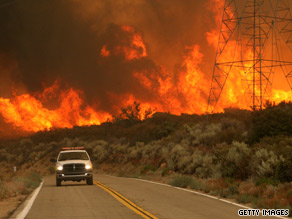
More than 105,000 acres are on fire in Southern California. For those of us from relatively wet regions of the country, this seems unbelievable. For those of us with children with a particular fear of fire, it's horrifying. For a firefighter and their family, it's a source of some ambivalence.
Firefighters become firefighters because they want to fight fire. It sounds silly when you put it that way, but often we forget. No one trains for this who doesn't get something out of it. Jeff Mitchell (whose brother, Doug, is a fire fighter) says you have to be crazy to do it. The natural reflex of any sane person is to run out of a burning building -- these guys run in. So many firefighters across the country are looking at the Station Fire and wishing they were there. Some of them are getting their chance, as firefighters from neighboring states are being called in.
On the other hand, firefighting is only enjoyable when everything comes out right. Nothing beats the rush these guys can have when they beat back the flames and save a house or a life and no one gets hurt. But when one of our nation's bravest dies fighting a fire, every firefighter in America feels the loss, and every family member of a firefighter takes a blow to the gut. Two firefighters out of Los Angeles have died in the Station Fire already. When this is over -- which isn't predicted to be for one or two more weeks -- that's going to be a hard truth to cope with for the others in their own company, the other fighting this fire, and those who just know it could have been them.
Reading the coverage of the fire, the inklings of what the themes of an intervention on this event might be are starting to emerge. Right now there are five people trapped by the fire because they did not comply with mandatory evacuation orders. Not only did they put their own lives at risk when they made that choice, but they also put the lives of the firefighters who now must try to get to them on the line. I can't imagine there isn't going to be anger about that, particularly if someone gets hurt or, God forbid, dies trying to get them out.
CISM teams most often help with incidents that happen very close to home. Right now, CISM teams all over the west are getting ready to intervene with firefighters caught in a critical incident in another state -- some of them may be deploying there right now. And CISM teams may be hearing about the Station Fire all over this country, as fire departments everywhere watch, wait, and mourn two of their own.
Getting Back on the Horse

The L.A. Fitness in Bridgeville, Pennsylvania reopened yesterday, 18 days after a gunman opened fire on a fitness class, killing 3 and injuring 9 more, and then killed himself. Reports say that the room where the shooting occurred is already being used for classes. The floors and mirrors have been completely redone. Apparently it looks pretty nice.
Upon reading about this, I tried to put myself in the shoes of a member of that club. I tried to imagine going back into that club, into that room, knowing what had happened there. And honestly, I'm not sure I could, not after just 18 days. But at the same time, I know that I go into rooms where tragedy has occurred all the time. As tourists, we often go to see the place where someone famous was assassinated or something terrible happened. My own daughter, who was visiting relatives in Washington, D.C. this week, took a tour of the Ford Theater, where Lincoln was shot.
How can we reconcile the idea that it would be hard to return to a space where someone was killed with the fact that we seek them out without a second thought? Two factors come into play: time and emotional distance. There is no doubt in my mind that it would be easier for me to go to that L.A. Fitness than it would for someone who was injured in the shooting. It's probably easier for me than for someone who is a member but wasn't there that night. I have a cognitive association, but I don't have any sensory connection to that space. When I open up the file drawer on that space in my memory, I have newspaper stories and web photos, but I don't have any visceral associations. What's more, I have no doubt that as time passes that space will become less "loaded" for those who were there.
That having been said, there are probably victims who will never set foot in that building again. When the shooting started, their brains flooded with chemicals that heightened their senses and their memory, a throwback to our days in the wild when it was very important to be able to remember everything that was associated with a danger so you could avoid another one. The sight of that space may well be a trigger for them or, alternately, they may find it distressing that the room doesn't look the same. Over time they may feel better about going there, but maybe not.
The earliest studies on post traumatic stress (which is not necessarily post traumatic stress disorder, remember) were done on soldiers in World War I. They found that if soldiers were removed from the front lines and sent to a hospital for treatment, they were much less likely to return to the line than those who had intervention off the front line but still in the field. Once you leave the place where a trauma occurred, it is that much harder to go back.
That's why, to the maximum extent possible, we always tell people not to send their staff home after a trauma until there has been some opportunity to give them information about critical incident stress and self-care. When they leave when things are still in a state of chaos, that is what they viscerally believe will be there to greet them when they return. When they leave after help has arrived -- help for them-- it's easier to believe that things may be manageable if they come back.
The space where a tragedy occurred holds power, sometimes forever. There was a car accident that killed both parents and a son half a mile from my house four years ago, and I think about it every single time I drive through that intersection. But holding power doesn't mean that power has to be absolute. Healing holds power, too.
Grief, Trauma and Traumatic Grief

I was recently asked to assist at a school where a student had died after a lengthy illness. The usual characters had assembled -- the Principal, the counselors, the social worker, the district communications person, and me on behalf of the crisis team. As we started to think about what needed to be done, one of the others at the table said,
Let's not have a secular response to a spiritual event.What a great way to put it. This child's death was very sad. Staff and students were grieving, and grieving hard. But they were, indeed, grieving. They were not traumatized. They didn't need intervention, they needed support. My colleague wasn't advocating prayer in public schools, he was advocating recognition that this event was fundamentally different than death from a car accident or a suicide.
I often run into trouble explaining this difference to people. Saying that a death isn't a critical incident, isn't a crisis or isn't a traumatic event is sometimes heard as saying that the event isn't hard or horrible, and that's not what I mean at all. It's just that grief and trauma are different.
If you look up the two words in the New Oxford American Dictionary, you find the following:
Grief: Deep sorrow, especially that caused by someone's death.
Trauma: Emotional shock following a stressful event or a physical injury, which may be associated with physical shock and sometimes leads to long-term neurosis.
The difference between trauma and grief does not have to do with how serious a situation it is, or even with how upset you are. Trauma, however, involves shock, and grief does not. You can see this when you talk to people who have experienced the traumatic death of a loved one. While they may feel sad, that sadness is not usually the primary emotion. Instead, they are shocked, angry, scared or in a state of disbelief.
You can see a difference in the signs and signals of distress that people exhibit with grief and with trauma as well. While those who are traumatized may cry, those who are grieving don't usually experience the numbness and physical ailments that come with trauma.
Traumatic incidents do, of course, very often cause grief. The death of a loved one in a car accident is still a death. What we find, however, is that the trauma gets in the way of the grief. Until people have processed the trauma and its effects, they can't really face and process their grief. The biggest mistake people make in dealing with trauma is trying to talk immediately about the loss and grief and skipping over talking about how it happened and all the reactions surrounding that. When someone dies, we think we're supposed to feel sad and talk about the person who died. We don't allow ourselves or others the room and time to deal with our own reactions to how it happened and to the shock.
On the flip side, it's easy for those of us trained in trauma intervention to treat everything like a trauma, even when it's not. Once an organization has a CISM team, they often want to do CISM for everything. But the C and the I in CISM stand for Critical Incident, and while those trained in CISM may have some good people skills, the techniques of CISM are not designed for uncomplicated, non-traumatic grief.
I don't know if I'd say that trauma is secular and grief is spiritual, but I see what my colleague is getting at. And if it helps us remember to use the right tools at the right time, I'm all for saying that we shouldn't use a secular response for a spiritual event.
What Makes an Incident a "Bad One"

I know it when I see it.
Supreme Court Justice Potter Stewart famously used that line to try to define hard-core pornography. That's how it feels sometimes trying to define a critical incident. That's particularly true when you're dealing with first responders -- cops, EMS, firefighters -- who see this stuff every day and can't possibly be traumatized by all of it. What makes one incident particularly bad?
I know it when I see it.
Yesterday, California Highway Patrol attempted to stop a car on a traffic violation in Dinuba, California. The car wouldn't stop and the police chased it for about four miles. Then the car ran a stop sign and hit a pickup truck carrying 5 children. As of this writing, 8 people -- 5 children and all 3 adults from the car -- are dead. Four of the children, ages 1,3,4 and 7 were ejected from the truck and died at the scene.
I know it when I see it.
There are certain rules of thumb about critical incidents. There are certain types of things that are likely to impact a first responder -- line-of-duty-death or serious injury, officer-involved shooting, trauma involving children, and multiple casualties all raise red flags. And yes, this was a multiple casualty incident involving children. But that's not what makes me, and probably you, say that this is a "bad one."
You just know it when you see it.
This one would probably be a big one even without the police chase. An accident involving multiple dead children offends our sense of how the world should be and, if we are parents or have children close to us, makes us feel uneasy about their safety. I don't know about you, but one of my first reactions was also to question how five children could possibly be riding safely in a pickup truck, and whether the fact that they were ejected means they weren't wearing seat belts or were riding in the back. Someone has to be to blame. Then you add in the car running a stop sign, and you have someone else to blame. It makes me angry -- it probably makes you angry too.
And then you add the police chase, which means there were officers on the scene who are now asking themselves what they could have done to stop that car or whether they should have given up the chase, and who witnessed the accident and were first on the scene to see the carnage. The Fresno Bee already indicates some people are blaming them for the crash. So now there's going to be an investigation, on top of the guilt. And that's in addition to being mad at the driver and mad that those children weren't safe and afraid for their own children.
I know it when I see it. It looks like that.
Critical Incident, or Just a Crisis?
 As you may know, I have Google Analytics installed both on this blog and on the website for my consulting services. This service tracks statistics about visits to the sites, and enables me to generate nifty reports about all sorts of things, such as what browser my readers are using and what state they are in. This morning, I noticed that a visitor to my consulting site from Australia had found my page after googling, "what is the difference between a critical incident and a crisis?" I thought that was a pretty good question, and one that is not, in fact, addressed on my consulting site, so I'm going to try to address it here. Maybe my Aussie fan will google his/her question again and find an answer this time.
When people talk about Critical Incident Stress Management, they often use "critical incident" and "crisis" interchangeably. You will note that I am not the Monday Morning Critical Incident Quarterback, for example, although CISM is what I do and what, for the most part, I write about. But they aren't really 100% the same. Let's look at some definitions.
The New Oxford American Dictionary defines "crisis" as "a time of intense difficulty, trouble, or danger."
The term "Critical Incident" is a term of art, and like all good terms of art it is used by two totally different groups to mean two very different things. One way it is used is in the phrase "Critical Incident Technique." According to Wikipedia, in this context a critical incident is "one that makes a significant contribution - either positively or negatively - to an activity or phenomenon." The Critical Incident Technique seeks to study these incidents and how people respond to them to learn how better to respond to future instances.
In the phrase "Critical Incident Stress Management," on the other hand, a critical incident is defined as one which, because of how intense, violent, sudden or frightening it is, has the potential to overwhelm people's usual methods of coping. Critical Incident Stress Management, then, is a technique to help manage the stress that can be, but is not always, caused by critical incidents.
So what's the difference between a crisis and a critical incident? From a CISM perspective, all critical incidents are crises, but not all crises are critical incidents. The current economic crisis, for example, is a crisis for our country, but only a critical incident for some of us. A shortage of Big Macs is a crisis for McDonalds, but probably not a critical incident, at least not for most people. On the other hand, 9-11 was a crisis for the country and a critical incident for large number of people around the country.
So, Aussie person, that's the difference. I hope it helps you and some other readers as well.
The Line of Duty
 Detective Mark DiNardo died this morning at 9:35 AM. He was a 10 year veteran of the Jersey City Police Department in New Jersey, and tomorrow would have been his 38th birthday. He leaves behind a wife and three small children. He was promoted to Detective just this past week, but he didn't know it. He was in a coma on life support after he and four of his colleagues were shot while trying to arrest a robbery suspect on Thursday.
There are five types of critical incidents that require a CISM team with special expertise. In fact, there's a whole extra class on them. Death in the line of duty is one of them. Death of a colleague is always hard. Traumatic death of a colleague is worse. But death of a colleague in the line of duty introduces a whole new layer of complexity, both for the surviving colleagues and for the team supporting them.
I started to write this post about what was different about line of duty deaths, but as I reflect upon it, they aren't really different, they are just the usual traumatic themes only moreso. Here are some issues that come up:
- Survivor's Guilt: If I had been [fill in name of circumstance] it would have been me. If I hadn't stopped to tie my shoe. If I had gone in first. If I hadn't called off sick. It should have been me, because my wound was worse, he was a better cop, etc.
- Self-Blame: My job is to protect and serve, but I could do neither for my colleague. If we can't do it for each other, what makes us think we can do it for anyone else?
- Familiarity: I see death and destruction every day. Usually bad guys do it to each other. But this was one of us.
- Anger at the Brass: If we weren't working long hours, if we were properly equipped, if they hadn't let this guy out on bail this wouldn't have happened.
- Identification: What will happen to my wife or husband if this happens to me?
- Self-Doubt: Now I go out on the street and everything makes me jump. What if I can't do my job?
- Keeping it In: If I talk about how this has affected me, they will take me off the street. Besides, cops don't cry.
- Suicide Risk: I can't handle this, and I have a lethal suicide method on my hip all day every day.
In many departments CISM has become required for certain kinds of incidents, usually officer involved shootings and line of duty deaths. There are problems with this -- requirements build resentment, and some people really will do better on their own. But by making it part of what is expected, departments create a way for officers to get the help they need without losing face, and without specifically deciding they need it.
My thoughts are with the men and women of the Jersey City Police Department tonight. Good luck on the journey ahead.
The Intersection of Crisis Response and . . . Pretty Much Everything
 " Referring to the recent crash on the D.C. Metro that killed 9 people, he wrote:
The relative rarity of air and rail disasters makes them novel, and hence news. Car crashes bite man, and rail and air crashes bite dog. Intensive coverage of the few air and rail accidents that do occur in turn promotes the widespread — and erroneous — inference that planes and trains are unsafe. In an unfair irony, in transportation perhaps too much safety can be a dangerous thing.The Quarterback brings this up because in a recent post about the murder of Neda Sultan, I wrote:
We live our lives based on what is likely, not what is possible, in terms of danger. This video brings home in a very vivid way what of course we already knew -- that the world is not safe, particularly if you are a protester in Tehran.But Morris brings up the flip side of that, which is that trauma messes with our understanding of what is possible vs. what is likely. When something like this happens, we feel like we've been duped. We've been living our lives in a state of complacency, believing, say, that the Metro is safe, and we feel like all of a sudden we have woken up from our stupor to the horrible truth that it really isn't. And the media coverage reinforces that false perception.
On a related note, on Monday Freakonomics posted the following:
In the 1990’s, a call went out for the F.A.A. to stop letting air-traveling parents carry young children in their laps, making them buy a ticket for their children instead, so that every person could wear a seatbelt. The F.A.A. refused, saying that the cost of an extra ticket could force parents to travel by car instead. Car crashes are the leading cause of death for children. On the other hand, the problem of child safety in air travel, the F.A.A. said, “barely exists.” Yet another example of how terrible we are at assessing risk, especially when it comes to our children.One of the commenters replied:
The response to your blog is simple . . .The overwhelming majority of people are ignorant of the scientific method — thus, probability and risk.
I can't tell you how strenuously the Quarterback disagrees with this analysis. The fact that rational information tells us something different than that upon which we feel compelled to or choose to act does not mean we don't understand better information, or how good information is obtained. It just means that there are things that are psychologically more compelling than empirically derived data in this instance, and that, as the original post notes, we are actually pretty bad at estimating what the empirically derived data on danger will tell us.
Morris understands this when he looks at how the relative rarity and the news coverage of a transportation accident skews our perception of the danger of that mode of transportation. It may be that if you ask people which is safer, a car or the Metro, they will say a car. They will be wrong. But I doubt that if you told them the relevant statistics most people would say, "No, the Metro is still more dangerous." What they will say, however, is, "Even though I know that, my gut instinct is just to avoid the Metro."
Our guts are powerful, and yes, they are influenced by data and by the scientific method. They are also influenced by media coverage, shock, personalization, and perhaps most powerfully, by what we can control. We can avoid a plane, or strap our child in. We can avoid the Metro. We can drive defensively. But what most of us can't do without completely changing our entire lives is avoid driving, so it is important to us that, on a gut level, we continue to be able to drive. We therefore ignore that data, perhaps not cognitively, but instinctively. We're not stupid, we're just trying to get by, to live in the shadow of what is likely and what is possible.
The Crisis that Isn't: RIP Michael Jackson

The Quarterback is somewhat at a loss for a topic for today because apparently the only thing that happened yesterday is that Michael Jackson died. And while I certainly was sorry to hear that, the death of Michael Jackson is not, in point of fact, a "Critical Incident." This might be a good time to talk about what makes a critical incident, and what doesn't.
A critical incident is an event that overwhelms one's usual coping mechanisms. All of us have a set of skills that help us to deal with stressful situations. And all of us have some point past which we can't deal anymore. That point is when incidents become critical, and it is different for everyone.
Certainly there are some things that we can safely presume will constitute critical incidents for most people. Watching your spouse be murdered, for example, would overwhelm most people's ability to grieve and move on. And certainly there are some things that are generally not critical incidents for most people. For example, the death of an elderly grandparent after a long but not particularly painful illness is sad, but not usually overwhelming.
There are a lot of incidents that lie in the middle. What is intolerable for one person is within the realm of tolerable for another. One person may be seriously traumatized by a shooting in the neighborhood, while another is not, perhaps because it happens more frequently for them. As my frequent readers know, there are some predictors of traumatic stress: believing that you are going to die, sensory exposure to the event, triggering of past events, violation of your worldview and the involvement of children in the event are all predictive, but there are others that can cause trauma and these can all be there and a person still not be traumatized.
The death of Michael Jackson is not, for most people, a critical incident. It is sudden and perhaps shocking, and you may feel that it is sad. But it is within the realm of what most of us can cope with. It won't cause most of us nightmares or loss of appetite or drinking or depression. There may be exceptions, either for his family and close friends, those who were there when he died, or for people who have recent similar losses in their own lives. And if you are traumatized by it, that doesn't make you "wrong" or "crazy," just unusual.
Arguably, the death of Michael Jackson is more likely to be traumatizing than the death, also yesterday, of Farrah Fawcett. Hers was a long time coming, she was older, and she was ill, so it was not as sudden and perhaps not as shocking. But neither are likely to traumatize the general public.
Meanwhile, every family who did experience trauma this week now has an added wrinkle. The families of Neda Soltan and Ed Thomas will now add to their story, "and then Michael Jackson died, and everyone stopped looking at us very suddenly." This may be good and it may be bad. Most likely it will be some of each. But let's not lose sight of what a real critical incident really looks like.
Meet the Quarterback

- Naomi Zikmund-Fisher
- is a clinical social worker, former school Principal and a Crisis Consultant for schools and community organizations. You can learn more about her at www.SchoolCrisisConsultant.com

Subscribe


 Posts
All Comments
Posts
All Comments