Showing posts with label peers. Show all posts
Showing posts with label peers. Show all posts
Monday, June 7, 2010
Kyron Horman's Disappearance is a Nightmare for Everyone


On Friday morning, 7-year-old Kyron Horman attended his school science fair in Portland, Oregon with his step-mother. At 8:45 AM, he walked down the hall at Skyline Elementary School, towards his 2nd grade classroom. He has not been seen since. Just before 4 PM, when Kyron didn't get off the bus at home, his step-mother called the school and learned he had never been in class.
The disappearance of a child is every parent's nightmare. Most of us know that instinctively. This particular scenario, however, is also every school's nightmare. A child makes it to school and the school loses track of them, and they're gone. I wish I could say that I can't imagine how this could happen, and certainly it isn't easy, but honestly, this could have happened at any school I've ever worked in.
Most schools have a system that works something like this: when the bell rings, the teacher takes attendance. That is conveyed -- either by a child messenger or by computer -- to the office. Someone in the office, meanwhile, is taking phone calls from parents calling to say their child is sick and matching these with reported absences, also taking into consideration any children who come in late. Then the office, or an automated system, calls the homes of children who are not accounted for. Ideally, this should be done by the time an hour or so has passed.
There are plenty of places for this system to go wrong. The teacher accidentally marks the wrong child absent. She marks "excused absence" instead of an unexcused one, perhaps because a friend says he's sick, so the computer records that the parent has called the child off. There is a sub who doesn't know how to properly mark the sheet, so the office misreads the attendance sheet. There is a sub in the office who doesn't fully understand the system, or doesn't make phone calls at all. Someone with a similar name signs in late, and the wrong child is marked tardy. Some emergency takes attention away from attendance in the office, or a single phone call doesn't get made.
Now a child is missing
 , and it isn't hard to point fingers at the school, rightly or wrongly. This is one of those times when the need for peers in early crisis response is especially clear. The school staff are feeling terribly guilty, and they need to be able to talk to someone who understands how this could happen. The Principal needs a Principal who gets that sometimes attendance isn't done properly. The secretary needs a secretary who knows how hard it is to keep track of everyone. The teacher needs another teacher. And all of them need school staff who know how very responsible all of us in schools feel when something goes wrong on "our watch," and how much harder it is when you're being blamed from the outside as well as yourself.
As much as I know this could have happened in my school, or any school, I will also admit to some healthy skepticism. The chances of the system failing for any individual child are pretty small. The chances of it failing for the one child who happens to be missing are infinitesimal. Something else happened here. Maybe the school knows what it was, maybe they don't. But even if they know what it is, even if they know it wasn't their fault, they're still going to feel guilty, and they're still going to get blamed. Let's hope that somehow, Kyron gets home safe soon, and both the parents and the school can wake up from this nightmare.

Tuesday, November 10, 2009
Hostage Situation at Stissing Mountain Middle School: Send in the Peers

This morning, a man walked into Stissing Mountain Middle School in Pine Plains, New York, assembled a gun in the bathroom, and took my colleague, Principal Bob Hess, hostage. The standoff lasted two hours before the suspect surrendered, releasing Mr. Hess. The entire bulding locked down for those two hours, with children hiding in locked classrooms, the school kitchen and even under the desk in the counseling office right next door to where the gunman was.
The fact is, we all know it's a possibility. Any school Principal who has given any detailed thought to an armed intruder coming into the school has already realized that the most likely target is the Principal. An angry parent, a custody dispute that we intervene in, a trespasser we ask to leave, or a disturbed child, if they took out a gun, could all very well be aiming it at us. In places where, as in Michigan, we practice locking down the school, we practice it with the administrator directing the rest of the staff and taking the lead. We try not to think about the possibility that we would be shot or held hostage ourselves.
Counseling will now be offered to the students, staff and families at Stissing Mountain. In the official curriculum I teach on Critical Incident Stress Management, they say that peers may not be necessary in delivering CISM services to schools. If there's anyone from Pine Plains out there listening, I want you to know that I think a peer is absolutely critical in assisting Mr. Hess.
If this were me, I would not want to talk to a counselor or a social worker or a psychologist. I would want to talk to someone else who has lived with the knowledge they walk around with a big target on their head every day. I would want my person to understand that in an emergency I take pride in being able to keep everyone calm and safe, and who can imagine that being the one person least able to do anything in this situation was horrible. I would want someone who has had their own child in the building when something bad happened, and had to worry about the group, not the individual. I would want someone who knew the significance of having something happen "on your watch." I would want to talk to a really well trained Principal.
I hope they have one in Pine Plains. And Principal Hess, I'm glad you're safe.
Saturday, July 25, 2009
The Culture of Different Professions
 I spent the last 48 hours on an Amtrak train from Chicago to Seattle, courtesy of my 11 year-old daughter, the travel agent. It was spectacular and I highly recommend it, particularly if you have an 11 year old who loves scenery and a 4 year old who loves vehicles of all kinds. This trip should explain my failure to post for a few days.
I spent much of the trip editing Powerpoint slides for the Group Crisis Intervention class I'm teaching for the Ann Arbor Public Schools in August. The International Critical Incident Stress Foundation (ICISF) provides a standard set of over 200 slides, and the approved instructor has the opportunity to edit and rearrange them as long as the content of the class remains the same. In this instance, I was tailoring the presentation for an audience comprised of school personnel.
I came upon the standard slide about the use of peers in CISM, and found myself very disquieted. The slide explains, quite rightly, that using peers -- people in the same profession or of the same background as those receiving the intervention -- is essential when therecipient group is specially trained or educated, the group possesses a unique culture, group members perceive themselves as unique, little understood or misunderstood, or the group extends minimal trust to those outside the group. Then, in the notes accompanying the slide, it says that businesses and schools may not need peers.
Now, I can't speak to businesses because I don't work in a business. I work in a school, and I have my entire adult life. I have never encountered a school or school district that did not fit the above criteria. We may not look like cops. We may not act like firefighters. But we educators have our own culture, are constantly feeling dumped on and distrustful of "top down" initiatives and the community.
I have had the privilege of doing CISM response in many schools as a peer. The need for a peer becomes evident in the first 5 minutes, as the school team starts talking about the pressures of AYP, NCLB and Ed Yes* that form the backdrop for whatever has happened. The CISM mental health professional's eyes glaze over while we talk, and I know that I've formed an instant bond with those with whom we are intervening. I also know that when I sit down with the Principal, who sometimes doesn't feel comfortable receiving support in a group with his or her staff, they almost always say, "I'm fine, I'm just worried about my teachers." And 90% of the time, when I respond, "I know you are, but I also know how hard it is to be in charge of everyone else's needs but your own," they start to talk, and they are not fine. They just think they have to be, and only another Principal has the credibility to understand how hard it is to admit that they're not.
So, at the risk of annoying others who teach this class, I decline to tell those I train that they may not need a peer. In my humble opinion, a peer is something you always want. You may be able to function without one, but you won't be as effective. That's my 2 cents.
*In case you're wondering, those stand for Adequate Yearly Progress, which is a measure mandated by the No Child Left Behind act, and Education Yes is the Michigan State reporting system for this.
Tuesday, July 21, 2009
The Line of Duty
 Detective Mark DiNardo died this morning at 9:35 AM. He was a 10 year veteran of the Jersey City Police Department in New Jersey, and tomorrow would have been his 38th birthday. He leaves behind a wife and three small children. He was promoted to Detective just this past week, but he didn't know it. He was in a coma on life support after he and four of his colleagues were shot while trying to arrest a robbery suspect on Thursday.
There are five types of critical incidents that require a CISM team with special expertise. In fact, there's a whole extra class on them. Death in the line of duty is one of them. Death of a colleague is always hard. Traumatic death of a colleague is worse. But death of a colleague in the line of duty introduces a whole new layer of complexity, both for the surviving colleagues and for the team supporting them.
I started to write this post about what was different about line of duty deaths, but as I reflect upon it, they aren't really different, they are just the usual traumatic themes only moreso. Here are some issues that come up:
- Survivor's Guilt: If I had been [fill in name of circumstance] it would have been me. If I hadn't stopped to tie my shoe. If I had gone in first. If I hadn't called off sick. It should have been me, because my wound was worse, he was a better cop, etc.
- Self-Blame: My job is to protect and serve, but I could do neither for my colleague. If we can't do it for each other, what makes us think we can do it for anyone else?
- Familiarity: I see death and destruction every day. Usually bad guys do it to each other. But this was one of us.
- Anger at the Brass: If we weren't working long hours, if we were properly equipped, if they hadn't let this guy out on bail this wouldn't have happened.
- Identification: What will happen to my wife or husband if this happens to me?
- Self-Doubt: Now I go out on the street and everything makes me jump. What if I can't do my job?
- Keeping it In: If I talk about how this has affected me, they will take me off the street. Besides, cops don't cry.
- Suicide Risk: I can't handle this, and I have a lethal suicide method on my hip all day every day.
In many departments CISM has become required for certain kinds of incidents, usually officer involved shootings and line of duty deaths. There are problems with this -- requirements build resentment, and some people really will do better on their own. But by making it part of what is expected, departments create a way for officers to get the help they need without losing face, and without specifically deciding they need it.
My thoughts are with the men and women of the Jersey City Police Department tonight. Good luck on the journey ahead.
Sunday, July 5, 2009
The (Un) Happiest Place on Earth

As if we needed more reminders that trauma can strike anywhere, anytime, there was a crash on the monorail at Disney World's Magic Kingdom early this morning. One driver was killed. There were only five passengers on board, since it was 2 AM, and they were treated at the scene.
What caught the Quarterback's eye about this was the following line in the AP story:
The other train operator was not injured, but was taken to a hospital because he was emotionally shaken.Now, please don't misunderstand me. I in no way wish to call out the other driver for being emotionally shaken or for needing more help. I remember how shaken I was after a fender bender in which no one was hurt, so I can only begin to imagine being in one where someone was killed. On the contrary, this caught the Quarterback's eye because a) it was publicly acknowledged and b) they took him to the hospital.
The hospital? Really? You have to be pretty incredibly overcome to need to be treated in a hospital for the psychological effects of trauma right after it happens. Not to say it doesn't happen, mind you, but most people's reactions are shaking and crying and intrusive images and thoughts, espeically right away. Most people don't completely dissociate or have a psychotic episode.
What I'm hoping happened, really, is that the first responders and/or the folks at Disney recognized that this poor guy needed some support and that there were going to be reporters all over the place, and decided to take him to the hospital and hope someone there could help him. And it's entirely possible there are CISM personnel at the hospital, and hopefully they know how to get a hold of a team if there aren't. I hope, for his own sake, that this event didn't totally blow out this guy's ability to be out in the world, to the point where he was a danger to himself or others, that fast. I doubt it did, but you never know.
The other thing that of course draws our attention to this story is that it happened at Disney World. There are 150,000 passengers on the monorails there every day. If you live on the East Coast or near it, you either have been to Disney World, are planning to go to Disney World, would like to go to Disney World or loathe the very idea of going to Disney World. Nobody reads this story and says, "Disney World? Never heard of it."
So it's easy to identify. It's easy to put yourself on that monorail and imagine what a crash would be like. If we were traumatized at all by the D.C. Metro crash, this also triggers that association. And it's probably also easy to find relief that the accident occurred at 2 AM, when most of us know we would never be on the monorail. As fast as we personalize, we detach.
The Quarterback's deepest condolences to the family of the driver killed, a speedy recovery to the other one, and a moment of silliness in which I imagine the CISM team peers for Disney World cast members, dressed as Mickey, doing a debriefing. The Quarterback needs to get more sleep.
Tuesday, June 30, 2009
Journalists Under Fire

Yesterday on NPR, Fresh Air had on Chris Cramer. He was a reporter for the BBC in 1980 when he was applying for a visa at the Iranian embassy in London. You may recall that there was a hostage siege at the Iranian embassy in London that year, and lucky Mr. Cramer happened to be there when the terrorists showed up. He was held captive for a day and a half.
Following that experience, he decided that perhaps he did not want to be covering war and conflict and went into management. He was an executive at the BBC, president of CNN International, and is now Global Editor for Multimedia at Reuters. More interestingly, at least for the Quarterback's purposes, Cramer is President of the International News Safety Institute.
I, for one, had never heard of INSI, but they look pretty cool. They are committed to having safety standards for journalists. Very controversially, Cramer was among the first to say that, "no story is worth a life." INSI also trains journalists who are going into conflict areas on things like battle first aid, how to survive a kidnapping, and other light topics.
From a CISM point of view, all that training not only gives journalists the skills that they need if they're going to be in the middle of a war zone, but it also serves to inoculate them against the stress of the experience, at least to some degree. You may recall the Quarterback's recent speculations about New York Times columnist David Rohde and how he might be doing following his recent escape from the Taliban. It might be interesting to know if he had gone through INSI training.
Cramer talked a lot about how journalists know when to take a break, and about the need for managers to tell them when it's time to come home because they don't always see the situation clearly up close. He also talked about how some journalists immediately go see a counselor when they come back from an assignment, and others have trusted friends they talk to.
This is a poster child advertisement for Critical Incident Stress Management. The original idea behind CISM is that first responders would be more comfortable talking to another first responder -- a peer -- than to a counselor, so it was important to train the peers in early crisis intervention and train the mental health professionals both in early crisis intervention and in working with peers. Seems like the same principle might apply to journalists: If folks are going to talk to their peers about traumatic experiences, let's train the peers.
The Quarterback has no idea whether there are journalists out there -- a few or a lot -- who are trained in CISM. It sure sounds like there should be. And if they need a Quarterback to train them, I know just the person!
Wednesday, June 24, 2009
Behind the Scenes: The Murder of Ed Thomas
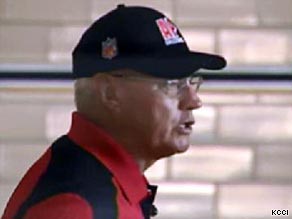
Ed Thomas, the football coach of Aplington-Parkersburg High School in Iowa, was shot to death in the school's weight room this morning in front of students. A suspect is in custody, but no one is commenting on who it is (except to say it's an adult) or what happened. "Crisis Counselors" are reported to be at the school working with the witnesses.
Before commenting, a disclaimer: the Quarterback is not there, doesn't know Ed Thomas and doesn't work for the Aplington-Parkersburg schools. I am acquainted with some folks high up in CISM response for the state of Iowa, and know that they have a pretty well organized structure. Also, this story is only about two hours old as I write this, and by the time you read it more facts may be public. If so, I will try to update the Quarterback site so this post remains relevant.
As you may know, responding to just this kind of situation is what the Quarterback does and is passionate about. So I thought it might be instructive to walk through what I would be thinking about and doing if I were in charge.
As my regular readers know, in Critical Incident Stress Management we talk about the 5 T's: Trauma, Target, Timing, Theme and Team. Let's walk those through:
Trauma: This is fairly straightforward -- a beloved coach was shot in sight of students. Whoever is heading up the response is going to want to get as much detail as possible about what happened, and I guarantee that there is more detail to be had than what is in news reports at this point. Some questions to ask: Do we know who the shooter is and/or what the motive might be? Did the witnesses know the shooter? What did he say? Who tried to help the coach? Who called the police? How were parents notified?
Target: First, a reminder -- we're responding to people's reactions to the incident, not to the incident itself. So we can sketch out who may need help and what might be appropriate, but we won't know if we're right until we find out how people are reacting.
- In the center of the circle are the people who were in the room with the coach when he was shot. Most likely, we'll be wanting to do a Defusing (a.k.a. Immediate Small Group Support) for these folks, depending on how many there are. This is a process whereby they get to briefly talk about what happened and the team will give them information on what kind of stress reactions they might experience and how they can best take care of themselves.
- Someone needs to be assigned exclusively to the family and will be doing Defusings and one-to-one intervention.
- Next out, we may need to do a Defusing with first responders, depending on how awful the scene was.
- We will probably also want to Defuse the staff who were in the building.
- Now it's time to deal with the rest of the community. It's time for a Crisis Management Briefing. A member of the team will M.C. The Principal will welcome everyone, the police will state the facts and the state of the investigation, and the team will educate folks on traumatic stress reactions, and then hang around afterwards to talk to anyone who needs individual support.
- Throughout this all, we are assessing, assessing, assessing: Who seems to be in the worst shape? What resources do they have for recovery? What more do they need? Based on the answers to that, we will be doing a lot of individual crisis intervention and may well schedule a Critical Incident Stress Debriefing for those towards the center of the circle.
Theme: Three big things are going to come up, particularly for the kids in the room when it happened. 1) I should have stopped him. 2) I thought he was going to come after me next and I do not feel safe now and 3) This town was devastated by a tornado last year and now this. Trauma always brings up trauma -- it causes you to open up the same file drawer in your mind and out comes everything else. Folks may well still be fragile from the tornado, so reactions are going to come harder and faster for this.
Team: Everyone responding needs to be trained in CISM. School counselors and social workers are often wonderful, talented, fabulous clinicians, but they do not generally have training in early crisis intervention. The tendency if you are in mental health but don't have this training is to start down the road towards therapy, and now is not the time for that. If this were my response, I would want to send in (presuming we have the personnel) CISM trained counselors, social workers and/or psychologists who work in schools, a CISM trained Principal and teacher, and whoever is CISM trained who the kids feel the most comfortable with, if it's not the folks above.
God bless the folks in this town. I hope they get the best CISM response in the history of the world.
Subscribe to:
Posts (Atom)
Meet the Quarterback

- Naomi Zikmund-Fisher
- is a clinical social worker, former school Principal and a Crisis Consultant for schools and community organizations. You can learn more about her at www.SchoolCrisisConsultant.com

Subscribe


 Posts
All Comments