Showing posts with label CISD. Show all posts
Showing posts with label CISD. Show all posts
Wednesday, September 30, 2009
Earthquakes, Tsunamis and Typhoons, Oh My!


My husband and I have a theory. It posits that any given person, when contemplating earthquakes, hurricanes and tornadoes, is ok with one, has a healthy fear of another and is absolutely terrified of the third. Growing up, as he did, in the midwest, earthquakes are not such a big deal to him, but hurricanes scare him to death. I, on the other hand, grew up in New England, where hurricanes hit but not hard. What scares the daylights out of me is tornadoes.
To be fair, however, our theory is incomplete. While it is true that I have recurring nightmares about tornadoes, I also have recurring nightmares about being covered by waves of water. My husband points out that, when I have these, it probably means I need to go to the bathroom. My worst nightmares involve water spouts -- tornadoes over water. I don't have them very often, but they are very consistent and consistently scary.
You might think, then, that the tsunamis that hit Samoa yesterday and the typhoons in the Philippines and Vietnam, with all of their flooding, would be very scary for me to contemplate. In fact, they probably would be, if I could bring myself to contemplate them, but I can't. And this is how I know that my fear of giant waves and of unrestrained water is actually not pathological.
If this were truly a dangerous phobia, I would hear about a tsunami and find myself thinking about it all the time. I would "live" it in my mind. It would trigger more nightmares. But in fact, I know my fears and have control of them sufficiently that I know not to do that. I can bring myself to imagine what the earthquakes in Indonesia and Samoa must have felt like, or the rain and winds from the typhoon in the Philippines and Vietnam. I can contemplate the death and destruction in all three places. But when it comes to the flooding and the tsunamis, I simply cannot see them happening in my mind's eye. I cannot put myself there. My mind is very good at protecting itself.
I was recently involved in a Critical Incident Stress Debriefing (CISD) where some of the participants kept talking about how awful the incident must be for others. They were saying things like, "I just keep thinking what he must be going through" and "I imagine how awful it is for her and I just cry all the time." My partner for the CISD had what I thought was a terrific way of responding to this. During the teaching phase, he said, "Let me suggest to you that you do not have to try on other people's trauma."
I am horrified and yes, a little terrified by what I see on the news today. But I know enough to know that I don't have to try it on to care.

Saturday, August 15, 2009
CISM (Or Lack Thereof) at the Lockheed Wildfire

Over 2,400 people in Santa Cruz County, California, have now been evacuated due to the Lockheed Wildfire which began burning earlier this week. With all these people in crisis, you might wonder what the CISM response looks like right now. And if you think of CISM as mostly being one-to-one and small group work, then the answer is: not much.
But that's not completely accurate. CISM includes a large number of components, but I would predict that right now there are only two that are generally and widely appropriate: the Crisis Management Briefing (CMB) and the Demobilization. Both of these, however, are large group interventions.
Demobilization is a strategy used mostly for first responders in large scale operations, which this certainly is. In a demobilization in this instance, as firefighters come off the line following their first shift, they come to some predetermined location where there is food and drink, possibly shower facilities and/or cots. A member of the CISM team spends maybe 10 minutes with them while they eat. They share any new information about the fire and give them some self-care tips and information about what they can expect emotionally in the days ahead, gives them a handout about common stress reactions and about self-care, and then sends them off either to rest or to go home, depending on how the rotation is working.
CMBs may be being used for evacuated residents and/or first responders prior to subsequent shifts. In this intervention, some person in authority (a representative from the fire department or the governor's office, for example) gives the latest information about the fire, what is currently being done, and what the plans are moving forward, and a member of the CISM team does some education about critical incident stress and how to take care of yourself.
What you'll notice in both instances that all the CISM team is doing is "information push." Disaster victims and responders are not really being given an opportunity to process their thoughts and feelings with the team. The reason for this is simple -- the incident isn't over. To draw an analogy, it would be like trying to stitch up a dog bite in someone who is still being chased by a dog. They can't possibly hold still and cooperate in their care because their mind is on outrunning the dog, and they're going to be pretty mad at you if you try to stitch them up instead of at least cheering them on in the outrunning of the dog.
I can't say categorically that nowhere in any shelter is anybody getting any individual or small group help. Folks who had to be rescued from a burning building, for example, may need some support for that portion of the incident and they may be ready to talk about it. But maybe not. Most folks are still worried about whether their home will be there when they get back, whether their pets made it, trying to find loved ones and a more permanent place to stay, etc. And crisis responders ought to be helping them with those things.
Sometimes after mass disasters and major incidents people don't ever get the help they need because it takes so long for an incident to end or the ending is not very clear. For example, many rescue and recovery workers at Ground Zero got some support at the scene but never did a Critical Incident Stress Debriefing (CISD) because there was no agreed upon time when they were done. The CISM teams that supported them on site also didn't always get Post Action Staff Support (PASS) because it never felt like they were done. After Katrina, by the time New Orleans residents were settled enough to get CISM help, they were scattered all over the country. Planning to support victims of long-lasting disasters is a great challenge for crisis responders. I know my colleagues in Santa Cruz are up to the job.
Tuesday, August 11, 2009
Grief, Trauma and Traumatic Grief

I was recently asked to assist at a school where a student had died after a lengthy illness. The usual characters had assembled -- the Principal, the counselors, the social worker, the district communications person, and me on behalf of the crisis team. As we started to think about what needed to be done, one of the others at the table said,
Let's not have a secular response to a spiritual event.What a great way to put it. This child's death was very sad. Staff and students were grieving, and grieving hard. But they were, indeed, grieving. They were not traumatized. They didn't need intervention, they needed support. My colleague wasn't advocating prayer in public schools, he was advocating recognition that this event was fundamentally different than death from a car accident or a suicide.
I often run into trouble explaining this difference to people. Saying that a death isn't a critical incident, isn't a crisis or isn't a traumatic event is sometimes heard as saying that the event isn't hard or horrible, and that's not what I mean at all. It's just that grief and trauma are different.
If you look up the two words in the New Oxford American Dictionary, you find the following:
Grief: Deep sorrow, especially that caused by someone's death.
Trauma: Emotional shock following a stressful event or a physical injury, which may be associated with physical shock and sometimes leads to long-term neurosis.
The difference between trauma and grief does not have to do with how serious a situation it is, or even with how upset you are. Trauma, however, involves shock, and grief does not. You can see this when you talk to people who have experienced the traumatic death of a loved one. While they may feel sad, that sadness is not usually the primary emotion. Instead, they are shocked, angry, scared or in a state of disbelief.
You can see a difference in the signs and signals of distress that people exhibit with grief and with trauma as well. While those who are traumatized may cry, those who are grieving don't usually experience the numbness and physical ailments that come with trauma.
Traumatic incidents do, of course, very often cause grief. The death of a loved one in a car accident is still a death. What we find, however, is that the trauma gets in the way of the grief. Until people have processed the trauma and its effects, they can't really face and process their grief. The biggest mistake people make in dealing with trauma is trying to talk immediately about the loss and grief and skipping over talking about how it happened and all the reactions surrounding that. When someone dies, we think we're supposed to feel sad and talk about the person who died. We don't allow ourselves or others the room and time to deal with our own reactions to how it happened and to the shock.
On the flip side, it's easy for those of us trained in trauma intervention to treat everything like a trauma, even when it's not. Once an organization has a CISM team, they often want to do CISM for everything. But the C and the I in CISM stand for Critical Incident, and while those trained in CISM may have some good people skills, the techniques of CISM are not designed for uncomplicated, non-traumatic grief.
I don't know if I'd say that trauma is secular and grief is spiritual, but I see what my colleague is getting at. And if it helps us remember to use the right tools at the right time, I'm all for saying that we shouldn't use a secular response for a spiritual event.
Thursday, August 6, 2009
Sharing Our Trauma: The Pittsburgh Gym Shootings

As you all know, on Tuesday night a man walked into a fitness class at a gym outside Pittsburgh, turned off the lights, took out a gun and opened fire, killing three women and injuring many more before killing himself. I posted about this a few hours later from my perspective as a former Pittsburgher with friends in the 'Burgh.
As is often the case in highly publicized mass shootings, there's a lot of "woulda shoulda coulda" in this situation. The shooter had been planning this a long time, had done several "dry runs" of one kind or another, and had a blog that was pretty explicit about what he intended to do. It's hard to wrap our head around the notion that no one saw this coming. And would you want to be the gym employee who showed him, when he asked, how to turn out the lights? It's awful.
Because I came to this story from the perspective of a former Pittsburgher, I was somewhat surprised at how much of an impression this story made on the rest of the country. I had taken "ownership" of this incident from the perspective of my own history, but many more people identified with being in a fitness class. The most chilling thing I heard was a discussion on NPR's "Talk of the Nation." The host, Neal Conan, remarked that many women heard the news and said, "That could have been me." Rene Balcer, head writer for NBC's "Law & Order" commented,
But it's interesting, the reaction that could be me, because there are probably a lot of people who might be thinking of that gunman and saying that could have been me. . . Because, you know, one of the things that one of my detectives has said is, you know, bad men do what good men dream.I don't know if I agree with Mr. Balcer on this one. It certainly doesn't resonate with me personally, but perhaps I'm simply not of the right background. Maybe women in this instance identify with the victims and men may identify with the shooter (and maybe not -- male readers, what do you think?)
But all of this got me to thinking. Incidents like this are a nationally shared experience. We aren't all traumatized as the people who were there are, but on a national level we have heard the same horrifying news and identified in a personal way with it. Perhaps the greatest example of this, of course, was 9-11, when the whole country suffered secondary trauma en masse.
When we do Critical Incident Stress Debriefings (CISD) with those involved in traumatic incidents, one of the most powerful and beneficial things that happens is that participants realize they can support each other. This small, homogeneous group has gone through a common experience, but often they have kept to themselves in trying to process it. CISD helps them realize that they went through it together and they can be together in dealing with it too. Because different people tend to struggle with different aspects of an incident, they can offer each other perspective from someone who has truly "been there."
Wouldn't it be nice if our society supported us in being able to do that with these shared traumas? What if the conversation could get past, "Wow, that was freaky" and into, "I'm having trouble with this, are you?" What if being freaked out wasn't just something to say, it was something to get help from friends and colleagues about. We don't really like to talk about our feelings in this society. It's seen as a sign of weakness and instability. And as a result, we deprive ourselves of the best coping resource there is out there -- each other.
Wednesday, June 24, 2009
Behind the Scenes: The Murder of Ed Thomas
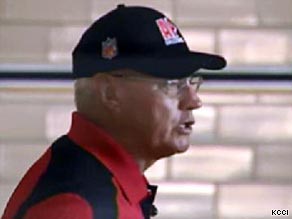
Ed Thomas, the football coach of Aplington-Parkersburg High School in Iowa, was shot to death in the school's weight room this morning in front of students. A suspect is in custody, but no one is commenting on who it is (except to say it's an adult) or what happened. "Crisis Counselors" are reported to be at the school working with the witnesses.
Before commenting, a disclaimer: the Quarterback is not there, doesn't know Ed Thomas and doesn't work for the Aplington-Parkersburg schools. I am acquainted with some folks high up in CISM response for the state of Iowa, and know that they have a pretty well organized structure. Also, this story is only about two hours old as I write this, and by the time you read it more facts may be public. If so, I will try to update the Quarterback site so this post remains relevant.
As you may know, responding to just this kind of situation is what the Quarterback does and is passionate about. So I thought it might be instructive to walk through what I would be thinking about and doing if I were in charge.
As my regular readers know, in Critical Incident Stress Management we talk about the 5 T's: Trauma, Target, Timing, Theme and Team. Let's walk those through:
Trauma: This is fairly straightforward -- a beloved coach was shot in sight of students. Whoever is heading up the response is going to want to get as much detail as possible about what happened, and I guarantee that there is more detail to be had than what is in news reports at this point. Some questions to ask: Do we know who the shooter is and/or what the motive might be? Did the witnesses know the shooter? What did he say? Who tried to help the coach? Who called the police? How were parents notified?
Target: First, a reminder -- we're responding to people's reactions to the incident, not to the incident itself. So we can sketch out who may need help and what might be appropriate, but we won't know if we're right until we find out how people are reacting.
- In the center of the circle are the people who were in the room with the coach when he was shot. Most likely, we'll be wanting to do a Defusing (a.k.a. Immediate Small Group Support) for these folks, depending on how many there are. This is a process whereby they get to briefly talk about what happened and the team will give them information on what kind of stress reactions they might experience and how they can best take care of themselves.
- Someone needs to be assigned exclusively to the family and will be doing Defusings and one-to-one intervention.
- Next out, we may need to do a Defusing with first responders, depending on how awful the scene was.
- We will probably also want to Defuse the staff who were in the building.
- Now it's time to deal with the rest of the community. It's time for a Crisis Management Briefing. A member of the team will M.C. The Principal will welcome everyone, the police will state the facts and the state of the investigation, and the team will educate folks on traumatic stress reactions, and then hang around afterwards to talk to anyone who needs individual support.
- Throughout this all, we are assessing, assessing, assessing: Who seems to be in the worst shape? What resources do they have for recovery? What more do they need? Based on the answers to that, we will be doing a lot of individual crisis intervention and may well schedule a Critical Incident Stress Debriefing for those towards the center of the circle.
Theme: Three big things are going to come up, particularly for the kids in the room when it happened. 1) I should have stopped him. 2) I thought he was going to come after me next and I do not feel safe now and 3) This town was devastated by a tornado last year and now this. Trauma always brings up trauma -- it causes you to open up the same file drawer in your mind and out comes everything else. Folks may well still be fragile from the tornado, so reactions are going to come harder and faster for this.
Team: Everyone responding needs to be trained in CISM. School counselors and social workers are often wonderful, talented, fabulous clinicians, but they do not generally have training in early crisis intervention. The tendency if you are in mental health but don't have this training is to start down the road towards therapy, and now is not the time for that. If this were my response, I would want to send in (presuming we have the personnel) CISM trained counselors, social workers and/or psychologists who work in schools, a CISM trained Principal and teacher, and whoever is CISM trained who the kids feel the most comfortable with, if it's not the folks above.
God bless the folks in this town. I hope they get the best CISM response in the history of the world.
Subscribe to:
Posts (Atom)
Meet the Quarterback

- Naomi Zikmund-Fisher
- is a clinical social worker, former school Principal and a Crisis Consultant for schools and community organizations. You can learn more about her at www.SchoolCrisisConsultant.com

Subscribe


 Posts
All Comments
Posts
All Comments