Showing posts with label natural disasters. Show all posts
Showing posts with label natural disasters. Show all posts
Wednesday, August 31, 2011
All Hazard Preparedness (for Some, Anyway)

 |
| Rikers Island circled in blue on evacuation map from NY Times |
As Hurricane Irene churned its way up the East Coast last week, New York City Mayor Michael Bloomberg ordered the evacuation of coastal areas of the city. 300,000 people were ordered out of their homes (although a fair number didn't leave).
In the middle of this unusual situation, someone asked a very interesting question. What about Rikers Island? For those of you who don't watch Law & Order
 reruns, Rikers is the principal correctional facility for New York City. It currently houses about 12,000 prisoners. As the name suggests, it's on an island, and it's smack dab in the middle of the zone that was evacuated ahead of the hurricane.
But Rikers Island was not evacuated for Irene. We can argue about whether it -- or anywhere else in New York City -- really needed to be. But it turns out that Rikers has no evacuation plan. Let me reiterate that, because it really is striking. There is no plan in place to evacuate Rikers Island under any circumstance. Not a hurricane, tornado, flood, fire, earthquake, riot or anything else. If someone brings a bomb into the visitor's room and they can't diffuse it, too bad. If the whole island catches fire, oh, well.
I know that concern about the welfare of criminals is not a politically popular stance, and maybe that's why they haven't figured this out. But there are some other things to consider. First of all, Rikers houses people temporarily awaiting transfer to other facilities, those serving less than a year in jail and those awaiting trial who cannot make bail or are being held without bail. This is not, overall, the place you find the most hardened criminals of New York. What's more, a sizable number of them have never been convicted of a crime. They are accused and poor, but presumed innocent.
What's more, in order to maintain the prisoners at Rikers, there is a sizable staff of guards, cleaning crew, cooks, medical personnel and others who make the place run. Those people aren't even accused of crimes. They're just doing their jobs. And as long as there are prisoners on Rikers Island, they have to be there.
The public school where I was Principal has not one but two different evacuation locations plus a variety of plans based on the hazard. We have to practice evacuating the building, as does every school in the country. If your business doesn't know how to evacuate its personnel and its customers in the event of a disaster, I'd call that negligent. But a facility with about 20,000 people in it, all told, has no plan.
I'm sure evacuating Rikers would be a nightmare. It is possible that even if they had a plan, implementing it for Irene would not have been worth it. Fine. But not having a plan at all isn't just stupid, it's criminal. I don't know which is more horrifying -- that there is no plan, or that nobody thought it was a problem until now.


Tuesday, August 30, 2011
Irene, Goodnight
 |
| The remains of a VT highway bridge. |
It seems like I should have something to say about Hurricane Irene. I write about traumatic events, and this storm certainly did some serious damage to parts of the east coast and was a major nuisance to others. At least 40 people died, and many more lost their homes and businesses.
It's not really that I don't have anything to say about Irene. But all weekend and yesterday I found myself having difficulty formulating something. I think I've finally put my finger on why. Put simply, the media coverage of Irene stunk. Or, perhaps more precisely, the national media coverage -- which was the only coverage you could get if you weren't in the storm's path -- stunk. And I really don't have much to say about the storm as it was portrayed in the media.
 |
| The former Rte. 7 |
This was big news, and the potential for disruption to those two cities got a ton of coverage. I found the breathless speculation that Wall Street might not open for business on Monday a little much. Yes, that would be unusual. Yes, it would be newsworthy. And if it happened, there would be much more important stories of damage and loss of life to talk about. It's a stock exchange. It's one day. Let's get a grip.
 |
| Killington Ski Resort base lodge |
Except that is not even vaguely a decent picture of where the news from Irene actually happened. The state of Vermont was massacred by this storm (Keene, NY, by the way, is fairly near the Vermont border). Vermont, since it is not on the Atlantic coast, was not nearly as over-prepared as some other places. The damage was horrific, the power was out, and no one had reporters there to report. One might expect NPR (or other outlets -- I'm just picking on them because that's where I got my news yesterday) to talk about this, even if only to say that information was sketchy. They didn't. The word "Vermont" did not make the newscast.
On the one hand, I think storm coverage is often overblown. Hurricanes happen. It's a storm, not the apocalypse, at least most of the time. But I certainly think we owe it to our friends in Vermont to have headlines that are a little more relevant than "Storm Doesn't Close Wall Street After All."

Thursday, April 28, 2011
Life and Death in Tornado Alley

I remember when I was an undergraduate, I was working on a computer project in an evening class during a wind storm. All of a sudden, the TA started yelling "Save, save! Everybody save!" About two minutes later, the lights went out. From the main computer lab across the courtyard, we could hear people screaming -- they hadn't saved. The TA was from Oklahoma. He said, "I just knew."
There are places in this country where tornadoes are a fact of life. Oklahoma is one of them, as are many places in the south. Last night, those facts hit hard. A string of storms ravaged the southern U.S., killing at least 214 people including 131 in Alabama alone.
Remember, these are places that are prepared for tornadoes
 . They know they get tornadoes -- perhaps not as many as last night in a typical night, but some. They practice for tornadoes. They have a plan. And 214 people still died.
 This brings up a difficult issue for me, and perhaps for you as well. Preparedness
 for likely threats is important, and some of us like to think we're pretty good at it. My family has a tornado plan and an automatic weather radio. We know where to go and what to do when a storm is coming, and we have done it several times. Luckily, the storms have never hit us directly.
 What we don't spend a whole lot of time thinking about is the simple truth that if a tornado actually hit our house dead on, there's no guarantee that we'd survive it. We have a better chance in our little basement room, certainly. But if a twister flattens the house, we pretty much have to hope that the first floor doesn't fall on us in the basement. Our safe room is useful for a storm that goes nearby, breaks the windows, picks up the cars and throws them, and generally wreaks havoc, as long as it doesn't actually hit our house.
Most of the time, however, we choose to ignore that fact. This is largely because we can't do anything about it. We know where the safest place to be during a tornado is, and we make sure our kids know it too. But "safest" and "safe" isn't the same thing. Sometimes, your TA doesn't have time to yell "save!" or they do but you don't have time to hit the right keys.
They're cleaning up across the south today. A lot of people are digging through a lot of rubble. And a lot of folks are facing up to what they already knew in the back of their minds -- you won't know if you're safe from the next storm until it comes.

Tuesday, March 15, 2011
Japan -- The Kid Version

As many of you know, I have a 5-year-old son. As you may also know, I believe strongly in talking to children about traumatic events if they affect your family, if they are going to hear about them from somewhere else, or if you are very affected by them. Since my husband, my 12-year-old and I are talking a lot about Japan and it is all over the news, I have been talking to my 5-year-old as well. This seemed especially important since he has a little friend in his kindergarten class whose family is from Japan. I'll call him Taro.
My son knows about earthquakes. He heard about the one in Haiti, and that learning was reinforced when I went to Haiti to do some intervention work with kids last summer. His class also recently learned a little about plate tectonics, and his science fair project involved modeling how mountains form using sheets of lard floating in a pan of water. So we had a starting place.
On Friday, I explained that there had been a very huge earthquake in Japan. He immediately exclaimed, "Taro comes from Japan!" He was happy about this -- he had a personal connection to a grownup thing. That's a big deal when you're five. We then talked about tsunamis, which he has also heard of from a children's book called The Magic Fan
 in which the hero saves the town from a tsunami because he has built a giant bridge over the village. We talked about how the earthquake starts a big wave, and how, just like water sloshing in the tub, it sloshes one way and then sloshes the other. In this case, it sloshed all the way to Hawaii and California.
Interestingly, my son seemed to completely miss the idea that this was a scary thing. He's in the stage of his life where science is very cool and big things moving in the earth are even cooler. He does not connect that real people just like him live where all this is happening. It's like a cartoon to him, and that's probably just as well. His comment after I explained all of this was, "On Monday, I will tell Taro that there was a big earthquake and tsunami in Japan." I suggested that Taro might already know.
Over the weekend, my son asked what a nuclear accident is. This feeds into another parenting principle -- if they're asking, you need to answer. But explaining nuclear power to an adult is hard enough, let alone a kid. I explained it this way:
There are lots of different ways to make electricity. A lot of times, to make electricity you need something very hot. Often they use fire by burning coal or gas. Another way to make something very hot is called nuclear reaction. They take two chemicals and they bang them together, and it makes a whole new chemical and it gets very hot. The chemicals are dangerous, so they keep them in a strong container so they won't make anyone sick. After they use the chemicals to make the electricity, they're still hot, so they put water around them to cool them down.
In Japan, they had a very smart system. As soon as there was an earthquake, the chemicals stopped banging together. That was really good thinking. But the earthquake broke the part that puts water around the chemicals to cool them down. So they are really, really hot and people are worried because they might melt the strong container and let some of the chemicals out, and people could get very sick from that.
This explanation is not very precise, but I thought it wasn't bad for a five-year-old's purposes, and my son seemed satisfied.
This morning, I asked him if he had talked to Taro about the earthquake. He replied, somewhat dejectedly, "Yeah, he already knew about it." I said I wasn't surprised, and that I guessed Taro's family was very worried. I said (and kicked myself for not saying earlier), "A nice thing to say would be, 'I heard about the earthquake. I hope your family is OK.'" Then, out of nowhere, my son said, "Taro says his grandmother was swept away in the tsunami. He also says that his house is gone and he doesn't know where he will live when he goes back to Japan."
Now, let me say up front that I have no idea if this is true. I don't know if Taro said it, and if he did, I don't know if he meant it. It is not at all unusual for kids -- either Taro or my son -- to "try on" a tragedy to experiment with what it would feel like or mean if it were true. Of course, it might be true. My son said that this was a discussion he had with Taro after school at daycare, so it wasn't at all clear to me that the adults knew about it. I put in a call this morning to my son's teacher and left her a message to let her know, in case she didn't, that either this family has suffered a terrible loss or that the kids are trying this trauma on for size. This triggers yet another principle -- if the kids are talking about it, you need to be talking about it too.
My son is still not too phased by the situation. He knows about it, and he knows it touches his friend. It certainly matters to him. But it's about at the level of the extinction of the dinosaurs in his mind. It happened, but it so remote from his experience that there's no real need to worry about it. I don't know about you, but I find myself wishing I could feel that way sometimes, too.

Sunday, March 13, 2011
Now that Japan Has Your Attention, Let's Talk Preparedness

Depending on where you live, the earthquake and tsunami in Japan may or may not seem like something that can happen to you. Here in Michigan, our chances of an 8.9 earthquake are pretty low. Even a tsunami on Lake Michigan wouldn't reach my house. But a nuclear reactor accident? Before today I didn't even know where the nearest nuclear power plant to my house was (it's about 40 miles). Floods, tornadoes, hurricanes, blizzards, chemical spills . . . there are a lot of reasons why you might, someday, need to either evacuate your house or shelter in place.
FEMA has been on us for years to get ready. Most of us aren't. At a recent meeting of CISM providers, the FEMA director asked for a show of hands of how many people had an emergency bag for evacuations. Less than half of us raised our hands. Then he asked how many had a plan for evacuating their family. In a room of 800 people, I was one of two.
Make no mistake about it. When the time comes to leave your house, you will not necessarily have any time to get ready. Depending on what the disaster is, you might have a day and you might have less than 5 minutes. That's not the time to be thinking about this for the first time.
So, let's get practical. Here is a list of things you can do, roughly in order of the ease of doing them. This list is not exhaustive, nor does it take into consideration every possible catastrophe that could befall you. But it's a start. Find something on this list you haven't done yet, and do it.
- Talk. Seriously. Have a conversation with the other people in your house and make the following decisions:
- Where would you meet in the event of an evacuation at a time you weren't together. Pick someplace out of the immediate area.
- Where would you meet if that place was also evacuating.
- Who are two people outside your area who you will call in an emergency if you can't reach each other, so they can relay messages to the others when they call.
- If you have children and you have to evacuate during the school day, who is responsible for picking them up (if possible -- they may have to go with school personnel, keep in mind).
- If your children are home alone, where should they go? Who is a safe person who is nearby who can help them?
- Find out what the official evacuation route or procedure is, if there is one, for the catastrophe most likely to happen in your area.
- Educate yourself about that catastrophe. Find out what the dos and don'ts of surviving it are. Do this even if you think you already know. Conventional wisdom may well be wrong.
- Make sure you have a battery operated radio
and a flashlight
, and that everyone in the house knows how to use them. Also make sure everyone in the house knows where in the house is safest in the event of an earthquake or tornado, if applicable.
- Make a list of the medications everyone in the house takes, both so you can grab them on your way out and so you can tell people at the shelter if you don't have your meds.
- Make sure you keep 3 days worth of food in your house at all times. It doesn't have to be 3 days of great food, but don't let your cupboards get bare.
- Stock up on clean water. You should have one gallon per person per day for 3 days. If you have a chest freezer, you can stick a gallon or two in the freezer, which will also save electricity.
- Create a bag with the things you would need if absolutely everything else in the world were destroyed. This probably includes medications, vital documents, a first aide kit, and at least a little non-perishable food. Put a list in the bag of anything that isn't in there that you need to remember (e.g. your child's asthma nebulizer).

Friday, September 24, 2010
The World Isn't Coming to an End -- It's Only an #X24

If you were killing time on Twitter around noon Eastern Time today, you might well have gotten the impression that there was something big going on in California. Shortly after noon, news filtered out of an earthquake measuring 9.2 on the Richter Scale near the Aleutian Trench, south of Alaska. A tsunami warning was issued, and a few minutes later a magnitude 7.2 earthquake hit California. Then came the tsunami. If you weren't paying close attention, you might have been alarmed, but none of it was real. It's part of an exercise running today and tomorrow called Exercise24, or X24.
The purpose of X24 is to test the use of various tools on the Internet in the event of a major disaster. X24 has been using Twitter (with the hashtag #X24 and clear warnings of "This is a test. This is not real." They have a page on Facebook. They are using Google Docs to exchange requests for aid and match providers with requesters. The idea is to see what works and what doesn't, and whether there are uses for social media and the Internet in such a situation that folks might not already have thought of.
Exercises like this one are used in emergency response organizations all over the world. Sometimes they are simulated using actors to portray victims or criminals, and sometimes they are done entirely virtually, merely sitting around a table and talking through what should happen next.
The idea is that having a great plan is wonderful, but you won't really know if you have a great plan until you try to use it. The problem is, if you need to use it, it's really too late to discover it's not all that wonderful. In addition, being taught or trained how to do something in an emergency is different than actually doing it. For example, if you had a choice between two surgeons with exactly the same education, one who had done your procedure five times this week and one who had only watched other people do it, who would you want? Simulations also serve as inoculation training for first responders. They introduce various traumatic possibilities to people in a relatively controlled way. When a real emergency hits, there are fewer elements that the responders' brains have never encountered before. This makes them more resistant to the effects of the trauma exposure, and more able to stay calm and do their jobs.
There are two truths about exercises like this. Truth #1 is that something will happen or not happen during the exercise that no one, in all of their planning, ever thought about. This is, in some sense, the entire point. By running a drill, you can discover what is missing from your plan. Truth #2 is that, no matter how extensive your drills are or how many you have, during an actual emergency something will happen that never happened during the drill. There are, in turn, two reasons for this. First, every emergency is different and you can't possibly simulate every possible scenario. Second, people behave differently in an actual emergency than they do if they know it's just for practice.
X24 is an interesting exercise because it uses the Internet -- and hence the whole world -- to practice in. The organizers should be cautious, however, in leaning too much on this exercise to answer specific questions about how the Internet would handle an emergency. I strongly suspect that the number of people retweeting the #X24 tweets and posting information to Facebook, as well as looking for information on emergency and news sites, during the exercise is a tiny fraction of the number who would do so if an actual tsunami hit California. You can tell from this exercise whether you can use Internet tools to share information, but until it actually happens we won't really know if those tools have enough capacity to make it a good idea.
Thursday, September 2, 2010
We Are the World, Except for Pakistan

Frequent Quarterbacker Edwin dropped me a note earlier this week to suggest that I might like to write about the flooding in Pakistan, seeing as how it is being branded one of the worst natural disasters ever. In case you missed it, 20 million people have lost their homes and an estimated two thousand have died. Those surviving are, aside from being homeless, at tremendous risk for disease and starvation.
This is certainly a crisis, and certainly the sort of thing I write about. So why haven't I? My reasons are somewhat specific to me. The flooding in Pakistan hit the news in this country during the second week in August. It may have gotten coverage before that, but certainly not a lot. My regular readers know that during the second week in August I was in Haiti, doing crisis intervention following their earthquake in January. I first heard about the flooding the day I returned and, to be perfectly honest, I was resentful that there was another natural disaster. My gut, emotional reaction was that Pakistan was stealing the spotlight from Haiti, and they should wait their turn. That was not a rational reaction, of course, but it was real.
I shared that reflection with Edwin when he asked, and he said that, in some ways, he had a similar reaction. The floods were too much, too soon after the Haiti earthquake (not to mention the Chile earthquake, the gulf oil spill, etc.). It's interesting that he described it as being too much, as though he (and by extension, we) couldn't absorb it all. Others would say that the rapid succession of disasters has made us numb.
Edwin and I are no alone, however, in not really focusing attention or assistance on Pakistan. In contrast to the reaction to Pakistan, international aid has been very slow in funneling to Pakistan. I haven't seen any cell phone text message fundraising campaigns, and there is no "We Are the World
 for Pakistan." I'm absorbed with Haiti. Edwin feels like it's too much too soon. What's up with the rest of the world?
I think there are a number of factors in play here, and any one of them may play more or less of a role for one person or another. If one doesn't resonate with you, keep going down the list. Something will. In addition to what I'll call the "natural disaster overload" described above, here are some things I think are going on:
- Floods are calamities in slow motion. Unlike an earthquake, there is no shocking breaking news that shakes us all out of complacency. The moment when a flood goes from a problem to a catastrophe is not clear, and the more time we have to get used to something the less likely we are to feel like it requires action.
- The impact is measured in lives displaced, not lives lost. Two thousand people is a very large number, but the death toll from the Haitian earthquake was more than one hundred times as great. Death gets our attention.
- It's Pakistan
. Americans, at least, don't particularly like the Pakistani government, despite the fact that they are technically our allies.
- It's Pakistan. The Pakistani government is notoriously corrupt, and the country has a significant Taliban
presence which makes operating there very difficult.
- It's Pakistan. There is a tremendous anti-Islamic sentiment in this country right now. While relatively few Americans would consciously decide not to help because these are Muslims, the anti-Muslim
rhetoric makes it much easier to not notice that these are people.
Sunday, June 13, 2010
The Incomprehensible Arkansas Flash Flood Deaths
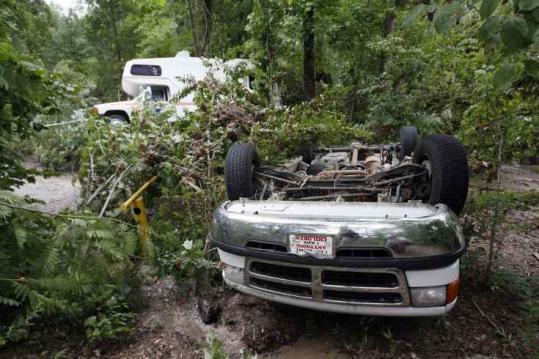
Nineteen people are known dead and at least one is still missing from a flash flood that hit a remote Arkansas campground last week. The Missouri river flooded in the middle of the night, meaning that many of the campers did not get word of the flood warnings until it was too late. Reports indicate there were 4 feet of water at the campsite at 2 AM and more than 23 feet by 5 AM. Bodies have been found as far as 8 miles away. The reason no one is absolutely certain how many are missing is that no one is absolutely certain who was camping there when the floods came, and many folks are still on camping trips and can't be reached.
Today, about twenty members of families of the dead and missing were brought to the campsite to see for themselves where this happened, and to look through the debris for personal items belonging to their loved ones. The damage is horrific. The water literally peeled up paved roads and sent campers floating down the river. Everything that was in its path and couldn't move out of the way is moved or destroyed.
I have always found flash floods
 difficult to wrap my mind around. I grew up in a hilly part of New England where the nearest rivers flooded, but didn't come anywhere near my house. When flooding was really bad the river behind my uncle's house would swell through his backyard and into his basement, and local roads would close. Flash floods, however, were not something I was familiar with. The terrain where I lived was not conducive to large amounts of water pouring into the rivers and streams all at once, causing the water to rise by feet at a time. If you went to bed dry, you would wake up dry -- that's how the world worked.
I think even to those of us who live (as I do now) where flash flooding does happen, we still generally believe that to be true. Floods happen, sure. But they come with warning and time to get away. Flooding that comes fast and furious is the stuff of broken levees, not of campgrounds on hillsides. In our connected world, we expect that, with the exception of earthquakes, natural disasters have some warning
 . If bad stuff is coming, we will know.
Nineteen people, including at least 6 children, went camping last week, one presumes for fun, and are not coming home. They were in their campers or trailers or tents, and the water came faster than they could run. No one went camping last week thinking they were going to die. Even the most nervous among us think the dangers of camping involve bears and wolves, or maybe the bogey man hiding in the bushes. If we imagined that you could drown in your sleep while camping, no one would ever go. This isn't supposed to happen. It's incomprehensible.
image: Reuters
Wednesday, January 20, 2010
California's Apocalyptic Weather

Yesterday afternoon, a headline appeared on Google News that read, "Parts of LA Under Tornado Warning." This did not particularly grab my attention, so I was surprised when, a few minutes later, a list of the most popular stories also included this one. What, I wondered, could possibly be so interesting about a tornado warning in Louisiana? Then I looked more closely at the sources for the various articles and realized that, in this case, LA was not the postal abbreviation for the state of Louisiana, but the acronym for Los Angeles.
Context is everything. I read the headline as being about Louisiana simply because it was much more plausible. Louisiana has tornadoes. Southern California has earthquakes and wildfires. That's how the world works. If I was thrown for a loop by yesterday's weather in Los Angeles, I can only imagine what Angelenos themselves are thinking. Today is bringing another storm and mudslides with attendant evacuations.
Storms like this are never fun, no matter where you are or how often they come around. But if you live in an area that gets them a lot, tornado warnings and the like become a part of life. Even here in southeast Michigan, where we have at most three tornado warnings a year, school children drill for them and my own kids know exactly where the "safe room" in our house is. We are used to severe thunderstorms and flooded basements in the spring and summer, and bitter cold and snow in the winter. That's how the world works.
A tornado in Los Angeles, on the other hand, feels about as likely as a major earthquake in Michigan -- it could happen, but nobody thinks it will. After the Eureka earthquake I wrote about how whether an earthquake is "big" depends a lot on your previous experience with earthquakes (and of course, little did I know that I'd soon be blogging about another big, much more devastating one). Whether or not a tornado warning feels particularly scary or traumatic, similarly, has a lot to do with whether you have them all the time.
A kid in Los Angeles isn't as likely to know where the safe room is or to have practiced for severe weather in school. On the other hand, my children haven't a clue what to do in an earthquake and would be terrified by even a modest tremblor. So, in addition to being more and less accustomed to certain things, we also are more and less prepared for them. Preparation gives a sense of safety and lessens the traumatic impact of a crisis -- it's much more scary to have a tornado nearby if you first have to figure out what to do and only then can take cover.
We all have expectations for how the world works. The more those expectations are violated, and the less we are prepared, the more traumatizing an incident is going to be. So if it's all the same to Mother Nature, let's keep the earthquakes in Los Angeles and the tornadoes in Michigan. That's the way the world works.
Friday, October 16, 2009
Carolina Forest High School: Not By the Book

There was a school shooting in Myrtle Beach, South Carolina this morning, and a 16 year old boy is dead. That, by itself, is very upsetting, certainly to the people who were there, but also to society as a whole, as we reflect on what our world has come to that someone can be shot in school. And that's where it gets, well, weird.
The details are still dribbling in, but as best as we can tell, Trevor Varinecz, a junior at Carolina Forest High School, asked to see the school resource officer -- a police officer stationed at the school -- at about 8:25 this morning. The door to the room where the two met was closed, so no one knows for sure just yet, but it appears that Varinecz stabbed Officer Marcus Rhodes and Rhodes shot Varinecz in self-defense. Rhodes is in the hospital. Needless to say, if there is such a thing as a "typical school shooting," this is not it.
When you train as an early crisis responder, you learn that there are certain patterns that different types of incidents fall into. While each incident is different, there are predictable themes that come up. Suicides cause one set of reactions, natural disasters another, domestic violence yet another. You can expect different things from those who have been involved in car accidents than from those who witnessed a mass shooting. No two incidents have exactly the same reactions, but you can prepare. From time to time, as a responder, you work on an incident and come out saying, "that was page 73 of the textbook." Sometimes it is that cut and dried.
A good Critical Incident Stress Management Team knows what to expect from an officer involved shooting. They know what to expect when an officer is injured. They know the patterns when a child dies, and those from violence in a school. They even know that sometimes two types of incidents combine into one event.
All that having been said, I don't think there is a team in the country that feels truly prepared for what happened at Carolina Forest High School today. There is no page in the textbook for the injury of an officer at a school in an incident resulting in an officer involved shooting of a child. As a school CISM Team Leader myself, I look at this incident and have to take a few moments just to swear under my breath before I can even consider where I would start.
This is just one more reminder that emergency preparedness isn't just about practicing for every awful event you can imagine. It's also about developing a tool kit of skills and the creativity and flexibility to use them in new ways, when those things that you can't possibly imagine in a million years happen on your watch.
Thursday, October 1, 2009
Aiding Indonesia: Why Tents and Food are Not Enough

An estimated 1,100 people have died in Indonesia in the last few days, following an earthquake that measured 7.6 on the Richter scale and another today that measured 6.6. The number of dead is really more than we can truly wrap our minds around. After a certain number, it just registers as "many." Too many.
Many people, at this moment, feel an urge or an obligation to help the survivors. Money is pouring in to international rescue organizations to help people in Indonesia, Samoa, the Philippines and other countries recently hit by natural disasters. Survivors' most urgent needs right now are food, water, shelter and, to the extent possible, safety from further damage caused by aftershocks and the like. Most of us, if we can afford it, will chip in ten or twenty dollars for a blanket for a child in Indonesia without much hesitation.
Once the physical needs of people in Indonesia are met, which will take quite some time when you consider all the rebuilding that needs to happen, attention should turn to the psychological needs of survivors. Studies have indicated that between 40% and 50% of survivors of mass disasters will experience significant psychological impairment of their ability to function, including (but not limited to) PTSD or depression. When a disaster affects such a large swath of a country, as these earthquakes do, that is a significant reduction in the productivity and stability of the country.
So what are they going to do? I don't know about this particular disaster. The Red Cross and the United Nations, to name two organizations, do have mental health disaster response personnel, and at some point I would hope they will deploy. Teams from other countries may be brought in, although language barriers make that difficult. Still, this is work that has to be done.
So here is my question to you. If you would donate $20 for a blanket for a child in Indonesia, would you donate $20 for some mental health assistance for her? One might save her life. The other might make her believe that her life is worth living.
Look here for a partial list of relief organizations accepting donations for those affected by the recent flooding, earthquakes and tsunamis.
Wednesday, September 30, 2009
Earthquakes, Tsunamis and Typhoons, Oh My!

My husband and I have a theory. It posits that any given person, when contemplating earthquakes, hurricanes and tornadoes, is ok with one, has a healthy fear of another and is absolutely terrified of the third. Growing up, as he did, in the midwest, earthquakes are not such a big deal to him, but hurricanes scare him to death. I, on the other hand, grew up in New England, where hurricanes hit but not hard. What scares the daylights out of me is tornadoes.
To be fair, however, our theory is incomplete. While it is true that I have recurring nightmares about tornadoes, I also have recurring nightmares about being covered by waves of water. My husband points out that, when I have these, it probably means I need to go to the bathroom. My worst nightmares involve water spouts -- tornadoes over water. I don't have them very often, but they are very consistent and consistently scary.
You might think, then, that the tsunamis that hit Samoa yesterday and the typhoons in the Philippines and Vietnam, with all of their flooding, would be very scary for me to contemplate. In fact, they probably would be, if I could bring myself to contemplate them, but I can't. And this is how I know that my fear of giant waves and of unrestrained water is actually not pathological.
If this were truly a dangerous phobia, I would hear about a tsunami and find myself thinking about it all the time. I would "live" it in my mind. It would trigger more nightmares. But in fact, I know my fears and have control of them sufficiently that I know not to do that. I can bring myself to imagine what the earthquakes in Indonesia and Samoa must have felt like, or the rain and winds from the typhoon in the Philippines and Vietnam. I can contemplate the death and destruction in all three places. But when it comes to the flooding and the tsunamis, I simply cannot see them happening in my mind's eye. I cannot put myself there. My mind is very good at protecting itself.
I was recently involved in a Critical Incident Stress Debriefing (CISD) where some of the participants kept talking about how awful the incident must be for others. They were saying things like, "I just keep thinking what he must be going through" and "I imagine how awful it is for her and I just cry all the time." My partner for the CISD had what I thought was a terrific way of responding to this. During the teaching phase, he said, "Let me suggest to you that you do not have to try on other people's trauma."
I am horrified and yes, a little terrified by what I see on the news today. But I know enough to know that I don't have to try it on to care.
Tuesday, September 29, 2009
What Makes Something Important?
Generally speaking, I blog about whatever heinous situation is dominating the news at the moment. Sometimes, that's a very easy event to spot. Generally speaking if it gets several columns on the front page of the New York Times, or more than one story on the splash page at CNN, you know it's "big." And if it's "big" and traumatic, it's stuff for the Quarterback.
Sometimes, however, it's not as obvious what is "big" in American media. Finding traumatic events is not much of a problem. Finding ones that seem compelling (and that I have something to say about) is sometimes harder. Today I had a particularly difficult time finding a story I wanted to blog about, so I started to reflect on what makes me think a story is "compelling." Sometimes the reflection isn't so pretty.
By my gut level definition, a story is compelling if it meets one or more of the following criteria, the more the better:
- the event is unusual
- the event affects people in an unusual way
- the event affects a group of people you might not think of as being affected
- the news coverage of the event raises a particularly interesting point
- the event affects people who I believe most people will identify with
There are two examples of this that became clear to me as I was desperately searching for a topic today. The first has to do with natural disasters. In my searching, I had skimmed over the deaths of hundreds of people in the Philippines during recent flooding, and decided I didn't have much to say. Somewhat later, a breaking news headline appeared detailing a very large earthquake near Samoa and a tsunami warning in New Zealand, and I caught myself thinking, "If there's a tsunami in New Zealand, then I'll have something to write about." Really? Deaths from natural disasters in the Philippines aren't compelling, but those in New Zealand are? How can I possibly assume that somehow people in the Philippines are "used" to this sort of thing?
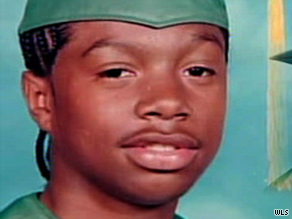
Which brings me to my second example. Derrion Albert, 16, was beaten to death when he got caught in the conflict between two groups of students on his way home from school on Thursday. He was an honor student, a church-goer, and an innocent bystander. If this had happened in my hometown, it would be national news. But it happened in Chicago, and Derrion was black, and so it didn't make the news until a video of the beating surfaced, and we white folks could see that this is not a sort of violence you can ever "expect" or "get used to." But let's face it, privileged, suburban, white folks, of which I am one, still think of it that way.
All life is precious. We know that intellectually, but we can't seem to act like it. We distance ourselves a hundred different ways from trauma, whether to protect ourselves from the idea that it could happen to us or for more sinister reasons of racism, classism or xenophobia. If trauma happens to "those people," it doesn't happen to "us." But we are all those people, and they are all us. We probably won't make much progress in this world until we really believe that.
Wednesday, September 23, 2009
Dying on the Phone: The Georgia Floods

Nine people thus far have died in flooding in Georgia. That is truly awful, and it certainly has made the news. These are nine human beings who are not going home to their families. That is worthy of our attention. But does it always get it?
If nine people died in a random shooting at a mall, it would be all over the news. We would be interrupting our regularly scheduled program for round the clock coverage. If they died in a terrorist bombing in an American city, there would be nothing else in the news. If they died in a bombing in an Iraqi market, it would be a passing mention.
I am as guilty of making these distinctions as anyone else. We care most about things closest to us and most violating of our expectations and world view. The idea that flooding is dangerous is easier to accept than the idea that shopping in the United States is dangerous. We already knew that shopping in Iraq was dangerous. So I, like most of you, greeted the news out of Georgia with a click of my tongue.
Then, however, I read a story about one of the women who drowned. She was literally on the phone with 911 as the water came into her car, which had been swept away in a flash flood and stuck in some trees. She was on the phone when she died. You can read about it online, and you can listen to the 911 call.
Maybe you shouldn't.
First of all, our society usually accepts that someone's death is a private thing, or at least a family thing. There is a voyeuristic feeling to listening to someone dying, and I'm saddened that the authorities chose to release the call.
Second, 911 dispatchers will tell you that listening to someone in great distress is traumatic. You know they need your help and you are powerless to help them. While listening to the tapes after the fact is less distressing because we know how it is going to end and we don't expect that we will help the caller, it is still the witnessing of a traumatic death, just as surely as watching it would be. None of us need that exposure. Some of us will truly be disturbed by it.
The 911 call brings this victim out of the expected and into the unexpected. We know that people die in floods. We don't like to think about how exactly that happens. We allow ourselves to think that it's just "one of those things." But in reality, this week it was nine of those things, each one with its own story and its own traumatic truth.
Wednesday, September 2, 2009
Why Do We Care, Or Not?

- So far, 34 people have died in today's earthquake.
- In the last 6 years, at least 300,000 people have died and 3 million have been forced to leave their homes because of their ethnicity.
- More than 1,300 children have abnormally high levels of lead in their system due to the malfeasance of 8 local factories.
- Five years ago this week, 334 people, 180 of them children, were killed following a three day hostage-taking standoff at a school.
- A kidnapped girl reappeared after being missing 18 years.
Now, let's be honest. Which one of these incidents did you instantly recognize? Which ones did you say, "Wait, where did that happen?"
"Where did that happen," is often our instant reaction to bad news. And, on the whole, that's not an unreasonable question. If there is a major earthquake at my parents' house, for example, I really would like to know that (and it would really be big news, since major earthquakes are not frequent in Massachusetts). It seems straightforward and understandable that we want to know whether people we know and love may be in trouble.
If you don't have any relatives or friends in, say, California or Indonesia, for example, why do you care where today's earthquake was? But you probably do. There are two explanations for this phenomenon, one more palatable than the other.
The first explanation is that you simply are trying to reassure yourself that not only are your loved ones safe, but that something like this will not happen to you or your loved ones in the future. An earthquake in California makes us feel, somewhat irrationally, like an earthquake in Massachusetts is more likely. Certainly a hostage siege in a school in California makes us worry about security in American schools.
The second explanation, which is a little harder to swallow, is that this is not actually about location, but about "alikeness." When things happen to people "like us" it makes us feel less safe -- and less compassionate -- than when they happen to people who we think are not "like us." On some level, we even come to imagine that events that would absolutely devastate anyone in this country are not so upsetting to people elsewhere, particularly in non-European, non-prosperous countries. Somehow, "they" must be used to it. We may not say these things out loud, or even think them consciously, but they resonate with us. Call it racism, call it xenophobia, call it American self-centeredness, but we just do not care nearly as much about trauma that happens in other parts of the world.
- Today's earthquake was in Indonesia. It's not even the top story on CNN as of 12:30 this afternoon. Imagine what the coverage would be if it were in California.
- The genocide in Darfur, Sudan, is something we know about but which gets next to no daily coverage, nor most people's attention, in this country.
- The factories in China have been shut down until they comply with safety standards. It's not a "top story" in this country.
- The siege in Beslan, Russia, caught our attention as it was happening and quickly faded from memory.
- Imagine what the coverage would be of Jaycee Lee Dugard's story if she were in Senegal, or China, or Belize. Imagine what it would be if she were African-American.
Monday, August 31, 2009
The Station Fire
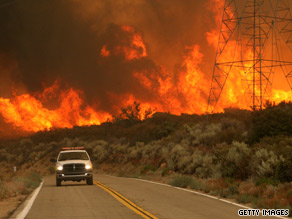
More than 105,000 acres are on fire in Southern California. For those of us from relatively wet regions of the country, this seems unbelievable. For those of us with children with a particular fear of fire, it's horrifying. For a firefighter and their family, it's a source of some ambivalence.
Firefighters become firefighters because they want to fight fire. It sounds silly when you put it that way, but often we forget. No one trains for this who doesn't get something out of it. Jeff Mitchell (whose brother, Doug, is a fire fighter) says you have to be crazy to do it. The natural reflex of any sane person is to run out of a burning building -- these guys run in. So many firefighters across the country are looking at the Station Fire and wishing they were there. Some of them are getting their chance, as firefighters from neighboring states are being called in.
On the other hand, firefighting is only enjoyable when everything comes out right. Nothing beats the rush these guys can have when they beat back the flames and save a house or a life and no one gets hurt. But when one of our nation's bravest dies fighting a fire, every firefighter in America feels the loss, and every family member of a firefighter takes a blow to the gut. Two firefighters out of Los Angeles have died in the Station Fire already. When this is over -- which isn't predicted to be for one or two more weeks -- that's going to be a hard truth to cope with for the others in their own company, the other fighting this fire, and those who just know it could have been them.
Reading the coverage of the fire, the inklings of what the themes of an intervention on this event might be are starting to emerge. Right now there are five people trapped by the fire because they did not comply with mandatory evacuation orders. Not only did they put their own lives at risk when they made that choice, but they also put the lives of the firefighters who now must try to get to them on the line. I can't imagine there isn't going to be anger about that, particularly if someone gets hurt or, God forbid, dies trying to get them out.
CISM teams most often help with incidents that happen very close to home. Right now, CISM teams all over the west are getting ready to intervene with firefighters caught in a critical incident in another state -- some of them may be deploying there right now. And CISM teams may be hearing about the Station Fire all over this country, as fire departments everywhere watch, wait, and mourn two of their own.
Friday, August 28, 2009
Hurricane Katrina and the Help That Never Came

Where were you four years ago? This is an easy one for me, since I was home with a three month-old baby watching "overblown" news coverage about this hurricane that was heading straight for New Orleans. The predictions seemed outlandish. Flooding of an entire city? Don't be silly. In the days that came, my son and I continued to watch as the Convention Center in New Orleans where I had given a talk just a year before filled with people and the spokespeople in Washington incredibly said they were unaware that anyone was there, because they had been told not to go there.
The delay in rescuing the people of New Orleans was a national shame. The delay in restoring essential services got less attention, but was no less appalling and no less a failure of our society to care for those in need. There was another delay, though, that is more understandable. That is the delay -- or absence -- of mental health assistance for those whose lives were demolished by the storm and by the lack of help that followed.
In the days directly after the storm, people's basic physiological needs were not being met. It would have been totally inappropriate to go talk to people who are crammed into the Superdome or the Convention Center without basic food and sanitation about how they are feeling. Anyone who had the time and ability to do that should have been, and mostly was, getting people to safety, feeding them, and finding them someplace to stay.
The rule of thumb is to provide early crisis intervention services when the situation is stable and the incident itself is over, as close as possible in time and location to where it happened. But because of the way this disaster played out and the delays in assistance for physical needs, there was never an obvious opportunity to do that. It took many months, if not years, for many who had weathered the storm to be in a physically stable situation. By the time they were, they were literally scattered all over the country. CISM is designed for people who have been through hell and are now returning to a world that is basically still normal, but they don't feel normal. The world was never "still normal" for many Katrina survivors.
That is not to say that no one ever got help. Those with the most extreme manifestations of Post-Traumatic Stress Disorder are still being served by the mental health system. CISM is not designed to prevent PTSD, so I won't argue that earlier intervention would have made a difference. However, studies of PTSD in Katrina victims show that increased watching of news coverage following the storm was associated with risk of PTSD symptoms, and between 38% and 50% of people who lived in New Orleans when Katrina hit have or had symptoms of PTSD. The only thing I can imagine might have been done early is to advise people not to watch TV. That probably wouldn't have worked.
By the way, it's not that no one got CISM services after Katrina. Teams from around the country were mobilized to work with rescue workers following the storm. They had the possibility of coping with this as a discrete incident. Most of the residents never did.
Monday, August 24, 2009
What If It Is Your Fault?

You may have missed it in all the static that sometimes passes for news, but as Hurricane Bill passed off the Maine coast yesterday, a large group of people watching the resulting surf were hit by a gigantic wave. Three were swept out to sea, including 7 year-old Clio Dahyun Axilrod and her father. Clio died, her father was rescued by the Coast Guard, and her mother was seriously injured. 16 people were admitted to the hospital.
Now, let me ask you to imagine a conversation with Clio's parents. They were with her when the wave hit, and in fact were moving away from the shore because of the danger. There had been warnings issued about the surf. What do you want to say to them? What is your gut instinct?
Generally speaking, people give one of two types of answer. The first is, "What were you thinking, that was an incredibly stupid place to be." The second is, "It wasn't your fault, you couldn't have known." We are very black and white about this sort of thing. I'm reminded of a line the Wizard sings in the musical Wicked:
There are precious few at easeYou're either right or wrong, at fault or innocent.
With moral ambiguities
So we act as though they don't exist
The fact is, the truth in this situation is somewhere in between. Yes, there were warnings about the waves and they should not have allowed their daughter to be where she was. And yes, they could not possibly have known that that wave was coming at that moment, and they were trying to move away.
The fact is also that neither of our natural reactions to this family are likely to be at all helpful to them. "It's all your fault" is hardly the support they need. They can beat themselves up, thank you, without our help. At the same time, "It's not your fault" denies reality, and actually takes away their permission to talk about how they are feeling. If you tell them it's not their fault when they think it is, you're telling them they're wrong. They're not going to want to talk to you after that.
So how do people learn to live with situations like this? How do you go on, knowing that you are at least partially responsible for the death of your own child? All I know is that people do. They make their peace. They come to forgive themselves for their human failings. They try to prevent similar things from happening to others. They turn to their spiritual beliefs about forgiveness and the afterlife. It isn't easy.
We can't tell people how to feel, and trying only makes things harder. The best we can do is affirm that what they are feeling makes a lot of sense, and help them explore what those thoughts and emotions mean to them. As judgmental as we like to be, it's not about our judgment.
Saturday, June 20, 2009
Noah's CISM Needs
 On Wednesday evening, a massive bank of thunderstorms rolled through the Quarterback's former stomping grounds in Pittsburgh, PA. Some reports indicate that up to 3 inches of rain fell in an hour. The damage was massive: there were flash floods, downed power lines, uprooted trees and lots and lots of water damage. The roof of my former synagogue partially collapsed.
I bring this up for two reasons. First, because last night in Ann Arbor, MI we had quite the storm system ourselves and the Quarterback's basement is flooded. Second, and hopefully more relevant to what brings all of you here, is that it raises some interesting issues about crisis response.
Natural disasters that affect large numbers of people are one of the "Big 5" in Critical Incident Stress Management (CISM) [the other four are suicide of a colleague, death on the job, multiple incidents in rapid succession and response after a substantial delay]. These are the ones they teach you about in the Advanced Group Crisis Response class. These are the "don't try this at home" responses.

What makes disasters so complicated? There are a number of issues. First, one of the basic principles of CISM is to remember Maslow's Hierarchy of Needs. If you're not familiar, here's the pyramid. Basically, what Maslow said is that everyone strives for self-actualization, but there are layers that support that and you can't deal with a higher level unless you've dealt with the one below it. People who have been through a disaster are very much rooted in the lowest level. Their physiological needs are threatened. They may not have food or clean water and their shelter is unstable or non-existent.
But CISM works fundamentally at the second and somewhat the third level. We are dealing with the fact that people's sense of safety and security has been damaged, and trying to return them to a sense of love and belongingness. We can't do that work until people's physiological needs are taken care of. People are not ready to deal with their critical incident stress until they are sure they and their family are going to live, they've had a good meal, they have a reasonably long-term place to stay and they've gotten a good night's sleep. Only the first two of those can reasonably be accomplished in a Red Cross shelter.
The second problem with disaster response is that chances are good that if a community is heavily impacted by a storm or an earthquake, most of the crisis responders are affected too. And another of the basic principles of CISM is that you don't respond if you yourself are impacted by the event. Sometimes, the helpers need help.
This is where mutual aid agreements are so important. Those agreements are what will enable members of the Pittsburgh-area teams to combine forces to create whole teams from the bits and pieces of each one that are not personally affected. They will also allow Pittsburgh to call for help from other Pennsylvania teams or teams in other states.
This is also where consistent becomes crucial. If you're going to show up in another town or another state to help out, you have to know that everyone, regardless of where they come from, speaks the same language and is using the same techniques. This is exactly when you don't want some well-meaning therapist or counselor self-deploying and trying to help. Unless they've had specialized coursework, most social workers, psychologists, psychiatrists and counselors -- even those who specialize in treating PTSD -- don't have training in early trauma intervention. And doing it wrong is worse than not doing it at all.
Subscribe to:
Posts (Atom)
Meet the Quarterback

- Naomi Zikmund-Fisher
- is a clinical social worker, former school Principal and a Crisis Consultant for schools and community organizations. You can learn more about her at www.SchoolCrisisConsultant.com

Subscribe


 Posts
All Comments
Posts
All Comments