Showing posts with label Haiti. Show all posts
Showing posts with label Haiti. Show all posts
Friday, March 11, 2011
Namazu Wakes: The Japanese Earthquake

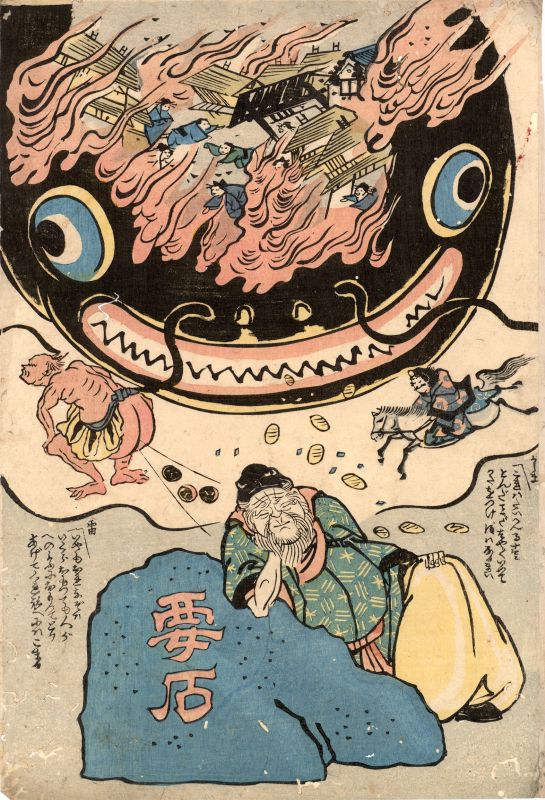
In Japanese mythology
 , Namazu is a giant catfish who lives in the mud on the ocean floor. The god Kashima restrains Namazu with a stone, but from time to time Kashima loses focus and Namazu wakes, thrashing around and shaking the ocean floor. This morning, 80 miles off the coast of Sendai, Japan, Namazu awoke.
 An earthquake measuring 8.9 on the Richter Scale hit northern Japan just after midnight Eastern time. The resulting tsunami devastated coastal towns in Japan, and then made its way across the Pacific, hitting many island nations, Hawaii, and the west coast of the United States. While the loss of life in the U.S. is nothing compared to what has happened and continues to happen in Japan, the damage to ports and harbors is considerable.
This is the largest earthquake in Japanese recorded history. It is likely there has not been one this big in Japan for more than 1,000 years. This earthquake was almost 100 times stronger than the one that devastated the nation of Haiti in 2010. In a country that builds and practices and prepares for "the big one," this was the big one.
While I don't mean to minimize in any way the devastation in northern Japan, the lives lost, or the very real dangers still posed by emergencies at two nuclear power plants damaged in the earthquake, it's also important to recognize the strengths present in this situation. Japan's construction standards are clearly designed to take an event like this into consideration. If you compare the destruction and loss of life in Haiti, where no such building standards existed, to what we are seeing in Japan, it is clear that Japan was as ready as you can be for something like this. The first news report I heard on the radio this morning was from a reporter standing on a balcony overlooking Tokyo. Just the fact that there is a single balcony left in Tokyo tells you how well the Japanese prepared.
The horror we feel considering what has happened in Japan, then, is very different than what we experienced after the earthquake in Haiti. In Haiti, we saw roughly 230,000 people wiped off the planet by a natural disaster and by the unpreparedness and fragility of life in abject poverty. In the United States, we suddenly knew, in a way that many of us hadn't before, that Haiti was our neighbor and that we needed to step up and help.
The horror many of us feel today is different. Far fewer people have died. Japan is much farther away. And, as I've already said, they were prepared. At the same time, we generally regard Japan as being something "like us." While the culture of Japan may be different, it is a highly industrialized, modern country. We have high expectations for their ability to function in all kinds of circumstances. So we watch what is happening there and realize that if it could happen to them, it could happen to us. In Haiti, we felt guilty. In Japan, we feel scared.
Of course, this is not a one size fits all situation. If you have family in one of these countries, have traveled there, or feel some other connection, then one of these quakes may have hit you in a particularly poignant way. I have traveled to both places and have friends in each. Not surprisingly, as I wait for word about people I know in Japan, my mind drifts to worrying about folks in Haiti I haven't heard from in a while. That's the way it is sometimes. Namazu makes connections when he wakes.


Thursday, September 2, 2010
We Are the World, Except for Pakistan

Frequent Quarterbacker Edwin dropped me a note earlier this week to suggest that I might like to write about the flooding in Pakistan, seeing as how it is being branded one of the worst natural disasters ever. In case you missed it, 20 million people have lost their homes and an estimated two thousand have died. Those surviving are, aside from being homeless, at tremendous risk for disease and starvation.
This is certainly a crisis, and certainly the sort of thing I write about. So why haven't I? My reasons are somewhat specific to me. The flooding in Pakistan hit the news in this country during the second week in August. It may have gotten coverage before that, but certainly not a lot. My regular readers know that during the second week in August I was in Haiti, doing crisis intervention following their earthquake in January. I first heard about the flooding the day I returned and, to be perfectly honest, I was resentful that there was another natural disaster. My gut, emotional reaction was that Pakistan was stealing the spotlight from Haiti, and they should wait their turn. That was not a rational reaction, of course, but it was real.
I shared that reflection with Edwin when he asked, and he said that, in some ways, he had a similar reaction. The floods were too much, too soon after the Haiti earthquake (not to mention the Chile earthquake, the gulf oil spill, etc.). It's interesting that he described it as being too much, as though he (and by extension, we) couldn't absorb it all. Others would say that the rapid succession of disasters has made us numb.
Edwin and I are no alone, however, in not really focusing attention or assistance on Pakistan. In contrast to the reaction to Pakistan, international aid has been very slow in funneling to Pakistan. I haven't seen any cell phone text message fundraising campaigns, and there is no "We Are the World
 for Pakistan." I'm absorbed with Haiti. Edwin feels like it's too much too soon. What's up with the rest of the world?
I think there are a number of factors in play here, and any one of them may play more or less of a role for one person or another. If one doesn't resonate with you, keep going down the list. Something will. In addition to what I'll call the "natural disaster overload" described above, here are some things I think are going on:
- Floods are calamities in slow motion. Unlike an earthquake, there is no shocking breaking news that shakes us all out of complacency. The moment when a flood goes from a problem to a catastrophe is not clear, and the more time we have to get used to something the less likely we are to feel like it requires action.
- The impact is measured in lives displaced, not lives lost. Two thousand people is a very large number, but the death toll from the Haitian earthquake was more than one hundred times as great. Death gets our attention.
- It's Pakistan
. Americans, at least, don't particularly like the Pakistani government, despite the fact that they are technically our allies.
- It's Pakistan. The Pakistani government is notoriously corrupt, and the country has a significant Taliban
presence which makes operating there very difficult.
- It's Pakistan. There is a tremendous anti-Islamic sentiment in this country right now. While relatively few Americans would consciously decide not to help because these are Muslims, the anti-Muslim
rhetoric makes it much easier to not notice that these are people.
Thursday, August 26, 2010
Haiti -- Reentry and Reflection
 |
| Me, with one of my new friends |
It's been 12 days since I returned to Michigan from Haiti. That seems both the blink of an eye and an eternity. My return and reentry has presented an interesting opportunity for me to experience some of what I hear when I talk to people who have been in emergency situations first hand, because, while I was not in the earthquake itself and I was fairly comfortable for a brief week in Haiti, the shock to my worldview presented by what I saw and heard was real.
As I mentioned in my last post, I had some foresight to recognize that I might not be firing on all cylinders when I returned. In addition to upgrading my flight to first class, I also prearranged with colleagues from the community crisis team on which I serve to have someone talk to me when I returned. I was not surprised that I needed it. I was somewhat surprised at the reasons I needed it.
I expected to come back with visions of destruction and tales of horrible trauma running through my head. For the most part, that did not happen. What I did not expect was to come back feeling as attached and responsible for the people I met as I did. The conditions under which virtually everyone is living are of a type we simply would not permit in the United States. Even after Hurricane Katrina
 when, it might be argued, we as a country failed our fellow Americans in a way never before seen, we did not permit this kind of living conditions for this long. It felt callous to spend a week and then pack up my things and go because I "had" to leave. It even felt callous to be asking for help with what I had experienced. I experienced a week. Those kids are experiencing a lifetime.
This brings us to another layer of how I was feeling. Yes, it has been seven months since the earthquake. In reality, however, while things are worse for these families now than they used to be, they weren't starting from a great position to begin with. The level of poverty in Haiti is incomprehensible to someone used to US standards. Most of the poor here would be doing fairly well compared to Haitian poverty, and in Haiti there is no government safety net.
I came back feeling like I hadn't accomplished anything. I hadn't helped anyone. I had come down, picked up my gold star for going, packed up and gone home. Worse, that was all I could do, because the level of need is so high that even the most fabulous volunteers are not even going to make a dent in all that needs to be done. I felt, and to some extent still feel, truly helpless. And I feel that the world community has, throughout the 200+ year history of Haiti, failed in a moral obligation to at least try to give everyone a decent chance at a decent life.
At the same time, I feel guilty for talking like that. Yes, things in Haiti are bad. But this is people's home, and now I know some of those people. I wouldn't walk into a friend's house and comment on how small or broken down it is. Can you imagine going over to the neighbors and saying, "Geez, your house is a pit?" In the same way, while it's no secret to the people in Haiti that they are poor and have little, it doesn't seem right to insult their country or their living conditions. The fact is, they are making do with what they have, much better than I think I ever could. They are playing the hand they've been dealt, and they're playing it pretty well.
So, I have mixed feelings. That is the name of the game when it comes to complex, traumatic situations. In these moments, I find myself thinking about the teaching we have in Judaism that, when God made the world, it was intentionally left imperfect. It is up to us to repair the world, in partnership with God. This, of course, is an overwhelming task. No person could possibly repair everything that is wrong in our world. Rabbi Tarfon, one of the great thinkers, is quoted in the Pirkei Avot
 (ethics of the fathers) on this subject:
It is not for you to finish the work, but neither are you free to desist from it.I know I did something in Haiti. Was it enough? No, because it could not possibly be enough. But I did not desist from the work, and I find some small comfort in that.
I hope you've enjoyed reading about my experiences in Haiti. You can read this series from the beginning here. We now return to your regularly scheduled Quarterback, commenting on the news as usual.
Tuesday, August 24, 2010
My Trip to Haiti -- Part IX
 |
| Sun rising over Leogane as we left for the airport |
Day 9 -- Saturday, August 14, 2010
I woke up Saturday morning at 3 AM and absolutely could not fall back to sleep. I finally got my iPod and played some games for a while and then dozed off. My alarm woke me at 5. Hillary and I were both leaving that morning, so we had arranged to share a ride to the Port-Au-Prince airport. Fearing "Haitian Time," we told the driver that my flight was an hour earlier than it was, and then left extra time on top of that. We were supposed to leave at 5:30. One of the women who works at the camp came into the guest house shortly after I got up to make sure we were awake, and we quickly finished our packing and got ready to leave.
Those of you following this whole series may recall that when I came to Haiti I had donations of clothes for the kids and lots of workbooks in my luggage. On the way back, the main compartment of my suitcase was filled with dirty laundry, and both my carry on and checked luggage were much lighter. It also helped that anything I did not have a definitive purpose for was left with the kids. I packed up my mosquito net and left it and my repellent for Christopher. The two boxes of snack bars
 I had brought with me were long gone, given to kids who told me they hadn't had anything to eat on a given day. My fan, flashlight and batteries were given to Daniel's family. I had my clothes, my journal, my iPod and not much else. We left the property at 5:30, with no opportunity for a morning goodbye to anyone other than Amelia.
 Driving back through Leogane and into Port-Au-Prince was again surreal. The relative tranquility of the camp was replaced with more visions of rubble, collapsed buildings and tent cities.
We had been warned not to let anyone "help" us with our luggage at the airport. However, a porter had grabbed my suitcase long before I even got out of the car, so I let him bring me to Spirit for check-in. I got out a dollar to tip him, and he said, "For fast check-in, price is $5." I knew I was being had, but it wasn't a lot of money, so I dug out a $5 bill, whereupon he said, "For fast check-in, price is $20." I told him no, and took my luggage and placed it on the first security scanner belt. In Port-Au-Prince, you actually have to go through security to get into the airport, on top of the screenings to get on a plane.
After waiting in line for an extremely long time, I checked my bag and went upstairs to where the shops and cafeteria/bar is. I wandered around and bought gifts for my kids. My son collects vehicles of all sorts, so I bought him a model of a tap-tap
 . My daughter collects keychains, so I got her a keychain with a tap-tap on it. Finally, I bought a bottle of rum for the friend who was meeting me at the airport in Detroit, and went out to the counter to get something to eat. A snack and a coke later, and it was time to go through security. After a few minutes they called my plane, and I started down the hall to the entrance.
 Before we could get on the plane, a handful of security personnel rescreened our luggage by hand. I then picked up the rum (which of course couldn't go through security so it had been dropped at the plane door for me) and got on the plane, settling in next to a Haitian man. He buckled himself into his seat, clutching a manila envelope for dear life. I looked at it, and realized it was an immigrant visa to the United States. I offered him words of welcome. The plane took off, and I started to cry, the first of many times that day.
Customs and immigration in Fort Lauderdale were relatively speedy, and I got my bag and headed over to Delta. I had truly not known how I was going to be feeling when I returned, and so I had made some plans before I left on this trip to deal with the real possibility that I would be a wreck -- physically, emotionally or both -- coming back. I had cashed in some frequent flyer miles to upgrade this last leg of the trip to first class, which turned out to be wonderful. I just needed to feel pampered, which a bottle of water (which I really needed since I had probably been mildly dehydrated all week) followed by a beer, unlimited snacks and wide seats were just what the doctor ordered. Before I knew it, we were in Detroit.
My husband had left for the weekend to pick up my daughter at camp, but I knew that I might not feel much like driving myself home from the airport. We had therefore arranged for a dear friend to watch my son for a few hours and pick me up. I highly recommend being met at baggage claim by a 5-year-old who loves you and hasn't seen you in a long time for anyone whose ego needs a little boost. As I came down the escalator, a little voice screamed "Mommy!!!" and my son came tearing down the terminal towards me. I felt like a rock star.
My bag was the first one off the plane, and my friend, son and I headed out to her car. We headed up the highway, chatting, and I described some of what I had seen. As we drove along, we came to a place where an overpass had been demolished and a new one built. The remains of the original bridge were in a pile by the side of the road. As we drove past, I caught myself about to point out the pile as an example of the kind of destruction the earthquake caused before I realized that, of course, that wasn't earthquake damage. I realized then that the reentry to my life at home was going to be even bumpier than expected.
After a nice dinner, we headed home. I enjoyed my first hot shower in more than a week, although of course I hadn't wanted hot showers in the heat of Haiti. Nonetheless, I enjoyed being able to control the temperature. I got out in my centrally air conditioned house, tucked myself into my nice soft bed, and went to sleep. As I drifted off, I thought about Daniel, sleeping in his tent almost 1800 miles away, and I cried again, not sure if the tears were for him or for me.
Tomorrow -- Reentry and Reflection
Monday, August 23, 2010
My Trip to Haiti -- Part VIII
 |
| The kids with perfect attendance get their crowns. |
Day 7 -- Friday, August 13, 2010
While the property where we were staying in Leogane was not really a farm, there were a smattering of farm animals hanging around. Cows and goats were on the field to one side, and most of them belonged to people from the area who brought their animals to graze. There were two or three roosters and a family of ducks that roamed free throughout the property, and the occasional dog, cat or pig happened by. Each morning as the sun came up, I was awakened by one of the roosters crowing. It bothered me the first night, but after that I got used to it and went back to sleep each day.
On Thursday night, however, something was different outside. Some dogs appeared to be getting into a fight of some kind directly outside the bedroom window. They were barking and growling for what seemed like hours, and I had a terrible time going to sleep. No sooner had they stopped, it seemed, when a rooster and one of the dogs appeared to get into a heated argument. The rooster would crow, the dog would bark, the rooster would crow again, the dog would bark louder, the rooster would crow louder, and on it went. Once in a while a cow would chime in from the field, making for a scene that would have been downright funny had it not been the middle of the night and had I not been trying to sleep. I finally gave up around 5 AM, and so I was quite tired and downright cranky as I entered my last full day in Haiti.
The plan was to grab the three kids we were most worried about before the assembly started that morning, but there was general chaos and disorganization, and we weren't able to do it. The entire morning was devoted to the last day assembly, during which the various groups of children reported on their activities, performed music, dancing and skits, and generally had a good time. Hillary had some Burger King
 crowns she had gotten donated for a craft project, and the kids with perfect attendance got crowns. Soon, everyone, even the adults, was wearing a Burger King crown. This might not have gone over very well in the United States, but in a place where Burger King does not exist, the difference between a BK crown and some other kind of crown is nonexistent, and the kid were very happy.
Sometime around 11:30, I hit the wall. I could not keep my eyes open any more, so I snuck back into the guest house and laid down. While the music from the assembly was substantially louder than the livestock from the previous night, I was able to put some white noise
 on my iPod
 next to my head and go to sleep for about 45 minutes. When I woke up, the festivities were still underway but almost over.
Amelia got hold of the head counselor for the older children and made it clear that we needed to talk to some of the kids before they left. Her first thought was to get all 16 kids who had scored high on the assessment, but in the time we had I felt it was most important to reach the children who were suicidal. Two of the three of them were there that day, and we took them aside together.
I explained that we wanted to talk to them because they were two of the children who said they had thought about killing themselves, and we were very worried about them. I gave them the choice to talk to us together or apart, and they both wanted to be apart. One of them, Olivia, waited off to the side while we spoke to the other, Nicole. As it turned out, while Nicole was clearly upset and depressed, she was not currently suicidal. She was 18 and had lost both of her parents in the earthquake. She was one of the few kids who had a house, but she had no family and no way of supporting herself. We spent some time problem solving with her, trying to come up with ways she could make sure she had food and was able to go to school, and ways she could find adults to talk to and confide in. I was not at all sure we had really helped her much when we moved on to Olivia.
Unlike Nicole, Olivia was clearly suicidal
 . I went down the usual assessment questions with her: How often do you think about killing yourself? What do you think about doing? Would that be hard or easy to do? What do you think are the chances you will actually do it? This girl was straight out of a textbook on suicide, and she was at tremendous risk. While we were talking to her, her mother came along and she gave us permission to bring her mom into the conversation.
  |
| A Doctors Without Borders clinic in Port-Au-Prince |
I have no idea whether the mother took her daughter there, or whether Doctors Without Borders had any way of helping Olivia. It was the best we could do to make the referral and to tell Olivia she was important, that we understood how much pain she was in, and that there was help for her if she could just hold on. She seemed to believe us. As I went back into the house for lunch, I said to Amelia and Hillary, "That is the work I came here to do." While I was worried for Olivia, I also knew that this, unlike any other problem I had worked on all week, was a situation where I had specialized knowledge that could make a difference. I just hope it did.
After lunch, Daniel attached himself surgically to my hip. He knew that this was my last day in Haiti, and he clearly wanted to be around me. The feeling was mutual. We sat on the porch for the entire afternoon and into the evening, sometimes just us and sometimes with Christopher, playing cards, drawing in my journal and playing Doodle Jump on my iPod.
My confidence in my ability to communicate with Daniel in French had improved over the week, even though my French itself probably had not. Still, I ventured into some heavier topics with him. We talked about my family, his family, and our respective religions, and about stereotypes of Haiti and of black people that are common in the United States. We talked about his school, and I told him about how important it was for him to do well in school. We even discussed the possibility of him going to college on scholarship some day. He asked if it was difficult to come to the United States, and if he could come visit me someday. I gave him my contact information and email address, and he and Christopher gave me the email address of Christopher's uncle, who also lives on the property, to use to contact them.
As the night drew to a close, I gave Daniel my battery-operated fan
 , my flashlight
 , my extra batteries
 for both and an extra bottle of bug repellent
 . I gave Christopher my cards
 , which he was constantly playing with, and promised him I would leave my other bottle of repellent for him when I left in the morning. Daniel admitted he was sad that I was leaving, and I certainly was as well. He asked me if I would return to Haiti, and I told him the truth -- I didn't know. I told him that if I did, I hoped he had a house when I returned. He said he wanted one too, but that he really wanted a telephone and a DVD player
 . He is, after all, thirteen. In my lousy French, I summed up the trip, and our newfound friendship, before I headed off to bed:
Before I came here, I didn't know that I loved Haiti. Now I know that I love Haiti and I have people I love in Haiti, so maybe I will come back.Tomorrow -- The Journey Home
Sunday, August 22, 2010
My Trip to Haiti -- Part VII
 |
| The Quarterback, Amelia and Hillary at the beach |
Thursday was beach day, and we were told we would be leaving at 9:30. It soon became evident that this meant 9:30 "Haitian Time," since the assembly didn't start until around 9:30. In addition to the usual prayers, the head counselor lead the children in prayer for their safety on the trip. I don't want to read too much into this, because I suspect the prayer was exactly the same one she would have offered any other summer. However, Eloise had told us that many parents were still quite skittish about sending their children to the beach. There was a small tsunami with the earthquake, not like the big one in southeast Asia
 a few years back but just big enough that if you happened to be standing on the beach or in the water when the earthquake happened you probably would have drowned.
At around 10:30, a school bus painted blue and white drove onto the field next to the gazebo, and the children began to pile on. There were about 125 kids and about 10 adults going on the trip, and any teacher will tell you that far exceeds the safe capacity of a school bus. The kids and regular counselors got on, and the volunteers were told we would take another bus.
After the kids had been on the bus for several minutes, I heard voices yelling my name. Christopher and Daniel were leaning out the window, and when they saw they had my attention, they motioned to me to come to the bus. I jogged over, and they asked me why I wasn't going to the beach. I explained that I was going separately with the other volunteers, and they seemed very happy.
 |
| Our tap-tap |
The "other bus" we were taking was not what would pass for a bus in the U.S. Haiti has an informal system of vans and converted pick-up trucks called "tap-taps" which function as somewhere between buses and taxis. They are brightly painted, and people stand on the side of the road and hail them, or you can call them if you and they both have a phone. People ride in, on and on top of these vehicles to get around. One had been called for us.
It was about now that we noticed that the school bus wasn't leaving. The kids had been on it for a good half hour, and we imagined the heat was horrible. The driver was now standing in front of the bus with the hood open. It had broken down. At about 11:10, we piled into the tap-tap, the bus driver got the bus going, and we headed towards the beach.
Having spent five days inside the grounds of the camp, it had been easy to forget that we were actually at ground zero for the earthquake. While the living conditions of survivors were in evidence daily, the destruction caused by the quake was not. As soon as we ventured out of the gates, however, it was back to reality. Rubble, empty foundations and collapsed buildings were everywhere. Where there weren't building remains, there were tent cities. Very few buildings were standing and undamaged. We continued through what, I suppose, had once been the center of town and out onto a dirt road which wound its way to the shore. At 11:30, we got out of the tap-tap and waited for the kids to arrive.
 |
| The remains of a building near the beach |
What was perhaps most striking about the beach was that it could easily have been on any island in the Carribbean. With all the poverty and misery in Haiti, it's easy to forget that it is, in fact, a beautiful tropical island. The beach had a lot of garbage and debris on it where the tap-tap let us off. There had been heavy rains for several nights in a row, and it probably wasn't that clean to begin with. Once the kids arrived, we headed down the beach to a much cleaner and nicer stretch, and to a house owned by Eloise which also had withstood the quake.
As soon as we arrived, the kids started taking off their clothes and putting on whatever they were going to swim in. A majority had bathing suits, although the two-piece suits didn't necessarily match. The smallest kids were mostly in underwear. Some kids wore shorts and t-shirts, or suits that obviously were too small or too big. No one cared. As soon as the counselors gave permission, everyone headed into the water. I took my time getting ready, and by the time I walked towards the beach, a little girl decided I was late and needed to be pulled into the water.
The scene in the water was unlike any that would be permitted at any camp or school trip in the U.S. Adults stood around the perimeter of a relatively small area of water. 125 children all squeezed into this area and jumped all over each other in what, in my experience, is "no horseplay or you're out of the pool" behavior at American venues. I asked one of the counselors how many of the kids knew how to swim. He had no idea. The motion of the children kicked up sand from the ocean floor, meaning that when children went under water they couldn't be seen. I spent most of my time praying I wasn't going to have to rescue
 or, God forbid, not rescue any children.
Once I had been yanked into the water, four or five kids at a time clung to me for dear life. While I understood the impetus, I was truly afraid they were going to send me under the water and I wasn't sure I'd be able to get back up with them on top of me. Add to this that Christopher and Daniel very much wanted to be around me, and showed their enthusiasm by leaping on top of the pile of kids who were already holding on to me.
After a swim it was time for lunch. Some men who appeared to be camping on the property brought out freshly picked coconuts
 and, while the kids played, the adult paid them 25 gourdes (about 60 cents) each to hack off the top of the coconuts with a machete so we could drink from them. It was fabulous.
The plan had been for Amelia and me to grab the three children who said they were thinking of suicide and talk to them sometime today. However, it was pretty clear we were not going to be able to do that in all the hubbub. This was difficult for me, since my training is certainly not to let it go when a child says they are suicidal. The fact that we had already let it go for 24 hours was disturbing enough, but there really wasn't a way to even find these kids (whom we did not know), let alone assess them. Finally, Amelia went and spoke to the head counselor, and we agreed we would talk to the kids before assembly the next day. After another swim, we headed back down the beach to the bus and the tap-tap, and back to camp. We were due back at 2:00. We arrived close to 3:30.
After dinner, Amelia asked Daniel if he would like to talk to us about the earthquake, and whether he thought some other kids would too. He said yes, and told us he would ask around to see who wanted to come. At about 8:00, we sat down on the porch to talk to Daniel, Christopher and Christopher's cousin, Marie, age 10. Each told us what had happened to them during the earthquake*. I asked each of them what they thought was happening, and they all had different ideas, but each of them mentioned that it had crossed their mind the island might be sinking into the ocean. This was not something that had even occurred to me, but then, I don't live on an island.
We discovered that none of them had much of an idea what causes earthquakes. This seemed important. Even though earthquakes can't be predicted reliably, I surmised that the idea that they "just happen" made their fear that it would happen again more pronounced. I was right. After a brief lesson in plate tectonics
 , all three of them visibly relaxed.
 We spent some time talking about the definition of bravery. The kids, both this group and the many others, did not seem to feel they had been brave during the earthquake. They were using a definition of bravery that equaled not being scared, and they felt that no one had been brave. I asked them what they thought the most important thing to do during the earthquake had been, and they told me it was to get outside and away from buildings, to pray for survival and to find their families. I pointed out that that is exactly what they had managed to do. They may have been scared, but staying alive was their number one priority, and they had done it. I also told them that I knew it was hard to talk about this, and so the fact that they told us their stories and how scared they still were meant that they really were brave. They like that.
It was 10 PM, and Marie was visibly exhausted and wanted Christopher to walk her to her tent in the dark, so they left. I told Daniel he needed to go to sleep, but he refused. I asked him what time he went to sleep usually, and he said 11 or midnight. I asked him what time his mother wanted him to go to sleep, and he said 9, looked embarrassed, said goodnight and headed toward his tent. I went inside and, as I tried to sleep, contemplated something that another volunteer, a Haitian-American, had told me at the beach:
It's good that you're here. Only by coming here can you know that these children are human.* You might reasonably be expecting me to relate the children's stories at this point. I have struggled with how much to share, because what they say is supposed to be confidential. I have decided to strike a balance by only relating what I believe anyone who knows them already knows and what I said to them, rather than all of what they had to say.
Tomorrow -- The Work We Came Here to Do
Saturday, August 21, 2010
My Trip to Haiti -- Part VI
 |
| Kids getting ready for our group. |
Today, Amelia and I planned to go through the assessment at the back of the workbook with the kids. First of all, Amelia had been told by our coordinator that if nothing else we had to do the assessment, and second, we figured that given that there were so many kids and time was short, this would give us a good idea of where to concentrate our efforts.
The assessment is essentially a checklist in two parts. The first has to do with what the child experienced before, during and after the earthquake, with each thing given a certain point value. Some items are factors that put the child at psychological risk. For example, having a parent who had died before the earthquake is worth +15 points. Having a parent killed in the earthquake is +35. Other factors are protective. For example, having reliable housing within one month after the earthquake is -5. Having daily access to the people close to them is -10. The second part of the checklist is a list of post-traumatic stress reactions the child is currently experiencing and which are new or have gotten worse following the earthquake. These also are given a point value. Difficulty sleeping is +5. Thoughts of suicide are +35.
The instructions for the checklist are adamant about two things. First, the checklist is to be filled out by an adult who is familiar with the child, and second, any child who scores more than 100 points is to have a medical evaluation. Those of you closely following our heroine, however, may notice two problems. First, we had 50 kids and limited time. Second, we had no medical personnel on our team.
Amelia and I decided the best way to do this, which was suboptimal but probably sufficient, was to go systematically through the checklist with the whole group, asking kids to self-report on each item. We told them not to worry about the numbers, just write yes or no (or, more accurately, either "oui" (French) or "wi" (Kreyol) or "non") and we would score it later. Of course, the questionnaire was not worded in what we in the education biz call "kid-friendly language
 ," so for each question, I would explain the French and Kreyol questions in their books in English developmentally appropriate language and Amelia would translate my explanation back into Kreyol.
 The first thing we noticed was that a large handful of kids were not responding to the questions at all. The second thing we noticed was that a fairly large number of kids said that they had not had one parent die before the earthquake, but had had both parents die before the earthquake, which was both not possible (you can't have two dead parents without having one) and not true (these were uniformly kids with two living parents). Eventually, she started trying to help kids better understand questions individually while I continued on, using Krystal, a Haitian-American woman who was there with another volunteer group, as my translator.
When we were done, which took absolutely forever, I took the stack of questionnaires back to the guest house to score them before lunch. I was stunned. Of the 45 children who answered the whole checklist (some had left in the middle), 16 had scored above the magic 100 point threshold, and 3 said they were thinking about killing themselves. Every single one of the 45 said they had multiple stress symptoms, seven months after the earthquake.
I need to emphasize that these kids did not appear, to the casual observer, to be troubled in any way. I had watched them play and work for three days, and while I didn't know what they had been like before, I would not have pegged this as a group of kids with "issues," and I certainly could not have picked the highest scoring 16, or even the 3, out from the others. The level of suffering they said they were enduring was tremendous. At the same time, I knew that they had had a lot of trouble understanding some of the questions, so it was possible that some of the scores were artificially high or, I hated to think it, artificially low.
Amelia and I talked about what to do after lunch. We had discovered, at the end of the camp day, that there was a beach field trip planned for the whole camp for Thursday, and we already knew that Friday would be devoted to a big celebration for the last day of camp. That meant that, effectively, we had no more time to work with the kids. At the same time, we had 16 kids who might be in significant distress, and three who might well be in imminent danger.
One of my CISM instructors used to say, "Do what you know you can do well, and get out of there." With that in mind, we decided there were two things we could do. One was to try to help some of the kids who were staying on the property, since we could work with them outside of camp hours. The second was to try to assess how much danger the three who said they were suicidal were actually in. We hatched a plan to do both of these things on Thursday, and I went to bed.
Tomorrow: When Fun Gets in the Way of Trauma
Friday, August 20, 2010
My Trip to Haiti -- Part V
 |
| The picture that caused a broken heart |
When I woke up Tuesday morning I made the mistake of reading email, mostly hoping to hear from my family. Unfortunately, there were a few fairly petty work emails that really struck me the wrong way. Between how ineffective I had been feeling the day before and these, I went quite quickly into a funk. I went into the bathroom and stood under the shower and cried.
After breakfast, it was time to go out to the gazebo and get ready for the morning assembly. This day, a little girl who I didn't remember at all from the day before decided to attach herself to me. She liked having her picture taken in a variety of poses with a variety of people, and also enjoyed telling other people where they should stand and what they should do while I took their pictures. When the assembly started, she carefully made sure I had a chair and sat down beside me with her chair (and leg) touching mine.
The kids sang their morning prayers and then sang the same welcome song they had sung the day before. Three new volunteers had arrived the night before from a different project, and they needed welcoming, too! I should mention that this welcome song has motions to it and involves standing up, sitting down, shaking hands and various other things.
My little shadow for the day felt strongly that I needed to participate in this, but of course I didn't understand most of the words to the song. This was not of concern to her. She stood me up and sat me down, grabbed my hand, and, at the very end of the song when they sang "we're glad you're here" she kissed me on the cheek. At this point, I started to cry. I couldn't help it. The whole scene just struck me as so touching, and I had gotten off to such a rotten start that morning.
Today Amelia and I were not given time to work with the kids in our group. Instead, they were learning a particular way to braid string to make straps for sandals. The counselors showed each of the volunteers how to do it and we each took turns practicing. Once we had it, we were sent to teach it to the kids.
Those of you who know me know that handicrafts are not exactly my strong suit. I could do the braiding . . . sort of. Add to this the fact that while I had learned to do it with four strands, kids were coming over to learn who had been given six or eight strands, and I hadn't the slightest idea how to braid them. Plus, of course, I didn't really speak the language. I'm embarrassed to say I did a lot of demonstrating a step or two, badly, and then giving the string back to the kid and hoping that he or she figured out what to do. Some of them did, most of them didn't.
After lunch I was extremely tired and my mood was lousy, so I went and took a nap. I then went out to the porch and, almost immediately, Daniel and Christopher showed up. They wanted to play cards
and Doodle Jump on my iPod. We frittered away the rest of the afternoon hanging out, drawing and playing.I asked the boys to draw me pictures of their houses before the earthquake. Then I tried to find out what had happened to their houses, but this was easier said than done. As it turns out, three years of high school French
 included very few of the necessary vocabulary words to discuss earthquake damage. However, pantomime holding my hands apart vertically and then slapping them together worked well to convey the concept of a house collapsing, and Daniel said his house had indeed collapsed.
 Christopher said his house had not collapsed, and also was not broken. This seemed somewhat unlikely given that he was living in a tent on the property. I asked him what had happened to his house. He stood up and started shaking, first to the right, then to the left, then forward, then backwards, saying, "Il fait comme ça, et comme ça, et comme ça . . ." ("It goes like this, and like this, and like this . . .") I'm still not exactly sure what happened to his house, but it was pretty funny!
The high point, such as it was, of the evening came from a man who also lives on the property named Jean. He had been watching me and Daniel after Christopher went back to his family, and he was starting to make me a little nervous -- he clearly was watching pretty intently. Then he said, "Je t'aime," ("I love you") and then something else I couldn't quite catch, and then he told me I was beautiful. Then he said, in English, "I said I love you. You did not say you love me." Given the cultural and language barriers, I really couldn't tell if he was goofing around or actually trying to pick me up.
Better to be safe than sorry, I always say, so I went into the house and got my little photo album
 with pictures of my family. He looked through it and asked how many children I had and commented on how good looking they were (and who was I to argue?). Then he came to a picture of me with my husband, and his face fell. He asked if I was married. I said yes, for 18 years. He asked if I had gotten married as an infant. Then he again told me he loved me and I was beautiful, and again said something I didn't understand.
At this point Daniel started to laugh uncontrollably, and all kinds of ideas were racing through my head about what Jean, who loved me and thought I was beautiful, was trying to tell me. I offered to go get Amelia to translate, but he was insistent that I not. This only made me more suspicious. Finally, when it was time for dinner, Amelia walked by on her way into the house. I flagged her down and asked her to find out what Jean was trying to tell me. They talked animatedly for a few minutes, and then she whispered to me, "I'll tell you later." My curiosity was certainly piqued.
After dinner, I pulled Amelia into our room and asked her again what Jean had said to me. She said, "He likes the way you keep yourself and your body after two children." No wonder Daniel was laughing! Amelia said she had registered her disapproval with Jean, and he never tried to say anything more than hello to me for the rest of the week.
Tomorrow: Assessing the Damage
Thursday, August 19, 2010
My Trip to Haiti -- Part IV
 |
| Kids play with my iPod and journal in the dark. |
Today was a camp day. We were told that the children arrive at 8:30 and the morning assembly starts at 9 and goes for 45 minutes or an hour. And so it was that I was introduced to the concept of "Haitian time." Some of the kids showed up as early as 8, but most came right around 9. The assembly started more like 9:20. It was over around 10:15. This was exceedingly prompt as these things go, and closer to "on time" than anything the rest of the week.
Before the assembly, we met with all of the counselors. We agreed that Amelia and I would work with the older kids while Hillary worked with the youngest ones. Before we came, Hillary took the children's book Brave Bart
 , a story about a black cat who had a "bad, sad and scary thing" happen to him and who learns about trauma, and rewrote it to be about a turtle because there are superstitions about black cats in Haiti. She redid the illustrations and a friend of hers translated it into Kreyol. She was reading it with the kids and using it as a way to help them deal. They could talk about Kiki (the turtle) instead of about themselves, and make suggestions for what might help Kiki. She also made puppets with them and told them they could talk to their puppets anytime a bad, sad or scary thing happened to them.
The assembly began with a prayer
 . The children closed their eyes and sang in French. Amelia translated for me, but once she started I recognized what they were saying:
My GodIt was lovely, and so powerful given the situation that these kids are in.
My God
Give me the serenity
To accept the things that I cannot change
The courage to change
That which I can
And the wisdom
To know the difference
After prayer, the head counselor told the kids that they had new visitors and introduced us. The kids then sang a song of welcome to us, and then they sang some songs and danced in a circle. I took lots of pictures, mostly of individual kids (who kept coming up to me saying, "Fais le photo!")
After the assembly, Amelia and I took the two oldest groups and combined them into one group of 50. I explained, and she translated, that we had come to talk to them about the earthquake. I've never been through something like that, I told them, but I've worked with lots of kids who have and I might be able to help. I told them they didn't have to talk if they didn't want to, and that while they might be feeling OK they might be able to help someone else who isn't.
Then we handed out the workbooks. These books take the kids through a deliberate process of thinking about who they are, who and what is important to them, what their lives were like before the earthquake, what happened during the earthquake, the good things that happened after the earthquake, the bad things that happened afterwards, the reactions (particularly nightmares) they may be having, their hopes for the future, their ideas about safety, and the things they can do to help themselves feel secure. It also has a triage assessment in the back.
Just getting the kids situated, handing out the books and making sure everyone had something to write with was a major undertaking. As we worked, more kids trickled in, but we were out of workbooks. We had the kids turn to the first page and answer the first questions: My name is ________ and Here is a portrait of myself. That may not seem like a lot to ask, but those of you who have been teachers may relate to the notion that getting a big group of kids to do something that would be trivial for an individual child is a lot like herding cats or, perhaps, stuffing spaghetti into a cocktail straw. The kids wanted to draw very detailed pictures of themselves, and that was taking a long time.
Finally, we looked at our watches and realized we'd probably better skip ahead if we were going to get to talk about anything about the earthquake at all. We skipped to what I consider a very interesting section of the book -- a reading about the history of Haiti
 . That might seem like an odd thing to put in a workbook like this, but actually it was very interesting to the kids and very relevant to the work we were doing. The reading began with the slave revolt in 1804 and the pride of Haiti at being the first free black country in the Western Hemisphere. It also talked about how the French demanded and received reparations and the US blockaded Haiti after independence, and said, "Haiti has never recovered from this unfair beginning." It talked briefly about other natural disasters, corruption in the government and various coups d'etat, and pointed out that Haiti has gone through difficulties before. For the kids, this was both interesting intellectually and gave them a sense of community, pride and dermination -- all good things following a traumatic event.
The next page asked the children to tell and/or draw where they were when the earthquake started and who they were with. We circulated, looking at their pictures. This was very frustrating for me, because ordinarily at this point I would take the opportunity to talk to some kids one-on-one about their drawings and do a little processing with them. However, my French, and certainly my Kreyol, are not sufficient to do that, so the aim of splitting up and circulating was mutually exclusive with the aim of processing with kids.
Our alotted time was coming to an end and we had done about 6 pages of this 70+ page book. Some of the kids really wanted to keep working, while others were tired of it. I asked the kids how many of them had told their story about the earthquake to someone before, and most raised their hands. I asked how many had never told it to anyone, and was surprised by the large minority for whom that was true. In seven months, they had never told anyone where they were and what happened to them during the earthquake.
Many of us have had the experience of being in a stressful or emergent situation and going into a sort of "autopilot" where our training just takes over. At this point in the activity, that's what happened to me. We had 50 kids writing about emotional stuff and no way to process it with them effectively. My training kicked in, and I remembered a mantra I once heard from Jeff Mitchell: "When all else fails, push information." While some of the kids continued to work, I shared some good stress management and stress reaction education with them. My key points were:
- This is your story. It will always be yours, and no one can take it away from you. You may feel like it's upsetting and you wish you didn't have it, but it is very important and it is very important to tell it to other people because it will help it not be so upsetting.
- You are among the only people in the world who know what happened in Leogane that day. That makes you very important, too.
- Nightmares (which a lot of kids said they had) are your brain's way of trying to make sense of what happened and put it away. They're no fun, but they're normal.
- Being grumpy and moody is a typical reaction to stress. (None of them admitted to being grumpy themselves, but they identified with their caregivers being grumpy.)
- You can help yourself by doing things that you like to do, being with people who care about you, getting exercise and other ways of taking good care of yourself.
In the afternoon, I sat down to write in my journal and Daniel came by with the baby. He simply walked up and plopped the baby into my arms -- he knew I liked holding him, and this was the most direct way to accomplish that. After a while he took the baby back down to the tents and then returned, soon followed by a 14-year-old girl named Iris. They sat on either side of me, and I drew some basic pictures and we exchanged English and Kreyol vocabulary words. They helped me draw a simple family tree for each of them so I could understand how many parents they each had, their brothers and sisters and their ages. We covered terms for family members, weather, parts of a house, clothes and parts of the body. Then we attempted sports.
The football/soccer/American football distinctions were complicated enough, but then I tried to explain hockey. Keep in mind that these kids do not have and possibly have never watched television, and they live in a climate where "cold" is 50 degrees. They had a concept of ice, and so I thought we were getting somewhere. However, when they thought of ice they thought of ice cubes. When I told them that the players in hockey stand on ice, they looked at me like I had three heads.
Iris taught me to play a card game they called "casino," which bore no resemblance to the game of the same name I knew. She taught it to me with no words at all, which was cool in and of itself. After a while, more kids came. The generator wasn't working because someone had accidentally put the wrong fuel in and damaged it, so as the evening came the house got darker and darker. By 8 o'clock, there were two groups of kids sitting in the main room of the guest house. The first were passing my journal back and forth and drawing pictures while other kids held my flashlight so they could see. The second were sharing my iPod
, playing Doodle Jump, which is apparently addictive in any culture.In my journal, I wrote:
I don't know how much I'm helping from a CISM standpoint here, but I'm glad I'm spending quality time with some of the kids. It's going to be hard to leave, I can tell already. At the same time, I really want to go home. Internet is out so I haven't talked to [my husband and son] today. I miss them terribly. Five more days.Tomorrow: A Whole Lot of Nothing
If you're not familiar with the history of Haiti, it's worth a few minutes of your time to read the Wikipedia article on this topic. It puts a lot of what is happening there now in very important context. You can access it here.
Bonus Feature -- The Children of Leogane
Using my mad iMovie skills, I put together this movie of my pictures of Leogane, set to music put together by the kids at my school. Enjoy! (N.B. The initial slides have no sound -- it's not you, it's them!)
The Children of Leogane
skills, I put together this movie of my pictures of Leogane, set to music put together by the kids at my school. Enjoy! (N.B. The initial slides have no sound -- it's not you, it's them!)The Children of Leogane
Wednesday, August 18, 2010
My Trip to Haiti -- Part III
 |
| My bed in the guesthouse, with mosquito net. |
Sunday was a relatively lazy day. Amelia and I woke up early and had a relaxed breakfast of oatmeal with a very unusual and yummy flavor to it. I said it was anise
 . She said it was cinnamon
 , and after some good-natured arguing she bet me $5. Later, we asked Eloise what the spice was. She said it was cinnamon, and also some anise. We called it a tie.
After breakfast, Amelia went to church and I wandered down the path to the edge of the area where the tents are set up. I didn't feel comfortable going further back -- those are people's homes, and I hadn't been invited -- so I sat under a giant mango tree near the tent where the food is prepared. I attempted to chat with Fatima, the baby's mother. She is 19, and the baby's father was sent by his family to Port-Au-Prince when she got pregnant. We tried to converse in French, but since it is neither of our first languages it was a stretch for both of us.
After a while a bunch of kids went up to the gazebo outside the guest house, which serves as the center for all activities on the property. They decided to play school, and I joined them to watch. After a while one girl started banging on a drum
 and the others played musical chairs. It was truly amazing how busy they kept each other and how effortlessly they played together.
Two little boys ran around while all this was going on and occupied themselves by repeatedly sneaking up behind me and poking me in the back. What could be more fun? One of the little boys is Georges, age 4. While he was generally having a good time, he burst out crying every time anything even vaguely didn't go his way. I wondered if this was a post-traumatic reaction, so I asked Eloise whether he was like that before the earthquake. Sure enough, he wasn't. Apparently he was hit by a beam in the quake and lost a big piece of his scalp. His parents couldn't get him help right away, and, at 4, he told his mother he knew he was going to die. He looks fine now, but the fear is still there.
I played with another little girl who was enjoying writing me questions in Kreyol which I would answer, in writing, in French. She asked me my name, my age, and other basics. Then she asked where my mother was. I told her they were in the United States. Then I asked where her mother was, and she simply put her finger against her throat and made a slicing motion. Her mother is dead. She is 7.
In the afternoon, I was completely exhausted, mostly from the heat. I was trying hard to stay hydrated, but it was not easy. Most of the water in Haiti is not potable, and the drinking water at the guest house is bought by tanker truck and placed in giant barrels on the porch several times a week. There also is no electricity since the earthquake, so they use a generator
 6-12 hours a day. This meant that when I went to lie down for a nap, I couldn't use a fan
 . You wouldn't think a mosquito net
 would trap heat, but it does. Luckily, a thunderstorm in the late afternoon cooled things off substantially, and I was able to stop sweating quite so much and catch up on my water.
Hillary, a play therapist from Canada, arrived and we began planning in earnest for camp the next day. Before bed, I wrote in my journal,
I don't know how I feel about tomorrow. I want to help. . . . (But mostly) I want to help right. We'll see.
Tomorrow: Herding Cats
Subscribe to:
Posts (Atom)
Meet the Quarterback

- Naomi Zikmund-Fisher
- is a clinical social worker, former school Principal and a Crisis Consultant for schools and community organizations. You can learn more about her at www.SchoolCrisisConsultant.com

Subscribe


 Posts
All Comments
Posts
All Comments