Showing posts with label world view. Show all posts
Showing posts with label world view. Show all posts
Friday, January 28, 2011
The Challenger Disaster 25 Years On


Those of us of "a certain age" remember vividly where we were the day the space shuttle Challenger
 exploded. It was January 28, 1986 -- 25 years ago today -- and by "certain age" I mostly mean the age such that we were in school 25 years ago.
 I myself was a junior in high school, and I was on a break from physics lab when a friend who was given to hyperbole ran up and said the space shuttle had exploded. No one believed him. By the end of the afternoon, we were all glued to the television watching the coverage, still gripped by disbelief, but knowing it was true.
Every generation, it seems, has a day like this -- a day where everyone remembers exactly where they were when they heard. For generations before ours, it was the Kennedy assassination, and, before that, Pearl Harbor. For the generation after, it was 9-11. In fact, I think it is now 9-11 for pretty much everyone.
Looking back, it seems almost quaint. The entire country came to a grinding halt 25 years ago because of the death of seven astronauts. The President postponed the State of the Union address by a week, and delivered a live address to the country from the oval office instead. It was a really big deal.
Twenty-five years later, it's hard to explain what was so gripping about this event. Yes, it was a tragedy. That we can tell just by reading about it. But the country didn't stop 17 years later when the Columbia exploded. Most people barely remember it. And compared to 9-11, the Challenger explosion seems incredibly small.
Twenty-five years ago, most of us thought of space travel as relatively safe. If you were in school then, you were too young to remember the Apollo 13 near-disaster or the earlier Apollo 1 launchpad fire. The space shuttle was still relatively new, it was cool and, on this particular mission, it was carrying the first teacher to space. A very large number of school children were watching the launch live on an upstart cable network called CNN when it exploded. The thing I remember most vividly was the palpable sense that things like that were not supposed to happen.
In 2011, we still don't like things like that to happen, but most of us know that they do. In the intervening 25 years, we've had another shuttle explosion, numerous mass shootings, the bombing of a Federal Building that killed 168 people including children, a massive Tsunami in Asia and several big earthquakes. Perhaps most importantly, we've had the 9-11 attacks. There is no way that the death of seven astronauts could seem like the worst thing that could happen when it is dwarfed by the memory of an event that killed more than 400 times as many people.
January 28, 1986 was a day that seriously challenged our collective worldview, which had been carefully rebuilt, one might argue, since the Kennedy assassination or, perhaps, the murders of Dr. Martin Luther King, Jr. and Bobby Kennedy. Having your worldview challenged is very painful and very memorable, and so we remember where we were that day. Our worldview as a country isn't so rosy twenty-five years later. One wonders how long it will take, or if it is even possible, to build it back again.


Sunday, September 12, 2010
After the San Bruno Explosion, What are You Scared Of?

Thursday night, a giant explosion ripped through a neighborhood in San Bruno, California
 . The blast and subsequent fire, apparently caused by a ruptured gas line, leveled 38 homes and killed at least 7 people. Six more are missing.
 I don't know about you, but if you gave me an hour to list all the horrendous things that could happen to me I could come up with a pretty long list, but I doubt a gas explosion destroying my neighborhood would be on it. It certainly wouldn't be on the top. We all know, in the back of our minds, that there are certain things that could happen to us -- car accidents, homicide, natural disasters (different ones, depending on where you live) -- but there are other things that just don't make the list because they are so rare we don't know about them. Gas leaks? Sure. Gas explosions? Maybe. The entire neighborhood detonating? Not so much.
I'm not sure whether that makes the typical person's reaction to this better or worse, but it does make it different. When we hear about, say, a horrible car accident that killed multiple people, it may make us more afraid to drive. We may lose our own sense of safety on the road. We may imagine what it would be like to be a family member getting that call, or to be on the road and witness or be involved in the crash.
Our reaction when something so bizarre happens is a little bit different. Yes, we probably are more sensitive to the smell of gas or more careful not to leave the stove on. We probably don't spend a lot of time imagining what it would be like to be in the incident itself, largely because we just can't. Even once it's happened somewhere, our minds can't yet process fully how such an event would play out.
The most important difference is the quality and amount of fear we may feel. When we hear about a car accident, if we feel afraid we feel afraid when we drive, or when our loved ones drive. The fear is specific to the incident. An extraordinary incident like the San Bruno explosion, however, can cause two different kinds of reactions: either it seems so unlikely that even though it's happened it doesn't seem possible, or it seems so random that the entire world seems less safe. Our fears, if we have them, are not specific to gas lines or even to sitting in our homes. They are about something completely random coming out of nowhere and hurting us. We don't react to the sudden discovery that a specific situation is not safe, we react to the discovery that the world is not safe.
Most of us experienced this kind of reaction nine years ago, after the 9-11 attacks
 . The fear we felt and the reactions we had were not necessarily about flying or working in an office building or even about the type of person we presumed to be the terrorists. It was fundamentally about the notion that a day could start as normally as that day did, and turn into such a nightmare without warning. Our worldview was violated not because we used to think flying was safe and now it wasn't, but because we used to think that life was safe and we found out maybe we were wrong. The people of San Bruno found that out again this week, and in some small way, so did the rest of us.
Sunday, June 27, 2010
In Central Park, the Sky Really Is Falling

Yesterday afternoon, a branch fell off a tree just outside the seal lion exhibit at the Central Park Zoo
 in New York. It was not windy or raining, and no one really knows why it fell. About thirty feet below, Gianna Ricciutti, aged six months, was having her picture taken by her father, Mike, while being held by her mother, Karla Del Gallo. It was part of a visit from their home in New Jersey. The branch hit Gianna and her mother, leaving Gianna dead and Karla in critical condition.
This is the sort of story that makes you gasp and exclaim how awful it is. The sheer randomness of this event, coupled with the death of a tiny child, seems especially horrible. As we start to think about it, we wonder why it doesn't happen more often. After all, parks are full of tall trees, and branches fall off trees, so it was just a matter of time, we suppose, before this happened. And if it happened once, it can happen again.
If that's how we feel, imagine what it would be like to be just outside sea lion exhibit at the Central Park Zoo and suddenly hear a loud noise and see a woman and her baby crushed by a falling tree limb. Gianna's father witnessed his baby's death and his wife's serious injury, completely powerless to stop it. There were certainly others, perhaps not as focused on that particular pair, who saw the accident or arrived shortly thereafter.
A security guard at the scene was interviewed by the New York Times
 . The Times reports his experience as,
he heard a loud crack, like a thunderclap, and saw the branch plummet. After the mother fell, members of her family shrieked, the guard said, and her husband began screaming and jumping around. “He was going crazy,” the guard said.The phrase "going crazy" really bothers me in this context. First of all, what, exactly, is our expectation for rational behavior when you have just seen two of the most important people in your life critically injured in a freak accident? How do we expect this man to act under the circumstances? Is screaming and jumping around really that odd?
The second problem I have with this description is that the number one thing I talk to people who have been traumatized about is the sense they have that they are going crazy. I would say that at least 80% of what I do is assure people that there reactions are typical and understandable. They are not crazy, the situation is. Behavior and reactions that would be totally bizarre on a regular day or in reaction to regular stress make total sense when the world has turned upside down.
At the same time, I can't blame the guard too much. He just witnessed something awful as well, and frankly I wish the press wasn't so eager to get quotes from people in situations like this. I doubt very much that the security guard actually thinks Mike Ricciutti's reaction was so out of whack. He was describing the scene, and he used a turn of phrase that was unfortunate. Under the circumstances, I can more than forgive him.
I really hope everyone who was in that part of the park yesterday gets some support. It's going to be hard to walk under trees for a while, not because trees really are, statistically, all that dangerous, but because they seem that way. I also hope all of those people have a chance to talk to each other at some point. They need to know they aren't crazy, that this really was awful, and that the others around them didn't think their reaction was nuts. It's easy, at moments like this, to feel like you're the only one reacting the way you are. It might help them to know that others are gasping and exclaiming how awful it is, too.
Thursday, June 24, 2010
Do Not Become a Casualty Yourself

Anyone who's ever had any kind of emergency training at all has heard some version of the same speech. "Before you try to help," it goes, "make sure that you yourself can assist safely. Do not become a casualty yourself." In a Red Cross CPR
 class, this comes in the form of the reminder to "Check, Call, Care," that is, check to make sure it's safe before you do anything else. In a lifesaving swim
 class, it takes the form of "Reach or throw, don't go," meaning don't get into the water if you can help the struggling swimmer any other way. CISM has a similar principle, usually expressed along the lines of, "If the incident is personal for you, get someone else."
I bring this up because on Tuesday I was assisting with a response and became a casualty myself, although not, perhaps, in the way you would think.
Earlier this week, a family from Ann Arbor was involved in a major car accident in Virginia. The mother, Theresa Supica, and one of the daughters, Samantha, were killed, and two other daughters are in the hospital. The girl who was killed was a student at Slauson Middle School in Ann Arbor, where I am the training coordinator for the CISM teams. Tuesday night, the team leader for that part of the district had organized a crisis management briefing and general get together for the middle school community as well as the associated elementary schools and the high school the sisters attend. It was outside on a large patio in front of the middle school. She asked me to attend as one of the supporting members of the team, which I was happy to do.
Tuesday was a pretty hot and humid day in Ann Arbor. After work I went to a weight lifting class and, despite the air conditioning, we were all sweating profusely. About three quarters of the way through the class I started to feel somewhat nauseous, so I sat out in the hallway (where it was a little cooler) for the end of class and felt much better. I hopped in my car and headed towards Slauson, about 10 minutes away.
Half way there, my stomach started to feel icky again. I realized I probably should stop driving, and that I wasn't going to be much use at the CMB. My cell phone was dead, so I thought I'd get to Slauson and find someone I knew to call my husband to come get me. I pulled into the parking lot, got out of the car, sat down in the grass near my car and, not seeing anyone I knew in the immediate vicinity, flagged down a stranger who was just arriving.
I don't know what I looked like at this point, but it can't have been good, because the woman immediately looked alarmed and said, "What's wrong?" I asked her to call my husband, and she went to get her cell phone out of her car. By the time she returned, I was vomiting in the grass, breathing very heavily and losing feeling in my hands. The woman called 911.
At this point I was pretty much doing a face plant in the grass. I could hear everyone and I knew what was going on, but I couldn't move and felt just ghastly. I could hear the woman trying to give directions to where we were, estimating my age ("middle aged" -- I was a little disheartened) and asking if I'd ever had a stroke "before." When the paramedics arrived and got me onto the stretcher, I was shocked to see that quite a crowd had gathered. It hadn't occurred to me that I was causing such a ruckus.
To make what is already a long story a little shorter, after 5 hours in the ER and all sorts of tests, the only thing wrong with me was dehydration. I should know better. Apparently, however, I don't. I was embarrassed to have caused such a scene.
More than anything, however, I knew that I had caused a scene in a place where people did not need more drama. A community reeling from the sudden death of one of its own does not need the image of a relatively young (OK, middle aged), relatively healthy person being wheeled into an ambulance. They don't need to hear sirens. They are working on believing that the world is a safe place once again, and my little episode underlined that maybe it isn't.
To the friends, neighbors, teachers and family of Samantha Supica, I send my heartfelt apologies. I became a casualty myself. You have my deepest sympathies and my sincerest regrets. Thank you for helping me when I should have been helping you.
Sunday, June 13, 2010
The Incomprehensible Arkansas Flash Flood Deaths
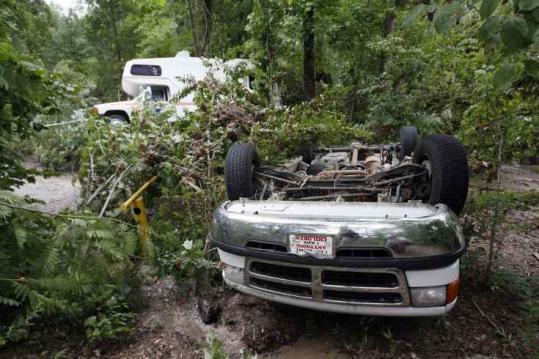
Nineteen people are known dead and at least one is still missing from a flash flood that hit a remote Arkansas campground last week. The Missouri river flooded in the middle of the night, meaning that many of the campers did not get word of the flood warnings until it was too late. Reports indicate there were 4 feet of water at the campsite at 2 AM and more than 23 feet by 5 AM. Bodies have been found as far as 8 miles away. The reason no one is absolutely certain how many are missing is that no one is absolutely certain who was camping there when the floods came, and many folks are still on camping trips and can't be reached.
Today, about twenty members of families of the dead and missing were brought to the campsite to see for themselves where this happened, and to look through the debris for personal items belonging to their loved ones. The damage is horrific. The water literally peeled up paved roads and sent campers floating down the river. Everything that was in its path and couldn't move out of the way is moved or destroyed.
I have always found flash floods
 difficult to wrap my mind around. I grew up in a hilly part of New England where the nearest rivers flooded, but didn't come anywhere near my house. When flooding was really bad the river behind my uncle's house would swell through his backyard and into his basement, and local roads would close. Flash floods, however, were not something I was familiar with. The terrain where I lived was not conducive to large amounts of water pouring into the rivers and streams all at once, causing the water to rise by feet at a time. If you went to bed dry, you would wake up dry -- that's how the world worked.
I think even to those of us who live (as I do now) where flash flooding does happen, we still generally believe that to be true. Floods happen, sure. But they come with warning and time to get away. Flooding that comes fast and furious is the stuff of broken levees, not of campgrounds on hillsides. In our connected world, we expect that, with the exception of earthquakes, natural disasters have some warning
 . If bad stuff is coming, we will know.
Nineteen people, including at least 6 children, went camping last week, one presumes for fun, and are not coming home. They were in their campers or trailers or tents, and the water came faster than they could run. No one went camping last week thinking they were going to die. Even the most nervous among us think the dangers of camping involve bears and wolves, or maybe the bogey man hiding in the bushes. If we imagined that you could drown in your sleep while camping, no one would ever go. This isn't supposed to happen. It's incomprehensible.
image: Reuters
Sunday, June 6, 2010
SBNR After a Trauma

CNN.com has an article today about people who consider themselves "Spiritual But Not Religious," also known as SBNR
 . According to this piece, over 70% of people between the ages of 18 and 29 consider themselves to be more spiritual than religious. This has various organized religious institutions worried for reasons ranging from the practical -- people who are SBNR don't join organized religious institutions -- to the moral -- some are concerned that if all that matters is your personal relationship with God, you have no reason to be altruistic.
 I have a different concern, or at least a question: What happens to people who are SBNR when they are exposed to traumatic incidents? Make no mistake about it -- early crisis response has everything to do with religion. While we definitely don't push any particular religion in CISM practice, religion can be an important topic. One of the common reactions people have to traumatic stress is to experience a crisis of faith. When something awful happens, they wonder how God could let it happen. On the other hand, some people find the opposite -- that their faith helps them through a difficult time.
So what happens if somebody doesn't have religious beliefs at all? On the one hand, they don't experience a crisis of faith, so they get to avoid that sense of disequilibrium. They had no expectations that God would prevent bad things from happening in the first place, so it doesn't throw them off, at least in that way, when something happens. At the same time, they don't have the comfort of being able to turn to their faith in a crisis, believing (or knowing) that God will take care of them.
There is another important role that religion plays in recovering from a traumatic event, however. People who have experienced a critical incident need a lot of support. Isolation is a serious risk factor for mental health problems and for suicide. People need to be part of a community. Religious congregations, for many people, provide that community. In fact, when we train CISM responders to know the difference between typical reactions to serious events and those that are possible warning signs of significant problems, cessation of religious activity is on the latter list, because it represents people withdrawing from their support system.
So what about these SBNR folks? What happens to them following a traumatic incident? Obviously, there's no one answer to that. What I will say, though, is that religion is not actually the key issue here, nor is spirituality. What is key is community. So, if people who consider themselves SBNR are part of a community -- whether it is other SBNR people, or a softball team or a community center, they get many of the same benefits that someone who is active in their church gets after an incident. If, on the other hand, being SBNR means that they are spending less time with and have less connection to other people, they will have one less resource to help them when something bad happens.
I don't think you need religion, necessarily, to recover from trauma. I also don't think you need religion to be altruistic. It just so happens that organized religion comes with a sense of community, which promotes both healing and altruism. As long as you can get that community some other way, whether you are part of an organized religious group or not is truly a matter of personal faith, not a practical necessity.
Saturday, May 29, 2010
Chicago Gynecologist Charged With Rape: The Second Trauma of Not Being Believed

In August, 2002, a Chicago woman who was 8 months pregnant reported that her gynecologist had raped her. Forensic evidence, including a rape kit, was gathered, but no comparison sample was ever taken from the doctor. This wasn't the first allegation of sexual assault against this doctor nor, as it turns out, would it be the last. His license was suspended for several months last year after four women made allegations. On Thursday, the doctor was arrested in the 2002 case, almost 8 years after it happened, but less than two weeks after his DNA was finally tested against the rape kit.
Now, a few disclaimers. I don't know the alleged victim or the alleged perpetrator in this case, and obviously I don't know what happened that day in 2002. Everyone is presumed innocent until proven guilty, and that holds for this case as much as for any. However, for the sake of argument, I'm going to presume that this crime occurred exactly as described and the doctor is guilty. Again, I don't know if that's true, but let's imagine it is.
When most people hear the word "rape
 " they imagine someone jumping out of the bushes or a dark alley and accosting a woman. They imagine a weapon of some kind. They imagine that the perpetrator and the victim don't know each other. In fact, however, the rapist and victim are strangers to each other in only about 1 in 4 rapes.
Rape, regardless of the circumstance or relationship, is traumatic. Rape violates the victim's sense that the world is a safe place and that they are in control of and can protect their own bodies. Rape by someone you know and trust adds the extra violation of the victim's belief that they can judge character and that they are loved and cared for by those closest to them. In this instance, there is the additional factor that the victim was pregnant. While violence against pregnant women
 is certainly a known phenomenon, most of us hold the belief that pregnant women are sacrosanct, particularly towards the end of the pregnancy. Here, a woman was raped while pregnant, not just by someone she knew but by someone she trusted to help her pregnancy be safe. Obviously, that trust was violated in the worst way.
People who have experienced or been exposed to trauma often experience a sense of unreality, both during and after the incident. It's very common to hear people say, "This can't be happening" or "It isn't true." What they are actually saying, though, is that the fact that it is true is too much for them to bear. They can't process it. The only thing that helps that is time spent living with the notion that it did happen, and opportunities to process what that means for them. But in this case, as in too many cases of sexual assault, the people who were supposed to help this woman either didn't believe her or didn't care enough to follow up, or maybe they had some other motive.
Whether the victim was actually told this didn't happen, she certainly got the message that it didn't matter. That is an especially difficult message to receive, because it directly interferes with processing the original incident and coming to terms with it. People already worry that they are crazy for how upset they are and how a critical incident affects them. If they're told it didn't happen, while they still know it did they have entered another phase of the incident and their own disbelief -- not only was this woman raped, and she felt it couldn't be happening, she wasn't believed, which again must have felt unreal. If she was told it didn't matter, that just reinforced how crazy she was already feeling.
Reading about this case, I was reminded of an exam I had during my own pregnancy with my son. My doctor, who is male, and his physician's assistant, who is female, entered the room. I made some wise-crack about the PA being my bodyguard, and my doctor said very seriously, "She's not here to protect you, she's here to protect me." In fact, she was there to protect us both, and to attest that nothing inappropriate happened during the exam. I can only vaguely imagine what it would be like to be assaulted under those circumstances. I can't begin to fathom what it would do to me, after that, to not be believed.
Photo copyright istockphoto/jenjen42
Monday, May 24, 2010
Verdict in Newark Schoolyard Murders

The first of six defendants was convicted today in the murder of three young adults in Newark, New Jersey
 three years ago and the attempted murder of a fourth. The dead, Iofemi Hightower, 20; Terrance Aeriel, 18; and Dashon Harvey, 20; and the survivor, Natasha Aeriel, 19, were all students or soon-to-be-students at Delaware State University, were hanging out on a Newark school playground when they were attacked with guns and machetes. At least one of the female victims was sexually assaulted.
These murders are widely referred to as the "Newark Schoolyard Murders." They got a fair amount of attention when they happened, and the Associated Press says they
jolted New Jersey's largest city into trying to fix its crime problem.I find this an interesting phenomenon. Clearly this is not the only homicide Newark has ever seen. There were 106 homicides in Newark the year that these killings took place. What made these stand out?
While there is plenty that is fairly typical about these murders, they also have particular aspects that propel them to the top of the front page. First of all, while people in Newark might have come to expect homicides by the time these occurred in August of 2007, there were some caveats. Generally speaking, there was one victim at a time, killed by one or two perpetrators. There was gang violence, but it usually killed other gang members. The number of murders involving unknown assailants and random violence was still a tiny percentage. In this instance, the murders happened in a low crime part of town, relatively speaking, and the victims were college students, not gang bangers. The motive appears to have been initiating a new gang member, with robbery as an afterthought. In short, these murders violated all of the basic worldviews that allow people to think of violence as something that happens to other people. If these kids could be killed, anyone could.
I think that the factor that most tipped the scales in favor of massive publicity, however, was that the killings took place in a schoolyard. When you read the term "schoolyard murders," your first thought is probably about school children being killed, perhaps by other students. We as a society are obsessed with school violence
 despite lots of evidence that school is one of the safest places for children in this country. Sending our kids to school takes a leap of faith, because we as parents can't watch over them, so murders in schools are a big deal. In this instance, even though it was nighttime, summer, and neither the victims nor the killers were students at the school, the simple use of the term "schoolyard murders" triggers a visceral response, and we want to learn more.
Certainly these young people did not deserve to die like this. No one does. And to the extent that this event was a catalyst for change, that's all to the good. It's important to remember, though, that 103 other people were murdered in Newark that year. Not all of them were minding their own business, not all were college students, not all happened to have been killed on a school playground. All 106 murder victims were human beings who had people who cared about them. As the coverage of this and the remaining trials hits the news, let's take a moment to remember them, too.
Tuesday, March 2, 2010
The End of the Search for Chelsea King

Chelsea King will not be coming home from the jog she went on after school last Thursday. Her body was found today in a shallow grave in Rancho Bernardo Community Park in San Diego where she went for her run. A registered sex offender is under arrest, charged with her murder and linked to an assault on another jogger in the same park in December.
When things like this happen, you often hear people remark, "I just can't imagine what her parents must be going through." This is undoubtedly the case. Unless you've experienced something similar, it is unlikely that anything in your life is even vaguely related to the emotions that this family is experiencing right now. When we try to imagine what it would be like, we put ourselves directly into the worst of it -- knowing that your daughter has been raped and murdered. But of course the family does not receive the news this way, and that is part of why we really can't imagine what it's like.
When Chelsea was later than usual coming home from her run, I imagine there was some stretch of time when no one noticed. A minute or two late wouldn't get anyone's attention. As time went on, and her family noticed she was late, the decision that something might be wrong probably came on gradually. After all, if three minutes late isn't a big deal, is four? What about five? When do you decide it's a big deal? Not worrying turns to worrying slowly, and there is an in-between time when folks are both worried and telling themselves they shouldn't be.
This same pattern repeats itself over and over. There's worrying while knowing it's most likely she's fine, followed by knowing that she probably isn't fine (and the in-between time in the middle of those). The hope that she's just injured somewhere fades into the fear that she's not, which fades into the knowledge that there's been an arrest but she might be alive, which fades into the realization that she probably isn't, which fades into the certainty.
One of the most common things people say after the traumatic death of a loved one is, "this doesn't feel real" or "this can't be true." Part of this is because the sudden death of someone we care about is not on our mental menu for things that can happen on a normal day, so it seems like it can't possibly happen. The other part, however, is that, at least in situations like this one, there have been so many transitions in the understanding of what is going on. It's hardly surprising that, when it's over, it still feels like it's in that in-between place.
Chelsea King is not coming home. Her parents know that now. One can hardly blame them, however, if they have fleeting moments when their minds refuse to accept delivery on that particularly gruesome message.
Tuesday, February 16, 2010
Fear of Flying

Hundreds if not thousands of times a day, we make decisions that are based on the presumption that the other people around us are not crazy, hostile or violent. From crossing the street in front of stopped traffic to sitting down in a crowded restaurant, we, by our actions, are testifying to our general faith that no one is randomly going to try to harm us.
There is perhaps no context where that faith is more evident than on a commercial airplane. We voluntarily confine ourselves to a small, crowded space, operated thousands of feet in the air by someone else, where if something goes wrong we really don't have a whole lot of recourse. There is no place to run, so the person sitting next to us had better be reasonably friendly, or at least not scary, or the next few hours are going to be awful.
Two stories in the news this week have attested to this very issue. The first concerned director Kevin Smith, who was removed from a Southwest Airlines flight after airline personnel decided he was too large to fit safely and comfortably into a coach seat. I have no idea whether Kevin Smith can actually fit into a coach seat (although I guarantee he can't fit comfortably -- no one fits comfortably into a coach airline seat), but this has brought into focus an airline policy that exists for two reasons. The first and more official is that packing people too tightly is a safety hazard in the event of an emergency. The second, less official, but very real one is that the person in the next seat over does not want their space infringed by a heavy passenger next to them. This is one of a number of policies designed by the airlines to try to prevent the person next to you from making your flight miserable. The controversy comes when that policy is enforced to benefit one person to the complete detriment of another.
There are situations, however, that are much more obvious, which brings us to the second news story this week. On Monday on an Air Canada flight, former Massachusetts Governor Mitt Romney asked the passenger sitting in front of his wife to raise his seat back. The other passenger responded by trying to hit Romney. He was subsequently removed from the flight, which hadn't yet taken off.
Most of us who fly have hopes about the people sitting near us. We hope they won't smell bad or talk too loud or, if we are on the aisle, have a weak bladder. We hope they won't have offensive political views which they share loudly or use lots of profanity in front of our children, and a lot of people hope they won't be extremely large.
Our expectations are different than our hopes. While we know we may get a seat mate of size, we absolutely expect that they will not respond to civil requests with violence. We expect it so clearly that we don't even know we expect it, because we never think about it until that expectation is violated. In the rare instance where someone is hostile enough to try to hurt someone for asking them to put up their seat, it has to be a little harder for the victim to get on the next plane. As they board, they are looking at their fellow passengers with a new and more distasteful eye, hoping that whoever they get stuck sitting with not only bathed this morning, but isn't out to get them. That doesn't make for a relaxing flight.
Sunday, February 14, 2010
The Alabama Shootings

On Friday, a faculty meeting at the biology department at the University of Alabama ended in gunfire. When it was all over, three faculty members were dead and two more plus a staff assistant were wounded. Another professor was under arrest. Although no official theory of motive has been issued, the alleged shooter was embroiled in a particularly messy battle of the denial of her tenure.
We all carry with us an inherent understanding of where danger lurks and where it doesn't, and of which jobs are inherently dangerous and which are not. If you are a police officer, for example, you have probably considered the possibility that you will be shot at in the course of your work. Convenience store clerks and even toll takers consider security. No one thinks of "professor of biology" as a dangerous profession, and most university faculty members I know consider the greatest risk at a faculty meeting to be dying of boredom. This just isn't supposed to happen.
It is unfortunate but true that, when something like this does happen, we also have expectations for how the story will unfold. The shooter, in our minds. is a white, middle-aged male with job issues. He is either dead, having killed himself after the shootings, or seriously wounded either by himself or the police. Coworkers and friends are interviewed and they either tell us that the suspect seemed perfectly normal or that he was quirky and kept to himself, but they never imagined something like this could happen. Further digging will turn up some kind of troubled past that could explain this behavior -- problems with mental illness, for example, or a childhood of abuse. The suspect, if alive, pleads insanity but probably isn't found to be insane because it will turn out that he planned this for a while, showing that he was somewhat in touch with reality. That's how these stories go.
This particular story, however, violates these expectations, plus some other ones, in some pretty significant ways. The first issue is that the alleged shooter is female. This is fairly unusual statistically and certainly violates our mental image. She did have job problems, she is white and she is middle aged, but the fact that she is a woman is sufficiently surprising that early bulletins about the shooting did not say, "a suspect is in custody," as you would expect, but rather, "a female suspect is in custody." The second issue is that not only is she alive but she is not injured. As you would expect, coworkers and friends are saying they had no inkling that this could happen. They say she was odd, but aren't all brilliant scientists?
When we dig into her past, things get weird. It turns out that the suspect shot and killed her brother in 1986 in an incident that was ruled an accident even though local police said it happened during an argument. She was also questioned briefly when she was in graduate school about a mail bomb that was sent to another biologist. She was cleared. It speaks to the power of our expectations that, despite this past, at least one news organization ran the headline, "Alabama Professor Showed No Hint of Violence."
This brings us to another belief we generally hold, which is that, at least in some lines of work (and professor of biology is one of them), the bad guys have been weeded out. We know that someone could "snap" without warning. We know that someone could be seriously disturbed. But I doubt that any of us think that it is even remotely possible that the quirky person in the next cubicle has already killed someone and not been jailed. This is not one of the questions you ask people at the water cooler, because it never crosses our mind that it is even a possibility.
Whenever something traumatic happens, it messes with our understanding of how the world works. That much is a given. This incident certainly does that for the victims and witnesses, who will have a hard time trusting colleagues again. But it also, to a lesser extent, does it for the rest of us. All of us know someone who is a little odd and we don't think much of it. If they were a danger, we think, they'd have already been put away. Now we're all looking at that person and wondering if that's true.
Friday, January 22, 2010
The Death of Montana Lance

Montana Lance died yesterday. He apparently hung himself in the nurse's bathroom of his school in The Colony, Texas. A staff member found him and emergency personnel responded, but he was pronounced dead at the hospital. His school was Stewart's Creek Elementary School. Montana Lance was 9 years old.
We all have somewhere in our minds, whether the front or the back, the knowledge that people kill themselves. We probably try not to think about anyone we know completing suicide, and certainly not our offspring. But even though we know that this is something that can happen, I doubt that any of us, when we imagine a person who would even attempt suicide, imagine a 9 year-old child. The result is that this story seems at one and the same time truly horrific and truly surreal.
That surreal feeling is reflected in the comments readers have been leaving on news stories about this tragedy. A blog post from the Dallas Morning News website has numerous comments from people who flatly refuse to believe that this was a suicide. They say that no problem this child could possibly experience at this young age could lead him to kill himself. Implicitly, they are saying what we all want to be true, which is that we don't want the world to be such that a child kills himself.
The fact is, while suicide in pre-teen children is not nearly as common as in older children, it does happen. The rate of suicide among children under 12 is 0.8 per 100,000, compared to a rate of 7.7 per 100,000 for children aged 15-19. The reported rate of suicide for children under 12 has doubled since 1979. However, it is not clear how much of this represents an actual increase and how much represents people's willingness to acknowledge that a death is a suicide and to report it as such.
At 9, children have a limited understanding of death. Many have some grasp of the idea that it is final and irreversable, but others do not. They also do not fully grasp the consequences of their actions and often have difficulty thinking a difficult situation all the way through. What this means is that if a young child contemplates suicide and, as some do, "rehearses" it, he may end up dying when that was not actually his intent.
We all want to believe that the world is kind to children. We do not know, and probably never will know, enough about Montana Lance to know in what way the world was cruel to him. It seems likely, though, that there is a backstory to this news -- there usually is. And without knowing that backstory, it really isn't responsible to say that he cannot have completed suicide. It seems, from all evidence, that he did.
As an educator, I have heard children as young as 7 threaten to kill themselves. Blessedly none of them has made a serious attempt, and we've always been able to get appropriate help for them. The staff at Stewart's Creek was not so lucky, and I feel for the person who discovered Montana in that bathroom. That is a sight they will never forget and will take a long time getting over.
Wednesday, January 20, 2010
California's Apocalyptic Weather

Yesterday afternoon, a headline appeared on Google News that read, "Parts of LA Under Tornado Warning." This did not particularly grab my attention, so I was surprised when, a few minutes later, a list of the most popular stories also included this one. What, I wondered, could possibly be so interesting about a tornado warning in Louisiana? Then I looked more closely at the sources for the various articles and realized that, in this case, LA was not the postal abbreviation for the state of Louisiana, but the acronym for Los Angeles.
Context is everything. I read the headline as being about Louisiana simply because it was much more plausible. Louisiana has tornadoes. Southern California has earthquakes and wildfires. That's how the world works. If I was thrown for a loop by yesterday's weather in Los Angeles, I can only imagine what Angelenos themselves are thinking. Today is bringing another storm and mudslides with attendant evacuations.
Storms like this are never fun, no matter where you are or how often they come around. But if you live in an area that gets them a lot, tornado warnings and the like become a part of life. Even here in southeast Michigan, where we have at most three tornado warnings a year, school children drill for them and my own kids know exactly where the "safe room" in our house is. We are used to severe thunderstorms and flooded basements in the spring and summer, and bitter cold and snow in the winter. That's how the world works.
A tornado in Los Angeles, on the other hand, feels about as likely as a major earthquake in Michigan -- it could happen, but nobody thinks it will. After the Eureka earthquake I wrote about how whether an earthquake is "big" depends a lot on your previous experience with earthquakes (and of course, little did I know that I'd soon be blogging about another big, much more devastating one). Whether or not a tornado warning feels particularly scary or traumatic, similarly, has a lot to do with whether you have them all the time.
A kid in Los Angeles isn't as likely to know where the safe room is or to have practiced for severe weather in school. On the other hand, my children haven't a clue what to do in an earthquake and would be terrified by even a modest tremblor. So, in addition to being more and less accustomed to certain things, we also are more and less prepared for them. Preparation gives a sense of safety and lessens the traumatic impact of a crisis -- it's much more scary to have a tornado nearby if you first have to figure out what to do and only then can take cover.
We all have expectations for how the world works. The more those expectations are violated, and the less we are prepared, the more traumatizing an incident is going to be. So if it's all the same to Mother Nature, let's keep the earthquakes in Los Angeles and the tornadoes in Michigan. That's the way the world works.
Friday, January 8, 2010
Does the ABB Shooting Make You Look at Your Coworkers Funny?

An employee turned up at the ABB transformer manufacturing plant in St. Louis yesterday armed with at least four guns and a fanny pack full of ammunition. He opened fire in the parking lot and continued into the plant. He killed three coworkers, injured five others, two of them critically, before he shot and killed himself.
There are two aspects of this case that are different than what we've come to expect from workplace shootings. The first is that we don't really know why he did it. He was suing the company over pension fees, but that was old news. While the trial started recently, the suit was filed more than 3 years ago, and it was a class action lawsuit, meaning that there were plenty of other people involved in the same dispute.
The second unusual fact is that this was not a former employee, but a current one. We are accustomed, when we hear about these things, to hearing about how the gunman was a disgruntled former employee. We read that he was recently fired, or he left a long time ago and blamed the company for something. Or he was never an employee at all but had a dispute with someone who worked there. Not this time. This guy showed up for work armed to the teeth and killed the people he worked with.
Certainly no one (except, perhaps, police officers) expects to be shot at while at work. However, most of can think of people more likely to shoot up our workplace than others. If we let ourselves imagine the worst, we think of the person who was fired or left "under a cloud." We think of the angry client who cussed us out the last time we saw them, or the evil ex-spouse of a coworker. Most of us do not think of the person in the next cubicle, or the person down the assembly line from us. For the most part, we may not like our coworkers, but we don't think of them causing us harm.
That is what makes this shooting particularly disturbing. If no one knew this guy was angry or dangerous and he opened fire at his job, what does that mean about the people we work with? This messes with our understanding of when and with whom we are safe. This is not the way things are "supposed" to work. Honestly, I still can't imagine any of my coworkers doing something like this. But I'd be lying if I said today I'm not just a little concerned that maybe I'm fooling myself about that.
Monday, January 4, 2010
Boy, 9, Stabbed in his Uncle's Home, So Why Didn't You Hear About It?

Anthony Maldonado, a 9 year-old from New Jersey, was visiting his uncle in Manhattan over the holidays. In the wee hours of Saturday morning, he was playing video games with three other people when two of them decided to go get something to eat. This left Anthony alone with the 25 year-old son of his uncle's partner. Just after 3:30, he staggered to his uncle's room and collapsed, bleeding from multiple stab wounds. He died later that morning.
We all have a basic understanding of what we believe to be the threats "out there" to children. Children are killed in car accidents. They are killed by predators. They are killed in the crossfire of disputes between adults. Once in a great while, they are killed by family members as part of a family annihilation murder. They are killed in mass shootings.
We tend to operate under the assumption, however, that children are not murdered by adults who are not predators, are not trying to wipe out the family, and are not shooting at random. That is, kids aren't targeted for things like drug disputes, love triangles and business deals -- the kinds of situations that get adults killed -- nor are they generally targeted for robberies and muggings. We know that children die, and that's bad as it is, but we assume that young children don't die because someone, put simply, is gunning for them. That explains the fact that, in New York City, about two percent of murder victims last year were under 10. (Kudos to the New York Times for reporting this statistic in its coverage today. Context is important!!)
So what happened to Anthony Maldonado? It seems that the man he was left alone with suffers from schizophrenia and has a history of violence. He was released from prison last summer. As recently as Christmas, he told his mother he wanted to kill someone. His statement to police about the stabbing was, from published reports, fairly incomprehensible. He said that Anthony provoked him, but it's not clear how.
There are plenty of people we can point the finger at here, from the justice system to the parole system to his mother to the uncle to Anthony's mother. None of that will bring this young man back. No one should be unsafe with family. It offends our sense of order in the universe.
This story has all the makings of front page news. You would at least expect to see it picked up as a side story in the national press. We have a dead child, killed in an incident that is completely out of the ordinary. It ought to get coverage. But if you do a Google News search for "Anthony Maldonado" you find lots of stuff in the New York and New Jersey press, and basically nothing anywhere else. Even in the New York Times, this story ran on page 22 in the local news section.
Why didn't Anthony Maldonado get our attention? My guess, and that is all that it is, is that there were two factors. First, Anthony's family is Latino and speaks Spanish. While that shouldn't matter, you need only look at the coverage of the crime to know that it does -- both the Times and the New York Daily News, for example, felt it was necessary to specifically state that his mother's comments about the crime were made in Spanish. Second, Anthony died north of 123rd Street in Manhattan, in a housing project. Somehow, our society believes that deaths in these neighborhoods and projects are less gut-wrenching than the same things happening elsewhere.
I don't know which stories should get our attention or tug at our heartstrings. I don't make decisions about what page stories run in the paper or how far down they are in the news cast, and I'm glad I don't have to. I do suspect, however, that if Anthony Maldonado had an Anglo name and was murdered at 86th and Park Avenue, we'd probably have heard a lot more about him. That's a tragedy all its own.
Wednesday, December 23, 2009
Reality Check: Hostages Taken at Virginia Post Office

A man in a wheelchair is, as I write this, holding at least 5 people hostage in the Wytheville, Virginia Post Office. We know he has a gun, and he has what he claims is 5 pounds of C-4 explosive strapped to his chest. The only demand he has made thus far, at least as far as police have reported, is for pizza.
This story especially caught my eye because I have been joking around all afternoon, giving people my latest "hot tip" -- on December 23, do not attempt to mail a package at the Inman Square Post Office in Cambridge, Massachusetts. As you might guess, I myself attempted this feat this morning. The post office in question is very small, and it was very busy this morning, as were, probably, most post offices in the United States, including the one in Wytheville.
Wytheville has a population of just 8,500 people. This is not a bustling metropolis, nor is it a place anyone would pick as a high profile terrorist target. I bring this up, because most of us, rightly or wrongly, have an idea in the back of our minds that, because terrorists with major government agendas tend to pick very public, large places to attack, that no one ever attacks small towns.
This is, if you think about it, obviously false. While it may be true that people with grandiose agendas pick places like the World Trade Center, the Oklahoma City Federal Building, Fort Hood, or even the Holocaust Museum, there are numerous examples of people with smaller agendas, or just pure mental illness and no agenda at all, who strike in much more random places. Those places are often small.
I often write about how trauma affects us, even from a distance, because we can make a personal connection to something about the event. Certain types of incidents, locations, motives, or any number of factors that can make us identify just that little bit more it takes to go from thinking an event is horrible to really taking it personally. For me, today, it is knowing that I mailed a package in a crowded post office today, and knowing that it is just random chance that there wasn't a gunman in a wheelchair with explosives coming after me.
Sunday, November 29, 2009
Man Traveling with Family Dies at the Grand Canyon

A man fell more than 200 feet from the south rim of the Grand Canyon on Saturday and died. His name has not been released pending notification of family members, and it is not clear how this happened. Some of his family members, however, already know. He was visiting the park with his son and daughter-in-law and "other extended family."
If we assume this man was not pushed, there are two possible scenarios, both truly awful to contemplate. The first is that the victim was either looking out over the edge or hiking when he fell, in which case he was almost certainly with members of his family who saw him die. The second is that he spent the holiday weekend with his family at the park, and then went off by himself and jumped. Obviously this is a tragedy either way, but it seems to be even more of a tragedy because his family was there in the park. Why is that? Why is it worse to have a loved one die while you are traveling with him than while he's off with some tour group?
Having someone die before your eyes has a particular impact. Our naive but deep-seated belief is that we have control over what we are close to, and particularly what we can see. When we see someone die, it very much shakes up this understanding of how the world works. Having this particular belief shaken, furthermore, is especially damaging because trauma makes us feel helpless as it is. It's bad enough having to deal with the notion that trauma happens and we can't control it. It's more distressing when it happens in a way that, on a visceral level, we feel like we should be able to control. Feelings of helplessness and loss of control are, as any mental health professional will tell you, warning signs of depression and red flags for suicide risk. As much as traumatic incidents always put people at risk, this sort of event may be even worse.
If this were a suicide, on the other hand, it might be even messier. Suicides leave behind a lot of guilt about what survivors could have or should have done to stop it. They leave that sense of helplessness that can make suicide contagious. If this man completed his suicide while traveling with family, however, it adds the additional sense that people have that they are responsible for one another when they are traveling together or even just engaged in an activity together. "I should have known" becomes "it was my personal responsibility to know."
There are two or three deaths by falling every year at the Grand Canyon, and most of them are accidents. In all of 2006 there were only 11 violent deaths in the entire National Park system, and only one was a suicide. Two were people being pushed over cliffs, so, at least that year, a fall from a cliff was more likely to be a murder than a suicide. Anecdotally there are many more suicide attempts by jumpers or people wanting to leap into the geysers at Yellowstone. When we imagine the final scary moments for a visitor who falls into the Grand Canyon, we tend to imagine the fall itself -- particularly if we're afraid of heights and have peered nervously over that edge. Sometimes we forget that every visitor has a family, and sometimes they're watching the tragedy first hand.
Thursday, November 26, 2009
Giving Thanks the Day After Nutty Putty Cave

At about midnight last night, John Jones, 26, died in a tiny crevice in Nutty Putty Cave in Utah. He had been stuck upside down for more than 24 hours, and rescuers had been working feverishly to get him out. At one point they did get him free, but after an equipment failure he got stuck again. After hours and hours of talking to him and reporting that he was in good spirits, rescuers noted that he was not responding. He left behind his wife, who is pregnant, a young daughter, his parents and six siblings.
Today is Thanksgiving. I'm sure it feels very different for the Jones family, as well as for the rescue workers. The obvious impulse, especially for the Jones family, must have been to cancel their Thanksgiving dinner. How can anyone concentrate on turkey at a time like this?
As much as we all understand that impulse, I'm hoping that isn't what happened. When a trauma occurs, it feels like nothing is normal in the entire world. The mundane tasks of life appear to be completely irrelevant. The world, it seems, ought to stop turning. But the world doesn't stop turning, and acting like it has actually prolongs that feeling of unreality. At times of trauma, people need exactly what they don't feel like giving or can't give themselves -- normalcy.
What I hope happened is that the neighbors, the church, or whomever else is in the Jones' lives reached out to them today. No, they couldn't necessarily face making a turkey and all the trimmings, but they still need to eat. What's more, Thanksgiving is always going to have a negative association for this family from now on. Skipping Thanksgiving entirely this year would cement that feeling even more. And it would be lonely. At a time when the world seems to be coming to an end, these people need friends to reach out and tell them they're going to be OK.
The rescue workers are going through something else right now. Not only have they experienced someone dying literally before their eyes, but someone has died while they were a hair's breadth from saving him. Their deeply held belief that they are good at what they do and that they make a positive difference with their work is shaken. We on the outside know they did all they can, but it still feels awful. And so I'm guessing there were some quiet tables this Thanksgiving, as these workers tried to process what happened and weren't quite ready to join in the revelry.
The Jones family issued a very lovely and moving statement this afternoon. They said, in part,
We would like to express our heartfelt appreciation and gratitude to the brave, dedicated, and selfless men and women – many of whom were volunteers – who we know did all they could to get John out. We are told nearly one hundred personnel – including sheriffs, firemen, paramedics, cavers, and other rescue workers – were involved with the search and rescue operation, and we are deeply thankful for the compassion and care they showed John and our family – even to the point of singing John primary songs to help get him through the night.Even in their own darkest hour, the family gave the rescuers a little of what they need.
No trauma is ever "good," but sometimes it teaches an important lesson. When the world stops turning, everyone involved needs to reach out to and support each other, and hopefully we all remember that we have a reason to give thanks.
Wednesday, November 18, 2009
Missouri Incest Case Raises Questions for All of Us

In the last week, six members of a single family in Independence, Missouri have been arrested on charges based on absolutely horrifying allegations of child molestation, incest, and abuse. The allegations come from adult children in the family, and involves years and years of abuse, child pregnancy, forced abortion, and possibly murder. The accused are a father, his four sons, and his brother. I would describe my own reaction to this case as revulsion.
As with the Shaniya Davis case, these allegations turn our ideas of how parents and families are supposed to work on their heads. We don't fear for our own safety or the safety of our children, so much as we are repulsed by what a parent whose job it is to protect a child is accused of doing to that child. Our reaction is not to the bogey-man who endangers our kids, but more to a sense that the world has gone crazy.
This case adds another layer, however, that has taken me a week of reading the coverage to put my finger on. Whenever someone does something horrible to someone else, we have to face the notion that there are people out there who do awful things. But in this case, there wasn't just one bad guy, there were, allegedly, six. While we can imagine that there are six people with these disgusting proclivities out there in the world, furthermore, these six are related to each other. That means that they did not form a group around their criminal activity, but entered into that activity as a group.
The natural conclusion is that people can be taught to behave this way. The two oldest accused were brothers, and either were taught this by someone else or learned it together. The four sons, it would seem, learned it from their father and uncle. These actions, which we all perceive instinctively as evil, were not mutations that happened in a single person. They were passed from one person to another. And if that is possible, then, on a gut level, we must realize that all of us have the capacity, under the right circumstances, to do that kind of evil.
This case doesn't make us fear for our children. It doesn't make us fear for our safety. What is, perhaps, the most revolting thing about this case is the possibilities it points to in ourselves.
Monday, November 16, 2009
The Unthinkable: Shaniya Davis' Body Found

The body of 5 year-old Shaniya Davis was found in Fayetteville, North Carolina this afternoon. She had been missing since Tuesday, when her mother reported she disappeared from their home. Since then, a man has been arrested for kidnapping and Shaniya's mother has been arrested for human trafficking and felony child abuse involving prostitution. In other words, her mother is accused of selling her into the sex trade.
Usually when I blog about a situation in the news that gives you a kick in the gut, the reason has to do with our own safety. We lead our lives believing the world is safe, and when something shakes that belief it upsets us. When someone is killed in a mass shooting or a plane crash, it damages our understanding of how the world works as a generally safe place. We know it could have been us, and we feel scared, or we blame, or we push it away. These are all healthy defense mechanisms.
This case is different. Almost no one will learn of little Shaniya Davis and think that it could have been them. Very few of us will worry for the safety of our own children based on what happened to her. We feel no personal connection for her particular circumstances. We don't say, "There but for the grace of God."
But make no mistake about it -- this case very much disturbs a deeply held worldview most of us share. That belief is that everyone understands that children are special and deserve our protection. We know there are people who beat their children. We even reckon, when we have to, with the notion that people sometimes kill their own children. But the idea that someone would sell their own child for sex at the age of 5 goes beyond that. It represents not just anger and disdain for human life. It represents a complete and total disregard for the value of that little girl's life by her own mother. And we don't believe that mothers are supposed to act that way.
Shaniya Davis' murder may not leave us feeling scared, but it does leave us shaken. It overwhelms our ability to understand. We have no convenient space in our minds under which to file this incident. No schema we have allows us to process it. That's what makes it traumatic -- for her father, who allowed her to go live with her mother; for the searchers who found her body; and for all of us who think of parenthood as a sacred trust. This isn't how the world is supposed to work.
Subscribe to:
Posts (Atom)
Meet the Quarterback

- Naomi Zikmund-Fisher
- is a clinical social worker, former school Principal and a Crisis Consultant for schools and community organizations. You can learn more about her at www.SchoolCrisisConsultant.com

Subscribe


 Posts
All Comments
Posts
All Comments