Showing posts with label water main break. Show all posts
Showing posts with label water main break. Show all posts
Wednesday, May 5, 2010
Who's to Say What Constitutes a Crisis?


Earlier this week, I blogged about what I referred to (with tongue somewhat in cheek) as "the great water crisis of 2010," the Massachusetts water main break that left 2 million people without safe drinking water. I also used the term "catastrophe," although I said it wasn't a very catastrophic catastrophe. A Quarterbacker calling him/herself I'm Just Musing wrote an interesting comment:
Do you really feel this was a "crisis" or a "catastrophe"? What has happened to this country when something like this causes panic and people fighting in supermarkets to get bottled water. You could drink the water if you boiled it first, that isn't so hard to do. The power going out, I can see that being a problem, although even with that, you would be surprised how well people can function without it, it's just that we would rather complain than try to make do without.I responded briefly to this reader in the comments, but I think this deserves a more thorough explanation. Is a water main break automatically a crisis, or automatically not one?
What Musing is actually arguing here is not so much that the water incident in Massachusetts isn't a crisis, but rather that it shouldn't be a crisis. People should not react strongly to this. It's a little inconvenient, but it's not a big deal. We should not be upset. But whether something should be a crisis probably isn't the major factor in whether it actually turns out to be one.
I am reminded of a scene in one of my favorite movies, The American President, in which the President (played by Michael Douglas) says, "This is not the business of the American people," and his Chief of Staff, played by Martin Sheen, responds, "With all due respect, sir, the American people have a funny way of deciding on their own what is and what is not their business." In a similar vein, it is all well and good to say we shouldn't be upset about something, but our minds have a funny way of deciding for themselves what is and what is not upsetting.
From the point of view of early crisis intervention, it is completely irrelevant whether we should or should not be upset by something. The only thing that matters is whether we are. If something impacts us so significantly that it overwhelms our usual coping skills, it is a crisis. There is no "should" about it. There is only "is."
One of the biggest mistakes overly enthusiastic responders make, particularly when they're new, is to come at a situation with all the intervention tools they've got based on what they think people are probably feeling. On the flip side, it is equally bad to fail to notice that something is a crisis for the people involved because it wouldn't both most people. Experienced teams listen carefully to how people are doing before planning their response. That doesn't mean you can't use the event to predict who might be upset and what they may be feeling, but this shouldn't prevent you from noticing people who are impacted whom you didn't expect, or from discerning that everyone's actually doing OK.
So should the water incident in Massachusetts have been a crisis for people? I think Musing makes a compelling case that it should not have been, at least for your average citizen. For your average crisis responder, however, anything big can be a crisis, and we know that, for someone out there, this probably was.

Monday, May 3, 2010
The Big Story of the Weekend (no, not that one)
This weekend someone packed a bunch of explosive and flammable material into an SUV and parked it in Times Square in New York. The investigation of this is the number one most popular story on Google News today, and I am not going to blog about it. President Obama gave the commencement speech at the University of Michigan here in Ann Arbor, and I'm not blogging about that either. Thousands of gallons of oil are threatening the Gulf Coast, and I probably will blog about that tomorrow. Massachusetts is still without drinking water, and I blogged about that yesterday. You probably knew about all of these things (perhaps not the U of M
 story, but you would if you lived here).
Early this morning, Detroit police officers responding to shots fired in a vacant apartment were ambushed. Four were wounded, one was killed. Officer Brian Huff became the first line of duty death in the Detroit Police Department
 since 2004. The national press barely covered it. The Ann Arbor press, 40 minutes from Detroit, didn't cover it at all. Neither did the Michigan-wide public radio affiliate.
Certainly a lot more people are affected by the Massachusetts water situation and the oil spill in the Gulf. The President speaking in town is pretty rare. The bomb in Times Square affected a lot of people directly, and scares a lot of people vicariously. All of these things are important.
In a typical year, there are less than 70 police officers nationwide that are killed by suspects. Michigan has had two this year, but had none last year. This isn't terribly common. It may not affect as many people as some of the other stories, but those it does impact are affected much more severely. Frequent Quarterbackers may recall that there is a whole Critical Incident Stress Management course just on responding to the 5 most serious types of incidents. Not only is death in the line of duty one of those, but there is actually an additional course just on that.
So why did Officer Huff's death and his colleagues' shootings get so little attention? I think there are two reasons. First, there was a lot of news affecting a lot of people this weekend, which meant that this story had to more actively compete for coverage. Second, Detroit has a lousy reputation for high crime. In other words, people think that this sort of thing is about par for the course in Detroit. This is especially ironic since, although Detroit's crime rate is high, its rate of line of duty deaths for police officers isn't. By any objective standard, this ought to be a big story. We just don't make those judgments by objective standards.
There is no community in this country for which a police officer shot in the line of duty feels normal. The Detroit press is covering this story closely. It's the rest of us, outside (but not all that far outside) of Detroit that are turning a blind eye. We think "those people" in "that city" expect this sort of thing. Unfortunately, we think wrong.
Sunday, May 2, 2010
Not a Drop to Drink -- We Mean It
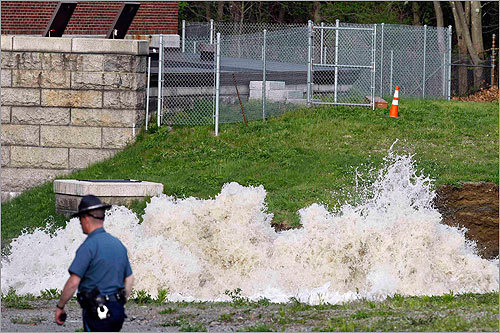
About two million people in the greater Boston area are under a boil water order for the second night tonight, after a massive water main break in Weston, about 15 miles west of the city. The vast majority of communities in the Boston area are part of the Massachusetts Water Resources Authority (MWRA), which provides water and/or sewer service through a centralized system. All communities in the MWRA east of I-95/Route 128 were affected by yesterday's break. The backup reservoirs that are being used while the break is fixed are not as large as the one that usually feeds the system, and are largely untreated, so in addition to the water being unsafe to drink, people are also being asked to minimize their water usage.
In the history of catastrophes, certainly there are many more catastrophic than this one. It is unlikely anyone will die from this water emergency, at least if they follow the boil order. At the same time, this kind of story grabs our attention, or at least it grabs my attention. As a native of the Boston area, I feel a particular connection to this situation. In a more general way, however, this is also impressive because of the sheer number of people affected. It draws our attention to how much we take for granted the phenomenon of turning on the faucet and getting drinkable water. It also serves as something of a dry run for a truly life-threatening emergency. We all figure we'd manage if something failed at our house -- we could always go to the neighbors or a hotel or the next town over. Something like this makes you realize what happens when everyone is affected at the same time.
Because this isn't a life-threatening disaster, it's easy to think that people shouldn't be too upset. That might sound logical, but the human mind isn't all that logical. There are all sorts of signals -- from the tone of the news reports to the disruption of normal routines -- that something big has happened, and it's understandable that a lot of people find themselves feeling hyped up for what seems like no good reason. Some people will even find themselves disappointed that this wasn't scarier or bigger or more important. That's understandable, too, because they're actually wishing that events would justify their gut reactions.
There is something about a situation like this one that brings people together. This is the sort of thing where people will say, "Do you remember the great water crisis of 2010?" and people will swap their stories. In that sense, there is something of the feeling of adventure to this type of incident. It is just serious enough to make us really pay attention, but not so serious that it will be too scary to reminisce about it.
The last such that fits this description for me was the Northeast Blackout of 2003. A massive succession of failures in the power grid on August 14, 2003 blacked out much of the mid-Atlantic and southern New England, as far west as Lansing, Michigan. I bring this up because not only is it the same kind of event, but, for my family, it had a similar effect. We live in a township without access to municipal water, so our water comes from a well in our backyard via a pump -- an electric pump. With no electricity, we had only the water in our pressure tank, and no idea how long we would have to make it last.
I have great stories about those couple of days. There are some about neighbors helping neighbors. Some about the crazy things that people did to get what they needed. Some that would embarrass my child if I told them publicly. That's how this sort of thing goes. When this is over, the people of Eastern Massachusetts will have good stories, too. In the meantime, they've got a major nuisance to deal with, and possibly a gut reaction to it that seems embarrassingly strong. They might be surprised to know how many of their neighbors have that reaction, too.
Subscribe to:
Posts (Atom)
Meet the Quarterback

- Naomi Zikmund-Fisher
- is a clinical social worker, former school Principal and a Crisis Consultant for schools and community organizations. You can learn more about her at www.SchoolCrisisConsultant.com

Subscribe


 Posts
All Comments
Posts
All Comments