Showing posts with label military. Show all posts
Showing posts with label military. Show all posts
Monday, July 11, 2011
PTSD Lower Among UK Vets: What Do They Know That We Don't?


Soldiers from the United States and the United Kingdom are fighting side by side in Iraq and Afghanistan. They are facing the same dangers and experiencing the same amount of death and destruction. You would expect, then, that they would be experiencing Post Traumatic Stress Disorder at about the same rate. You would be wrong.
Frequent Quarterbacker Brian (better known to some of you as my husband) sends along an article from Miller-McCune that points out that US soldiers experience PTSD at about 7.5 times the rate of UK Soldiers. There are a number of possible explanations for this, not the least of which is that the rate of PTSD in the general US population is much higher than in the UK, which suggests that our soldiers were more traumatized to begin with than theirs. UK troops also serve much shorter tours of duty than do US troops.
The article also alludes to the practice in the British military, which is common outside of the US but unheard of here, called "Third Location Decompression" (TLD). British troops, before they come home, go to Cyprus for 24-36 hours before they come home. They hang out and relax with their unit. It is mandatory.
I did a little digging about TLD, and discovered something important that I think Miller-McCune missed. During TLD, in addition to having barbecue and volleyball and even a limited amount of alcohol, soldiers get 45 minutes of psychoeducation. In other words, for 45 minutes someone explains to them that readjusting to civilian life is going to be difficult, and what they might expect. In addition, soldiers spend their TLD with the same people they served with, giving them some time away from the war zone but still with those with shared experiences to talk about what they went through.
I don't have any way of knowing whether 45 minutes of psychoeducation make all the difference in diminishing the incidence of PTSD among British troops. It seems like it's probably some combination of factors at work. But, as someone who is a big believer in early trauma intervention, introducing the idea that you might have problems and you might need help seems like an obvious positive. I compare this to the stories I've heard from US vets, who were screened for PTSD on the day they returned and told that, if they failed the screening, they couldn't go home (how honest would you be?), I have to imagine the British are getting things right. And besides, who among us couldn't benefit from a day with friends on a tropical island?


Wednesday, July 6, 2011
Policy Change: President to Send Condolences Following Suicides
President Obama announced today that he would change the long-standing practice, in existence at least since the Clinton administration, that the President does not send a letter of condolence to families of servicemen and women who die by suicide, even in a combat zone. Obama will begin to send such letters, just as he does to families of military members who are killed in action. Obama said he was making the change to emphasize that people who need mental health care in the military are not weak and should not be stigmatized.
I first wrote about this issue in November, 2009, when the drive to change the policy was relatively new. Since then, I have begun working with veterans with PTSD directly, and have a lot more first-hand knowledge of what the state of mental health care and stigma is in our armed forces. When I went back to read my thinking from 18 months ago, however, I found that it really hasn't changed much. There were pros and cons then, and there are pros and cons now. So I'm reprinting my original post, below.
I want to make it absolutely clear that I fundamentally believe that deaths by suicide are, without question, service-related and/or combat-related deaths. My ambivalence about this policy comes not out of any desire to stigmatize these families or lessen the importance of the sacrifice, but rather out of my number one priority, which is to prevent as many of these deaths as we can.
**********************************
Wednesday, November 25, 2009
Should the President Send Condolences When a Soldier Kills Himself?
 If your loved one dies while serving in the United States Military, whether they are killed in action or by accident, you will receive a letter of condolence from the President. Presidents have been doing this since Abraham Lincoln. If your loved one serves in the military and kills themselves, however, you will get many of the same things that other families get, but you will not receive a letter from the Commander in Chief. That has been true at least since the Clinton administration.
There is a push on from some military suicide survivors to change that policy. They argue that their loved ones died in service of their country, certainly as much as someone who was killed in an accident. The injuries they suffered were not visible, but they were certainly service related. Their families deserve the same consideration from the President as anyone else's, and to do so would go a long way towards reducing the shame that has for so long been associated with death by suicide, particularly in the military.
This is one of those issues which, spun the way these families and the press coverage are spinning it, seems pretty clear cut. Of course being a suicide survivor should not have stigma associated with it. These families are grieving just as much as any other, and deserve all the support we can give them.
There is a problem, however. One of the rules of thumb in responding to a suicide and memorializing people who die by suicide is that you in no way want to glorify the act of killing yourself. When you have grand ceremonies to honor their memory, you run the risk that someone else who is considering suicide will, consciously or unconsciously, view killing themselves as a means to get that kind of attention for themselves and their families. This is probably more of an issue with teenagers, who aren't fully able to appreciate the consequences of any action because their brains are not yet fully developed, but it remains an issue for others, too.
I don't know that I have a good answer for this. On the one hand, families who are survivors of military suicides should not be treated with any kind of stigma. They deserve our honor and support in a very, very difficult and complicated time. On the other hand, there is an argument to be made that even what is already done for these families -- receiving a folded flag, a 21 gun salute at the funeral -- let alone a letter from the President might look pretty appealing to a soldier considering suicide. They might think that in death they can bring honor to their family that they feel they could not bring in life.
Taking away the stigma associated with suicide in the military may well save lives by making soldiers more willing to seek help. The question is, by honoring grieving families properly, how many lives will we lose?

Wednesday, March 23, 2011
Soldiers are People Too

Yesterday morning, an F-15 Eagle Fighter
 crashed in rebel-held territory in Libya. The crew safely ejected and was rescued. Yesterday morning, NPR had some snippets from an Egyptian doctor who happened to be staying in the hotel where one of the crew members was brought. She was asked to treat him, but he pretty much only had bumps and bruises. The doctor commented that although the pilot was basically unhurt, he needed someone to sit with him because he was anxious and unsettled.
Our servicemen and women go through a lot of training, and they're very good at what they do. Pilots are trained on how to eject during a crash, and this crew clearly utilized that training. Anyone who flies in the military has considered the possibility that they're going to either be shot down or crash for some other reason. This isn't completely unforseen.
It pays to remember, however, that training for what to do and considering it ahead of time is very different than actually doing it. Servicepeople train so they can do the job, and so panic will not be added to the emotional stress of the situation. But you can't prevent people from feeling stress at all. The training these pilots had was like an emotional bullet proof vest
 -- it prevented this crash from completely overwhelming them. But people who get shot while wearing Kevlar will tell you that it still hurts, and can knock you down. It's not unreasonable for them to need a little help getting back up.
We tend to look at situations like this and think, "Well, that's their job," and, of course, it is. But even if it's your job to be in danger, there are times that are just plain scary, regardless. You might be prepared for them. You might handle them just right. But you're going to feel it when you're done. This might be a good time to remember that the men and women who serve in the military are still, first and foremost, people.

Saturday, March 19, 2011
Is There Going to Be a War?

When I was just shy of 12 years old, the British and Argentina got into a spat over the Falkland Islands
 . If you are a) British or b) Argentinian, this was probably a very big deal. For the rest of the world, not as much, to the point where, if you were not alive then you probably have no idea what I'm talking about. And while I don't remember much about the particulars, I do remember, as the tensions rose, a very serious conversation I had with my father.
We were walking through a museum -- I remember that distinctly -- and I told my father I was scared. I had heard on the news that there was this argument between these two countries, and the newscaster had said they were on the brink of war. From my point of view, there had never been a war in my lifetime, and I was really afraid.
Looking back, I suspect my father didn't know where to start. It's not that he couldn't explain the tension between Argentina and the UK. It's probably not even that he couldn't give some good predictions about what would happen between the two countries. The problem is that, in the second half of the twentieth century, as well as in the first half of the twenty-first, there is no good definition of what is and is not a war.
I bring this up, because the United States, along with several allies, has started air strikes in Libya. And even now, at the age of 40, I have a visceral reaction of, "Oh, no, I hope this doesn't become a war," followed by, "Wait, maybe it already is." In fact, last week my own 12-year-old asked me if the fight between Gaddafi's forces and the protester/rebel/opposition fighters was "at the point of becoming a war." I had no answer.
Technically speaking, the U.S. has not been at war since World War II. That was the last time the United States Congress exercised its constitutional power to declare war. Congress has authorized the use of military force since then, the President has ordered the use of force without Congressional authorization, and the U.S. has participated in military action authorized by the United Nations. In my lifetime, our troops and/or planes have fought in Vietnam, Cambodia, Bosnia, Grenada, Panama, Iraq, Kuwait, Afghanistan Somalia and Libya, and that's just right off the top of my head. But we have not been at war. At the Veterans Administration Hospital where I'm currently doing an internship, we talk about OEF/OIF vets, referring to Operation Enduring Freedom and Operation Iraqi Freedom, but not to the Iraq or Afghanistan wars.
While historians and legal scholars probably have a lot to say on the difference between declaring war and just fighting under some other authority, to a kid this is a distinction without a difference. To most young people, Vietnam looks just as war-like as World War I. Wars have an almost mythological status for kids, and probably for some adults, in which a switch is thrown and what was "fighting" becomes "The War" and everything is much, much worse.
So when a child asks whether there is going to be a war, what they are really asking is whether the conflict is going to affect their lives. Will their parents be called up. Will there be rationing. Will there be attacks on U.S. soil. Will people they know be killed. For children whose parents are in the service, the answer to "will there be a war" with Libya may well be yes. To most other kids in the United States, the answer is most likely no.
There was, in case you've forgotten, a war in the Falkland Islands in 1982. If I hadn't listened to the news, I would never have known anything about it. There was a war, but there wasn't a war the way I understood the term. In fact, I think 1982 may well have been the last time I actually had a working definition for what a war is.

Sunday, January 2, 2011
David Senft: A Foreseeable Suicide that Wasn't Foreseen

The New York Times
 ran an article today about Staff Sgt. David Senft, who died in Afghanistan in mid-November. All indications are that Senft killed himself with his roommate's firearm. This was at least his third attempt at suicide.
Senft was on his second tour of duty in Afghanistan, and had also done one tour in Iraq. It seems that everyone who knew him knew he was depressed and traumatized by his experiences in the wars, most notably responding to the site where a helicopter carrying wounded servicepeople had been shot down in Iraq. After one of his previous attempts to kill himself, Senft admitted himself to a psychiatric hospital and his deployment to Afghanistan was delayed. In Afghanistan, his superiors were concerned enough about his suicide risk that they took away his weapon.
Senft family wants to know why, if everyone knew he was in this much trouble, he was allowed to deploy to Afghanistan and why, if he was enough of a danger to himself to take away his weapon, he wasn't sent home. These are decent questions, and the army says they have three different investigations into Senft's death going on.
I have no idea who, if anyone, screwed up here. I am, as the name implies, just a Monday Morning Quarterback. However, I do know that it is much easier after the fact to look back and see what might have been done differently than it is to make predictions looking forward. Anyone -- in the military or not -- who ever comes into contact with someone who may be at risk of suicide has to make a judgment about how big the risk is. It's easy to look back now and say Senft was a big risk -- obviously, since he killed himself -- but what is obvious now was not necessarily obvious then.
Could this have been prevented? Probably. In fact, we could probably eliminate most of the suicides in the military if we disarmed all military personnel, stripped them naked and locked them in empty rooms. Everyone recognizes that we don't want to do that. But where is the line? How many other soldiers like Senft came across however he did and turned out to be OK? How do we balance the risk of a suicidal soldier with the risk of severely restricting someone who doesn't need those restrictions?
After a suicide, it's very typical to start pointing fingers about who should have or could have done something differently. In this case, the finger is being pointed at Senft's superiors. No doubt they're pointing fingers at themselves, too. Maybe they deserve it. Or maybe, this is a case where although they could have done something differently, no one at the time thought they should have. Sometimes, you just can't know.

Monday, May 31, 2010
This Memorial Day, Let's Honor the Survivors, Too

Today is Memorial Day in the United States. Most Americans spent the day doing yardwork or barbecuing or, perhaps, going to a parade. Summer is unofficially here, and women can wear white shoes without offending Miss Manners. But of course none of that (except, arguably, the parades) is the point of Memorial Day. We are supposed to be remembering those who died in the armed services.
There is one segment of the population that doesn't need much of a reminder of what Memorial Day is all about. There are thousands of families and friends across the country who have lost a loved one in the Iraq and Afghanistan wars, not to mention those who remember those who died in the first Gulf War, Vietnam, Korea and World War II, as well as a variety of smaller conflicts, attacks, and accidents. There are also an increasing number of people caring for severely disabled veterans, people who, in previous wars, would likely have died but who, through the miracle of modern medicine, are alive but living with significant lasting effects.
When someone you love goes off to war, you entertain the possibility that they might not come back. The day an officer and a chaplain knock on your door is not the first time this has ever occurred to you. In that sense, the death of a loved one in action is a little bit different than some other types of traumatic loss. At the same time, however, sudden, violent death is traumatic no matter how much you think you're prepared for its possibility.
You've probably read stories all over the news about veterans who come home with Post-Traumatic Stress Disorder
 (PTSD), and how we as a country do or don't effectively care for them. What you don't hear about is the post-traumatic stress (with or without the disorder) of those left behind by fallen soldiers, sailors, marines, airmen, etc. As mediocre a job of treating PTSD as we do for our veterans, I can't imagine we do much better for the relatives of the dead.
The men and women who gave their lives for this country deserve to be honored today, probably more than they actually are given the competition with white sales and going to the beach. At the same time, wherever they are we know they are not in pain. The same cannot be said for their parents, children, spouses and friends. We often say that those who died in war "made the ultimate sacrifice." For that we honor them. Let's take a moment, today, to honor those who have to live with that sacrifice for the rest of their lives, too.
photo copyright istockphoto/stephaniefrey
Sunday, March 14, 2010
Georgian TV Tries Out "War of the Worlds"

You've all heard the story. On October 30, 1938, CBS Radio aired an adaptation of H.G.Wells' classic "The War of the Worlds," narrated and directed by Orson Welles. It caused widespread panic, because listeners thought it was real. The first chunk of the show was in the format of news bulletins and there were no commercials, and people freaked out.
I bring this up because Imedi TV in the country of Georgia broadcast a "simulation" of a Russian invasion of Georgia last night. They used actual clips of Vladimir Putin and Dmitry Medvedev and footage shot during the Russian-Georgian conflict in 2008. They, too, used simulated "news bulletins" to further the story. They didn't announce it was fictional beforehand, and nothing at all on the screen let viewers know it wasn't real. They noted it was simulated at the end of the broadcast. People freaked out.
It's probably fairly tempting to think that there is no harm done here. I mean, yes, they scared people, but now that people know it wasn't real everything's fine, right? Wrong. Fake trauma can be truly traumatic. People can and are traumatized by the belief that they are in serious danger. If you think you're about to die and then don't, you are (at least most people would agree) better off than if you think you are going to die and then do. But you aren't necessarily OK.
People who have experienced situations where they truly believed they were in danger exhibit all the same symptoms as people who actually have been in danger. They have trouble sleeping, intrusive thoughts about the incident, difficulty concentrating, changes in appetite, irritability, and on and on. They have increased fear of whatever the situation was that scared them (e.g. getting in the car if they thought they had a close call in the car). What's more, because whatever scared them turned out to be fake, they are less likely to use the resources that help people in such situations, like talking to a friend or even writing their feelings in a journal.
So, given the history of "War of the Worlds," which I can't imagine they didn't know about, and the possible ill effects of scaring the pants off of people, why would Imedi TV do this? Of course I don't know for sure. The station is referred to as being "pro-government," which I guess is as opposed to "pro-Russian." One can imagine the government doing this intentionally to stir up fear of a Russian invasion, and cause people to look to the government to protect them. One can also imagine someone just being really stupid in making a programming decision. Whatever it was, this shouldn't have happened. It wasn't harmless.
Monday, March 8, 2010
Protesting the Fallen

The United States Supreme Court agreed today to hear an appeal of a $5 million verdict against a number of members and clergy from Westboro Baptist Church of Topeka, KS. The case stems from the church's sponsorship of demonstrations at the funerals of servicemen and -women who have been killed in Iraq or Afghanistan. Their church teaches that God is punishing the United States for tolerating homosexuality, and that these casualties, the deaths on 9/11, and a number of other things are the result of this tolerance. This particular case was brought after the group picketed the funeral of Lance Cpl. Matthew Snyder with such signs as "Thank God for Dead Soldiers." The family sued for for emotional distress and invasion of privacy and won.
I should say at the outset that I find the teachings of Westboro Baptist Church completely repugnant, and I in no way wish to appear to defend what they did. Whether or not their actions were protected by the Bill of Rights, they were incredibly offensive. I also don't want to in any way appear to say that having these people show up at your loved one's funeral is a good thing, or even a neutral thing.
What I wonder, though, is how much emotional distress this protest actually caused. I think we can probably agree it is not zero. People processing a traumatic loss find comfort in some things and difficulty in others, and this definitely caused difficulty. There is no question that the funeral would have been a better, more private, more tasteful event had the protesters not been there.
At the same time, however, this family was in a tremendous amount of emotional distress to begin with. They were angry, they were in shock, they were undoubtedly a mess. I have no doubt that the protesters completely enraged them, and I don't blame them one bit. The question is, how much did the protesters make their emotional states worse, versus how much did they simply provide a really obvious and convenient target for those emotions?
I am sorry Lance Cpl. Snyder died. I am sorry that these horrible people decided to picket his funeral -- they shouldn't have. In the end, however, Snyder would be dead whether they showed up or not. That would be awful, whether they showed up or not. And that part isn't their fault.
Thursday, December 17, 2009
Shedding Some Light on @Military_Mom's Tragic Tweets

Bryson Ross, a 2 year-old Florida boy, drowned in his family's swimming pool on Monday. His mother, Shellie Ross, is better known in the blogosphere as @Military_Mom, a mommy blogger with more than 5,400 Twitter followers who writes about her experiences parenting four children and being married to a military husband. Ross was tweeting just 1 minute before her 11 year-old called 911, and Ross performed CPR on Bryson. Thirty-four minutes after Bryson was taken to the hospital, she tweeted asking for prayers for him. Five hours later she announced his death on Twitter.
There has been a firestorm of controversy surrounding these tweets. Some are saying that Ross was too busy tweeting to watch her child, and was callous to tweet about the accident. Some are dismayed to have messages such as these delivered to their timeline when they are used to having much lighter-hearted fair from Ross. Many are asking the question, "What kind of mother tweets when her child is dying?"
I don't know Shellie Ross. I'm not a follower of hers on Twitter and I had not heard of her before this happened. But I do have an answer to that question. What kind of mother tweets when her child is dying? A blogging mother. More precisely, a blogging mother going through every parent's worst nightmare.
When trauma strikes, it is literally too big for our brains to process. We cannot assimilate the situation fully into the normal structures with which we understand the world. We have no place for this new information, and it gets stuck. Because we don't know what to do with what has happened, it is not at all uncommon for people to "revert to type" following a tragedy. That is, they suddenly and even compulsively do the things that are most comfortable for them.
I have heard stories of military wives who see a chaplain and an officer approaching their door and go take a bath before they let them in to deliver the news that their husband has died in action. I have seen people go to the kitchen and start cooking. Children in particular often shock adults by greeting horrible news with something like, "OK, can I go play now?"
When something awful happens, it can seem like the world has come to an end. Doing what is most familiar to us gives us a sense of normalcy that we desperately need in order to even begin to understand what has happened. Shellie Ross exhibited two basic, instinctive behaviors -- she did what was familiar and she asked the first people she could think of for help. Her behavior wasn't abnormal -- the situation was abnormal. So maybe we could all show a little compassion instead of rushing to judge.
Wednesday, November 25, 2009
Should the President Send Condolences When a Soldier Kills Himself?
If your loved one dies while serving in the United States Military, whether they are killed in action or by accident, you will receive a letter of condolence from the President. Presidents have been doing this since Abraham Lincoln. If your loved one serves in the military and kills themselves, however, you will get many of the same things that other families get, but you will not receive a letter from the Commander in Chief. That has been true at least since the Clinton administration.
There is a push on from some military suicide survivors to change that policy. They argue that their loved ones died in service of their country, certainly as much as someone who was killed in an accident. The injuries they suffered were not visible, but they were certainly service related. Their families deserve the same consideration from the President as anyone else's, and to do so would go a long way towards reducing the shame that has for so long been associated with death by suicide, particularly in the military.
This is one of those issues which, spun the way these families and the press coverage are spinning it, seems pretty clear cut. Of course being a suicide survivor should not have stigma associated with it. These families are grieving just as much as any other, and deserve all the support we can give them.
There is a problem, however. One of the rules of thumb in responding to a suicide and memorializing people who die by suicide is that you in no way want to glorify the act of killing yourself. When you have grand ceremonies to honor their memory, you run the risk that someone else who is considering suicide will, consciously or unconsciously, view killing themselves as a means to get that kind of attention for themselves and their families. This is probably more of an issue with teenagers, who aren't fully able to appreciate the consequences of any action because their brains are not yet fully developed, but it remains an issue for others, too.
I don't know that I have a good answer for this. On the one hand, families who are survivors of military suicides should not be treated with any kind of stigma. They deserve our honor and support in a very, very difficult and complicated time. On the other hand, there is an argument to be made that even what is already done for these families -- receiving a folded flag, a 21 gun salute at the funeral -- let alone a letter from the President might look pretty appealing to a soldier considering suicide. They might think that in death they can bring honor to their family that they feel they could not bring in life.
Taking away the stigma associated with suicide in the military may well save lives by making soldiers more willing to seek help. The question is, by honoring grieving families properly, how many lives will we lose?
Friday, November 20, 2009
Predicting PTSD Ahead of Time

The U.S. military is undertaking a large research project using its own soldiers to see if there is a way to predict who will suffer from Post Traumatic Stress Disorder. They are screening hundreds of soldiers before they deploy, including their baseline stress rate, brain scans, family histories and past history of mental illness, and will be looking to see if any factor or combination of factors can predict who is at highest risk.
This is a very new way to look at PTSD, and raises interesting issues for those of us who work in trauma response. The conventional wisdom which we learn in training is that the factors that affect whether someone will develop PTSD are mostly things that occur with the trauma. We are taught that people who are more closely and directly exposed to an incident are more likely to have PTSD. People who experience dissociation and/or depression immediately surrounding the trauma are at increased risk. In addition, the more closely held beliefs, expectations and worldviews are violated, the more likely you are to have PTSD down the line.
This experiment aims to short-circuit most of those factors. What if we could predict who is most likely to experience those predictors? What if we knew that this person is at increased risk for dissociation, and that person will react particularly strongly to the violation of their worldview? What would that mean for trauma responders? What would that mean for the people themselves?
Let's suppose, for the sake of argument, that we discover that certain people have a particular kind of activity in a particular part of their brain, and that if you have that activity you are more prone to PTSD. Do we allow those people to serve in the military? Can they be police officers or firefighters? What if it turns out that that same anomaly is associated with bravery and calm under pressure, so these people also make especially good soldiers and first responders? How will we decide?
We also have to think about how we treat those people. Traumas will always happen, even if we exclude those most at risk for PTSD from serving. If we come upon someone at increased biological risk who has, say, witnessed a murder, will they immediately be referred for further care, or can early intervention still help? Will we be doing brain scans at the scene?
I often say that I love crisis work and I hate that I love crisis work. I feel guilty that I get so much satisfaction out of helping with other people's misery -- shouldn't I be hoping they aren't miserable? If this research is successful, it's possible that the whole way we proceed with this work will change. It's hard to imagine, though, that we won't need to do it at all.
Monday, November 9, 2009
The Children of Fort Hood

As everyone knows by now, 13 people died and 30 were injured in a mass shooting at Fort Hood last Thursday. There has been a lot of focus, quite appropriately, on the people who died and on their families. There has also been some given to those who were wounded, some quite critically. And of course there has been an inordinate amount of speculation about the alleged shooter, who, reports say, is now awake and talking in the hospital.
It is impossible to predict how any individual person will be affected by Thursday's events. Some who you might expect to be very emotionally impacted will bounce back quickly, and some who seem to be on the periphery of the incident may be profoundly affected. As the CISM personnel work to triage those traumatized by the shooting -- those who lost a loved one, those who were shot, those who knew the shooter, those who witnessed the shooting, etc. -- there is one group that is probably giving them a little pause: the children.
To my knowledge there were no children present when the shooting started on Thursday. That means no children saw the scenes of violence first hand. But that in no way means that the children at Fort Hood aren't impacted, and they are going to need a lot of support. But we all know intuitively that helping children through these moments is different than helping adults, and few early crisis interventionists have any training at all in working with kids.
CNN reports that officials at Fort Hood have called in child psychologists as well as disaster management experts. That means the impact here is big -- bigger than what their town of 60,000 can handle on their own. It is a disaster, just as surely as a building collapse in a large-ish town that killed 13 and injured 30 would be, only probably worse, or at least different, for the families.
So why are the children impacted? There are numerous factors. First, these kids were on lockdown for several hours on Thursday. During that time, they did not know what was going on, where their parents were, if anyone in their family had been injured, or when they would see them again. If they looked out the window they saw what amounted to a live military operation going on outside of their schools, and for all they knew the "bad guy" was coming for them next.
Some of these children, of course, lost a parent in the shooting or have a parent who was injured. If not, they almost certainly have a neighbor or friend who was impacted. They went to school on Thursday morning believing that they were OK in school and their parents were OK at work, and came home knowing that very well might not be true at any given moment.
I've often said that trauma violates our world view. For these kids, that is doubly true. All of us need to believe that the world is generally a safe place, and this incident took away that belief from these children. But it also took away something else. It took away their visceral understanding that soldiers -- parents -- who are stateside are safe, and that danger lies in the war zone. A big part of how they can cope with having parents who put themselves in harm's way for a living is by telling themselves that the fact that they come home means they are OK. Now, 13 people who were stateside, who were home, are not coming home any more.
So what do we do for these kids? That depends, of course, on what they need. I suspect the days, weeks and months ahead will hold a lot of crayons and paper, a lot of tissues, and a lot of nightmares for some of these kids. Watching parents ship out is going to be really hard. Watching them come home is going to be surreal. So while we're honoring the dead and thanking our troops, particularly during Wednesday's Veteran's Day celebration, let's take a moment to remember their kids, and to thank them for all they give up in service to our country, too.
Saturday, November 7, 2009
Fort Hood: What Compassion Fatigue Is, and Isn't

As we all know by now, the alleged shooter in the Fort Hood massacre is a psychiatrist. There is a lot of speculation in the media right now that he suffered from "compassion fatigue," "vicarious traumatization," "secondary trauma" or "secondary PTSD." In many of these articles these terms are used interchangeably. The basic idea of all of these articles is that the shooter's treatment of people who had been traumatized caused his own traumatization. However, since virtually none of the reporters involved had ever heard of compassion fatigue before Thursday, there is a lot of oversimplification of the facts in the search for answers.
I have no first-hand information about whether this man suffered from compassion fatigue or anything else, and I (unlike both those who think he did and those who think this was religiously-motivated terrorism) am not going to speculate. We have absolutely no facts at all on which to base a diagnosis. What I do have, however, is some information about compassion fatigue that might be helpful at least in understanding what everyone is talking about.
There are two big risks that people who work with trauma victims face: burnout and compassion fatigue. Burnout is just what it sounds like, and just what it is in any line of work. It's the slow and steady deterioration of satisfaction with your job and your willingness and ability to do it well. It's what makes you not want to get up and go to work in the morning. Burnout can be associated with the stressfulness of the job, and listening to people's trauma is stressful. Among trauma interventionists, burnout manifests in not caring much about the stories you hear or the people who tell them, in not doing what you know needs to be done for them, and in quitting your job or volunteer position.
The second risk is compassion fatigue. Compassion fatigue, unlike burnout, usually comes on fast. A single story or a small set of them get to you in a serious way, and you start showing the same symptoms you would if you were exposed to a traumatic event: trouble sleeping, irritability, impaired judgment, appetite changes, nightmares, startling easily, etc. This is not the person who says, "Gee, I really don't feel like going to work today." This is the person who is afraid to get out of bed.
One of the most commonly used screening tools for burnout and compassion fatigue, as well as job satisfaction, in those who work with traumatized people, is the Professional Quality of Life Scale Compassion Satisfaction and Fatigue Subscales—Revision IV (Pro-QOL R-IV). Interestingly enough, when I went looking for a copy for reference for this post, I found it on the website for the Army Behavioral Health Provider Resiliency Training program.
Some of the questions on the Pro-QOL that relate specifically to compassion fatigue can help you understand what exactly it is:
- I jump or am startled by unexpected sounds
- I find it difficult to separate my personal life from my life as a helper
- I feel as though I am experiencing the trauma of someone I have helped
- I avoid certain activities or situations because they remind me of frightening experiences of the people I help
- As a result of my helping, I have intrusive, frightening thoughts
- I can't recall important parts of my work with trauma victims
Compassion fatigue and secondary PTSD are not synonymous. Post traumatic stress is a typical reaction of a normal person to an abnormal event. Post traumatic stress disorder is when it lasts, does not resolve, and interferes with functioning. Similarly, compassion fatigue is a normal hazard of the job. The vast majority of people who experience it get some support, back off their work for a while, and return to normal functioning.
So, could the shooter at Fort Hood have had secondary PTSD? Sure. Do we know that he did? No. And is it inevitable that someone in his position would be in that much trouble psychologically? Certainly not. Trauma is contagious, yes, but the contagion is also avoidable, given the right supports. What we don't know is whether this particular psychiatrist had those supports in place.
Quick Aside: You can now follow MMCQuarterback on Twitter!
Friday, November 6, 2009
No Easy Answers: The Why's and Wherefores of Fort Hood and Orlando

He had compassion fatigue. He was a Muslim. He had money problems. He was depressed. He was disgruntled. He didn't want to deploy. He was a terrorist. He was harassed. He faced discrimination. He hated his boss. He was turned down for unemployment. He blamed the company. He blamed the army. He should have been stopped.
Today, as America reels from the second mass shooting in as many days, the blogosphere and the traditional media are lighting up with commentary on why the shooters in the Fort Hood and Orlando killings did what they did. If you google the stories, you find headline after headline with various speculation about motive, interspersed with the occasional article referring to the motives in each shooting as a "mystery."
Human beings don't like uncertainty, as I discussed yesterday. And the media doesn't like to report anything nuanced, and certainly not "we don't know." Where's the human interest in that? So we look for answers, and sometimes the answers we come up with sound good . . . until you think about them.
The shooter at Fort Hood is a psychiatrist. He had treated many people who suffer from Post Traumatic Stress Disorder. Now there is speculation that this experience caused him to be traumatized himself, and in turn caused yesterday's shootings. No sooner had that theory hit the airwaves then we had articles arguing the opposite -- that PTSD is not contagious, and we are just making excuses.
The truth is, PTSD is indeed contagious, in a documented phenomenon called "compassion fatigue" or sometimes secondary or vicarious traumatization. People who work with the traumatized are susceptible to symptoms of trauma themselves -- this is a documented phenomenon and there are documented ways to try to prevent it. But as much as compassion fatigue is a real thing, most people who have it don't shoot people. Saying that is the cause is much too simplistic.
The shooter is also Muslim, true. And yet, most people who are Muslim don't shoot people either. And if mass shootings are caused by being Muslim, how do we account for the Orlando shooter, who certainly wasn't, or the perpetrator in the Pittsburgh gym shootings, or at Virginia Tech, or Columbine? Why is the Fort Hood shooting "terrorism" and those are horrible violent crime?
In Orlando, the shooter almost certainly was a disgruntled former employee with money problems. This is all true. But how many thousands of people fit that description, and never hurt a fly? How many hurt themselves but not others? How do you know who is who and which is which. Unfortunately, you don't.
There is a lot of commentary today suggesting that we as a country are hesitant to admit the "truth" about Fort Hood, and I think they are right. But that truth isn't that the shooter was a Muslim terrorist. That truth is that we just don't know. We may someday, or we may not. And if we don't know, we can't know it won't happen again, and that scares us.
We want to think that if we exclude certain ethnicities or nationalities or religions from our lives, we will prevent the next shooting from happening to us. We want to believe that if we know the Fort Hood shooter was a terrorist, we can protect ourselves by staying away from terrorists. But in Orlando, we discovered that that isn't true either. And that scares us more, so we pretend there's no inconsistency there, no nuance. It seems we'd rather live with our bigotry in this country than with our fear of what is random.
Thursday, November 5, 2009
Fort Hood: The Waiting is the Hardest Part

At least 12 people are dead and at least 31 injured in a shooting or shootings at Fort Hood, Texas this afternoon. One gunman, a soldier, is dead. Two others are in custody. By the time you read this -- indeed, by the time I finish writing it -- all of that information may turn out to be wrong. As the press says, this is a "breaking news story."
The shooting occurred almost two hours ago, but we still don't know what happened. Fort Hood, is on lockdown, or at least it was within the last half hour. So are the neighboring schools. Reports differ on how many gunmen there were and whether they are all accounted for. News like this, where the details are coming out piecemeal and the information is changing, are both extremely scary and also extremely hard to tear oneself away from.
This story is compelling for lots of reasons -- a lot of people are dead, the possibility of terrorism is on our minds, the dead are possibly servicemen and women who we presume to be safe before they are stateside. The fact that it's changing means that we don't want to turn off the news, because we want to know what happened and we aren't sure that we do. We have one set of facts now, and we might miss the next change if we break away. We want to understand.
The constantly changing nature of the story also adds to what is so traumatizing about an incident like this. Instead of hearing the news and reacting to it, we go through a seemingly infinite series of exposures. We hear the story, we experience the trauma or secondary trauma of it, and then new facts are announced and we experience it again.
This phenomenon was painfully obvious to me this afternoon as I drove with my daughter. When we got in the car I explained to her that there had been a shooting at a military base and a lot of people were dead, and that the news would be talking about it. At that time, the number of known dead was 7 with 20 injured, but I didn't tell her that. When the headlines came on, they announced that 12 people were dead and 31 injured, and I involuntarily winced. My daughter, on the other hand, was completely unphased. I was reacting to the new information, but for her the information hadn't really changed. I was traumatized again -- she wasn't.
Aside from that increase in the numbers, the most poignant and compelling part of this story thus far for me came in an offhand sentence in coverage by USA Today:
A spokeswoman for the City of Killeen, where the base is located, tells USA TODAY's Donna Leinwand the Army is "asking for EMTs because it's a mass casualty event."The term "mass casualty event" isn't one you hear in the newspaper a lot. If you work in emergency services or in crisis response, on the other hand, it is a term that has a lot of emotional charge. We talk about car accidents as having "multiple fatalities." Mass casualty events are huge. 9-11 was a mass casualty event, and even though this clearly has none of that scope, the seriousness of that kind of incident is invoked by using that term.
Another way to look at it is this: There are roughly 60,000 people at Fort Hood, and they have their own police, fire and ambulance service. Imagine what would have to happen in a town of 60,000 -- roughly the size of St. Cloud, Minnesota -- to completely overwhelm their ambulance service. It's bad.
This event will actually become less traumatic for everyone -- people there and people hearing about it on the news -- the minute the information stops changing. It may even feel anticlimactic. And then the real work begins.
Sunday, November 1, 2009
Keeping it Surreal: 9 Declared Dead Off California Coast

The search for 7 members of the Coast Guard and 2 Marines who went down in a collision between a plane and a helicopter off the coast of California last week has now been declared a recovery mission. The Coast Guard announced that, after 60 hours, the chances of survival were negligible. In a forgotten detail of this story, the missing boater whom the Coast Guard was searching for when their plane went down is also still missing.
Far and away the most common reaction people have when receiving news of a traumatic death is one of disbelief. I have seen people who have been notified of a loved one's death by someone who has seen the body still demand "proof." The mind can only handle so much, and refusing to believe bad news is one of the many ways we protect ourselves from the pain that sudden death of someone we care about can bring. Even once the news has "settled in" a little more, survivors report feeling like they are in a nightmare, waiting to wake up. It just doesn't seem real.
The Associated Press reports that the father of one of the missing, Marine 1st Lt. Thomas Claiborne, confirmed that his son has been "declared deceased." That very fact is surreal by itself. It's hard enough to accept that someone could be here one moment and dead the next. In this case, the divider between life and death is not a biological fact, but a decision by a superior officer. How can someone be declared dead? They either are or they aren't.
So it is no surprise and no shame that the mother of another missing sailor, Coast Guard Lt. Adam W. Bryant, is not accepting this news right now. She told the Associated Press,
Miracles do happen. Miracles every day.After all, how would she live with herself if he were found and she had given up hope? And how will she carry on knowing that he is dead? Clearly, denial is a lot easier. Acceptance will come slowly. Our hearts go out to these families. Even if they find the remains of these servicemen, healing is going to take a long, long time.
Thursday, October 22, 2009
Somer Thompson: Hearing the Unthinkable the Wrong Way
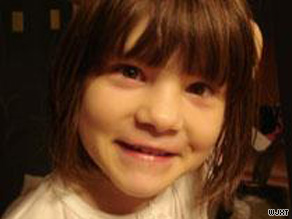
The body of 7 year-old Somer Thompson was found in a Georgia landfill yesterday. She was on her way home from school in Orange Park, Florida on Monday when she ran ahead of her friends and disappeared. The landfill where her body was found is about 55 miles north of there, and receives garbage from the Orange Park area.
As a mother, I cannot imagine anything worse than the murder of your child. It upsets what all of us perceive to be the natural order of things -- that parents outlive children, and children are protected. I imagine that Somer's mother had considered the possibility, between Monday and Wednesday, that Somer was dead. Still, I don't think anyone can truly prepare themselves to hear something like that.
The Clay County, Florida Sherriff, Rick Beseler, reflected this when he shared how hard it was to notify Somer's mother. He said,
It was the hardest phone call I've ever had to make in my life, and I hope I never have to make another one like that.
This quotation gave me a great deal of pause. First of all, I believe it comes from the heart. I'm sure that was an awful conversation to have. I'm sure it's not the only time he's had to do a death notification, but I am willing to believe it was the most difficult. What made me reread that quotation several times, however, is that he is talking about a phone call. He did a traumatic death notification by phone.
Think about the cop shows you've seen on TV. Think about how death notifications are done in the military. Someone goes to the house and rings the doorbell and sits down with the family. There are really good reasons for that. You are delivering news that will cause a traumatic stress reaction in the listener. You want to be there to assist when that happens. You want to make sure they are not alone afterwards. You want to get medical attention for them, as needed. You want to be humane. You want to make sure they understand what you are saying, and they know you are not joking. And you want, when they remember this awful moment, for them not to remember that you didn't have the decency to drive to their house.
There are people in law enforcement and the military who are specifically trained to do death notifications. In my wallet, I have an entire set of 5 credit-card sized cards with notes on how to deliver bad news. This isn't easy, and it's easy to mess it up. You can't make the truth of the situation any more palatable. But at least you can be compassionate enough not to deliver that truth over the phone.
Saturday, September 12, 2009
Terror(?) on the Potomac

Yesterday, September 11, at about 9:30 AM, CNN breathlessly reported that Coast Guard boats and a helicopter were apparently confronting a suspicious vessel in the security area of the Potomac River, near where the President was commemorating 9/11 at the Pentagon. The reports escalated -- the vessel had been fired upon. Cable news and the Internet picked up the story.
It was a training exercise.
Let the finger-pointing begin. CNN reported an interpretation of what they heard over a scanner picking up the Coast Guard radio traffic, but apparently didn't think it odd that the report of gun fire began with the radio transmission, "bang bang bang bang." They say they called the Coast Guard and were told they were not aware of anything going on on the Potomac. Meanwhile, the Coast Guard says that they never coordinate their training exercises with other agencies, and they train like this all the time.
So what went wrong? If training exercises like this one are commonplace in that area, why did this one make national news? I bet you already know part of the answer. It was September 11. And yes, that matters, and no, it's not because we're all crazy.
The date itself -- September 11 -- is a trigger for most people in this country. The various commemorations on the news heighten that. And that's not a bad thing, necessarily. But it means we are all in a space where we are much more willing to believe that terrorists will attack the US. Most days we know it's a possibility, but on September 11 it feels like a likelihood. This exercise, and what CNN heard over the scanners, was therefore much more believable, and the lack of confirmation was less troubling. It might have been a good idea if the Coast Guard had considered this and announced the exercise, or held it on another day, or at least made sure it's own people could tell the press what was going on. There are two sides to every coin, though, and CNN should probably have known that both they and their viewers were more willing to believe the worst and more prone to panic yesterday than, say, the day before.
It's interesting to consider how long it will be before we are not so triggered by September 11. I see signs that it is fading already: A few years ago I was lambasted for holding a fire drill on that date. We had one yesterday, and no one said a thing. The edge has, at least a little, been taken off. But not so much that everyone can not worry about the impact of anti-terror exercises and erroneous news reports.
Wednesday, September 9, 2009
Stephen Farrell: Survivor's Guilt, Survivor's Anger

New York Times reporter Stephen Farrell was rescued from the Taliban early this morning. He and his translator, Sultan Munadi, had been taken captive in Afghanistan four days before. The raid by British soldiers that rescued Mr. Farrell resulted in the death of both Mr. Munadi, one of the British soldiers and at least two others (news reports conflict about how many and who they were).
Most of us have heard the term "survivor's guilt." It's the guilty feeling that people have when someone else has died in an incident that could have killed them. It's the feeling of the person who called in sick to the World Trade Center on 9-11, or who skipped the exercise class at LA Fitness the night of the shootings, or who survived the accident that killed their friend. I think it's safe to say that Stephen Farrell is, at best, at high risk for feelings of survivor's guilt, both because of Mr. Munadi's death and because a soldier died trying to save Farrell's life.
There's a difficult twist to this episode as well, however. The British went in to rescue Farrell in part because he is a British citizen. His colleague, Munadi, died at least in part because the British initiated the raid, although it isn't clear who fired the shots that killed him. Certainly the British soldier died trying to resuce Farrell. This has the potential to leave some tricky mixed feelings.
On the one hand, Farrell has expressed great thankfulness for his rescue. He is glad to be alive and glad to be free. On the other hand, it has to have crossed his mind that, were it not for him, Munadi would probably not have been abducted and that, were it not for the British coming to rescue him, Munadi might still be alive.
Obviously none of that is Farrell's fault. It also doesn't mean the British military made the wrong call in going in. But it leaves Farrell feeling grateful to the same group that he is, on some level, angry at, and angry at someone who died trying to save him. We can all take a step back and say that all of this was the fault of the Taliban. Farrell probably can too. But the gut feelings following trauma are often not nearly that logical, and Farrell may not just experience survivor's guilt, he may experience survivor's anger, too.
Sunday, September 6, 2009
Who Owns Your Death?

Lance Corporal Joshua M. Bernard, 21, died in Afghanistan on August 14. An Associated Press photographer embedded with his unit captured a picture of him after he was wounded and before he was transferred to a medical facility, where he died. This week Defense Secretary Robert Gates blasted the AP for publishing the picture, against the express wishes of Bernard's family.
On Friday, my niece's high school notified parents of the death of one of her classmates. Support was offered to students and guidance offered to parents, but no information was shared about the cause of death. The local newspaper reported it was a suicide.
These two events may not seem to have much in common, but in fact they capture a very common problem in traumatic situations. What happens when the powers that be, or just some random witness, have information about a death that the family does not want to share?
There are always two sides to this argument. In the case of Lance Cpl. Bernard, the AP argues that publishing the picture helps the public understand what war is really about. It says it is,
choosing after a period of reflection to make public an image that conveys the grimness of war and the sacrifice of young men and women fighting it.Bernard's family, on the other hand, feels that the publication of the photo inflicts more pain on a family already traumatized and grieving. They prefer not to remember their son that way, and do not want others to see him that way. His father says the photo is disrespectful of his memory.
In cases of suicide, families often want to withhold the fact that their loved one killed themselves. There is a tremendous stigma in our society about suicide. Families often refuse to accept that the victim's death was, indeed, a suicide. Even if they do accept it, they fear that others will look down on them as the family, or will think ill of the dead family member who completed the suicide. It is not at all uncommon for families of those who complete suicide to hear from people trying to be "helpful" that their loved one was selfish or is going to Hell. Not surprisingly, families opt to limit the number of people who have cause to be "helpful" in this way.
On the other hand, from a high school administration point of view (and just generally from a public health point of view), it is important to talk about suicide. While no one wants to destigmatize it to the point where it is considered completely normal and acceptable, community leaders do want to get people talking about the depression and desperation that leads to suicide. The stigma surrounding suicide can prevent those who are contemplating killing themselves from getting the help they need, because they fear people's reactions if they talk about it. In a school setting, often the students know a classmate has completed a suicide, even when the administration does not acknowledge it. Not talking about it when everyone knows about it further sends the message that help is not available, and can lead to the clustering of suicides at high schools that sometimes occurs.
So, what to do? How do you weigh the educational and/or news value of a picture or a piece of information against the legitimate needs of a family in crisis? Whose needs for mitigating critical incident stress win? And whose values should we base that decision on?
We have a strong custom in this society of respecting the wishes of families of the dead. Because of this, violating those wishes provides an easy target for the natural anger that families feel after a traumatic death. I can't say that the AP made the right choice in the death of Lance Cpl. Bernard, even if I wish the family had given permission. They didn't. And I am not convinced that the picture had so much value that it should eclipse those wishes. Luckily, I don't have to make judgements like that most of the time.
As a school administrator and crisis team member, I will not disclose that a death was a suicide without family permission. But I will do two things to try to get around this. The first is that I will explain why I think it is important to share the information. Very often families are willing to hear that their disclosure may help another suicidal person, but they do not make that connection alone. School staff are also often reluctant to share this information, even if they can. We have to educate them about suicide prevention as well.
The second is, if I cannot get permission, to acknowledge when others say they heard it was a suicide. You can talk about it in the abstract even if you can't confirm. So when a child says, "I heard he killed himself" or "the paper says she took pills" I wills say, "I heard that too. If that were true, what do you think about that?" This finesses the whole question of telling when someone's death is a suicide by letting the students tell themselves. The AP could have written a story about the picture without publishing the picture, and explained that the family, who could be kept anonymous, did not give permission. This would have been a chance to talk about the impact of war on families at home, something they chose to gloss over by publishing the picture.
I think the AP, school administrators, and anyone else who has tough decisions to make about sharing or not sharing information, would do well to ask themselves what their ultimate goal is. If it's just to share information for its own sake, that takes you in a different direction than if, as in both of these cases, the aim is to educate. As the saying goes, there is more than one way to skin a cat, and there is more than one way to educate following a traumatic death.
I have chosen not to add the picture that the AP published of Lance Cpl. Bernard after his injury. I hope that the picture above is more in keeping with how the family would like this soldier remembered.
Subscribe to:
Posts (Atom)
Meet the Quarterback

- Naomi Zikmund-Fisher
- is a clinical social worker, former school Principal and a Crisis Consultant for schools and community organizations. You can learn more about her at www.SchoolCrisisConsultant.com

Subscribe


 Posts
All Comments
Posts
All Comments