Showing posts with label firefighter. Show all posts
Showing posts with label firefighter. Show all posts
Sunday, September 11, 2011
How I Spent My 9-11


I've lived in this neighborhood
For twenty-seven years
I know where to get good bagels
And exotic beers
The favorite sidewalk cafes
Where locals like to eat
But I never paid attention to
The firehouse on this street
My house is about half a mile from our main township fire station. I'm particularly glad about this given that, because of zoning regulations, our area does not have fire hydrants, it's somewhat reassuring to know that the tanker truck is right nearby. The one time we had to call an ambulance the firefighters got here really, really fast.
Last week, driving by, I noticed the station had put up its 9-11 memorial banner. It's a white banner with a red, white and blue lapel ribbon and the words, "We remember 9-11-01." My son, who is 6 and has no knowledge of the attacks, asked about it.
I explained that 10 years ago there was a terrible tragedy in New York where many firefighters were killed. All the firefighters all around the country were scared and sad, and all the people in the country were scared and sad too. The sign says that the firefighters here are remembering, because the 10th anniversary of that day is coming up.
Neighbors lit votive candles
Laid flowers at the door
Baked casseroles and homemade breads
But wished they could do more
And the guys inside were grateful
But preferred to grieve alone
Though trained to save the lives of others
They could not save their own
Laid flowers at the door
Baked casseroles and homemade breads
But wished they could do more
And the guys inside were grateful
But preferred to grieve alone
Though trained to save the lives of others
They could not save their own
I decided bringing something to the firefighters today would be a good and appropriate way to commemorate the anniversary and involve the kids. We had a massive Tollhouse Cookie fest this morning and made probably six dozen or more cookies. Every surface of the kitchen and every surface of my son was coated in flour and dough. The whole family helped, which was a nice bit of togetherness and unity.
This afternoon, my son and I took a huge plate of cookies over to the firehouse (important tip -- the total capacity of a single Chinette dinner plate is close to, but not quite, 6 dozen cookies if you stack them really carefully and then wrap in foil). There are two firefighters on duty at all times there, one in the other station in town, and nine total.
I'm not sure what I expected. Half of me was afraid this would be the 47th plate of cookies they got today. Another piece was afraid they'd look at me like I was crazy. Neither was true. The two guys on duty were quite appreciative and very touched. They kept saying "you didn't have to do this. You really didn't." But both of them acknowledged this was a really hard day. They said they were trying to keep busy and not turn on the TV.
The guys let my son wear one of their helmets and get his picture taken in front of the engine with him standing on the front bumper and the two firefighters below. They let him sit in the driver's seat. He was in heaven. We said goodbye and thank you, they said come by anytime.
I'm glad we went. And it was heartbreaking. I don't think it could possibly have been otherwise.
This afternoon, my son and I took a huge plate of cookies over to the firehouse (important tip -- the total capacity of a single Chinette dinner plate is close to, but not quite, 6 dozen cookies if you stack them really carefully and then wrap in foil). There are two firefighters on duty at all times there, one in the other station in town, and nine total.
I'm not sure what I expected. Half of me was afraid this would be the 47th plate of cookies they got today. Another piece was afraid they'd look at me like I was crazy. Neither was true. The two guys on duty were quite appreciative and very touched. They kept saying "you didn't have to do this. You really didn't." But both of them acknowledged this was a really hard day. They said they were trying to keep busy and not turn on the TV.
The guys let my son wear one of their helmets and get his picture taken in front of the engine with him standing on the front bumper and the two firefighters below. They let him sit in the driver's seat. He was in heaven. We said goodbye and thank you, they said come by anytime.
I'm glad we went. And it was heartbreaking. I don't think it could possibly have been otherwise.
Maybe next year the pain
Won't be as sharp
As it is today
Though it will never
Completely go away
We will talk in terms of
'Before' and 'after' the attack
And wish that more than anything
We could bring those brave men back
Reality sliced cleanly through
That slender thread of hope
The digging just went on and on
Some snapped
Most of us still cope
The photos of the missing men
Are missing from the glass
Of the red door where
We say a prayer
Whenever we walk past
Won't be as sharp
As it is today
Though it will never
Completely go away
We will talk in terms of
'Before' and 'after' the attack
And wish that more than anything
We could bring those brave men back
Reality sliced cleanly through
That slender thread of hope
The digging just went on and on
Some snapped
Most of us still cope
The photos of the missing men
Are missing from the glass
Of the red door where
We say a prayer
Whenever we walk past
Note: The lyrics interspersed in today's post are from the song "Firehouse " by Christine Lavin, off her album "I Was in Love With a Difficult Man
 ." It was written for the men of Ladder 25 on the Upper West Side of Manhattan. Every singer-songwriter wrote a song about 9-11. This one, in my humble opinion, is the best for many reasons, but mostly because it so well captures the common experience of 9-11 in all of its many facets, as well as the experience of the first responders who lost their brothers and sisters that day.
" by Christine Lavin, off her album "I Was in Love With a Difficult Man." It was written for the men of Ladder 25 on the Upper West Side of Manhattan. Every singer-songwriter wrote a song about 9-11. This one, in my humble opinion, is the best for many reasons, but mostly because it so well captures the common experience of 9-11 in all of its many facets, as well as the experience of the first responders who lost their brothers and sisters that day.

Thursday, April 1, 2010
Arson and Layoffs in Flint

On March 24, the city of Flint, Michigan announced that it would be laying off 23 firefighters and 46 police officers the next day. Within minutes of the press conference, an arson fire broke out in a vacant building. In the nine days since, there have been nearly 40 such fires, including five last night alone. Three firefighters have been injured. Flint has asked for mutual aid, a system under which cities and towns agree to help each other in an emergency, from other county fire departments. Now those departments are starting to cancel their mutual aid agreements because they, too, are stretched thin.
No one knows for sure who is starting the fires. Many have speculated that they are a protest against the layoffs. Some have gone further and accused firefighters of setting them. The head of the firefighter's union has said he is truly insulted by that accusation, and that he does not believe the layoffs and the fires are connected at all. It is always possible that this is a horrible coincidence.
Layoffs can be very distressing to people in any profession. In a profession, like firefighting, where colleagues are closely knit, it is especially difficult. Unless you know or are a firefighter, it's difficult to imagine how much these men and women rely on each other and bond together. Layoffs represent a separation of one or members of, essentially, the family. It's a grotesque understatement to say that that is bad for morale.
On the other hand, you might expect that firefighters don't mind a string of fires. After all, putting out fires is what they do. Most firefighters will tell you, however, that while they like their work and are glad to be able to help the community, they don't actually want there to be a lot of fires. Like most emergency workers, they like being able to make a difference, but they wish they didn't have to. What's more, every fire represents a danger to the firefighters who respond. Any fire could become dangerous or even lethal. In that sense, every one of the arson fires in Flint is an intentional assault on the fire department.
In addition to the double-whammy of layoffs and the fires, we now have other departments saying that they will not come to Flint to help. I'm certainly not in a position to criticize those decisions -- every city has to do what makes sense for their people and their community. To the Flint fire department, however, this just adds insult to injury. People who go through critical incidents often feel helpless. The sense of not being able to do anything is horrible. Asking for help and not getting it greatly complicates the situation. Imagine someone who is assaulted in broad daylight while passersby ignore it. Their reaction may have as much to do with being ignored as with the assault. Now the Flint firefighters are being assaulted repeatedly, and neighboring cities are saying they will no longer help.
I don't know who's setting the fires in Flint, or what their motivation is. I will say that if they are motivated by support for the firefighters and protest of the layoffs, their actions are truly counter productive. They have taken a situation that would be hard under the best of circumstances, and escalated it severely. With friends like this, the firefighters in Flint sure don't need enemies.
Thursday, December 31, 2009
The Decade in Crisis Response

This week, many in the blogosphere are writing about their "top 10" or "bottom 10" for the past year or decade, or about their hopes for the coming year in their particular area of expertise. I thought long and hard about writing about my hopes for the coming year in crisis response, but my honest hope is that very few people will need crisis response in 2010. That may be unrealistic, but if we're talking about New Year's Wishes, then that's mine. Besides, I am a Monday Morning Quarterback, which means I specialize in looking back. So here is my review of the last decade's major crises (as designated by my executive Quarterback fiat) and how they were handled:
- Y2K. Remember that? Remember how civilization as we know it was going to come to a grinding halt at the stroke of midnight 10 years ago? This was the crisis that wasn't. Quarterback Points go to the people who realized there was a problem and set about trying to solve it. Quarterback Demerits for the complete failure of anyone in government to share any kind of unified message about what to expect, or even to figure out how big the problem really was. The result was people with stockpiled food and weapons and nothing to do with them. Never a good thing.
- 9-11. This was undoubtedly a defining moment for our country and perhaps for the world. It also was a defining moment in crisis response to see what the early trauma intervention community could do on a truly huge scale. Quarterback Points to ICISF and the many CISM Teams around the country that went to Ground Zero for months after the event. Points also to the various agencies that recognized the need of their people for immediate and longterm mental health support. We also have points for the surrounding communtiy in New York that took responsibility for nourishing the first responders' bodies and spirits. Finally, points for our country and the world for recognizing the need to support each other in addition to getting angry. In a million small ways, for a few weeks we all remembered what it meant to be human. We were all in this together. Quarterback Demerits to the quick transformation from a balance between the emotional reaction and the tactical response to an entirely action-oriented focus where grief and trauma had no place to breathe. Big demerits also to the brass at the New York City Fire Department who had long resisted implementing CISM in their organization and had no effective way of supporting their people, and to EAPs and corporations who violated basic rules of CISM like "don't mix the people who were there with the people who weren't" and then threw up their hands and said that CISM doesn't work.
- Hurricane Katrina. Much has been and will be written on the governmental response, or lack thereof, to Katrina. While I certainly have opinions on whether things were handled decently, I'm only looking at the emotional and mental health repercussions. Therefore Quarterback Points to Jesse Jackson and other leaders, particularly in the African American community, who recognized quickly that dispersing the residents of New Orleans throughout the country was a bad idea. People needed to stay together and as close to home as possible. I didn't get that at the time, but I see it now. Quarterback Demerits to everyone who opened their mouth without sufficient information during and immediately after the storm, or who put a rosy face on things to save their own rear ends. It is one thing to not have your needs met. It's another to have someone say on national TV that they are helping you when they aren't. From "Heck of a job, Brownie," to press conferences claiming there were no people stranded at the convention center, what was said publicly was a kick in the teeth for the people of New Orleans.
- H1N1. If you read this blog with any frequency, you know I've had a lot to say on this topic. This story isn't really over yet, but that's never stopped me before. Quarterback Points to the CDC and local health departments for coordinating their fall prevention and education efforts so much better than they did in the spring. Quarterback Demerits also to the CDC and local health departments for completely failing to coordinate in the spring, causing the message to be garbled, confusing, and scary. Demerits also go out to Joe Biden for his absurd comments about flying on airplanes, and to every person who had the unmitigated gall to try to use this disease as an argument regarding immigration policy. Finally, the whopper of all demerits to the U.S. media, who simply could not report facts without hype and are still having trouble doing so, and who can't seem to find context for statistics to save their lives.
Sunday, December 6, 2009
The Children of Our Bravest: Some Thoughts on Nightclub Fires

A fire broke out at a crowded nightclub in Russia on Friday night, killing 112 people. Faulty fireworks are being blamed, and a number of people are under arrest. Most of the dead breathed toxic fumes from the fire. Reports from those who were inside indicate there was a stampede which wound up blocking everyone's way out.
This may sound familiar to Americans, who remember the fire at the Station Nightclub in West Warwick, Rhode Island in 2003. In that fire, pyrotechnics ignited foam installed around the stage, causing a fast moving fire. A stampede ensued, completely blocking the main entrance where most of the patrons headed even though there were four exits. 100 people died.
I had the privilege of taking a class with Dr. Anne Balboni, one of the CISM responders to that awful event. She described in gruesome detail the piles of bodies that firefighters had to remove, one corpse at a time. She also described their surprise after removing the bulk of one pile at finding a man who was alive and uninjured on the bottom. He had rolled on his side as he fell, protecting himself from being crushed, and the bodies above and beside him had protected him from the fire and smoke.
Perhaps the most riveting story, though, came when she talked about working with the children of the firefighters after the Station Nightclub tragedy. She invited all of them to draw a picture of their firefighter parent in whatever clothes they liked -- dress uniform, gear or whatever. One child drew a picture of his father and said, "He's in regular clothes. I'm going to be a firefighter so he doesn't have to anymore."
When something awful happens, we focus on those who died, those who were hurt, those who survived and all of their families. If we're astute, we remember to focus on the first responders, too. This story, however, illustrates vividly an important aspect of any event. Everyone affected brings their stress and associated symptoms home with them. That in turn impacts their families, leading at best to strain, and at worst to the breakup of families. I imagine somewhere in Russia there's a small child saying he wants to be a firefighter so his dad doesn't have to. I hope both of them get some support.
Notes: The fact that everyone headed for the main entrance at the Station Nightclub is a lesson for all of us. No matter where you are, always look around and figure out where the nearest exit is. If we all did that, fewer people would die in incidents such as this.
Also, I'd like to apologize to Anne Balboni if any of the details of this story are incorrect. The thrust of it is basically right, but I can't say with certainty that the particulars are 100% correct.
Sunday, October 4, 2009
Do You Have to be an Amateur to Be a Hero?
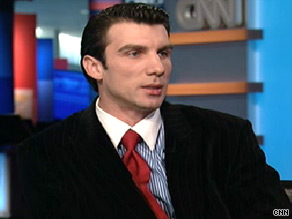
You may have seen the video. A Bronx, New York apartment building is on fire. A man, a civilian is on the top of the fire escape outside a fourth floor window. A firefighter hands him an unconscious 4 year-old boy, and he begins to walk down the fire escape. At the next landing he stops, lies the boy down and does something for a few seconds. Then he gives the thumbs up sign and yells "he's OK."
The man is Horia "Billy" Cretan, 33. He is a Romanian immigrant who owns an electronics store in the building. When the fire broke out late Wednesday afternoon, he heard the boy screaming and went up the fire escape to try to get to him. After firefighters arrived, one went into the apartment and handed the boy out to Cretan, who has become something of an instant hero as the video of the
 rescue circulates.
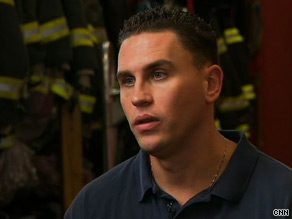
But, of course, there are two heroes in this story. Cretan is getting a lot of attention because he is a civilian who risked his own life for a little boy, and because the rescue was captured on video. Getting less attention is Jimmy Senk, the Bronx firefighter who entered the burning apartment and found the boy after he, as young children often do, moved away from the window just as Senk arrived on a ladder to rescue him. Senk went in the window next to where the boy wound up, and so handed him to Cretan rather than take him down the ladder.
Interestingly, this is not the first person Cretan has rescued from a fire. When he was 12, he rescued his own sister from a fire that killed his father. This makes me wonder whether he was motivated more by his own experience of fear and loss from his childhood or by his own experience of success in rescuing someone before. Either way, you have to imagine that this incident triggered some feelings and reactions related to that past trauma.
Senk, on the other hand, doesn't seem too phased. The fact of the matter is, firefighters are trained to do this. A successful rescue is a triumph, not a trauma. Firefighters are prepared for the fact that they will be working in burning buildings. The rest of us expect our buildings to, well, not be on fire. So an experience of successfully saving someone from a burning building, while joyous for everyone, is also traumatic for civilians. It isn't, necessarily, for firefighters.
That difference is part of the reason why Cretan has gotten all the attention. Senk did what he was trained to do. Cretan made a very risky choice that no one would expect of a civilian. Let's not forget, though, that working in a burning environment is dangerous for everyone, and rescuing someone from it is heroic regardless of whether it's your job or not.
Subscribe to:
Posts (Atom)
Meet the Quarterback

- Naomi Zikmund-Fisher
- is a clinical social worker, former school Principal and a Crisis Consultant for schools and community organizations. You can learn more about her at www.SchoolCrisisConsultant.com

Subscribe


 Posts
All Comments
Posts
All Comments