Monday, August 24, 2009
What If It Is Your Fault?


You may have missed it in all the static that sometimes passes for news, but as Hurricane Bill passed off the Maine coast yesterday, a large group of people watching the resulting surf were hit by a gigantic wave. Three were swept out to sea, including 7 year-old Clio Dahyun Axilrod and her father. Clio died, her father was rescued by the Coast Guard, and her mother was seriously injured. 16 people were admitted to the hospital.
Now, let me ask you to imagine a conversation with Clio's parents. They were with her when the wave hit, and in fact were moving away from the shore because of the danger. There had been warnings issued about the surf. What do you want to say to them? What is your gut instinct?
Generally speaking, people give one of two types of answer. The first is, "What were you thinking, that was an incredibly stupid place to be." The second is, "It wasn't your fault, you couldn't have known." We are very black and white about this sort of thing. I'm reminded of a line the Wizard sings in the musical Wicked:
There are precious few at easeYou're either right or wrong, at fault or innocent.
With moral ambiguities
So we act as though they don't exist
The fact is, the truth in this situation is somewhere in between. Yes, there were warnings about the waves and they should not have allowed their daughter to be where she was. And yes, they could not possibly have known that that wave was coming at that moment, and they were trying to move away.
The fact is also that neither of our natural reactions to this family are likely to be at all helpful to them. "It's all your fault" is hardly the support they need. They can beat themselves up, thank you, without our help. At the same time, "It's not your fault" denies reality, and actually takes away their permission to talk about how they are feeling. If you tell them it's not their fault when they think it is, you're telling them they're wrong. They're not going to want to talk to you after that.
So how do people learn to live with situations like this? How do you go on, knowing that you are at least partially responsible for the death of your own child? All I know is that people do. They make their peace. They come to forgive themselves for their human failings. They try to prevent similar things from happening to others. They turn to their spiritual beliefs about forgiveness and the afterlife. It isn't easy.
We can't tell people how to feel, and trying only makes things harder. The best we can do is affirm that what they are feeling makes a lot of sense, and help them explore what those thoughts and emotions mean to them. As judgmental as we like to be, it's not about our judgment.

Sunday, August 23, 2009
Getting Back on the Horse

The L.A. Fitness in Bridgeville, Pennsylvania reopened yesterday, 18 days after a gunman opened fire on a fitness class, killing 3 and injuring 9 more, and then killed himself. Reports say that the room where the shooting occurred is already being used for classes. The floors and mirrors have been completely redone. Apparently it looks pretty nice.
Upon reading about this, I tried to put myself in the shoes of a member of that club. I tried to imagine going back into that club, into that room, knowing what had happened there. And honestly, I'm not sure I could, not after just 18 days. But at the same time, I know that I go into rooms where tragedy has occurred all the time. As tourists, we often go to see the place where someone famous was assassinated or something terrible happened. My own daughter, who was visiting relatives in Washington, D.C. this week, took a tour of the Ford Theater, where Lincoln was shot.
How can we reconcile the idea that it would be hard to return to a space where someone was killed with the fact that we seek them out without a second thought? Two factors come into play: time and emotional distance. There is no doubt in my mind that it would be easier for me to go to that L.A. Fitness than it would for someone who was injured in the shooting. It's probably easier for me than for someone who is a member but wasn't there that night. I have a cognitive association, but I don't have any sensory connection to that space. When I open up the file drawer on that space in my memory, I have newspaper stories and web photos, but I don't have any visceral associations. What's more, I have no doubt that as time passes that space will become less "loaded" for those who were there.
That having been said, there are probably victims who will never set foot in that building again. When the shooting started, their brains flooded with chemicals that heightened their senses and their memory, a throwback to our days in the wild when it was very important to be able to remember everything that was associated with a danger so you could avoid another one. The sight of that space may well be a trigger for them or, alternately, they may find it distressing that the room doesn't look the same. Over time they may feel better about going there, but maybe not.
The earliest studies on post traumatic stress (which is not necessarily post traumatic stress disorder, remember) were done on soldiers in World War I. They found that if soldiers were removed from the front lines and sent to a hospital for treatment, they were much less likely to return to the line than those who had intervention off the front line but still in the field. Once you leave the place where a trauma occurred, it is that much harder to go back.
That's why, to the maximum extent possible, we always tell people not to send their staff home after a trauma until there has been some opportunity to give them information about critical incident stress and self-care. When they leave when things are still in a state of chaos, that is what they viscerally believe will be there to greet them when they return. When they leave after help has arrived -- help for them-- it's easier to believe that things may be manageable if they come back.
The space where a tragedy occurred holds power, sometimes forever. There was a car accident that killed both parents and a son half a mile from my house four years ago, and I think about it every single time I drive through that intersection. But holding power doesn't mean that power has to be absolute. Healing holds power, too.
Saturday, August 22, 2009
Harrison High School's Football Plane Crash

From time to time I am interviewed for some newspaper or magazine story about school safety. The reporter always asks something like, "What is something schools might not think of to do?" and I always say, "Prepare for the fact that bad things are going to happen no matter what you do, and figure out how they're going to respond." Thus far, no reporter has printed that, because it is not what people want to hear. People in the school safety business, and parents who want their kids to be safe, want to hear about metal detectors and buzzer system and closed circuit TV. They don't want to hear that all of that can't prevent traumatic events from happening at a school.
I bring this up, because last night just after 8 PM, a bi-plane crashed right next to the football field at Harrison High School in Harrison, OH during half-time of a scrimmage, killing two people. Witnesses report that the plane appeared to be heading directly for the field before it did an abrupt nosedive. There is some speculation that the pilot may have intentionally gone straight down when he realized he was going to crash into the crowd of between 1,000 and 1,200 people.
There is no possible way that the school could have prevented this from happening. All the metal detectors in the world cannot keep a small plane from crashing, and they certainly cannot heal the trauma experienced by a high school kid looking up in the sky and realizing there is a very good possibility that he or she is going to die. You can have closed circuit cameras, but they won't obliterate the memory of seeing someone on the verge of death die right in front of you after the crash.
Still, many school districts do not have a plan in place for dealing with trauma on their campus. Most don't even have a plan for the more likely eventuality that someone in the community will die suddenly in a car accident or the like. And after the fact is really not the time to be trying to make good decisions with no guidance and no training. You may be thinking that most schools have counselors or social workers, and that is true. Very few school counseling or social work educator programs have any coursework, and certainly not required coursework, on trauma. And I hope we can all agree that helping kids make a college or career plan is a different skill than talking to them about being terrified they were going to die.
If this happened in my district, we have Critical Incident Stress Management teams to assist. If it happened in my county, and the district knew to make the call, they could call in our community-based team. In my opinion, this is a second choice in this instance for two reasons. First, the community team is going to have it's hands full with people from the families of those who died, the people at the airport, and possibly the spectators who were not associated with the school. Second, on our county team there is exactly one educator (me). Many community teams only have mental health professionals. And really, you want someone who knows schools from the inside to help you figure this out. Peer response isn't just for first responders.
I don't know what the folks in Harrison have done or will do to support their community. I do know that they circled school buses around the scene to limit what could be seen from the field. I also note with interest that they quickly made the decision to continue with the football game despite the fact that the rescue and recovery operation was going on less than a quarter mile away. This probably surprises most people, but it actually was a good idea. As it turns out, because it was halftime the players were busy meeting with their coaches and probably saw the least and hence were the least traumatized. If they can manage to play, continuing with the game is a strong counteraction of the natural feeling of traumatized people that the whole world has just come to an end. It gives people some anchoring in normal life. And, frankly, that soon after the crash no one who was really affected was really ready to talk about it anyway. If they could have managed to get a little crisis management briefing at the end of the game, that would have been ideal, but it may not have been possible.
I greatly feel for my administrator colleagues down in Harrison. Monday is going to be an interesting day at Harrison High School. I hope they're ready.
Friday, August 21, 2009
Why the Press Doesn't Get It

My Sister-in-law, who lives in my old hometown of Concord, Massachusetts, wrote today about the evacuation of the Prudential Center in Boston:
As I sit in the waiting room hearing the reports on the Pru Tower water main break, I'm thinking of the "proper" way to keep people updated. Are there newscaster conferences? Can groups like yours do classes specifically for newscasters to be part of the solution instead of a big problem? Or do they already, and the news people don't listen or show up?SIL is making an assumption here, which is that newscasters, all things considered, want to do this the "proper" way. I don't want to say that isn't true, but I will submit to you that that is not their primary goal.
To bring you up to speed, a pipe for the air conditioning system, which runs from water tanks on the 52nd floor all the way down, cracked on the second floor of the Prudential Center, which is the second tallest building in Boston. Water flooded the mall below, knocked out much of the power and disabled the elevators. About 2,000 people were evacuated from the building using the stairs, and firefighters had to go fetch some folks who couldn't come down the stairs. There is water damage on multiple floors (including above the crack) but no one knows how much yet.
There, are you all worried? Traumatized? Concerned for the safety of your loved ones who work there? Probably not. The fact is that this is a "big" story in that it affects a lot of people in a very well-known building. But it's actually not a big story in terms of danger or trauma. It's a big nuisance more than anything else for most people.
So why are the newscasts so breathless? (I encourage you to watch one if you haven't seen them to get a sense of the tone.) Because the press' number one priority is not to keep people calm. It is to keep people informed while still keeping them watching. So they break into the regularly scheduled programming to tell us that this big story has happened, but it's hard to report that something is both important and not a scary situation. They really only have one model of reporting breaking news, and that is based on situations that are more dangerous, or at least more dramatic, than this one. And on some level, they are also anticipating that this could become dramatic, or might already be dramatic and they don't know it yet, and if that is true they want to be ready.
As a big story unfolds, the press is trying to report what happened, who it affects, and what will happen next. The result is that they report the absence of news as news. They say, "there are no reports of injuries thus far," for example, because people watching want to know if there are any injuries. But the result of a statement like that is to imply that there could be injuries at any moment. The elevators are out, so it's going to be a little harder to get those in wheelchairs out, and they report that there are "concerns about the evacuation." What they mean is that it's not completely straightforward, but what they imply is that it's dangerous.
To answer SIL's question, yes, there are classes that reporters take about disseminating public information. Some of them are much better at it than others. But fundamentally, they know you are not going to keep watching the broadcast if they say, "There's some excitement at the Pru, but really it's more of a mess than anything else."
N.B. If you want to ask me a question or suggest a topic for the Quarterback, feel free to leave a comment in the box in the righthand column, or email me at naomi@SchoolCrisisConsultant.com
Thursday, August 20, 2009
The Ghosts of Virginia Tech

On April 16, 2007, a student at Virginia Tech University went on a shooting rampage and killed 32 people before completing his own suicide. Today, the records on the shooter from the Cook Counseling Center at Virginia Tech were released, with permission from his family. These records were apparently illegally removed from the center and only recently discovered at an employee's home.
What the school records show is that this student made some suicidal comments and gestures in 2005 and was hospitalized. They also indicate that he was not homicidal to the best of the Center's knowledge and that they did not believe him to be a current threat to himself or others, although he was depressed and having difficulty with the stress of college life.
I have every respect for the families and memories of those who died at Virginia Tech and for those who were traumatized by living through that experience. I also believe that lessons can and have been learned about campus safety and crisis communication at colleges. But I also have to question what end is now served by rehashing this man's psychiatric history.
As you frequent Quarterbackers all know, our minds go to blame very quickly when we are traumatized. We want someone to be at fault and we want them to have consequences. We want trauma to be preventable so we don't have to feel scared. And make no mistake about it, this shooting scared anyone who lives, works or knows anyone on a college campus.
At the same time, the person truly at fault here was the shooter. We can file lawsuits, change policies and stage inquiries, but human beings fundamentally have free will. Stopping someone who is hell bent on killing and who does not care if he dies too is always going to be devilishly hard. And what's more, no matter where we pin the blame, we will never know if someone doing things differently would have made any difference.
Let me say that again. We will never know if this shooter could have been stopped. In our quest for a feeling of safety and security and to place blame, we cannot achieve what we really want, which is to know this will never happen to anyone ever again. We are, again, reminded that there is no such thing as closure.
What I worry is that people looking back at records like these, knowing how the story ends, will want colleges and counselors and hospitals to clamp down on people who seem to be "like" this shooter. In the case of these particular records, that would probably mean mandatory counseling, hospitalization and/or expulsion for depressed college students who express suicidal ideation and seem to be having difficulty adjusting to college life. That's an awful lot of people, most of whom never go on shooting rampages or even have a psychiatric diagnosis. I count myself among them.
Something happened to this shooter between December of 2005 and April of 2007. We don't know what that was, really, and we can't ever know for sure. It may be that the system failed in this case, and it may be that this could have been prevented. But let's make sure, in our efforts to be more vigilant, that we don't wind up pegging everyone with a bad day as a killer.
Wednesday, August 19, 2009
Tom Barrett's Recovery

Milwaukee Mayor Tom Barrett held his first news conference since being beaten after attempting to get emergency help for a woman and baby near the Wisconsin State Fair over the weekend. I blogged a few days ago about this incident, and about the complicated nature of psychological healing after a traumatic incident in which you are being hailed as the hero. I neglected, however, to talk about the added complexity of things when you are a politician, and everything you say or do is already incredibly complex.
Barrett does some interesting things in this news conference. After he introduces the various members of his family who are there and thanks his wife for being by his side, he introduces his niece, Molly, again and points out how terrific she was in the emergency. Then he goes on to explain why his security detail was not with him. Next, he characterizes the situation as one which any citizen of his city would have responded to in the same way, and then he starts to describe what happened, again pointing out that his niece did just what he did.
I think there are a number of things going on here. One is that this is a politician, and politicians always need to worry about how they come across. He can't be the only hero in Milwaukee -- this has to be something anyone would do -- because that makes citizens feel good about themselves and they associate that food feeling with him and vote for him. Imagine how obnoxious he would seem if he came out and said, "I know I was really brave and heroic, and few would do what I did." That would be the end of his career right then and there.
Another thing you see is Barrett explaining away some criticism -- that he didn't have his security detail -- up front. Part of this, too, is simply that he is a public figure. But part, also, may represent him thinking through what could have happened differently. Just about anyone who has ever been assaulted has questioned if they could have prevented it. I'm sure he has, too.
You also see Barrett talking repeatedly about his niece. This is, in part, because he is a nice person and a good uncle and he wants her to get some credit for what she did, as well she should. Realizing that she acted just as he did also helps all of us, and Barrett himself, focus again on the fact that this was random and that he wasn't doing anything wrong. Again, he has thought through whether he could have or should have prevented what happened. If Molly called 911, and if any citizen would have called 911, then calling 911 was not the wrong thing to do. And yes, I have heard criticism in the last few days suggesting he shouldn't have.
During the Q&A, someone asked what he was thinking during the attack. He replies, "This is really bad, this is really bad." Then a reporter mentions that her viewers are calling Barrett their hero, and asks for a reaction. He says that Molly's his hero. At this point, I have to say I don't think this is posturing or politics at all. This is a man who knows he could have been killed and knows who he has to thank for that not happening. A pure politician would have stuck with "I did what anyone would have done" and maybe claimed that during the attack he was concerned for the safety of his family or the baby and grandmother. This is an honest person who has experienced trauma speaking. It rings true.
But perhaps the part of the press conference that touched me the most was at the very end. In talking about the support he has received from others -- including a phone call from President Obama -- he said it meant a great deal to him because, "This is tough." I don't think he only meant physically.
Below is a link to the full video of the news conference, although you will have to go to Youtube to watch it.
Tuesday, August 18, 2009
The Trouble With "Closure"

The District Attorney in Westchester County has concluded the investigation into the crash that killed 8 people on the Taconic State Parkway in July. The crash was caused when a woman who was reportedly drunk and under the influence of marijuana drove her van with five children in the wrong direction on the Parkway and hit an SUV, killing three people in the SUV, four of the children and herself. The D.A. has announced that there will be no criminal prosecution in this case.
There has been a lot of backlash surrounding the lab reports that say the driver had a blood alcohol level of 0.19 (legally drunk is 0.08) and had chemicals from marijuana in her system. Her husband has said:
She did not drink. She was not an alcoholic. Something medical had to have happened. I never saw her drunk since the day I met her.He insists that he does not believe alcohol caused the crash that killed his wife and one of his two children, despite both the toxicology reports and the fact that a vodka bottle was found in the van.
Michael Bastardi, Jr., the son and brother of two of the men killed in the SUV, on the other hand, has this to say about the husband and his family:
I am appalled that they won’t face the facts that she was drunk and killed seven innocent lives and ruined the lives of so many people.The Bastardi family is planning a lawsuit.
So what is going on here? Is the husband in denial? Is Bastardi taking this tragedy out on the husband? Yes, and yes. Occam's Razor tells us that when you have two competing theories that have the same results, the less complicated one is true. In that case, the driver was almost certainly drunk. The husband is in denial.
So technically Bastardi is right, the husband "won't face the facts." But the word "won't" tends to imply "could if he really wanted to," and my guess is that he actually really can't right now. The facts are not just that his wife and daughter are dead. The facts are not just that his wife is at fault, or that 6 other people died too, or that everyone is angry at his wife, including him. Throw in there that his wife drank incredibly heavily and he didn't know it. I don't know if she did this a lot or this was a rarity, but it seems clear that her husband was clueless.
On the other side, the Bastardis are angry at the husband. They look at this situation and say that it is perfectly obvious that the wife was to blame, and since she's dead and her husband is defending her, he is a very convenient and obvious target for their natural rage. In tragedy, our minds go to blame. In this one, it doesn't have far to go.
The fact is also that both of these families are traumatized. They are trying to process a traumatic event of monstrous proportions. They won't be successful at doing that until all the investigating and suing and everything else is done, because all of that is retraumatizing. I'm not saying the Bastardis shouldn't sue -- I have no idea. I'm just saying that lawsuits tend to prolong the healing process.
At the same time, I cringe when I hear people say that families in a traumatic situation need to find "closure." That word implies that when all of this is over, this tragedy will be in a box and they can close the lid and move on. The fact is, while they are doing the hard work of processing what has happened, that box doesn't get closed and left behind. The work they are doing now is building a box into which this will fit, and then finding a space for it in their minds. That means moving some other stuff around, and their minds will never be quite the same. They may be healthy. They may be happy. But this will always be a part of them.
At some point, the husband is going to find a place for his wife's substance use/abuse in that box. At some point, Michael Bastardi, Jr. will find a place for anger and blame. Maybe they will "get over" their denial and anger. Maybe today's decision not to charge anyone will help, maybe a lawsuit will, maybe both will hurt. But there will be no closure. The only way to close the box is to bring the dead back to life and make this never have happened. Short of that, for both families, the lid will stay open.
Monday, August 17, 2009
"You Didn't Do the Best You Could"

I don't know about you, but I don't find John Yettaw to be a particularly sympathetic figure. Yettaw is the American who swam, uninvited, across a lake in Burma (Myanmar) to the compound of opposition leader and Nobel Peace Prize winner Aung San Suu Kyi last May. Both of them were placed on trial by the military government, along with two of Suu Kyi's employees. All were convicted, and Suu Kyi was sentenced to an additional 18 months of house arrest. Yettaw was sentenced to a total of seven years detention, including four hard labor. This weekend, Virginia Senator Jim Webb went to Burma and negotiated his release.
I say that I don't find Yettaw sympathetic because he single-handedly managed to get a world heroine put in even longer detention -- she's been under some form of arrest for 14 of the last 20 years. There are those who say he is part of a plot and that the timing was no accident. Under this theory, he did what he did when he did it specifically to get Suu Kyi into more trouble. There are those who think he is crazy. One thing that may point to this is that he testified at his trial that God wanted him to go to Burma because he had a dream that terrorists were going to attack Suu Kyi. Whether you think he's crazy, stupid or evil, I think we can all agree that he did something that caused a big problem.
On the other hand, one can imagine that being arrested and detained in a country known for human rights abuses and then sentenced to hard labor there could be traumatic. As such, Yettaw, depending on how he is feeling about the whole thing and what he experienced in prison, is a prime candidate for some crisis intervention. Would you want to be working with him? Few would.
But the fact is, we deal with less dramatic situations like this every day. Sometimes, something goes horribly wrong and it really is somebody's fault, even though they didn't mean to cause damage. Perhaps the most common instance is traffic accidents -- a driver runs a red light or a stop sign or is speeding, an accident occurs and someone dies. This is traumatic for the driver, but the blame falls squarely on him or her as well.
Folks just starting out in crisis intervention are very inclined to try to "rescue" the people they work with from their feelings. When someone says, "it's my fault this happened" or "I could have stopped it" we want to run in and say, "You did the best you could." This is almost always a huge mistake. We can rarely know whether someone truly did the best they could, and sometimes, as in Yettaw's case, we truly know they messed up.
The point of crisis intervention isn't to rescue people. People do not get over the guilt of what they have done by someone telling them not to feel guilty, any more than people stop panicking when we tell them not to panic. People who have made a mistake with horrible consequences do not need to be told they didn't make a mistake, they need to be helped to live with what happened. Somehow, some way, they need to make it a part of their "new normal." I don't know how John Yettaw will frame this experience for himself and learn to live with the havoc he has caused for himself, for Suu Kyi and for Burma, but I do know that under no circumstances should anyone say, "You did the best you could."
Sunday, August 16, 2009
The Trauma of Being a Hero

The mayor of Milwaukee, Tom Barrett, was attacked by a man with a pipe last night at the Wisconsin State Fair. That's the headline, at least. What it turns out is that the man was not after Barrett at all, but rather was attacking a woman when Barrett heard her calling for help and started to dial 911. The man then turned on him. He is in stable condition at a hospital in Milwaukee.
This is a good place for a reminder that one never, ever, ever tries to do early crisis intervention work with primary victims who are still hospitalized. If we keep Maslow's Hierarchy of Needs in mind, physical needs come first, and right now Barrett needs to worry about getting well (some of the worst research used to try to debunk CISM, by the way, has been done on victims still in the hospital). So I'm actually not going to talk about how one works with someone like Barrett.
What I would like to talk about, though, is what happens when someone is hailed as a hero. It's not uncommon at all for someone who acted heroically during a critical incident, no matter how successful they were, to be particularly badly impacted by the incident. The two things we hear most often from the "heroes" are, "If people knew how scared I was they wouldn't be calling me a hero" and "If I were a hero, everyone would have been OK." In this instance, it wouldn't be surprising if Barrett is feeling ashamed of his fear and ashamed of having been beaten up. I think that shame is misplaced, and you probably do too, but this is not an issue of reason, it's one of gut emotion.
What even further complicates processing an incident in which you are the hero is that, well, everyone says you're a hero. If you are walking down the street and someone attacks you, people understand that you are impacted. They offer support and cut you some slack. If you are walking down the street and see someone else being attacked and intervene, and in the process get attacked, people call you a hero and talk about how great you are, but often they forget that you are still impacted. You still need that support and that slack, but you are less likely to get it.
This can easily become a vicious cycle. You feel ashamed of how you felt or of not having been completely successful. Everyone treats you like you're fine, because after all, heroes are strong. Now you feel ashamed of feeling ashamed, because the world is telling you you're not "supposed" to be. And on it goes.
So, Tom Barrett, you are a hero. You may well have saved that woman's life. And you probably were scared out of your mind. As it turns out, being scared was a good instinct, because that guy was dangerous. I'm glad you're going to be OK physically, and I hope you give yourself some time to heal emotionally, too.
As an aside, I really couldn't let go by the quotation in the article from Patrice Harris, the spokesperson for the State Fair. She said,
it's our understanding it was just a domestic disturbance and he had replied to someone's cries for help when he was attacked.
This is a wildly unfortunate choice of words. There is no such thing as "just a domestic disturbance," and someone who would attack someone with a pipe for calling 911 could easily have seriously injured or killed the woman involved. I don't care if you are married, or if it's your girlfriend or your child or whomever. When you get violent, it's violence, and there's nothing "just" about it.
Saturday, August 15, 2009
CISM (Or Lack Thereof) at the Lockheed Wildfire

Over 2,400 people in Santa Cruz County, California, have now been evacuated due to the Lockheed Wildfire which began burning earlier this week. With all these people in crisis, you might wonder what the CISM response looks like right now. And if you think of CISM as mostly being one-to-one and small group work, then the answer is: not much.
But that's not completely accurate. CISM includes a large number of components, but I would predict that right now there are only two that are generally and widely appropriate: the Crisis Management Briefing (CMB) and the Demobilization. Both of these, however, are large group interventions.
Demobilization is a strategy used mostly for first responders in large scale operations, which this certainly is. In a demobilization in this instance, as firefighters come off the line following their first shift, they come to some predetermined location where there is food and drink, possibly shower facilities and/or cots. A member of the CISM team spends maybe 10 minutes with them while they eat. They share any new information about the fire and give them some self-care tips and information about what they can expect emotionally in the days ahead, gives them a handout about common stress reactions and about self-care, and then sends them off either to rest or to go home, depending on how the rotation is working.
CMBs may be being used for evacuated residents and/or first responders prior to subsequent shifts. In this intervention, some person in authority (a representative from the fire department or the governor's office, for example) gives the latest information about the fire, what is currently being done, and what the plans are moving forward, and a member of the CISM team does some education about critical incident stress and how to take care of yourself.
What you'll notice in both instances that all the CISM team is doing is "information push." Disaster victims and responders are not really being given an opportunity to process their thoughts and feelings with the team. The reason for this is simple -- the incident isn't over. To draw an analogy, it would be like trying to stitch up a dog bite in someone who is still being chased by a dog. They can't possibly hold still and cooperate in their care because their mind is on outrunning the dog, and they're going to be pretty mad at you if you try to stitch them up instead of at least cheering them on in the outrunning of the dog.
I can't say categorically that nowhere in any shelter is anybody getting any individual or small group help. Folks who had to be rescued from a burning building, for example, may need some support for that portion of the incident and they may be ready to talk about it. But maybe not. Most folks are still worried about whether their home will be there when they get back, whether their pets made it, trying to find loved ones and a more permanent place to stay, etc. And crisis responders ought to be helping them with those things.
Sometimes after mass disasters and major incidents people don't ever get the help they need because it takes so long for an incident to end or the ending is not very clear. For example, many rescue and recovery workers at Ground Zero got some support at the scene but never did a Critical Incident Stress Debriefing (CISD) because there was no agreed upon time when they were done. The CISM teams that supported them on site also didn't always get Post Action Staff Support (PASS) because it never felt like they were done. After Katrina, by the time New Orleans residents were settled enough to get CISM help, they were scattered all over the country. Planning to support victims of long-lasting disasters is a great challenge for crisis responders. I know my colleagues in Santa Cruz are up to the job.
Why I Don't Usually Update Stories
Some of my readers have asked why I often don't post ongoing information about investigations into the critical incidents I blog about. First of all, it's not true that I never update stories. I posted additional information about the Steve McNair murder/suicide and the Ed Thomas murder, for example. However, I have not posted available information uncovered by the investigations into the Disney monorail crash or the plane/helicopter crash over the Hudson, as counterexamples.
My rule of thumb is to write an additional post if the new information will fundamentally change or add to the discussion from a crisis response point of view. In the case of Steve McNair, for example, the information that his death was, indeed, a murder/suicide gave the opportunity to talk about suicide, suicide prevention, and crisis intervention following suicide.
Often, the new information gained in the investigation of an incident tells us who investigators believe is to blame for the incident. Sometimes the nature of the event is fundamentally changed by this, as it was when we learned that Ed Thomas' alleged murderer was a former student and that he had apparently been prematurely released from psychiatric care. More often, however, knowing who may be at fault doesn't really change anything except possibly where the blame is being pointed -- and there is always blame.
While this blog is a current events blog, it is a crisis response blog as well. Feeding blame is not something I, as a crisis responder, believe is particularly useful unless it serves some other purpose, so I choose not to do it. There are certainly cases where I make the wrong call -- where a piece of information actually really does change the perspective on the event or where I say it does when it doesn't. We're all human, even us Quarterbacks.
Friday, August 14, 2009
The Quarterback's 10 Commandments of H1N1 Crisis Communication

I've been blogging a lot recently about H1N1 and how various agencies and the media communicate about it. Most of my posts have been on the critical side, picking apart an incident or document or briefing and saying what is wrong with it and, usually, unless I'm in an especially bad mood, making suggestions for improvement. But, as an educator, I firmly believe that in order for students to have a fair shot at success you have to make your expectations clear ahead of time, and so I offer here something of a rubric for communication about H1N1.
The Quarterback's 10 Commandments of H1N1 Crisis Communication
- Thou shalt communicate in multiple media at once, for thy public gets their information from various sources and is confused by thy out-of-date or inconsistent messages.
- Thou shalt share all the information thou hast, for failure to be thorough and attempts to cover things up maketh thou seem unreliable, and thy public will not believeth thy word.
- Thou shalt empower thy underlings to share thy information, for attempting to centralize thy message maketh thy people not trust thee. Thou shalt make sure thy underlings haveth the most up-to-date information at all times so they may shareth it.
- Thou shalt explain thy reasoning in all directives, for "I saidest so" is insufficient for most people.
- Thou shalt put thy information in appropriate context so that thy public may understand the dangers they face with relation to other dangers, and not overreact to thy numbers.
- Thou shalt recognize the fear of thy public and acknowledge it as a natural response, for thy public will otherwise believe that thou do not gettest it, and ignore you.
- Thou shalt not say "don't panic" without explaining why not.
- Thou shalt debunk all rumors with relevant facts. "That's not true" doth not, by itself, constitute a relevant fact.
- Thou shalt plan for the contingency that thy public will not follow thy directions, for they act out of fear and thou art not as convincing as thou thinkest.
- Thou shalt not separate thy discussion of the current status of the pandemic from thy discussion of the emotional reaction to it. So mayest thy people know that thou understandeth them, and trusteth thee. So, too , may thou be constantly reminded that thy words have impact, and consider them, and not be led astray like Joe Biden of old.
Thursday, August 13, 2009
Friendly Fire

It reads like the "before the opening credits" section of a Law & Order episode. On May 28, New York City Police Officer Omar Edwards finished his shift and came out to find someone breaking into his car. He wrestled with the suspect, who got away, and then chased him with his gun in hand. Officer Andrew Dunton, who was working in plain clothes, drove by with two other officers and saw an armed man chasing another man down the street. He got out of the car, crouched down behind the door and told Edwards to stop and drop his weapon. Edwards turned towards Dunton with his gun still in his hand and Dunton opened fire, killing Edwards. When responding officers removed Edwards shirt, they found a Police Academy t-shirt, and then found his badge in his pocket. Roll opening credits.
The thing is, this story is true, and today a grand jury in New York declined to indict Officer Dunton, who has been on administrative leave since the shooting. You probably didn't even need to look at the picture with this post to predict that Edwards is African-American and Dunton is White. I don't know what happened that night, and I didn't hear what the grand jury heard, but I have to imagine this outcome will not be without controversy.
Death of a police officer in the line of duty is a "big one" in Critical Incident Stress Management, as are most officer-involved shootings. While Edwards wasn't technically killed in the line of duty, I think for CISM purposes that is a distinction without a difference. The fact that he was killed by "friendly fire" is not going to make this situation any smaller.
One of the reasons CISM works is that groups that work together in the same job with the same experience support each other really well. But it is extremely important that groups for CISM interventions be homogeneous in terms not only of their exposure to the event but their cohesion before the event. You absolutely cannot intervene with a group if there are factions within it or blame and anger at each other. The CISM response to this incident would have to very carefully sort through who goes with whom, looking not only at who was where when it happened and who works with whom, but who is blaming whom.
In the CISM Planning 5 T's of target, timing, trauma, theme and team (or more rightly the 6 T's, including technique), sorting out the targets will in some sense be by theme, and you're going to need a big and trusted team to intervene appropriately. What a mess.
Wednesday, August 12, 2009
The Latest from the Government on H1N1

My sister-in-law wrote this morning to ask for my thoughts about the latest post in the White House Blog about H1N1 preparedness. This post is an abbreviated form of a longer op-ed piece by Secretaries Kathleen Sebelius (Health and Human Services), Janet Napolitano (Homeland Security) and Arne Duncan (Education) that ran in a number of newspapers in the last couple of days.
The basic message of the communication is fairly simple: We're preparing for the flu, you should take it seriously, and we need you to prepare too. In my sister-in-law's e-mail, she points out that the blog post does not address the rumors or panic about H1N1. That is true, but there is some good stuff in the full article:
This new H1N1 is not the flu we’re used to. It was just getting started when our flu season should have been ending. While anyone can get sick, the pattern of infection is unusual. It hasn’t yet affected many seniors, but it spreads rapidly among otherwise healthy kids up to college age. Scientists at the Centers for Disease Control and Prevention continue to observe higher levels of flu-like illness than normal for this time of year.
But there’s one way in which the 2009 H1N1 flu isn’t different: it can still send you to the hospital with fever, cough, sore throat, headache, chills and fatigue, and sometimes, diarrhea and vomiting. For the worst cases, it’s still deadly. And it’s especially dangerous for people with chronic illnesses such as asthma, heart disease, or diabetes, and women who are pregnant.
I will admit to being somewhat surprised at the tone of this, and I'm wondering about the choices they made. This is written as though they do not believe we (and by "we" I mean the general public) are taking this disease seriously enough. In my experience, that hasn't been the problem at all. On the other hand, maybe folks have become complacent since the fall, I don't know. In my opinion, what is missing from this section is a third paragraph, pointing out that in many ways H1N1 is the same as seasonal flu in the number of people it doesn't kill or send to the hospital. At the very least, some clear statement about the relative danger from H1N1 as compared to seasonal flu would be helpful. And talking about the flu sending people to the hospital without putting it into some context can only add to the overwhelming of our ERs of which I've written before.
I think the government is getting better at communicating with us about H1N1 and sharing information. I think what they still need to work on is nuance. They seem really unwilling to convey that the situation is in shades of gray, not black and white. They can't seem to manage the message that we should take this seriously and prepare, as well as recognize that for most of us this isn't a very serious danger. There is something to be said for, when you want people to behave a certain way (e.g. wash their hands) being very directive and giving them reasons to do it. But don't forget, people don't only do what you say, they interpret and extend it. And if getting us all to plan and being very directive in one direction also makes us all panic, freak out and go to the Emergency Room, that's not actually a good thing.
Tuesday, August 11, 2009
Grief, Trauma and Traumatic Grief

I was recently asked to assist at a school where a student had died after a lengthy illness. The usual characters had assembled -- the Principal, the counselors, the social worker, the district communications person, and me on behalf of the crisis team. As we started to think about what needed to be done, one of the others at the table said,
Let's not have a secular response to a spiritual event.What a great way to put it. This child's death was very sad. Staff and students were grieving, and grieving hard. But they were, indeed, grieving. They were not traumatized. They didn't need intervention, they needed support. My colleague wasn't advocating prayer in public schools, he was advocating recognition that this event was fundamentally different than death from a car accident or a suicide.
I often run into trouble explaining this difference to people. Saying that a death isn't a critical incident, isn't a crisis or isn't a traumatic event is sometimes heard as saying that the event isn't hard or horrible, and that's not what I mean at all. It's just that grief and trauma are different.
If you look up the two words in the New Oxford American Dictionary, you find the following:
Grief: Deep sorrow, especially that caused by someone's death.
Trauma: Emotional shock following a stressful event or a physical injury, which may be associated with physical shock and sometimes leads to long-term neurosis.
The difference between trauma and grief does not have to do with how serious a situation it is, or even with how upset you are. Trauma, however, involves shock, and grief does not. You can see this when you talk to people who have experienced the traumatic death of a loved one. While they may feel sad, that sadness is not usually the primary emotion. Instead, they are shocked, angry, scared or in a state of disbelief.
You can see a difference in the signs and signals of distress that people exhibit with grief and with trauma as well. While those who are traumatized may cry, those who are grieving don't usually experience the numbness and physical ailments that come with trauma.
Traumatic incidents do, of course, very often cause grief. The death of a loved one in a car accident is still a death. What we find, however, is that the trauma gets in the way of the grief. Until people have processed the trauma and its effects, they can't really face and process their grief. The biggest mistake people make in dealing with trauma is trying to talk immediately about the loss and grief and skipping over talking about how it happened and all the reactions surrounding that. When someone dies, we think we're supposed to feel sad and talk about the person who died. We don't allow ourselves or others the room and time to deal with our own reactions to how it happened and to the shock.
On the flip side, it's easy for those of us trained in trauma intervention to treat everything like a trauma, even when it's not. Once an organization has a CISM team, they often want to do CISM for everything. But the C and the I in CISM stand for Critical Incident, and while those trained in CISM may have some good people skills, the techniques of CISM are not designed for uncomplicated, non-traumatic grief.
I don't know if I'd say that trauma is secular and grief is spiritual, but I see what my colleague is getting at. And if it helps us remember to use the right tools at the right time, I'm all for saying that we shouldn't use a secular response for a spiritual event.
Monday, August 10, 2009
What Makes an Incident a "Bad One"

I know it when I see it.
Supreme Court Justice Potter Stewart famously used that line to try to define hard-core pornography. That's how it feels sometimes trying to define a critical incident. That's particularly true when you're dealing with first responders -- cops, EMS, firefighters -- who see this stuff every day and can't possibly be traumatized by all of it. What makes one incident particularly bad?
I know it when I see it.
Yesterday, California Highway Patrol attempted to stop a car on a traffic violation in Dinuba, California. The car wouldn't stop and the police chased it for about four miles. Then the car ran a stop sign and hit a pickup truck carrying 5 children. As of this writing, 8 people -- 5 children and all 3 adults from the car -- are dead. Four of the children, ages 1,3,4 and 7 were ejected from the truck and died at the scene.
I know it when I see it.
There are certain rules of thumb about critical incidents. There are certain types of things that are likely to impact a first responder -- line-of-duty-death or serious injury, officer-involved shooting, trauma involving children, and multiple casualties all raise red flags. And yes, this was a multiple casualty incident involving children. But that's not what makes me, and probably you, say that this is a "bad one."
You just know it when you see it.
This one would probably be a big one even without the police chase. An accident involving multiple dead children offends our sense of how the world should be and, if we are parents or have children close to us, makes us feel uneasy about their safety. I don't know about you, but one of my first reactions was also to question how five children could possibly be riding safely in a pickup truck, and whether the fact that they were ejected means they weren't wearing seat belts or were riding in the back. Someone has to be to blame. Then you add in the car running a stop sign, and you have someone else to blame. It makes me angry -- it probably makes you angry too.
And then you add the police chase, which means there were officers on the scene who are now asking themselves what they could have done to stop that car or whether they should have given up the chase, and who witnessed the accident and were first on the scene to see the carnage. The Fresno Bee already indicates some people are blaming them for the crash. So now there's going to be an investigation, on top of the guilt. And that's in addition to being mad at the driver and mad that those children weren't safe and afraid for their own children.
I know it when I see it. It looks like that.
Saturday, August 8, 2009
Aviation Over the Hudson
Writing this blog requires that I scour the news for something awful every day. Some days it isn't hard, some days it is, and some days, like today, make you just go "ugh." Shortly after noon today a private plane collided with a tour helicopter over the Hudson River in New York. There appear to be no survivors.
When I saw the headline, I made a prediction about how the coverage would run before I ever saw it. I predicted that coverage would very quickly include reference to US Airways Flight 1549, the plane that landed on the Hudson in January. And I wasn't disappointed. The New York Times breaking news article at 4:40 Eastern had its mention of the "Miracle on the Hudson" in the 9th paragraph:
The accident, on a sun-drenched weekend that beckoned people out of doors, occurred seven months after a US Airways jetliner with 155 people on board lost power after striking birds on takeoff from La Guardia Airport and ditched in the icy Hudson a half-mile north of Saturday’s crash, with stunningly different results: all on board were quickly rescued by a flotilla of ferries and emergency boats.Let's think about this for just a moment. The US Airways crash has, objectively, essentially no relationship to this crash. The cause clearly is not the same, the aircraft are not the same, the people involved are not the same. The only thing they share is landing in the same body of water.
So why does the coverage fly immediately to the US Airways crash? And why does that make sense to us? I think it's because of how we naturally store information and memories. I like to compare our minds to a gigantic system of filing cabinets. We file memories and new information in one or more cabinets based on some label. When something else comes along with the same label, we open that drawer again to file it, and in the process review what's already in the drawer. Today we opened the "Hudson River Plane Crash" drawer, and not surprisingly flight 1549 was already in there.
People who have been traumatized are often surprised by the associations that come up for them. They find that their car accident has them thinking about when they broke their arm in the 3rd grade, and they can't imagine why. But that triggering is all the same mechanism. We only have so many labels in our file drawers, and things that don't have much to do with one another wind up getting filed together.
With that in mind, the people I am concerned about (other than the families of the deceased) in this instance are the pilots of water taxis and tour boats on the Hudson. These folks helped heroically in the rescue efforts for flight 1549, and responded again today. Their reactions today will be not just about today, but about January. And I hope they are able to remember that, when there were survivors to rescue, they made a big difference. They probably aren't feeling so effective today.
Friday, August 7, 2009
The New CDC H1N1 Guidance for Schools
 I often use this space to lament the inadequate or wrongheaded response of one group or another to a crisis. That is, after all, the essence of Monday Morning quarterbacking. However, I like to think of myself as a fair person, and as such I would like to give three hearty cheers to the CDC for the new guidance they issued today for schools regarding H1N1 "swine" flu.
I am in no position whatsoever to comment on whether these new guidelines are what they should be in terms of scientific content. At some point, we have to have some faith in our scientists that what they tell us is true. I suppose it is possible that these guidelines are absolutely horrific from a scientific standpoint and will get us all killed by this new virus. I doubt it.
From a crisis preparation and crisis communication standpoint, however, the guidance issued today is very, very good. And since I take such joy from tearing this sort of thing apart, I'd like to look in a fairly detailed way at what is right about how this was done:
- Information was shared in multiple ways. There was a press conference and a press release, and within a relatively short time a detailed guidance document, as well as the press release and the video of the press conference was available on the web. Someone reading about the new guidelines and wanting more information can find it relatively easily. And if they wanted even more information, each section of the guidelines links to a more detailed "Technical Report" intended for public health officials.
- The guidelines consider multiple contingencies. There are guidelines for what we expect to happen, and then guidelines for the possibility that the problem will be worse than we expect. This lends credibility to the message of the initial guidelines and makes people more likely to trust that things are under control, because they know up front that the authorities have considered the possibility that this could be really bad. Nothing makes people feel worse than hearing the equivalent of "here's the plan for right now, and if things change, well, we have no idea."
- Directives include information about why they are being issued, and also consider what those questioning might ask. For example, the directive on school cleaning reads: "School staff should routinely clean areas that students and staff touch often with the cleaners they typically use. Special cleaning with bleach and other non-detergent-based cleaners is not necessary." This not only tells us what to do, it tells us what we don't need to bother with. Last spring, many schools found themselves being pressured to do more than what the CDC recommended, particularly with regards to cleaning, and had no response. With a single sentence, the CDC now has provided them with something specific they can say -- "the guidelines indicate that special cleaners are not necessary." Extra points would have been awarded if they had explained why, but still, high marks.
- They give schools issues to think about that include emotional reactions to the situation. There is a very large amount of space devoted to how to make local decisions about schools, and it's all very good. The last section is entitled "acceptability" and it asks schools to consider how they will deal with people's anxiety about the flu and their possible resistance to whatever decisions are being implemented. Three more cheers just for this -- they recognized that implementing a plan isn't just about the science of the flu, it's about the psychology of those affected by the plan.
Thursday, August 6, 2009
Sharing Our Trauma: The Pittsburgh Gym Shootings

As you all know, on Tuesday night a man walked into a fitness class at a gym outside Pittsburgh, turned off the lights, took out a gun and opened fire, killing three women and injuring many more before killing himself. I posted about this a few hours later from my perspective as a former Pittsburgher with friends in the 'Burgh.
As is often the case in highly publicized mass shootings, there's a lot of "woulda shoulda coulda" in this situation. The shooter had been planning this a long time, had done several "dry runs" of one kind or another, and had a blog that was pretty explicit about what he intended to do. It's hard to wrap our head around the notion that no one saw this coming. And would you want to be the gym employee who showed him, when he asked, how to turn out the lights? It's awful.
Because I came to this story from the perspective of a former Pittsburgher, I was somewhat surprised at how much of an impression this story made on the rest of the country. I had taken "ownership" of this incident from the perspective of my own history, but many more people identified with being in a fitness class. The most chilling thing I heard was a discussion on NPR's "Talk of the Nation." The host, Neal Conan, remarked that many women heard the news and said, "That could have been me." Rene Balcer, head writer for NBC's "Law & Order" commented,
But it's interesting, the reaction that could be me, because there are probably a lot of people who might be thinking of that gunman and saying that could have been me. . . Because, you know, one of the things that one of my detectives has said is, you know, bad men do what good men dream.I don't know if I agree with Mr. Balcer on this one. It certainly doesn't resonate with me personally, but perhaps I'm simply not of the right background. Maybe women in this instance identify with the victims and men may identify with the shooter (and maybe not -- male readers, what do you think?)
But all of this got me to thinking. Incidents like this are a nationally shared experience. We aren't all traumatized as the people who were there are, but on a national level we have heard the same horrifying news and identified in a personal way with it. Perhaps the greatest example of this, of course, was 9-11, when the whole country suffered secondary trauma en masse.
When we do Critical Incident Stress Debriefings (CISD) with those involved in traumatic incidents, one of the most powerful and beneficial things that happens is that participants realize they can support each other. This small, homogeneous group has gone through a common experience, but often they have kept to themselves in trying to process it. CISD helps them realize that they went through it together and they can be together in dealing with it too. Because different people tend to struggle with different aspects of an incident, they can offer each other perspective from someone who has truly "been there."
Wouldn't it be nice if our society supported us in being able to do that with these shared traumas? What if the conversation could get past, "Wow, that was freaky" and into, "I'm having trouble with this, are you?" What if being freaked out wasn't just something to say, it was something to get help from friends and colleagues about. We don't really like to talk about our feelings in this society. It's seen as a sign of weakness and instability. And as a result, we deprive ourselves of the best coping resource there is out there -- each other.
Wednesday, August 5, 2009
Quick -- How Lethal is H1N1?
 Headlines based on an update yesterday from the World Health Organization include "Global Swine Flu Deaths Top 1,100" (CNN), "WHO Says Swine Flu Death Surge to 1,154" (New York Times), and "Swine Flu Death Toll Climbs to 1,154" (Wall Street Journal). So, this is a quiz, how does the mortality rate of H1N1 compare to seasonal flu? How does it compare to the death rate of the 1918 flu pandemic? Don't feel bad if you don't know. No one seems to be bothering to tell you.
At this point, most of us have heard the statistic that 36,000 Americans die every year from seasonal flu. What we don't have is some point of comparison to how many people actually get seasonal flu. So I did some digging. And I came up fairly empty. The best information I came up with was from the CDC, which says that between 5% and 20% of the U.S. population gets the flu each year. That comes out to a mortality rate of somewhere between .06% and .2%. The new numbers from the WHO come out to a mortality rate of .7%, which is anywhere from 3 to 12 times more lethal than a typical seasonal flu is in the United States.
The problem, of course, is that we don't have accurate figures on how many people have had H1N1 so far, or on how many people get seasonal flu each year. That's because most people don't get tested. Think about it. Have you ever had the flu? Did you get tested?
By the way, if you're wondering about the "Spanish Flu" of 1918, it had a mortality rate estimated between 10% and 20%, which I think we can all agree is much worse than anything we're talking about here.
So H1N1 may well be worse than seasonal flu, and that is definitely worth reporting. It would just be nice if the media bothered to report it in some context where the numbers actually mean something. Reporting a raw death toll tells you that 1,154 people have died. And I am sorry to hear that. But it doesn't tell you anything about how dangerous this virus is, and I'm guessing that's what most people want to know. Worse yet, unless you think carefully about it, it's easy to think that you know how dangerous H1N1 is just based on the death toll, and that's what leads people to react based on gut instinct rather than facts. And that's the last thing we need.
(Related Quarterbacking here)
Tuesday, August 4, 2009
Sometimes "Close to Home" Isn't Close . . . Or Home
 I was perusing the headlines from CNN before heading off to bed tonight when I saw one that read "5 Die in Gym Shooting Near Pittsburgh." This caught my attention because I lived in Pittsburgh for 9 years and still have dear friends there. I clicked through to the story for more details and found that the shooting was near Bridgeville, where I once worked when I was an itinerant teacher, but where I have no friends now, at a gym that doesn't ring a particular bell for me.
You might think I'd move on to the next story, or at least breathe a sigh of relief. And I guess I was a little relieved to realize that whatever awful thing may have happened didn't happen to anyone I know. I moved out of Pittsburgh more than 7 years ago, so letting this go should have been pretty easy. But the initial "Oh my God" reaction -- both cognitive and the physical "punch to the stomach" feeling -- remained, and I started looking for more information from the Pittsburgh media websites. The most complete and seemingly accurate coverage is from the Pittsburgh Post Gazette.
As I clicked around the web, I started to ask myself what I was looking for? True, I am just a news junkie, and nothing excites a news junkie like breaking news. But I think there are two other things going on. The first is that I was looking for additional confirmation that this didn't have any connection to me. One story wasn't enough. I needed to know it, and know it again. The second is that in the split second after I read that first headline, this story became mine even though it didn't have to be. I connected with it. And now, the fact that I don't know the victims or the perpetrator doesn't matter, because I've connected with the fact that someone knows them, and someone got that punch to the stomach and found out it was someone they know.
So what do you call this phenomenon? Secondary trauma is when you are traumatized by hearing about someone else's trauma. Perhaps it's that on a small scale. Countertransference is the over-identification, positively or negatively, with the people you're helping, but I'm not helping these people. I guess I would just say that this one hit a little too close to home, even though it's hundreds of miles away from my home. Sometimes your mind just works that way.
Monday, August 3, 2009
H1N1: Sound the Alarm! Or not . . .
(Note: This is the latest in a series of posts about H1N1. You might be interested in the previous ones.)
 This weekend the New York Times ran a series of four op-ed pieces about Influenza A H1N1 "swine" flu. They asked four people with expertise in four different areas to comment on what needs to be done to get ready for what the Times calls "Swine Flu, Round 2." The articles covered schools, airlines, emergency rooms, and vaccine safety. (A big Quarterback shout out to my mother, hereinafter referred to as the "Quarterback Mum," who drew these articles to my attention)
Now, far be it from me to criticize others for sticking their nose into H1N1 preparedness issues. People who live in glass houses shouldn't throw stones. But at the same time I would be remiss if I didn't give their Monday morning crisis quarterbacking some MMCQuarterbacking of its own.
I would say the Times commentaries are two for two. Let's start with the good ones:
Arthur Allen's piece, "Prepare for a Vaccine Controversy," does quite a good job at looking at the other side of the coin that I talked about last week with regards to H1N1 vaccination. While I looked at the controversy that was likely to occur because people who wanted vaccine couldn't get it, Allen points out that there are likely to be those who the government thinks should get it but don't want to, and those who do get it who then get sick or die, either from the vaccine itself or by coincidence. He urges the government to get out in front of this and talk about vaccine safety, the importance of vaccination, and how to tell a dangerous vaccine from the random chance that something bad will happen to you whether you get the vaccine or not. All good points, well stated, and, if his advice is followed, likely not only to get people vaccinated but also to keep their panic level down.
Eric Toner wrote, "E.R.'s May be the First Victims" about the overload on emergency rooms that occurred during the initial outbreak and what could be done about it if there's another big one. He suggests such steps as educating people better about when to stay home vs. when to go to the ER, setting up flu clinics and adding staff at Emergency Rooms. Frankly, he sounds a lot like what I had to say on the subject so it's hard to find fault.
Then we come to two articles that made me scratch my head:
The first is entitled "Fly the Germ-Free Skies" by an emergency physician named Marc Gendreau. Gendreau's basic argument is that airlines should do more to stop the spread of disease on airplanes. I don't actually disagree with that, but his breathless and alarmist tone is really counterproductive. As one example of many, Dr. Gendreau notes that
Keep in mind, thus far what is atypical about this virus is that it is new and it infected people in the spring and summer. Yes, it could come back around in a particularly virulent form during flu season. But we don't know that it will. What is causing everyone to worry is some combination of that possibility and the fact that initial reports out of Mexico City suggested that this virus was much more deadly than it appears to be now. Would Gendreau be "horrified" that people aren't sanitizing their hands on the way to Disney World during a typical flu season? I have no problem with a general campaign by airlines and airports to get people washing and sanitizing more often, but a little reminder to panic at the same time is not what we need.
Which brings us around to Dr. James C. King, Jr., a pediatrician who wrote "The ABC's of H1N1." King has a lengthy litany of things he believes schools and health departments should be doing, or preparing to do, during the coming flu season. He suggests that schools tell people to keep their kids home for 7 days if they are sick. He proposes schools have hand sanitizer dispensers installed. He thinks schools and health departments should work together to monitor flu activity and make sure preventative steps are taken. All of these things are good ideas. In fact, they are so good that schools started doing them in April at the latest -- some of them have been standard practice in many jurisdictions for years.
While there's no harm in making sure we school folk are doing what we're supposed to do, by putting these out as novel ideas it reinforces the notion among parents and the rest of the public that school don't know what they're doing. If April and May are any indication, the more measured and scientifically informed the steps that schools take, the more parents seem to believe we are not doing anything. What is needed is a unified message that schools are taking their lead from public health, period. King's article implies that cooperating with health departments is at best the exception, not the rule.
The kicker, to me, is that in the middle of his article, King throws out this gem:
My bottom line is this. Recommendations for what to do about flu when it happens should be based on what we know to be true. Preparations for worst case scenarios can take into account what might be. And responsible commentary needs to look at what is already being done. Words, particularly words in the newspaper of record, have power. I am very much opposed to covering up what needs to be shared with the public. But we need to anticipate the reactions people will have to what we say. While "don't panic" is insufficient, "go ahead and panic, we are unprepared" is irresponsible.
This weekend the New York Times ran a series of four op-ed pieces about Influenza A H1N1 "swine" flu. They asked four people with expertise in four different areas to comment on what needs to be done to get ready for what the Times calls "Swine Flu, Round 2." The articles covered schools, airlines, emergency rooms, and vaccine safety. (A big Quarterback shout out to my mother, hereinafter referred to as the "Quarterback Mum," who drew these articles to my attention)Now, far be it from me to criticize others for sticking their nose into H1N1 preparedness issues. People who live in glass houses shouldn't throw stones. But at the same time I would be remiss if I didn't give their Monday morning crisis quarterbacking some MMCQuarterbacking of its own.
I would say the Times commentaries are two for two. Let's start with the good ones:
Arthur Allen's piece, "Prepare for a Vaccine Controversy," does quite a good job at looking at the other side of the coin that I talked about last week with regards to H1N1 vaccination. While I looked at the controversy that was likely to occur because people who wanted vaccine couldn't get it, Allen points out that there are likely to be those who the government thinks should get it but don't want to, and those who do get it who then get sick or die, either from the vaccine itself or by coincidence. He urges the government to get out in front of this and talk about vaccine safety, the importance of vaccination, and how to tell a dangerous vaccine from the random chance that something bad will happen to you whether you get the vaccine or not. All good points, well stated, and, if his advice is followed, likely not only to get people vaccinated but also to keep their panic level down.
Eric Toner wrote, "E.R.'s May be the First Victims" about the overload on emergency rooms that occurred during the initial outbreak and what could be done about it if there's another big one. He suggests such steps as educating people better about when to stay home vs. when to go to the ER, setting up flu clinics and adding staff at Emergency Rooms. Frankly, he sounds a lot like what I had to say on the subject so it's hard to find fault.
Then we come to two articles that made me scratch my head:
The first is entitled "Fly the Germ-Free Skies" by an emergency physician named Marc Gendreau. Gendreau's basic argument is that airlines should do more to stop the spread of disease on airplanes. I don't actually disagree with that, but his breathless and alarmist tone is really counterproductive. As one example of many, Dr. Gendreau notes that
on a recent full flight from Boston to Orlando, Fla., I was horrified to see that most of my fellow passengers failed to periodically wash or sanitize their hands.Really? Horrified? On what planet does Dr. Gendreau live where people are constantly sanitizing their hands in the course of daily life? This wasn't in a hospital, it was on a plane. And there's a big difference between saying, "people should probably wash their hands" and being "horrified" that they don't.
Keep in mind, thus far what is atypical about this virus is that it is new and it infected people in the spring and summer. Yes, it could come back around in a particularly virulent form during flu season. But we don't know that it will. What is causing everyone to worry is some combination of that possibility and the fact that initial reports out of Mexico City suggested that this virus was much more deadly than it appears to be now. Would Gendreau be "horrified" that people aren't sanitizing their hands on the way to Disney World during a typical flu season? I have no problem with a general campaign by airlines and airports to get people washing and sanitizing more often, but a little reminder to panic at the same time is not what we need.
Which brings us around to Dr. James C. King, Jr., a pediatrician who wrote "The ABC's of H1N1." King has a lengthy litany of things he believes schools and health departments should be doing, or preparing to do, during the coming flu season. He suggests that schools tell people to keep their kids home for 7 days if they are sick. He proposes schools have hand sanitizer dispensers installed. He thinks schools and health departments should work together to monitor flu activity and make sure preventative steps are taken. All of these things are good ideas. In fact, they are so good that schools started doing them in April at the latest -- some of them have been standard practice in many jurisdictions for years.
While there's no harm in making sure we school folk are doing what we're supposed to do, by putting these out as novel ideas it reinforces the notion among parents and the rest of the public that school don't know what they're doing. If April and May are any indication, the more measured and scientifically informed the steps that schools take, the more parents seem to believe we are not doing anything. What is needed is a unified message that schools are taking their lead from public health, period. King's article implies that cooperating with health departments is at best the exception, not the rule.
The kicker, to me, is that in the middle of his article, King throws out this gem:
In cases of a widespread outbreak — if, for instance, there are confirmed cases of H1N1 flu in half the regions of a state — it may be wise to close schools for a few weeks until most of the children have recovered.The problem is that this is not the current recommendation from the CDC, which now encourages schools to treat H1N1 the same as it would ordinary seasonal flu. Can you imagine if schools shut down anytime half the regions in the state have confirmed cases of seasonal flu? We might as well just plan to close for the winter. And again, the last thing we need is panicked parents saying, "Why aren't you closed? The New York Times thinks you should be."
My bottom line is this. Recommendations for what to do about flu when it happens should be based on what we know to be true. Preparations for worst case scenarios can take into account what might be. And responsible commentary needs to look at what is already being done. Words, particularly words in the newspaper of record, have power. I am very much opposed to covering up what needs to be shared with the public. But we need to anticipate the reactions people will have to what we say. While "don't panic" is insufficient, "go ahead and panic, we are unprepared" is irresponsible.
Sunday, August 2, 2009
Rest in Peace, Captain Speicher
 The remains of Navy pilot Michael Scott Speicher were found in Iraq last week and positively identified in the last day or two. Until then, he was the only service person still Missing in Action from the first gulf war in 1991.
I try not to euphemise, and I particularly dislike the term "loss of a loved one" when we mean "death of a loved one" (although you will catch me using it from time to time, purely out of habit). But for families of those who are MIA, they truly are dealing with a "loss" in the literal sense. Frequent Quarterbackers already know how messy recovering from traumatic loss is when remains are missing. This situation was apparently no different -- for 18 years there have been rumors that Captain Speicher was alive, or that he survived his initial crash and then died some years later. He was classified as killed in action in 1991 and reclassifed as missing in action in 2002. That can't have been easy for his family.
So now his body is coming home, to a gravestone that is already standing at Arlington National Cemetery, and I would imagine that on some level that is a good thing for his family. I would also imagine that it is a complicated thing, because while they now have certainty they also don't have hope. And to whatever extent, over the last 18 years, they had brought closure to his loss or death -- however they chose to frame it -- it's being reopened now and will need to be reprocessed, at least a little. I also would guess that they feel some pressure from those around them to feel something clean and easily described, whether that is relief or grief or something else. And whatever they are feeling, it is probably not that simple.
In the musical Miss Saigon they say, "War isn't over when it ends." This situation is testament to that. While Captain Speicher may have disappeared 18 years ago, the discovery of his remains may create a critical incident in and of itself. I hope his family is getting some good support.
I also want to mention something that really touched me about this story. Apparently Captain Speicher's body was found by local Bedouins shortly after he was shot down and buried in the desert. On the one hand, some might argue that this kept the United States military from finding him. On the other hand, in most cultures of the Middle East, particularly those with nomadic origins, burying the dead is considered a selfless act of service to the dead and should be accomplished quickly. These Iraqis treated Captain Speicher with all the care they would have wanted for their own family. With all the anti-Arab sentiment in this country right now, that might be a lesson for all of us to learn.
Saturday, August 1, 2009
Update: Suspect in Provost Murder Completes Suicide
 The suspect in the murder of Seaman August Provost III completed a suicide in his cell at Camp Pendleton yesterday. He had been charged on July 23 (and I apologize for not bringing that to you -- I was on an Amtrak train with no internet access).
For those of you just joining this story (feel free to read the previous Quarterbacking on this topic), Provost was standing sentry at Camp Pendleton in the wee hours of June 30 when he was shot and his body set on fire. His family suspected a hate crime, since Provost was either bisexual or homosexual, depending on which article you read, and he had complained to them of being harassed both because of his sexual orientation and because of his race. The Navy said there was no evidence of a hate crime. They also failed to tell his family how he died -- they heard about it on the news.
The official story is that the suspect went on a really bad trip from hallucinogens sometime in May, and it was all downhill from there. He broke into a sailor's home and stole a gun and an xbox, and was pulled over in mid-June for driving while intoxicated. Provost allegedly confronted him as he was trying to set fire to a Navy landing craft, although there was no apparent motive for him wanting to set that fire. The Navy has said it was "part of a crime spree."
And now the suspect is dead. You might think that Provost's family would be glad he was dead -- an eye for an eye, a tooth for a tooth. But victims and their families rarely feel that way. They may well want to see the perpetrator put to death, but death without a conviction is symbolically difficult, because it means he will never officially have been punished for what he did. In this instance, the family also will not have the opportunity to find out whether there was a race- or sexuality-based motive. From their point of view, the truth died with the suspect. And I'm sure there are conspiracty theorists out there who find the suicide of the suspect just a little too convenient for the Navy.
I am not one of them. I believe that most people have a conscience, and that living with that conscience when the drugs or the alcohol or the rage wears off is pretty difficult. I have no difficulty believing that this suspect felt he couldn't live with himself. Now his family, as well as the Provost family, are left with the aftermath.
(Two notes on usage: I use the term "completed the act of suicide" or "completed a suicide" because it most accurately describes what happened. If you think about it, "completed" is the natural extension of "attempted," which we commonly use to describe someone who tried to kill him or herself and did not die. The more common "committed suicide" is somewhat euphemistic, and I try whenever possible to use plain language, particularly when dealing with issues around death. I also try to avoid the terms "successful" or "unsuccessful," because they imply that suicide is a goal to be attained, and I never say "took his own life" because, again, that is euphemistic -- where did he take it?
You may also have noticed that I never name suspects or perpetrators in this blog. This represents my value that those who kill others should not in any way be made the center of the story, particularly in a blog about trauma.)
Friday, July 31, 2009
The Texas Fertilizer Fire
 About 10 minutes west of my house, there is a billboard on the highway, courtesy of the Department of Homeland Security. It has a stylized map on it with an arrow pointing to part of it, and it says, "You are here. Where is your family?" It then directs you to the government preparedness website. My family has a little silly ritual we follow every time we pass that billboard. We drive by, I point to the billboard without speaking, and my 11 year-old daughter sighs and says, "Aunt Shirley's house."
When I tell friends and family this, some of them are somewhat disapproving. They are concerned that by having this conversation with our kids, we are scaring them unnecessarily. They also think that the emphasis on constant vigilance is a little overblown. I do see their points, but at least on that first item -- not scaring the children -- they have it exactly backwards.
It is in fact because of my daughter that we've had many of these conversations. Her temperament has always been such that she confronts things she is afraid of head on and wants to know exactly what "the plan" is if these things should happen. She is the one who insists on having fire drills at home. She has talked through every permutation of stranger danger that there is. She knows that we have a will and have provided for her and her brother if we should die. She likes to know the plan. And while she may be more inclined in that direction than average, kids in general do like to know the plan. Every school in this country is required to practice for a fire, and few argue that we are causing kids to be unnecessarily afraid of fire. In fact, I would argue that we are giving kids a feeling of power over something frightening. We can't make the possibility go away, but we can make them feel like they could handle it if it came along.
I am the first to say that we have been emergencied to death in this country since 9-11. I think we have been encouraged to experience fear for its own sake, and it hasn't helped anyone. However, there is some point to being prepared for bad things happening. There is a level of readiness short of stockpiling a year's worth of food and water and some firearms and ammunition for the coming apocalypse, where we simply ask ourselves what we would do in various circumstances.
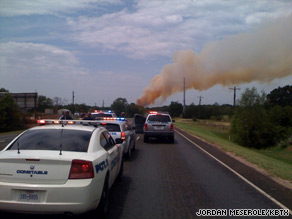 I bring this up because the town of Bryan, Texas is very much in need of a plan tonight. There is a major fertilizer fire at the El Dorado Chemical Company and 70,000 people have been told to evacuate. This is absolutely not the sort of thing that most of us are prepared for. If we live in a hurricane-prone area, we usually have a plan for that. If we live near a fault line, we have a plan for earthquakes. If we live in tornado alley, we know what to do when the sirens sound. But very few of us have looked at a map of, say, a five mile radius around our homes and figured out what hazards there are in the factories and businesses near us. Even fewer have considered what is being transported by rail and truck right past our doors.
However, the lesson of this is not, as you might imagine, that we should all start making a list of things that could go wrong and what we would do about them. The lesson is that we can't possibly anticipate everything that might happen. Therefore, we need to have a generic, all-threat plan. In my family, we don't know what on earth could cause us to have to rendez vous outside of our town, but we know we'll meet at Aunt Shirley's.
Here's the kicker, though. The purpose of having such a plan actually has very little to do with our physical safety. I have no doubt that in an emergency I could grab my kids and find somewhere to go, even if we didn't have a plan. The point of having a plan is to reduce the traumatic stress we experience in the event of an emergency. We will be scared, no doubt. We will be worried about each other until we meet. We will worry about our posessions and our friends. But we will not worry about whether we are doing the right thing, or about generating ideas for what to do, because we have a plan. Just like children, we need to feel power over that which we cannot control, so we've built a little bit of that into our lives ahead of time. We can't prevent traumatic events from occurring, but we can feel a sense of agency when they do, and hopefully that will give us a little bit of leg up when it comes time to recover.
(Check out these additional tips for talking to children about traumatic events)
Subscribe to:
Posts (Atom)
Meet the Quarterback

- Naomi Zikmund-Fisher
- is a clinical social worker, former school Principal and a Crisis Consultant for schools and community organizations. You can learn more about her at www.SchoolCrisisConsultant.com

Subscribe


 Posts
All Comments