Showing posts with label Seaman August Provost. Show all posts
Showing posts with label Seaman August Provost. Show all posts
Saturday, August 1, 2009
Update: Suspect in Provost Murder Completes Suicide

 The suspect in the murder of Seaman August Provost III completed a suicide in his cell at Camp Pendleton yesterday. He had been charged on July 23 (and I apologize for not bringing that to you -- I was on an Amtrak train with no internet access).
For those of you just joining this story (feel free to read the previous Quarterbacking on this topic), Provost was standing sentry at Camp Pendleton in the wee hours of June 30 when he was shot and his body set on fire. His family suspected a hate crime, since Provost was either bisexual or homosexual, depending on which article you read, and he had complained to them of being harassed both because of his sexual orientation and because of his race. The Navy said there was no evidence of a hate crime. They also failed to tell his family how he died -- they heard about it on the news.
The official story is that the suspect went on a really bad trip from hallucinogens sometime in May, and it was all downhill from there. He broke into a sailor's home and stole a gun and an xbox, and was pulled over in mid-June for driving while intoxicated. Provost allegedly confronted him as he was trying to set fire to a Navy landing craft, although there was no apparent motive for him wanting to set that fire. The Navy has said it was "part of a crime spree."
And now the suspect is dead. You might think that Provost's family would be glad he was dead -- an eye for an eye, a tooth for a tooth. But victims and their families rarely feel that way. They may well want to see the perpetrator put to death, but death without a conviction is symbolically difficult, because it means he will never officially have been punished for what he did. In this instance, the family also will not have the opportunity to find out whether there was a race- or sexuality-based motive. From their point of view, the truth died with the suspect. And I'm sure there are conspiracty theorists out there who find the suicide of the suspect just a little too convenient for the Navy.
I am not one of them. I believe that most people have a conscience, and that living with that conscience when the drugs or the alcohol or the rage wears off is pretty difficult. I have no difficulty believing that this suspect felt he couldn't live with himself. Now his family, as well as the Provost family, are left with the aftermath.
(Two notes on usage: I use the term "completed the act of suicide" or "completed a suicide" because it most accurately describes what happened. If you think about it, "completed" is the natural extension of "attempted," which we commonly use to describe someone who tried to kill him or herself and did not die. The more common "committed suicide" is somewhat euphemistic, and I try whenever possible to use plain language, particularly when dealing with issues around death. I also try to avoid the terms "successful" or "unsuccessful," because they imply that suicide is a goal to be attained, and I never say "took his own life" because, again, that is euphemistic -- where did he take it?
You may also have noticed that I never name suspects or perpetrators in this blog. This represents my value that those who kill others should not in any way be made the center of the story, particularly in a blog about trauma.)

Tuesday, July 14, 2009
You Can't Contain the Facts: The Murder of August Provost, Part 2
 Coverage of the murder of Seaman August Provost III at Camp Pendleton at the end of last month sputtered out basically the minute it got going. It never made the New York Times at all. It continues to be carried largely by the online media, and particularly by websites devoted to African-American and/or Gay communities. Provost's funeral was on Friday, and on Saturday U.S Representative Sheila Jackson Lee called for an investigation into the circumstances surrounding his murder.
To refresh your memory, Provost was murdered while standing sentry. He was shot three times, bound, gagged, and set on fire. He was African-American and, depending on which report your read, either gay or bisexual. He complained of being harassed by fellow service members, and his family believes his murder was a hate crime. The Navy, on the other hand, has said there is no evidence of a hate crime and referred to this murder as a "random act of violence."
The way the Navy has chosen to deal with this situation is unfortunate, and is probably making things worse for both themselves and the family. It turns out that when the Navy notified Seaman Provost's family of his death, they told them he was found unconscious on sentry duty and later died. They failed to mention that he was murdered, let alone share the details. Provost's mother found out he had been shot and burned from the television coverage.
This violates some very, very basic principles of how institutions should behave in a crisis. I wish I could say it was unusual, but unfortunately it is all too common. Institutions -- whether it's a school, the military, a business or the government -- like to clamp down on information. We have this naive notion that all that will become public is what we say, so we don't say much.
But facts exist whether we talk about them or not, and they have a way of making it into the public arena. Instead of asking, "What facts do we want people to have?" institutions should be asking, "If we don't share this fact, how will it look when it does become public." It's almost always better for people to hear bad news immediately, directly and completely.
The two rules I always share with staff in my school and other schools about sharing bad news with children are very simple:
- Tell the truth, the whole truth, and nothing but the truth (which also means no guessing) and
- Make sure that every known fact they will hear comes from you, and that no rumors do.
The minute you violate either of those rules, no matter how well-meaning you are, you lose all trust and credibility, and the same rules go for adults. As soon as it is known that you withheld information, gave inaccurate information or left facts to be revealed by the media or the rumor mill, no one will trust what you say and you will be completely ineffective in being supportive following the incident. People naturally want to blame others following an incident, and you will be the target whether you deserve it or not.
I wonder how this situation would have played out if the Navy had told the family how Seaman Provost died, had acknowledged the possibility of a hate crime even if they didn't think it was one, and had been honest with the Congressman on the base that day. I have to imagine that there would be a whole lot fewer conspiracy theories floating around.
Saturday, July 4, 2009
All Men are Created Equal
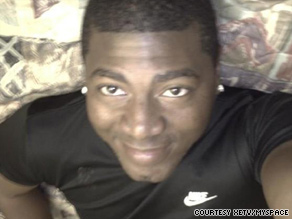
Update: The Quarterback has been updating this story as it unfolds. Take a look at what's happened since this post was written.
If the name August Provost doesn't ring a bell, don't feel bad. News of his death this past Tuesday hasn't made the New York Times yet. It just hit CNN today. We can't all be Michael Jackson.
Seaman August Provost was murdered at Camp Pendleton in California while he stood sentry. He was shot and the area set on fire, apparently in an attempt to cover up the evidence. The Quarterback just did some digging to find out how common homicide is in the armed forces, and hence how newsworthy this sort of thing should be. In 2007, the latest year I could find statistics for, there were 42 homicides in the military. That comes out to a rate of about 3.06 per 100,000. In the United States in 2007, the homicide rate was 5.9 per 100,000. So murder in the military is less common than in the general population, but still not unheard of.
What makes Seaman Provost's death particularly interesting is that he was an African-American bisexual man serving in the United States Navy, and he had apparently complained to his family that he was being harassed. They told him to tell his supervisors, and not surprisingly, given that he would be discharged for telling a supervisor he was bisexual, he did not. So now his family wants to know whether his death was related to either his race or his sexual orientation.
The Navy says that as far as they can tell, the answer is no. They have someone in custody, but no one has been charged. The Navy spokesperson said,
Now throw in another wrinkle: California Congressman Bob Filner was at Camp Pendleton on Wednesday after the body was found, and no one told him. He sat next to the Commander at an event and wasn't told. The base has a daytime population of about 100,000, so this probably happens about 3 times a year. If you were the mayor of a town of 100,000 with a homicide rate of 3 per 100,000, and your local Congressman came by just after a body had been found in your town, would you tell him? I don't know.What I can tell you, unequivocally at this point, based on the preliminary information that we have, is that regardless of the person standing watch in that sentry station, this crime would have most likely been carried out in the same way. In other words, another sailor could have been on that post and would have been the victim of this crime.
But let's be real here. This is news because Don't Ask Don't Tell and the issue of gays serving openly in the military is in the news right now. A cover up would be a very big deal. A hate crime would be a very big deal. So the reporters have gotten wind of it and are starting to write stories.
From a crisis response standpoint, we have here what we like to call, in technical parlance, a "mess." Let's tally up the factors. We have:
- A homicide, which is traumatic if you were close to the deceased whether or not you witnessed it or found the body
- A homicide far away from home (Seaman Provost is from Texas), adding to the family's feelings of helplessness that are already endemic to a homicide
- An ongoing investigation, making people feel reluctant to talk to critical incident personnel on the one hand, even though it's confidential, and making people want to talk about the investigation instead of the event on the other hand
- Blame being thrown around, making it hard to feel like the event is "over," especially given the ongoing investigation
- A politician involved, adding to the stress on all involved even if he's actually doing good
- Media coverage, meaning the event is being replayed for the family and friends
- Media coverage that came slowly, often making people feel like they didn't get the attention they deserved
- One group accusing another of indifference at best and a coverup at worst, making it even more critically important that responders don't mix up the two groups
- The other group gently saying that the first group is wrong, making anger at each other a major theme of the healing process
It's Independence Day, a day to celebrate our country. So the Quarterback would like to take this opportunity to honor Seaman August Pendleton for his service to our country and his death in its service, whatever the motive may have been. He may not have felt it, he may not have lived it, and he may have died because others didn't believe it, but he is a stark reminder of what we aspire to in our country, that all men are created equal.
Subscribe to:
Posts (Atom)
Meet the Quarterback

- Naomi Zikmund-Fisher
- is a clinical social worker, former school Principal and a Crisis Consultant for schools and community organizations. You can learn more about her at www.SchoolCrisisConsultant.com

Subscribe


 Posts
All Comments
Posts
All Comments