Showing posts with label detachment. Show all posts
Showing posts with label detachment. Show all posts
Friday, July 17, 2009
Why Us?: The Jakarta Hotel Bombings

 I had some insomnia last night, and happened to be online at 4 AM. It's a good thing, because otherwise I might well have missed the news that two suicide bombings in Jakarta, Indonesia had targeted the Ritz-Carlton and Marriott hotels. At that hour, the death toll was listed as eight and rose to nine while I was reading, but now is being reported as six. By the time I woke up after finally falling back to sleep, the story was no longer the top one. Now, at 3:30 PM, it isn't even in the list of top stories at CNN.com.
 This story raises two interesting questions. First, why did terrorists target these particular hotels? And second, why did we lose interest so quickly?
It seems obvious, but the goal of terrorism is to induce terror. The Broadway show Wicked has the wonderful line, "As terrifying as terror is . . . " The entire point is to make people afraid of what will come next, to make them look over their shoulders and alter their routine, and to ultimately make them decide that they would rather give in to some set of demands than continue to live in a constant state of fear.
In order for this to be successful, the terror has to be induced in those who are in a position to give in to the demands. There is no sense, for example, in making me scared in an attempt to get your mother in Cleveland to let you stay out past curfew, particularly if I don't know you or your mother. On the other hand, there may be some purpose in making me scared in an attempt to get me to let my own children stay out past curfew, or even to pressure my best friend into letting her kids stay out.
The answer as to why these hotels were targeted lies in the particular aims of the terrorists. Since no information is available as yet, at least in the mainstream media, about who is responsible, we can only surmise that either the perpetrators have a beef with western countries, most likely the United States (these were American-owned hotels where westerners stay) or believe that those countries are in a position to pressure others to do what they want. If their issue were more localized, we could expect they would be bombing marketplaces or other venues where Indonesians congregate. Clearly, the aim here was not to scare Indonesians. It was to scare us.
So why did we lose interest? Sometimes stories are pushed off the front page by more pressing stories, but today there is no single "big story" on major media websites. Quite frankly, we lost interest because we were not terrified enough, and we were not terrified enough because these bombings were not events we could personally identify with.
At 4 AM these bombings were big news because they were new and it was not clear they were over. Someone was trying to kill westerners and damage western property, and westerners, through their proxies in the media, were scared. But by 3:30 PM it was clear that while Americans had been wounded, none had been killed. No more explosions had occurred. And honestly, the vast majority of Americans feel absolutely no connection to Indonesia. Probably relatively few can even locate it on a map, and we have some vague idea that Indonesia is a place where bombings just happen. Our reaction would be vastly different if the exact same scale of attack occurred on U.S. soil. If the headlines at 4 AM could be translated as, "Someone is trying to kill us!," the coverage now boils down to, "They didn't kill us, and besides, it wasn't really us."
I'm sure that if you are in the habit of traveling to Indonesia, and certainly if you tend to stay at those hotels, this is still a big story. That's because, for that subset of the American population, the personal connection is much stronger. For the rest of us, we go back to judging what is likely vs. what is possible and decide that this really doesn't have much to do with us. For all our protestations that we care about all human life and suffering, we care about it a lot more when we can connect it to ourselves.

Sunday, July 5, 2009
The (Un) Happiest Place on Earth

As if we needed more reminders that trauma can strike anywhere, anytime, there was a crash on the monorail at Disney World's Magic Kingdom early this morning. One driver was killed. There were only five passengers on board, since it was 2 AM, and they were treated at the scene.
What caught the Quarterback's eye about this was the following line in the AP story:
The other train operator was not injured, but was taken to a hospital because he was emotionally shaken.Now, please don't misunderstand me. I in no way wish to call out the other driver for being emotionally shaken or for needing more help. I remember how shaken I was after a fender bender in which no one was hurt, so I can only begin to imagine being in one where someone was killed. On the contrary, this caught the Quarterback's eye because a) it was publicly acknowledged and b) they took him to the hospital.
The hospital? Really? You have to be pretty incredibly overcome to need to be treated in a hospital for the psychological effects of trauma right after it happens. Not to say it doesn't happen, mind you, but most people's reactions are shaking and crying and intrusive images and thoughts, espeically right away. Most people don't completely dissociate or have a psychotic episode.
What I'm hoping happened, really, is that the first responders and/or the folks at Disney recognized that this poor guy needed some support and that there were going to be reporters all over the place, and decided to take him to the hospital and hope someone there could help him. And it's entirely possible there are CISM personnel at the hospital, and hopefully they know how to get a hold of a team if there aren't. I hope, for his own sake, that this event didn't totally blow out this guy's ability to be out in the world, to the point where he was a danger to himself or others, that fast. I doubt it did, but you never know.
The other thing that of course draws our attention to this story is that it happened at Disney World. There are 150,000 passengers on the monorails there every day. If you live on the East Coast or near it, you either have been to Disney World, are planning to go to Disney World, would like to go to Disney World or loathe the very idea of going to Disney World. Nobody reads this story and says, "Disney World? Never heard of it."
So it's easy to identify. It's easy to put yourself on that monorail and imagine what a crash would be like. If we were traumatized at all by the D.C. Metro crash, this also triggers that association. And it's probably also easy to find relief that the accident occurred at 2 AM, when most of us know we would never be on the monorail. As fast as we personalize, we detach.
The Quarterback's deepest condolences to the family of the driver killed, a speedy recovery to the other one, and a moment of silliness in which I imagine the CISM team peers for Disney World cast members, dressed as Mickey, doing a debriefing. The Quarterback needs to get more sleep.
Thursday, July 2, 2009
Why We Love Bahia Bakari, But Not Enough to Know Her Name
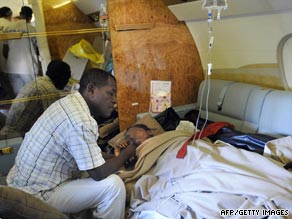
It's time for a little honesty. Would all Americans reading this blog please answer the following: Before this week, could you locate the Comoros Islands on a map? Can you locate them now? Do you know why I'm asking? My guess is that the most common answers to those three questions, respectively, is no, probably not but maybe and yes, with a fair number of people answering no for all three (the Quarterback admits that her answers are yes to all three, but only because she is very fond of the quizzes on Sporcle).
On Tuesday morning, a Yemenia Airways plane en route from Sanaa, Yemen to Moroni, Comoros crashed into the Indian Ocean. 152 people died. The only survivor is a 13 year-old girl named Bahia Bakari, who was apparently ejected from the plane and landed in the water, where she held onto debris until she was rescued.
There are two stories that have dominated the coverage of this tragedy. The first is Bakari's survival. Many Americans, including the Quarterback, first learned about the crash from news reports with headlines like "Rescuers Find Child Alive in Wreckage of Airliner Crash." The second is the poor maintenace record of Yemenia Airways and of this plane in general. Apparently the European Union had flagged this particular jet as having maintenance problems, but Yemenia Airways had flown planes in better condition into the EU ever since. On this flight, most passengers boarded in Paris and then switched planes in Yemen.
Certainly both of these stories are newsworthy. But it is notable that the kinds of stories we saw after the Air France crash off the coast of Brazil last month are almost completely absent. We don't know about the engaged couple, the European tourists, and the brilliant scientists who were on board the Yemenia Airways flight. We know about Bakari, but probably we don't remember her name.
In the humble opinion of the Quarterback, the two dominant stories and the absence of the other kind are all attributable to a single, understandable human reaction to tragedy, but one that has a very sinister side to it. As my readers know, we like to assign blame after a traumatic incident. If something can be blamed, it can be controlled.
But this crash offers Americans and to some extent Europeans something even better. It offers us the opportunity to completely detach from identifying with the victims. We white Americans can look at this situation and say, "Look, these people are nothing like us, they were on an airplane that we would not board on an airline that we would not fly. This could not happen in our world." We can easily convince ourselves that this cannot happen to us and people we think of as being like us. And make no mistake about it, when we say "these people are nothing like us" what we mean is that these people are black.
Which brings us back to Bahia Bakari. We love the fact that she is alive. It allows us to tell ourselves that even if something like this could happen to us, it's ok because we could survive. We all, on some level, believe that we are the one lucky one. But unlike if Bakari's name were Jane Johnson and she hailed from Nebraska, we don't want to look too closely. We don't want to know her name or her family background or why she was going to the Comoros Islands, because we'd rather not put ourselves on that plane with her, and we can avoid doing that because, well, she's nothing like us.
Avoiding identifying with the event and its victims is a healthy psychological defense mechanism. It certainly would not be helpful for everyone to personalize this story to the point of their own traumatization, and imagine in vivid detail the experience of being on a crashing plane. The Quarterback is not asking for that. But it might behoove us to be a little self-reflective about why, in this case, detachment is so particularly easy for us to do.
Subscribe to:
Posts (Atom)
Meet the Quarterback

- Naomi Zikmund-Fisher
- is a clinical social worker, former school Principal and a Crisis Consultant for schools and community organizations. You can learn more about her at www.SchoolCrisisConsultant.com

Subscribe


 Posts
All Comments
Posts
All Comments